
BuddhistCatholicContemplativeEvangelicalGeneral ChristianHinduJewishLatter-day SaintMuslimNew VisionsProgressive Christian
Beliefs
- Buddhist
- Catholic
- Contemplative
- Evangelical
- General Christian
- Hindu
- Jewish
- Latter-day Saint
- More Voices
- Muslim
- New Visions
- Pagan
- Progressive Christian
Topics
- Religion News
- Food and Religion
- Sports and Religion
- Religious Art
- Religious Music and Entertainment
- Religious Events
- History and Religion
- Style and Religion
- Politics and Religion
- Women in Religion
- Recreation Outdoors and Religion
- Business Finance and Religion
- Careers Workplace and Religion
- Education and Religion
- Family Parenting and Religion
- Health Fitness and Religion
- Home and Religion
- Relationships and Religion
- Technology and Religion
- Travel and Religion
Columnists
- Buddhist Columnists
- Business Finance and Religion Columnists
- Careers Workplace and Religion Columnists
- Catholic Columnists
- Contemplative Columnists
- Education and Religion Columnists
- Evangelists Columnists
- Family Parenting and Religion Columnists
- General Christian Columnists
- Health Fitness and Religion Columnists
- Hindu Columnists
- History and Religion Columnists
- Home and Religion Columnists
- Jewish Columnists
- More Voices Columnists
- Latter Day Columnists
- Muslim Columnists
- New Visions Columnists
- Nonreligious Columnists
- Pagan Columnists
- Politics and Religion Columnists
- Progressive Columnists
- Recreation Outdoors and Religion Columnists
- Relationships and Religion Columnists
- Religion News Columnists
- Religious Art Columnists
- Religious Events Columnists
- Religious Music and Entertainment Columnists
- Sports and Religion Columnists
- Style and Religion Columnists
- Technology and Religion Columnists
- Travel and Religion Columnists
- Women in Religion Columnists
Resource Library
- 2026 Calendar
- Library of World Religions
- The 100 Most Holy Places on Earth
- Patheos Answers
- Podcasts
- Videos
- Faith Leaders Database
- Anglican Episcopalian
- Bahai
- Baptist
- Buddhism
- Christianity
- Confucianism
- Eastern Orthodoxy
- Hinduism
- Holiness and Pentecostal
- ISKCON
- Islam
- Judaism
- Lutheran
- Methodist
- The Church of Jesus Christ of Latter-day Saints
- New Age
- Paganism
- Presbytarian and Reformed
- Protestantism
- Religion Behind the Scenes
- Roman Catholic
- Scientology
- Shia Islam
- Sikhism
- Sufism
- Sunni Islam
- Taoism
- Zen
- See all religions
Research Tools
 Ad-Free & Subscriber Log-In Subscription Support
Ad-Free & Subscriber Log-In Subscription Support
Follow Patheos 

- Trending:
- Forgiveness
- |
- Marriage
- |
- Consciousness
- |
- Death Penalty
- |
- Election
- |
- Halloween

- Home
- Religious Music & Entertainment
- Tehanu
Tehanu
Last updated on: September 5, 2012 at 6:21 am by Coyle Neal
Tehanu 2012-09-05T06:21:26-06:00 Coyle Neal
Patheos Explore the world's faith through different perspectives on religion and spirituality! Patheos has the views of the prevalent religions and spiritualities of the world.
Review of Tehanu by Ursula Le Guin
By COYLE NEAL
I think that Ursula Le Guin must be a desperately unhappy person. Not only is she one of the few female science fiction/fantasy writers out there (I want to say she was the only one when she started, but that might be a lie), but I get the impression that she is increasingly dissatisfied with her previous writings. If you aren’t familiar with Ursula Le Guin, you should be. She’s a genuinely talented writer who writes well in a variety of genres and even breaks into that academically-snobbish category of “literature.” Her book A Wizard of Earthsea is a masterpiece that has been popular since 1968 for a number of reasons, not least of which being that it draws on numerous themes and tropes from the Western canon. Which is what she seems to have a problem with. I suspect that she wrote The Farthest Shore (the sequel to the sequel of A Wizard of Earthsea) in reaction to the relatively pro-Western message of her earlier books, and I suspect that she wrote Tehanu (the fourth in the Earthsea cycle) in reaction to the perceived inherent masculinity in the previous books (something she does intentionally in The Left Hand of Darkness).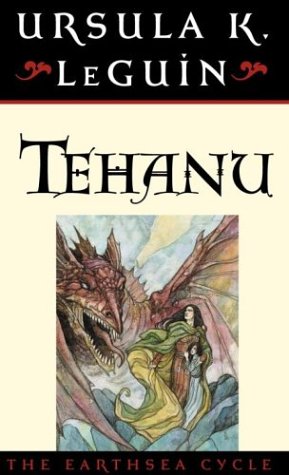
Regardless of Le Guin’s specific motivation, Tehanu certainly contains more feminist and Eastern themes than the previous entries in the series.
On the feminist side of things, Le Guin writes this book from the perspective of Tenar (the heroine of the second book of the Earthsea cycle: The Tombs of Atuan) as an older widow. Tenar spends a significant amount of time wondering why women are treated as second-rate citizens and why men seem to fear them and keep them oppressed. Throughout the book are hints that women have their own kind of power (distinct from the power of men, and specifically distinct from the kind of power held by wizards), but that this power remains dormant. It seems that Tenar’s adopted daughter will be the one to tap into this power and open up a whole new world of opportunity for women, though (spoiler alert!) the book ends before anything like this can happen. In fact, the book doesn’t have much of an ending at all; it just stops.
I think Le Guin runs herself into a problem that feminists (second-wave feminists, at least) generally encounter. She wants to argue that women are at the same time both different from and equal to men. Women are equal to men in that they have an inherent dignity and power. They are different from men in that their particular kind of inherent dignity and power is of a different nature from that possessed by men. The problem (on an artistic level, to say nothing of the real world) is the question of how to express this. In the world Le Guin has already established earlier in the cycle of novels, the women carry water, tend the crops, and manage the household. While all these activities are valuable and to be treasured, they are nothing like the deeds of Ged, the hero of the earlier books. Planting vegetables is not the same thing as fighting dragons, defying dark powers, and passing through death itself. (Though Tolkien of course would disagree.) This problem cannot be solved simply going back and rewriting the earlier stories with a female lead character in the place of the male. In that case you would just have a female acting like a man, when women are supposed to have a different kind of dignity and power. The artistic challenge is to establish some kind of actual difference between men and women that keeps the readers’ interest while giving both their full and equal due as unique types of human beings.
Unfortunately, I don’t think Le Guin has done a very good job of accomplishing this. At the end of the day, none of the problems are resolved. I can’t discuss it without giving away more of the plot than I have, so I’ll just have to leave it at saying that in terms of this theme the book is unsatisfactory (which may or may not be a reflection of the state of feminist thought when Le Guin wrote the book).
On the religious level, this book, especially when combined with The Farthest Shore, is a wonderful picture of how ultimately unsatisfactory Eastern thought is. (I suppose I should say “philosophical” rather than “religious”, since most Eastern systems aren’t specifically religions.) The message of the book, and in fact of the whole series, is that life and death, male and female, existence and non-existence are all different sides of the same coin, and hence ultimately parts of the greater whole. “Male” means nothing except in the context of “female” (again, see Left Hand of Darkness for more of Le Guin’s thoughts on that), and “life” and “death” are complementary truths which have no meaning outside of each other. This argument works, so long as 1) there is no existence outside that of the natural world—if there is any kind of transcendent reality, this definition falls apart; 2) we assume that death and life are morally neutral events or states of being (which Le Guin seems to do). If death is not wrong and evil, and life is not good and moral, then Le Guin has defined a system we can all agree with. The problem is that if death is not wrong, we need to get rid of laws against murder. If life is not right, we need to stop pulling over to let the ambulance through when we’re driving. Acceptance of these statements as truth has moral implications that run deeply contrary to the centuries of Western and Christian (especially Christian) ethics ingrained in us as individuals and a society—ethics which are frankly more appealing than the statement that your or my death and life have no meaning beyond being a fact in the natural scheme of things.
Having said all of that, this is yet another excellent book in the Earthsea cycle. Even though much of it is taken up with the mundane (Tenar spends far more time weaving and gardening that I’d really care to), Le Guin is a good enough writer to pull it off… mostly. This book is worth the read so long as you’ve read the first three books. Which you should.
Previous Post

September 4, 2012
The Philosophy of Murder
Next Post
September 6, 2012 When Religion Goes Bad, Turn to Paul
Browse Our Archives
Select a Category Action AFI Top 100 Animation Best Picture Winner BFI Top 250 Biography Biopic Books Childrens Christian Classics Classics Comedy Crime Documentary Drama Editor's Choice Family Fantasy Fantasy Films Foreign Historical Historical Fiction History Horror Horror IMDB Top 250 Indie Memoir Modern Novel Musical Mystery Non-Fiction Oscars Philosophy Poetry Popular Literature Reading and Writing Reality Romance Science Fiction Science Fiction Silent Sports Thriller TV Show Uncategorized Western Westerns Young Adult
Select a Month October 2026 September 2026 July 2026 June 2026 May 2026 April 2026 March 2026 February 2026 January 2026 December 2025 November 2025 October 2025 September 2025 August 2025 July 2025 June 2025 May 2025 April 2025 March 2025 February 2025 January 2025 December 2024 July 2024 June 2024 May 2024 April 2024 March 2024 February 2024 January 2024 December 2023 November 2023 October 2023 September 2023 August 2023 July 2023 June 2023 May 2023 April 2023 March 2023 February 2023 January 2023 December 2022 November 2022 October 2022 September 2022 August 2022 July 2022 June 2022 May 2022 April 2022 March 2022 February 2022 January 2022 December 2021 November 2021 October 2021 September 2021 August 2021 July 2021 June 2021 May 2021 April 2021 March 2021 February 2021 January 2021 December 2020 November 2020 October 2020 September 2020 August 2020 July 2020 June 2020 May 2020 April 2020 March 2020 February 2020 January 2020 December 2019 November 2019 October 2019 September 2019 August 2019 July 2019 June 2019 May 2019 April 2019 March 2019 February 2019 January 2019 December 2018 November 2018 October 2018 September 2018 August 2018 July 2018 June 2018 May 2018 April 2018 March 2018 February 2018 January 2018 December 2017 November 2017 October 2017 September 2017 June 2017 January 2017 December 2016 October 2016 September 2016 August 2016 July 2016 June 2016 May 2016 April 2016 March 2016 February 2016 January 2016 December 2015 November 2015 October 2015 September 2015 August 2015 July 2015 June 2015 May 2015 April 2015 March 2015 February 2015 January 2015 December 2014 November 2014 October 2014 September 2014 August 2014 July 2014 June 2014 May 2014 April 2014 March 2014 February 2014 January 2014 December 2013 November 2013 October 2013 September 2013 August 2013 July 2013 June 2013 May 2013 April 2013 March 2013 February 2013 January 2013 December 2012 November 2012 October 2012 September 2012 August 2012 July 2012
Follow Us!
TAKE THE
Religious Wisdom Quiz
I asked, 'What must I do to be saved?' after an earthquake freed my prisoners. Who am I?
Select your answer to see how you score.
A Roman centurion The Ethiopian eunuch The Philippian jailer Cornelius
Related posts from Schaeffer's Ghost




Thinking Critically about Critical Theory
TRENDING AT PATHEOS Religious Music & Entertainment

When Halloween Unmasks Married Hearts
Written by Dr. David K. Ewen from Eternal Truth Bible College Behind...

Aristotle. He’s been called the father of logic, the father of the...

Methodist Central Hall and Westminster Abbey
Situated on the same square is Methodist Central Hall and Westminster Abbey. ...

57th Dove Awards Honor Dolly Parton, Crown New...
On gospel music’s biggest night, the 57th annual GMA Dove Awards honored...

The First Eucharistic Controversy: Christ’s Real Presence
For Catholics, the Eucharist is the source and summit of the Christian...

What a Stop Sign Can Teach Us About...
How to Make a Decision When You Can't Hear God Main point:...
view all Religious Music & Entertainment blogs
Ad-Free & Subscriber Log-In Subscription Support
- About Us
- 2026 Calendar
- Videos
- Podcasts
- Library of World Religions
- Faith In Media Tracker
- Advertise With Us
- Write for Us
- Privacy Policy
- Terms of Service
- Do Not Sell My Data
- Contact Us
- Radiant Digital
- Manage Newsletter Subscriptions
- Unsubscribe From Notifications
- Sitemap
Copyright 2008-2026, Patheos. All rights reserved.
Subscription Support Ad-Free & Subscriber Log-In
Follow Patheos