
BuddhistCatholicContemplativeEvangelicalGeneral ChristianHinduJewishLatter-day SaintMuslimNew VisionsProgressive Christian
Beliefs
- Buddhist
- Catholic
- Contemplative
- Evangelical
- General Christian
- Hindu
- Jewish
- Latter-day Saint
- More Voices
- Muslim
- New Visions
- Pagan
- Progressive Christian
Topics
- Religion News
- Food and Religion
- Sports and Religion
- Religious Art
- Religious Music and Entertainment
- Religious Events
- History and Religion
- Style and Religion
- Politics and Religion
- Women in Religion
- Recreation Outdoors and Religion
- Business Finance and Religion
- Careers Workplace and Religion
- Education and Religion
- Family Parenting and Religion
- Health Fitness and Religion
- Home and Religion
- Relationships and Religion
- Technology and Religion
- Travel and Religion
Columnists
- Buddhist Columnists
- Business Finance and Religion Columnists
- Careers Workplace and Religion Columnists
- Catholic Columnists
- Contemplative Columnists
- Education and Religion Columnists
- Evangelists Columnists
- Family Parenting and Religion Columnists
- General Christian Columnists
- Health Fitness and Religion Columnists
- Hindu Columnists
- History and Religion Columnists
- Home and Religion Columnists
- Jewish Columnists
- More Voices Columnists
- Latter Day Columnists
- Muslim Columnists
- New Visions Columnists
- Nonreligious Columnists
- Pagan Columnists
- Politics and Religion Columnists
- Progressive Columnists
- Recreation Outdoors and Religion Columnists
- Relationships and Religion Columnists
- Religion News Columnists
- Religious Art Columnists
- Religious Events Columnists
- Religious Music and Entertainment Columnists
- Sports and Religion Columnists
- Style and Religion Columnists
- Technology and Religion Columnists
- Travel and Religion Columnists
- Women in Religion Columnists
Resource Library
- 2026 Calendar
- Library of World Religions
- The 100 Most Holy Places on Earth
- Patheos Answers
- Podcasts
- Videos
- Faith Leaders Database
- Anglican Episcopalian
- Bahai
- Baptist
- Buddhism
- Christianity
- Confucianism
- Eastern Orthodoxy
- Hinduism
- Holiness and Pentecostal
- ISKCON
- Islam
- Judaism
- Lutheran
- Methodist
- The Church of Jesus Christ of Latter-day Saints
- New Age
- Paganism
- Presbytarian and Reformed
- Protestantism
- Religion Behind the Scenes
- Roman Catholic
- Scientology
- Shia Islam
- Sikhism
- Sufism
- Sunni Islam
- Taoism
- Zen
- See all religions
Research Tools
 Ad-Free & Subscriber Log-In Subscription Support
Ad-Free & Subscriber Log-In Subscription Support
Follow Patheos 

- Trending:
- Forgiveness
- |
- Marriage
- |
- Consciousness
- |
- Death Penalty
- |
- Election
- |
- Halloween

- Home
- Religious Music & Entertainment
- Night Watch
Night Watch
Last updated on: September 3, 2012 at 6:11 am by Alexis Neal
Night Watch 2012-09-03T06:11:06-06:00 Alexis Neal
Patheos Explore the world's faith through different perspectives on religion and spirituality! Patheos has the views of the prevalent religions and spiritualities of the world.
Review of Night Watch by Sergei Lukyanenko
By ALEXIS NEAL

Years before emotionally stunted vampires first sparkled in idyllic mountain meadows, bloodthirsty creatures of the night stalked the streets of Moscow in search of human prey—and they are not the only ones. To the vampires, shape shifters, and dark sorcerers of the world, humans are a commodity, a resource to be exploited by any means necessary to any end deemed desirable. The only thing restraining these “Dark Ones” is a treaty with the other side—the agents of Light. From sunset to sunrise, the Night Watch (“Light Ones”) patrols the city, monitoring the Dark Ones’ compliance with the treaty and, if necessary, punishing the less compliant. When the sun rises, the Day Watch (Dark Ones) takes over, enforcing the treaty on the Light Ones. And so the never-ending battle between good and evil has slowed to a Cold War—still deeply serious and intense—but tempered by the restrictions of the treaty.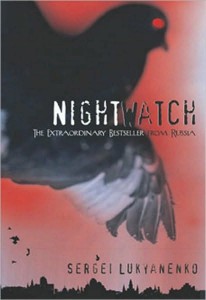
Enter Anton, a young Night Watch analyst out on his first field assignment. The task seems simple enough: keep an eye (and ear) out for unlicensed vampires and the siren songs they use to lure their victims. But before long, things get complicated as Anton finds himself entangled with a dark curse, a powerful magician, an undetermined destiny, and an owl who is more than she seems.
This book is rather difficult to summarize, even as the general premise is fairly straightforward: The Night Watch (good guys) patrols the night, trying to keep the forces of darkness at bay. During the day, the Day Watch (bad guys) does the same for the forces of Light. But because of the treaty, the two sides can’t really engage in an all-out war. Every act of ‘good’ in violation of the treaty entitles the Day Watch to perform some proportional act of ‘evil.’ Which means a lot of ‘good’ deeds never get done, simply because of the ‘bad’ things that would result.
Anton’s story is harder to explain. He is something of an odd duck, even in a world filled with vampires and magicians and other such creatures. His ‘otherness’ is based not on any particular powers he might have, but on the way he thinks about the various problems he faces. That, and he seems to simply be destined to be at the hub of some very significant events, at least in part because of his connections to a young woman named Svetlana and a boy named Egor. The book itself contains three discrete-but-connected stories, or rather one story (Anton’s) in three parts. The first story tells of Anton’s initial encounters with Svetlana and Egor and the resulting showdown with the evil head of the Day Watch. The second story sees Anton fighting for his very life as he is framed for the serial execution of various low-level Dark Ones across Moscow. In the final story, Anton must make the difficult choice between duty and happiness. The first story is the strongest, but the whole thing is excellent, and makes a great (and intellectually engaging) alternative to the vampire schlock that’s been flooding the market for the past few years.
As you can imagine, this tale of Dark vs. Light raises all sorts of questions about the nature of good and evil. There is a lot to unpack. However, this is a blog post, not a treatise, so for the time being I will limit my discussion to two particularly noteworthy aspects of this book.
Lukyanenko’s world is inherently dualistic. The Dark is the yin to the Light’s yang. Each action by one side results in an equal and opposite (or at least proportional) reaction by the other side. As a result, there isn’t much potential for any significant net victory by either side. The future holds only continued conflict (or, more accurately, a continued détente punctuated by periodic skirmishes). Indeed, most of the great tragedies in modern history (the Holocaust, the Gulag, etc.) are the direct result of attempts by the Light to gain ultimate victory over the Dark—attempts which were then twisted and perverted by the Dark, with catastrophic consequences. This is a world where no one ever wins, nor should they. Balance is best, and any effort by either side to gain the upper hand is ultimately detrimental to both that side and to the world in general. (Lukyanenko does hint, however, that the Dark side has a bit of an edge on the Light, so to the extent that any ultimate resolution is possible, the Dark will likely emerge victorious. Or the whole system will collapse and both sides will be destroyed. Gotta love Russian literature.)
This dualistic attitude extends beyond the supernatural realm and into the realm of human nature. Humans are capable of both good and evil (again, with evil having a slightly stronger hold on them). Even supernatural humans—known as Others—are morally neutral, at least at the start. Whether they become Light Ones or Dark Ones is more a matter of chance than anything else.
Lukyanenko’s dualism is both more pessimistic and more optimistic than the worldview presented in Scripture. As Christians, we know that man is not morally neutral. He is not equally likely to choose right or wrong. Rather, as a result of Adam’s sin in the Garden of Eden, every human who has ever walked this planet has had a definite tendency toward evil. We are, every one of us, tainted by original sin. The only solution to this state of affairs comes not from ourselves, but from God. The holy God who created the universe—and against whom we all rebelled—sent His Son to bear the punishment for our sin. Through faith in Christ, the spiritually dead have been brought to life, and we now have the ability (and desire) to fight our sin.
Still, anyone who’s been a Christian for more than five minutes will tell you that this is not a one-time fight. The penalty for sin is paid, yes—paid by Christ once and for all. But we still fight every single day. And we will continue to fight every single day. But unlike the Light Ones (and Dark Ones), our fight will end. One side will emerge victorious. And the Bible tells us quite clearly who that victor will be. At the end of all things, the Righteous One will judge the earth. Evil will be banished to hell, and everlasting peace and joy will come to those who are bought with the blood of the Lamb and whose names are written in His Book of Life. For Christians, there is a happily ever after coming. We know how the story ends, and we know who wins. It is this hope that strengthens us as we fight against our own sin and endure the trials and temptations that come from living in a fallen, sin-tainted world.
Another interesting aspect of this book—and one that is closely connected to Lukyanenko’s dualism—is the surprising similarity between the Light and the Dark. According to Lukyanenko, the real difference between Light and Dark is their motivation, particularly as it intersects with the human world. Light Ones seek to protect human life. Dark Ones merely want to exploit humans to benefit themselves. In other words, the bad guys care only about themselves, while the good guys care about—and are willing to sacrifice for—others. And, on some level, Christians agree. After all, leaving aside the first commandment (love God), the most important commandment is that we love our neighbors as ourselves.

Poster for the 2004 film, which I have not seen, but which is supposed to be . . . decentish.
However, while the two sides may have distinct goals, distinct ends, the means employed are remarkably similar. Anton wrestles with this issue throughout the book, noting the willingness of the Light Ones to manipulate, lie, and even sacrifice innocent life in order to further their (admittedly laudable) end: the greater good of mankind. This similarity between the means used by Light and Dark causes Anton no small amount of angst, and results in the disillusionment and potential corruption of an otherwise untainted soul.
God’s Word teaches us that it is not enough merely to have a laudable goal. We are not permitted to sin in order that some good may come. We serve a sovereign God, and while we do have an ultimate goal—His glory—we trust Him to bring that goal about while we labor to conduct ourselves in accordance with His law. For Christians, the end does not justify the means; rather, by God’s grace we bring the means (our actions) into compliance with what the Bible tells us is good and right and honorable, and God uses that obedience to produce the end He has planned. For this reason, Christians should always be distinguishable from the world, not just because we want different things, but because we strive to glorify God both as our ultimate end and in the means by which we seek that end. The end does not justify the means; rather, both the end and the means are submitted to the authority of God’s Word.
Previous Post

August 31, 2012
The Age of Innocence
Next Post
September 4, 2012 The Philosophy of Murder
Browse Our Archives
Select a Category Action AFI Top 100 Animation Best Picture Winner BFI Top 250 Biography Biopic Books Childrens Christian Classics Classics Comedy Crime Documentary Drama Editor's Choice Family Fantasy Fantasy Films Foreign Historical Historical Fiction History Horror Horror IMDB Top 250 Indie Memoir Modern Novel Musical Mystery Non-Fiction Oscars Philosophy Poetry Popular Literature Reading and Writing Reality Romance Science Fiction Science Fiction Silent Sports Thriller TV Show Uncategorized Western Westerns Young Adult
Select a Month October 2026 September 2026 July 2026 June 2026 May 2026 April 2026 March 2026 February 2026 January 2026 December 2025 November 2025 October 2025 September 2025 August 2025 July 2025 June 2025 May 2025 April 2025 March 2025 February 2025 January 2025 December 2024 July 2024 June 2024 May 2024 April 2024 March 2024 February 2024 January 2024 December 2023 November 2023 October 2023 September 2023 August 2023 July 2023 June 2023 May 2023 April 2023 March 2023 February 2023 January 2023 December 2022 November 2022 October 2022 September 2022 August 2022 July 2022 June 2022 May 2022 April 2022 March 2022 February 2022 January 2022 December 2021 November 2021 October 2021 September 2021 August 2021 July 2021 June 2021 May 2021 April 2021 March 2021 February 2021 January 2021 December 2020 November 2020 October 2020 September 2020 August 2020 July 2020 June 2020 May 2020 April 2020 March 2020 February 2020 January 2020 December 2019 November 2019 October 2019 September 2019 August 2019 July 2019 June 2019 May 2019 April 2019 March 2019 February 2019 January 2019 December 2018 November 2018 October 2018 September 2018 August 2018 July 2018 June 2018 May 2018 April 2018 March 2018 February 2018 January 2018 December 2017 November 2017 October 2017 September 2017 June 2017 January 2017 December 2016 October 2016 September 2016 August 2016 July 2016 June 2016 May 2016 April 2016 March 2016 February 2016 January 2016 December 2015 November 2015 October 2015 September 2015 August 2015 July 2015 June 2015 May 2015 April 2015 March 2015 February 2015 January 2015 December 2014 November 2014 October 2014 September 2014 August 2014 July 2014 June 2014 May 2014 April 2014 March 2014 February 2014 January 2014 December 2013 November 2013 October 2013 September 2013 August 2013 July 2013 June 2013 May 2013 April 2013 March 2013 February 2013 January 2013 December 2012 November 2012 October 2012 September 2012 August 2012 July 2012
Follow Us!
TAKE THE
Religious Wisdom Quiz
How many commandments were written on stone tablets?
Select your answer to see how you score.
Seven Thirteen Ten Twelve
Related posts from Schaeffer's Ghost




Thinking Critically about Critical Theory
TRENDING AT PATHEOS Religious Music & Entertainment

Methodist Central Hall and Westminster Abbey
Situated on the same square is Methodist Central Hall and Westminster Abbey. ...

57th Dove Awards Honor Dolly Parton, Crown New...
On gospel music’s biggest night, the 57th annual GMA Dove Awards honored...

The First Eucharistic Controversy: Christ’s Real Presence
For Catholics, the Eucharist is the source and summit of the Christian...

What a Stop Sign Can Teach Us About...
How to Make a Decision When You Can't Hear God Main point:...

Archdiocese Hosts Military Marriage Retreat in Germany
RASTATT, Germany — The transient military lifestyle, with its frequent deployments and...

Nearly every morning, I make the drive to Detroit with my high-school-age...
view all Religious Music & Entertainment blogs
Ad-Free & Subscriber Log-In Subscription Support
- About Us
- 2026 Calendar
- Videos
- Podcasts
- Library of World Religions
- Faith In Media Tracker
- Advertise With Us
- Write for Us
- Privacy Policy
- Terms of Service
- Do Not Sell My Data
- Contact Us
- Radiant Digital
- Manage Newsletter Subscriptions
- Unsubscribe From Notifications
- Sitemap
Copyright 2008-2026, Patheos. All rights reserved.
Subscription Support Ad-Free & Subscriber Log-In
Follow Patheos