
BuddhistCatholicContemplativeEvangelicalGeneral ChristianHinduJewishLatter-day SaintMuslimNew VisionsProgressive Christian
Beliefs
- Buddhist
- Catholic
- Contemplative
- Evangelical
- General Christian
- Hindu
- Jewish
- Latter-day Saint
- More Voices
- Muslim
- New Visions
- Pagan
- Progressive Christian
Topics
- Religion News
- Food and Religion
- Sports and Religion
- Religious Art
- Religious Music and Entertainment
- Religious Events
- History and Religion
- Style and Religion
- Politics and Religion
- Women in Religion
- Recreation Outdoors and Religion
- Business Finance and Religion
- Careers Workplace and Religion
- Education and Religion
- Family Parenting and Religion
- Health Fitness and Religion
- Home and Religion
- Relationships and Religion
- Technology and Religion
- Travel and Religion
Columnists
- Buddhist Columnists
- Business Finance and Religion Columnists
- Careers Workplace and Religion Columnists
- Catholic Columnists
- Contemplative Columnists
- Education and Religion Columnists
- Evangelists Columnists
- Family Parenting and Religion Columnists
- General Christian Columnists
- Health Fitness and Religion Columnists
- Hindu Columnists
- History and Religion Columnists
- Home and Religion Columnists
- Jewish Columnists
- More Voices Columnists
- Latter Day Columnists
- Muslim Columnists
- New Visions Columnists
- Nonreligious Columnists
- Pagan Columnists
- Politics and Religion Columnists
- Progressive Columnists
- Recreation Outdoors and Religion Columnists
- Relationships and Religion Columnists
- Religion News Columnists
- Religious Art Columnists
- Religious Events Columnists
- Religious Music and Entertainment Columnists
- Sports and Religion Columnists
- Style and Religion Columnists
- Technology and Religion Columnists
- Travel and Religion Columnists
- Women in Religion Columnists
Resource Library
- 2026 Calendar
- Library of World Religions
- The 100 Most Holy Places on Earth
- Patheos Answers
- Podcasts
- Videos
- Faith Leaders Database
- Anglican Episcopalian
- Bahai
- Baptist
- Buddhism
- Christianity
- Confucianism
- Eastern Orthodoxy
- Hinduism
- Holiness and Pentecostal
- ISKCON
- Islam
- Judaism
- Lutheran
- Methodist
- The Church of Jesus Christ of Latter-day Saints
- New Age
- Paganism
- Presbytarian and Reformed
- Protestantism
- Religion Behind the Scenes
- Roman Catholic
- Scientology
- Shia Islam
- Sikhism
- Sufism
- Sunni Islam
- Taoism
- Zen
- See all religions
Research Tools
 Ad-Free & Subscriber Log-In Subscription Support
Ad-Free & Subscriber Log-In Subscription Support
Follow Patheos 

- Trending:
- Forgiveness
- |
- Marriage
- |
- Consciousness
- |
- Death Penalty
- |
- Election
- |
- Halloween
 Sarah Thebarge
- Home
- Progressive Christian
- The Question Is Not, “Why Does God Let Bad Things Happen?” It’s, “Why Do We?”
The Question Is Not, “Why Does God Let Bad Things Happen?” It’s, “Why Do We?”
Last updated on: November 8, 2018 at 4:07 pm by Sarah Thebarge
The Question Is Not, “Why Does God Let Bad Things Happen?” It’s, “Why Do We?” 2018-11-08T16:07:54+00:00 Sarah Thebarge
Patheos Explore the world's faith through different perspectives on religion and spirituality! Patheos has the views of the prevalent religions and spiritualities of the world.
When I first started doing public speaking engagements, a philosophy professor contacted me and asked if I’d like to come speak to his Theodicy class.
I said, “Sure,” and then as soon as we got off the phone I Googled “Theodicy” because I had no idea what it was.
I learned that Theodicy is the study of why bad things happen in the world if the world is controlled by a loving God.
I’ve definitely asked that question. A lot, actually. Why did I get breast cancer when I was 27 years old? Why did the Somali girls’ three brothers die in Somalia before they could get out? Why do six million kids under age 5 die every year in the developing world?
We like to ask that question, don’t we? Why does a loving God allow so much suffering?
We like to speculate. We like to do mental and theological gymnastics to get our theology to fit with the world we experience. Philosophers have filled books with theories. Universities have courses that explore this difficult-to-answer question.
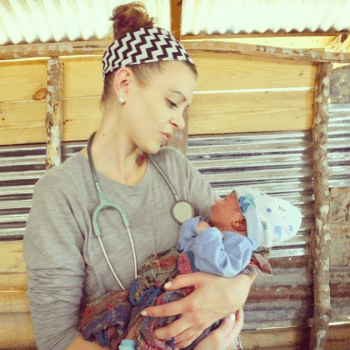
I thought a lot about it until I went to Togo and began practicing medicine at a hospital in rural West Africa that had no air conditioning, no ventilators, no mosquito nets and, sometimes, no water.
I handed dead babies back to their parents because they’d brought them to the hospital too late for us to save or because the children were simply too sick to survive.
I watched a wife weep over the body of her husband, a 55-year-old man with severe respiratory distress who kept looking at me with pleading eyes saying, “Madam — I — can’t — breathe — ” And I kept telling him, “I know. We’re trying as hard as we can.” And then his body gave out and he lapsed into a coma and died.
I watched skeletal, starving babies admitted to pediatrics lie weak and motionless in their cribs as flies crawled over them. Their mothers swatted the flies and mosquitoes away with strips of fabric that all too often became shrouds when the babies’ souls left this world.
I lost more patients in one week in Togo than I’d lost in 10 years of medicine in the U.S. And yet, in spite of how much suffering I witnessed there, the question I came back to was never, “Why does God allow this suffering to happen?” Instead, I kept asking, “Why do we?”
We go on all-you-can eat cruises, get mani-pedi’s, waste food, spend hundreds of dollars a month on cable TV and other forms of entertainment, buy 10,000-square-foot houses, drive SUV’s that cost a fortune and get 10 miles a gallon, buy $100 jeans and designer sneakers, drink expensive espresso drinks every morning and….
It’s not that any one of these expenses is wrong per say. It’s that all together, the picture of life in the U.S. is that we are wealthier than the overwhelming majority of the world. We have more expendable income than we realize. And we use our resources on amusement and entertainment rather than being generous and sacrificial and making a tangible difference in the world.
We literally amuse ourselves to death while
- Six million children die in the developing world each year of preventable, or easily treatable, causes.
- Nearly a billion people live in extreme global poverty — living on less than $1.90/day.
- In our country, one in six Americans faces hunger as 49 million people struggle to put food on the table.
- There are 123 suicides a day in our country, making it the tenth leading cause of death in the U.S.
- Rates of loneliness have doubled since 1980, with 40% of adults saying they feel lonely on a regular basis.
- Tens of thousands of Americans die each year from gun violence.
I could go on, but you get the idea.
Suffering continues not because God doesn’t do anything about it but because we don’t.
And this isn’t meant to make anyone feel guilty. Instead, I think it should give us incredible hope! Because solutions to problems that have plagued our world for far too long are absolutely within our reach.
Rates of child mortality and extreme global poverty have dropped by 50% since 1990 because people have gotten involved and loved the world enough to do something about it. We’re on track to end child mortality and extreme global poverty by 2030 — if we make the effort. If we give, if we work, if we sacrifice, if we act as though the wellbeing of our fellow human beings depends on us (because it so often does!)
So let’s stop sitting around, wasting time asking why God allows suffering to happen in the world and let’s ask ourselves, “Why do we?”
And then let’s roll up our sleeves and care enough to do something about it.
***
If you’d like to make a tangible difference in the world, here are a few opportunities.
Sponsor a child with Compassion International to provide a child in the developing world with food, medicine, clean water and mentoring.
Make a contribution to The Invisible Girls’ Trust Fund to help send five Somali refugee sisters to college.
Donate to St. Gregory’s Food Pantry.
Partner with Heifer International to provide families and communities in the developing world with a sustainable food supply.
Make a micro-loan with Kiva so an entrepreneur in the developing world can get a small business off the ground.
Previous Post

November 6, 2018
Vote with your ballot. Then vote with your life.
Next Post
November 14, 2018 No Place Love Won't Go
Browse Our Archives
Select a Category Uncategorized
Select a Month February 2019 December 2018 November 2018 October 2018 September 2018 August 2018 July 2018 June 2018 May 2018 April 2018 March 2018 January 2018 December 2017 November 2017 October 2017 August 2017 July 2017 November 2016 October 2016 September 2016 August 2016 July 2016 June 2016 May 2016 April 2016 March 2016 February 2016 January 2016 December 2015 November 2015 October 2015 September 2015
TAKE THE
Religious Wisdom Quiz
What happened to Lot's wife as they fled Sodom?
Select your answer to see how you score.
She fell into a well She turned into a pillar of salt She became blind She died by fire
Books by This Author Books by Sarah Thebarge
Related posts from Sarah Thebarge

Cisterns vs. Wells: Practicing rest in a restless...

The Meaning Of Mistletoe: How Love Brings The...
First Do No Harm: What Evangelical Missions Needs...
TRENDING AT PATHEOS Progressive Christian

What Being a Modern-Day Apostle Means to Me
In my last column, I discussed the ins and outs of modern-day...

Did Ancient China Once Worship the God of...
Across human history, a common thread weaves through the origins of the...

Love Your Neighbor – Including Earth-Kin: Lev. 19,...
God’s command to love your neighbor means acting in an ethical and...

Lead a Church Study of “Jesus and Lao...
Guest writer Jack Thomas (The Irreverent Reverend) reflects on leading his church...

Pastoral Wisdom for Responding to Sermon Pushback
Getting sermon pushback on your social justice sermon? Learn practical, Proverbs-based strategies...

Principles for Understanding the Apostolic Ministry Today
Whenever people discover that my formal ministry title is "apostle," as in...
view all Progressive Christian blogs
Ad-Free & Subscriber Log-In Subscription Support
- About Us
- 2026 Calendar
- Videos
- Podcasts
- Library of World Religions
- Faith In Media Tracker
- Advertise With Us
- Write for Us
- Privacy Policy
- Terms of Service
- Do Not Sell My Data
- Contact Us
- Radiant Digital
- Manage Newsletter Subscriptions
- Unsubscribe From Notifications
- Sitemap
Copyright 2008-2026, Patheos. All rights reserved.
Subscription Support Ad-Free & Subscriber Log-In
Follow Patheos