
BuddhistCatholicContemplativeEvangelicalGeneral ChristianHinduJewishLatter-day SaintMuslimNew VisionsProgressive Christian
Beliefs
- Buddhist
- Catholic
- Contemplative
- Evangelical
- General Christian
- Hindu
- Jewish
- Latter-day Saint
- More Voices
- Muslim
- New Visions
- Pagan
- Progressive Christian
Topics
- Religion News
- Food and Religion
- Sports and Religion
- Religious Art
- Religious Music and Entertainment
- Religious Events
- History and Religion
- Style and Religion
- Politics and Religion
- Women in Religion
- Recreation Outdoors and Religion
- Business Finance and Religion
- Careers Workplace and Religion
- Education and Religion
- Family Parenting and Religion
- Health Fitness and Religion
- Home and Religion
- Relationships and Religion
- Technology and Religion
- Travel and Religion
Columnists
- Buddhist Columnists
- Business Finance and Religion Columnists
- Careers Workplace and Religion Columnists
- Catholic Columnists
- Contemplative Columnists
- Education and Religion Columnists
- Evangelists Columnists
- Family Parenting and Religion Columnists
- General Christian Columnists
- Health Fitness and Religion Columnists
- Hindu Columnists
- History and Religion Columnists
- Home and Religion Columnists
- Jewish Columnists
- More Voices Columnists
- Latter Day Columnists
- Muslim Columnists
- New Visions Columnists
- Nonreligious Columnists
- Pagan Columnists
- Politics and Religion Columnists
- Progressive Columnists
- Recreation Outdoors and Religion Columnists
- Relationships and Religion Columnists
- Religion News Columnists
- Religious Art Columnists
- Religious Events Columnists
- Religious Music and Entertainment Columnists
- Sports and Religion Columnists
- Style and Religion Columnists
- Technology and Religion Columnists
- Travel and Religion Columnists
- Women in Religion Columnists
Resource Library
- 2026 Calendar
- Library of World Religions
- The 100 Most Holy Places on Earth
- Patheos Answers
- Podcasts
- Videos
- Faith Leaders Database
- Anglican Episcopalian
- Bahai
- Baptist
- Buddhism
- Christianity
- Confucianism
- Eastern Orthodoxy
- Hinduism
- Holiness and Pentecostal
- ISKCON
- Islam
- Judaism
- Lutheran
- Methodist
- The Church of Jesus Christ of Latter-day Saints
- New Age
- Paganism
- Presbytarian and Reformed
- Protestantism
- Religion Behind the Scenes
- Roman Catholic
- Scientology
- Shia Islam
- Sikhism
- Sufism
- Sunni Islam
- Taoism
- Zen
- See all religions
Research Tools
 Ad-Free & Subscriber Log-In Subscription Support
Ad-Free & Subscriber Log-In Subscription Support
Follow Patheos 

- Trending:
- Forgiveness
- |
- Marriage
- |
- Consciousness
- |
- Death Penalty
- |
- Election
- |
- Halloween
 Sarah Thebarge
- Home
- Progressive Christian
- wanted
wanted
Last updated on: February 9, 2018 at 4:46 pm by Sarah Thebarge
wanted 2018-02-09T16:46:42+00:00 Sarah Thebarge
Patheos Explore the world's faith through different perspectives on religion and spirituality! Patheos has the views of the prevalent religions and spiritualities of the world.

You know how some days you wake up in the morning, and you have no idea that by the time the day is over, your life will have been profoundly changed? That happened to me in June last year, when I was on a one-week trip to Israel.
Our Israeli tour guide took us to the banks of the Jordan River, where Jesus was baptized. At the river, there’s a long tiled wall where the verse Mark 1:11 is translated into at least a hundred languages.
The NIV translates the verse, “You are my Son, whom I love; with you I am well pleased.”
But our guide took us to the Hebrew translation, which translates, “You are my child. My soul wanted you.”
For a minute, time stood still and I just stood there, blinking, wondering if I’d heard the guide correctly.
I touched his elbow. “What does it say again?” I whispered.
“You are my child. My soul wanted to you.”
Of all the things a father could say to a son, of all the things God could say to his child, I can’t imagine anything more beautiful, more overwhelming, more generous or more transformative than those words.
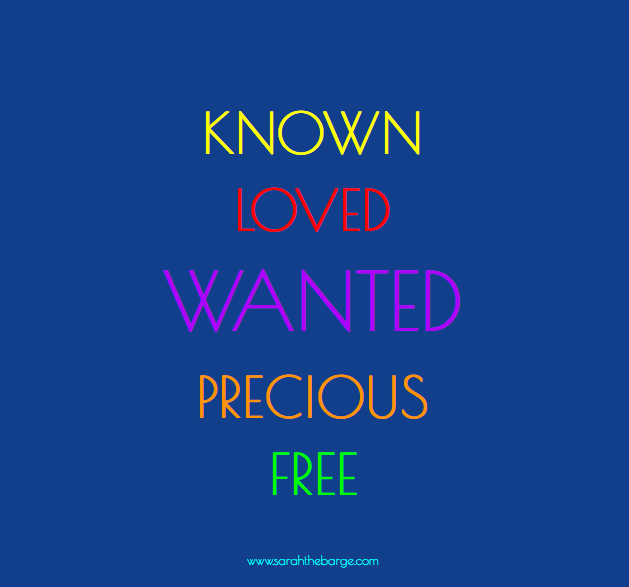
My Soul Wanted You.
Sometimes it’s hard for us to feel wanted.
We were made for connection and belonging and yet, because we live in a broken world that’s not yet been fully restored, we feel the distance between what is and what should be.
We were made for love and romance and intimacy, and yet whether we’re single or in an imperfect marriage, we feel the ache of not being known.
We were made to belong to other people and yet we often feel the sting of rejection. There’s no seat for us at the lunch table. We don’t make tryouts for the basketball team or the play. We fail to make the deans list. We don’t get the dream job we interviewed for.
Even inside the church, we face rejection. Single people are excluded from marriage classes. Childless women are excluded from the moms’ group. Broken people often feel excluded from the congregation of shiny people with solid marriages, two well-behaved kids, a middle-to-upper class income and a place to go for holidays.
We were made for intimate belonging — and yet even in small ways, from the time we’re young, we begin to lose the belonging we crave. As children, we lose our favorite stuffed animal in the chaos of the airport. Our best childhood friend moves three states away — or, worse, chooses a new best friend.
Throughout life we lose siblings and parents and friends to addiction and depression and misunderstandings and death.
And in this brokenness, in the feeling of rejection and unbelonging, we begin to learn a twisted way of being. A way of trying to insure our security while at the same time isolating ourselves from the possibility of risk and grief.
We come to rest our identity in things that give us dopamine surges, things that are more tangible than God, things that give us a stronger sense of control.
We come to believe that our belonging is mutually exclusive with another’s. That in order for us to belong more, other people have to belong less. And we begin to practice on others the same criticism, judgment, stiff-arming and rejection that we hate experiencing ourselves. We become the “in” crowd, the “it” group, the Mean Girls, the gate keepers who decide who gets let in and who gets turned back at the door.
As C.S. Lewis points out, true intimacy and guaranteed self-protection are mutually exclusive.
To love at all is to be vulnerable. Love anything and your heart will be wrung and possibly broken. If you want to make sure of keeping it intact you must give it to no one, not even an animal. Wrap it carefully round with hobbies and little luxuries; avoid all entanglements. Lock it up safe in the casket or coffin of your selfishness. But in that casket, safe, dark, motionless, airless, it will change. It will not be broken; it will become unbreakable, impenetrable, irredeemable. To love is to be vulnerable. (from The Four Loves)
I think we already know this on some level — that we can’t be selfish and intimate at the same time. But we try anyway.
What finally breaks down barriers, brings us peace, makes us feel like we finally belong — and makes us people who practice belonging instead of rejection towards others — is there in Mark 1. There on the wall at the Jordan River. There at the place of transformation. There at the place of deep acceptance — and empowerment to demonstrate that same acceptance to the world.
It’s standing in the river, seeing the clouds part, feeling God’s presence descending like a dove. It’s Divine Love washing off your confusion, failings, flaws, hurts and shames with the simple, transformative, soul-healing words: “You are my child. My soul wanted you.”
Previous Post

January 15, 2016
loved
Next Post
January 20, 2016 precious
Browse Our Archives
Select a Category Uncategorized
Select a Month February 2019 December 2018 November 2018 October 2018 September 2018 August 2018 July 2018 June 2018 May 2018 April 2018 March 2018 January 2018 December 2017 November 2017 October 2017 August 2017 July 2017 November 2016 October 2016 September 2016 August 2016 July 2016 June 2016 May 2016 April 2016 March 2016 February 2016 January 2016 December 2015 November 2015 October 2015 September 2015
TAKE THE
Religious Wisdom Quiz
Who healed a blind man by making mud and placing it on his eyes?
Select your answer to see how you score.
Peter Moses Elijah Jesus
Books by This Author Books by Sarah Thebarge
Related posts from Sarah Thebarge




so you want to change the world
TRENDING AT PATHEOS Progressive Christian

What Being a Modern-Day Apostle Means to Me
In my last column, I discussed the ins and outs of modern-day...

Did Ancient China Once Worship the God of...
Across human history, a common thread weaves through the origins of the...

Love Your Neighbor – Including Earth-Kin: Lev. 19,...
God’s command to love your neighbor means acting in an ethical and...

Lead a Church Study of “Jesus and Lao...
Guest writer Jack Thomas (The Irreverent Reverend) reflects on leading his church...

Pastoral Wisdom for Responding to Sermon Pushback
Getting sermon pushback on your social justice sermon? Learn practical, Proverbs-based strategies...

Principles for Understanding the Apostolic Ministry Today
Whenever people discover that my formal ministry title is "apostle," as in...
view all Progressive Christian blogs
Ad-Free & Subscriber Log-In Subscription Support
- About Us
- 2026 Calendar
- Videos
- Podcasts
- Library of World Religions
- Faith In Media Tracker
- Advertise With Us
- Write for Us
- Privacy Policy
- Terms of Service
- Do Not Sell My Data
- Contact Us
- Radiant Digital
- Manage Newsletter Subscriptions
- Unsubscribe From Notifications
- Sitemap
Copyright 2008-2026, Patheos. All rights reserved.
Subscription Support Ad-Free & Subscriber Log-In
Follow Patheos