
BuddhistCatholicContemplativeEvangelicalGeneral ChristianHinduJewishLatter-day SaintMuslimNew VisionsProgressive Christian
Beliefs
- Buddhist
- Catholic
- Contemplative
- Evangelical
- General Christian
- Hindu
- Jewish
- Latter-day Saint
- More Voices
- Muslim
- New Visions
- Pagan
- Progressive Christian
Topics
- Religion News
- Food and Religion
- Sports and Religion
- Religious Art
- Religious Music and Entertainment
- Religious Events
- History and Religion
- Style and Religion
- Politics and Religion
- Women in Religion
- Recreation Outdoors and Religion
- Business Finance and Religion
- Careers Workplace and Religion
- Education and Religion
- Family Parenting and Religion
- Health Fitness and Religion
- Home and Religion
- Relationships and Religion
- Technology and Religion
- Travel and Religion
Columnists
- Buddhist Columnists
- Business Finance and Religion Columnists
- Careers Workplace and Religion Columnists
- Catholic Columnists
- Contemplative Columnists
- Education and Religion Columnists
- Evangelists Columnists
- Family Parenting and Religion Columnists
- General Christian Columnists
- Health Fitness and Religion Columnists
- Hindu Columnists
- History and Religion Columnists
- Home and Religion Columnists
- Jewish Columnists
- More Voices Columnists
- Latter Day Columnists
- Muslim Columnists
- New Visions Columnists
- Nonreligious Columnists
- Pagan Columnists
- Politics and Religion Columnists
- Progressive Columnists
- Recreation Outdoors and Religion Columnists
- Relationships and Religion Columnists
- Religion News Columnists
- Religious Art Columnists
- Religious Events Columnists
- Religious Music and Entertainment Columnists
- Sports and Religion Columnists
- Style and Religion Columnists
- Technology and Religion Columnists
- Travel and Religion Columnists
- Women in Religion Columnists
Resource Library
- 2026 Calendar
- Library of World Religions
- The 100 Most Holy Places on Earth
- Patheos Answers
- Podcasts
- Videos
- Faith Leaders Database
- Anglican Episcopalian
- Bahai
- Baptist
- Buddhism
- Christianity
- Confucianism
- Eastern Orthodoxy
- Hinduism
- Holiness and Pentecostal
- ISKCON
- Islam
- Judaism
- Lutheran
- Methodist
- The Church of Jesus Christ of Latter-day Saints
- New Age
- Paganism
- Presbytarian and Reformed
- Protestantism
- Religion Behind the Scenes
- Roman Catholic
- Scientology
- Shia Islam
- Sikhism
- Sufism
- Sunni Islam
- Taoism
- Zen
- See all religions
Research Tools
 Ad-Free & Subscriber Log-In Subscription Support
Ad-Free & Subscriber Log-In Subscription Support
Follow Patheos 

- Trending:
- Forgiveness
- |
- Marriage
- |
- Consciousness
- |
- Death Penalty
- |
- Election
- |
- Halloween
 Sarah Over the Moon
- Home
- New Visions
- Is the Bible the Word of God? Or is Jesus? Or….
Is the Bible the Word of God? Or is Jesus? Or….
Last updated on: March 17, 2015 at 10:52 pm by Sarah Moon
Is the Bible the Word of God? Or is Jesus? Or…. 2015-03-17T22:52:31-05:00 Sarah Moon
Patheos Explore the world's faith through different perspectives on religion and spirituality! Patheos has the views of the prevalent religions and spiritualities of the world.
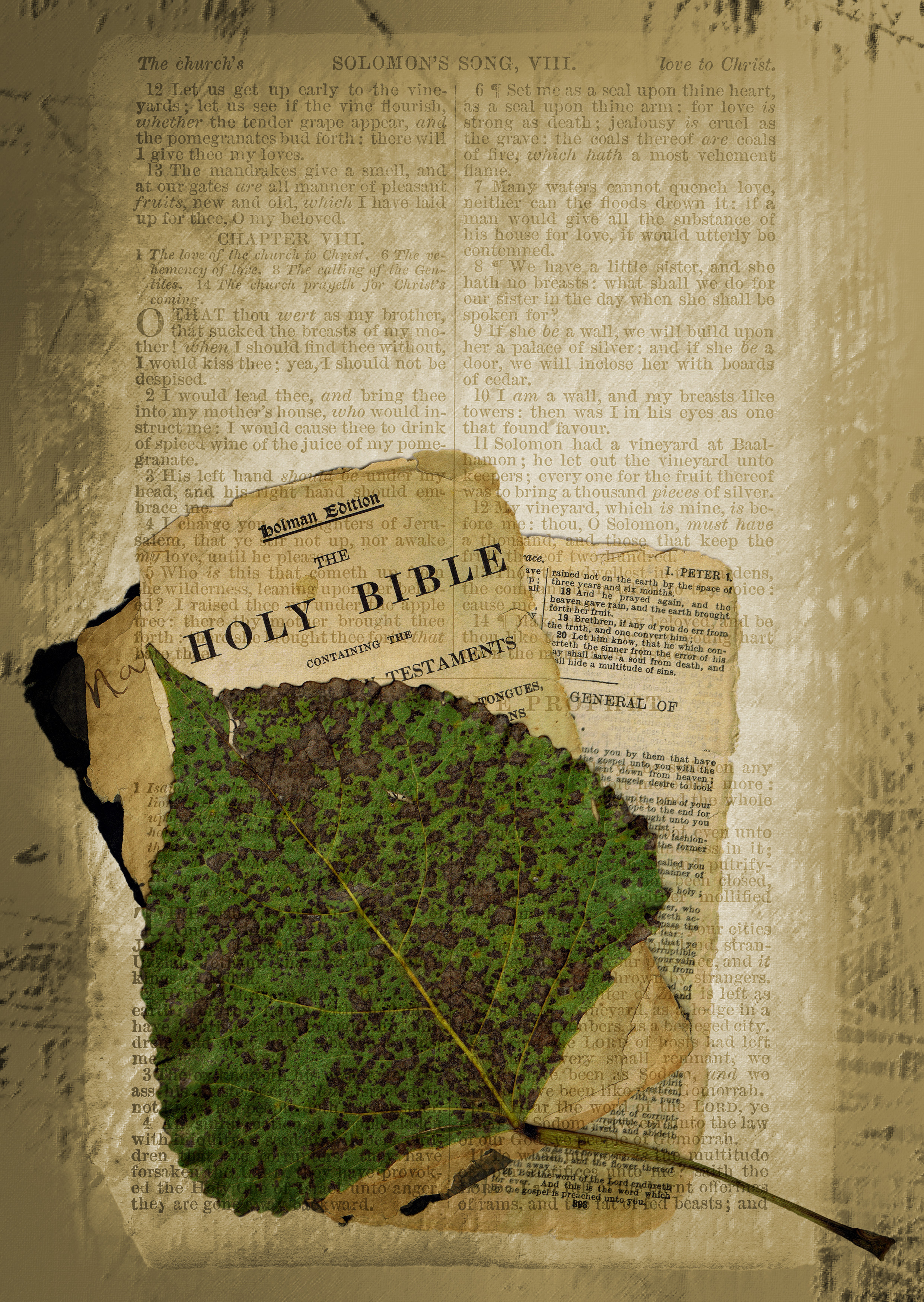
“Variations on a Bible Collage” by Billy Alexander (2014), via FreeImages.com
I’m not sure where the phrase “The Bible is not the Word of God; Jesus is” originated. The first time I heard the phrase, though, (on Rachel Held Evan’s blog) it was just short of life-changing. It became my go-to answer to those who used the Bible as a weapon to hurt me or others.
I say this show that I see how the phrase can be extremely liberating to those who are used to being oppressed by harmful Biblical messages.
I wanted to affirm that before I start deconstructing this phrase.
It’s been almost four years since I first heard that “The Bible is not the Word of God; Jesus is,” and I’m not sure I fully agree with it anymore. At the same time, I don’t disagree. But I think there’s more to the story here.
I want to talk about four things:
1. If “the Bible is not the Word of God; Jesus is” what does that say about the Hebrew Bible?
I cannot stand Christianity that pits the “Old” Testament against the New Testament. I’ve written before that there are some racist, white-savior-Jesus type implications behind this false dichotomy.
I worry that making Jesus “the Word of God,” over and against “the Bible” can easily lead to anti-semitism that views Christianity as “progressive” and “enlightened,” and Judaism as “backward.”
It can also work to erase the importance of the Hebrew Bible for Jewish people. Christians like Brian Zahnd often end up setting up their religion as somehow “better than” the very religion from which Christianity grew:

I am not comfortable at all with this kind of thinking. I am a Christian myself, but Jesus was a Jew. Jesus was raised in the teachings of the Hebrew Bible and quoted them frequently in his ministry. To pit Jesus against the “Old” Testament is ridiculous to say the least.
Last year, I picked up the book Psalms: A Spiritual Commentary, by M. Basil Pennington. An otherwise forgettable experience, one brief section of the book stuck out to me.
Pennington, a Catholic, describes a conversation with a Jewish rabbi, in which the rabbi explained to him, “What Jesus is to you, Torah is to us: The Word of God in human form.”
This has stuck with me, and comes to my mind every time I hear that “The Bible is not the Word of God; Jesus is.” For this Jewish rabbi, such was not the case. Torah is the Word of God. Can Christians learn something from that? I think so.
2. Can we even know Jesus, except through the Bible?
The idea that “The Bible is not the Word of God; Jesus is” has to take into account that most of our experiences with Jesus are filtered through the Bible. It’s nice to think that we can follow Jesus without placing the Bible on a pedestal, but how true is that?
Sure, there are a few extra-biblical sources that we can draw on as we try to learn who Jesus is. There is also mysticism and prayer, and church traditions.
But much of what we “know” about Jesus comes from the four gospels that made it into the book that we call the Bible. How do we “know” that Jesus fed the five thousand, or threw out the money changers? How do we “know” that he turned water into wine and calmed the seas?
Probably because we (or someone else like a priest or pastor) read it in the Bible.
I think “The Bible is not the Word of God; Jesus is” can be a liberating concept. But it’s liberating elements are still limited. Though we can claim mystic experiences that do not draw from the Bible specifically, those will often not be taken as seriously as the accounts of Jesus in the Bible (at least for those of us coming from an evangelical background).
And who put the Bible together?
Who chose which stories about Jesus were true and which ones were “extra-canonical?” Who says the gospel of Matthew is “truth” about Jesus, and the gospel of Mary is not?
Men in power have made those decisions throughout history.
Even if “the Bible is not the Word of God; Jesus is,” it is still often powerful men who decide what the “Word of God” is and what it is not.
3. If Jesus is the Word of God, then the Word of God is no longer “made flesh,” dwelling among us.
I am drawn to Christianity, because I love the idea from John 1:14 that states:
The Word became flesh and made his dwelling among us…
I think the story of Jesus as the Word of God made flesh is beautiful and powerful.
But Jesus died 2,000 years ago.
It can be argued theologically that Jesus is literally alive and “dwelling among us” today (depending on how you interpret the story of the resurrection). But I think even more conservative Christians will agree with me that the historical person of Jesus is not really living among us “in the flesh” right now.
So, if “the Bible is not the Word of God; Jesus is,” does that mean that the Word of God ceased dwelling among us 2,000 years ago? Does that mean the Word of God is now some intangible, spiritual substance that we cannot put our fingers on?
If Jesus alone is the “Word of God,” well, we don’t have the privilege of touching his scars, or even the hem of his garment, because even if Jesus is alive somewhere, he isn’t here.
I don’t like the idea of going through such a broken and hurting world, equipped with merely the “idea” of the Word of God. I want something physical, something real. Something made flesh and dwelling among us.
4. So…now what?
I hate to tear apart a phrase that I know has been liberating to so many people, and then leave you with nothing.
I don’t believe that Jesus alone is the “Word of God,” but I also don’t believe that we have to settle for hearing the “Word of God” filtered through the powerful men who put together the Bible.
I think back to the words of the rabbi that I quoted earlier, who said that Torah is the Word of God made flesh for Jewish people. I wonder why he would say something like that. I cannot know for sure, since the book I read did not share his reasons, and I am not Jewish myself so I do not have that perspective.
But I would guess that one reason could be that the Torah teaches people how to live in the wisdom and justice of God. And when we live in the wisdom and justice of God, the Word of God becomes flesh, and dwells among us.
For Christians, we read in the gospel of Matthew that Jesus did not come to abolish Torah, but to fulfill it. So much of the gospels center around Jesus fulfilling Torah, in fact: Jesus rejects worldly power, he preaches justice and love, he is in solidarity with the poor and the oppressed.
Maybe Jesus isn’t “the Word of God” made flesh simply because he’s Jesus. Maybe Jesus becomes the “Word of God” as he fulfills the law and the prophets: living justly, speaking truth to power, siding with the poor.
And maybe we can also be the “Word of God” made flesh as we do the same.
The book of Hebrews tells us that the Word of God is “alive and active.”
It’s not a book that sits up on a shelf. It’s not a formless historical figure that hasn’t stepped foot on the earth’s soil in 2,000 years. It’s something that’s alive and physical in our world today.
Maybe we hear the Word of God when we listen to protestors calling out, demanding justice. Or when we listen to the stories of abuse survivors and believe them.
Maybe the breath of God fills our lungs when we speak truth to power.
Maybe the Word of God is made flesh when we follow the example that Jesus, the Torah, the prophets, and so many others have set, and work to make our local communities safe, just, and equal.
The Bible is not the Word of God.
Jesus (alone) is not the Word of God.
God’s Word is still dwelling among us, and blessed are those who hear and do it.

Next Post

March 24, 2015 The Inherent Violence Of "Pro-Life Pacifism"
Browse Our Archives
Select a Category Uncategorized
Select a Month June 2017 March 2017 November 2016 October 2016 July 2016 June 2016 March 2016 July 2015 June 2015 May 2015 April 2015 March 2015 February 2015 December 2014 November 2014 October 2014 September 2014 August 2014 July 2014 June 2014 May 2014 April 2014 March 2014 February 2014 January 2014 December 2013 November 2013 October 2013 September 2013 August 2013 July 2013 June 2013 May 2013 April 2013 March 2013 February 2013 January 2013 December 2012 November 2012 October 2012 September 2012 August 2012 July 2012 June 2012 May 2012 April 2012 March 2012 February 2012 January 2012 December 2011 November 2011 October 2011 September 2011 August 2011 July 2011 June 2011 March 2011 February 2011 January 2011 December 2010 October 2010 September 2010 August 2010
Follow Us!
TAKE THE
Religious Wisdom Quiz
What does Paul tell Timothy to do with myths and old wives' tales?
Select your answer to see how you score.
Have nothing to do with them Ignore them Correct them Refute them
Related posts from Sarah Over the Moon

Why Does Dr. James Dobson Pretend He's Sad...
Liberating Liturgies: A Hymn for Queer Creation

12 Reasons Why You Can Totally Call God...
Tony Jones' Cross is a Symbol of Abuse...
TRENDING AT PATHEOS New Visions

Did Prayer Cure His Cancer? Or Was It...
At 4 AM one morning, Joshua W. Brown’s wife awoke to a...

8 Ways a Near-Death Experience Rewires the Soul
Does Consciousness Survive Physical Death? After 50 Years of Research, Dr. Raymond...

Holy Longing: What Our Restlessness Is Telling Us
“One can find so many pains when the rain is falling.” -John...

What this is NOT about. This blog is definitely not about...

Who said the Israelites were God’s chosen? That’s right, they did. Who...

The Spirit World Is the Real World: God...
A Monk’s Wisdom on Body and Spirit I sit with Brother Martin...
view all New Visions blogs
Ad-Free & Subscriber Log-In Subscription Support
- About Us
- 2026 Calendar
- Videos
- Podcasts
- Library of World Religions
- Faith In Media Tracker
- Advertise With Us
- Write for Us
- Privacy Policy
- Terms of Service
- Do Not Sell My Data
- Contact Us
- Radiant Digital
- Manage Newsletter Subscriptions
- Unsubscribe From Notifications
- Sitemap
Copyright 2008-2026, Patheos. All rights reserved.
Subscription Support Ad-Free & Subscriber Log-In
Follow Patheos