
BuddhistCatholicContemplativeEvangelicalGeneral ChristianHinduJewishLatter-day SaintMuslimNew VisionsProgressive Christian
Beliefs
- Buddhist
- Catholic
- Contemplative
- Evangelical
- General Christian
- Hindu
- Jewish
- Latter-day Saint
- More Voices
- Muslim
- New Visions
- Pagan
- Progressive Christian
Topics
- Religion News
- Food and Religion
- Sports and Religion
- Religious Art
- Religious Music and Entertainment
- Religious Events
- History and Religion
- Style and Religion
- Politics and Religion
- Women in Religion
- Recreation Outdoors and Religion
- Business Finance and Religion
- Careers Workplace and Religion
- Education and Religion
- Family Parenting and Religion
- Health Fitness and Religion
- Home and Religion
- Relationships and Religion
- Technology and Religion
- Travel and Religion
Columnists
- Buddhist Columnists
- Business Finance and Religion Columnists
- Careers Workplace and Religion Columnists
- Catholic Columnists
- Contemplative Columnists
- Education and Religion Columnists
- Evangelists Columnists
- Family Parenting and Religion Columnists
- General Christian Columnists
- Health Fitness and Religion Columnists
- Hindu Columnists
- History and Religion Columnists
- Home and Religion Columnists
- Jewish Columnists
- More Voices Columnists
- Latter Day Columnists
- Muslim Columnists
- New Visions Columnists
- Nonreligious Columnists
- Pagan Columnists
- Politics and Religion Columnists
- Progressive Columnists
- Recreation Outdoors and Religion Columnists
- Relationships and Religion Columnists
- Religion News Columnists
- Religious Art Columnists
- Religious Events Columnists
- Religious Music and Entertainment Columnists
- Sports and Religion Columnists
- Style and Religion Columnists
- Technology and Religion Columnists
- Travel and Religion Columnists
- Women in Religion Columnists
Resource Library
- 2026 Calendar
- Library of World Religions
- The 100 Most Holy Places on Earth
- Patheos Answers
- Podcasts
- Videos
- Faith Leaders Database
- Anglican Episcopalian
- Bahai
- Baptist
- Buddhism
- Christianity
- Confucianism
- Eastern Orthodoxy
- Hinduism
- Holiness and Pentecostal
- ISKCON
- Islam
- Judaism
- Lutheran
- Methodist
- The Church of Jesus Christ of Latter-day Saints
- New Age
- Paganism
- Presbytarian and Reformed
- Protestantism
- Religion Behind the Scenes
- Roman Catholic
- Scientology
- Shia Islam
- Sikhism
- Sufism
- Sunni Islam
- Taoism
- Zen
- See all religions
Research Tools
 Ad-Free & Subscriber Log-In Subscription Support
Ad-Free & Subscriber Log-In Subscription Support
Follow Patheos 

- Trending:
- Forgiveness
- |
- Marriage
- |
- Consciousness
- |
- Death Penalty
- |
- Election
- |
- Halloween
 Sarah Over the Moon
- Home
- New Visions
- Spiritual Abuse Awareness Week: Violences are Connected
Spiritual Abuse Awareness Week: Violences are Connected
Last updated on: March 18, 2013 at 4:59 am by Sarah Moon
Spiritual Abuse Awareness Week: Violences are Connected 2013-03-18T04:59:39-05:00 Sarah Moon
Patheos Explore the world's faith through different perspectives on religion and spirituality! Patheos has the views of the prevalent religions and spiritualities of the world.
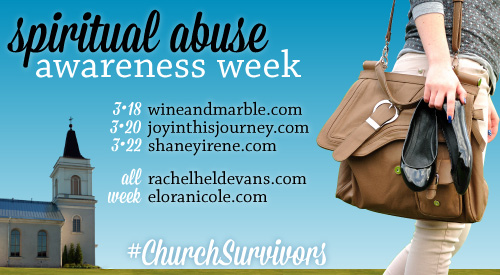
IMAGE BY DANI KELLEY
Back in February, Sen. Marco Rubio explained why he opposed the Violence Against Women Act:
I could not support the final, entire legislation that contains new provisions that could have potentially adverse consequences. Specifically, this bill would mandate the diversion of a portion of funding from domestic violence programs to sexual assault programs.
Rubio has this idea, apparently, that different types of abuse have nothing to do with one another. Not a surprising conclusion in a world that’s determined to paint all abuse as isolated incidences committed by monsters, but that’s not reality. Often, sexual abuse is present in violent relationships.
No one wants to talk about the fact that different types of abuse are connected because that means challenging the very society–ripe with hierarchies that enforce themselves with violence–that we live in.
Today, I’m discussing spiritual abuse as part of a Spiritual Abuse Awareness Week that some fellow bloggers are hosting. Also this week, Rachel Held Evans will be hosting a more general discussion of abuse (which I will be guest posting for) and Elora NIcole will be sharing the anonymous stories of survivors.
With all these thoughts of abuse in general going through my head, I think about how ridiculous statements like Rubio’s sound. As if we can end violence against women without ending sexual assault.
Truth is, the violences that women (and other oppressed groups) face often stem from the same root–a deeper violence that questions the legitimacy of their very humanity.
I don’t want us to miss this point while we talk about the different types of abuse that people face, inside and outside of the church. Abuse happens, and society either ignores or accepts it because there is an assault on humanity that says certain bodies are objects, or are public property. An assault that paints some bodies as worthless, gross, weird, animal-like, sinful, collateral, too sexual, needing to be taught a lesson, etc.
Religion is far from the only institution that perpetuates this kind of abuse, but spiritual abuse can be a powerful tool for painting some groups as less important than others and therefore “deserving” of violence.
This happens in obvious cases such as the Southern Baptist Church supporting the wars in Afghanistan and Iraq, or in the many church groups that advocate hitting children who misbehave.
It also happens more subtly in ways that I don’t think most leaders (though when you hear stories like Jack Schaap’s, you wonder…) or church members intend.
Here’s where my own story comes in. I grew up in church and grew up learning many things about myself and about my body and about the way the world is. I also ended up in an abusive relationship when I was 16.
I’ve spent a lot of time thinking about how I was physically, verbally, and sexually abused in that relationship, but little thinking about how I was spiritually abused. My ex-boyfriend used my own deeply-held religious beliefs to make me think that what he did to me was okay. It was easy for him to convince me, too, because I had been absorbing abusive ideas from the churches I’d attended my whole life.
I will be writing in more detail about how my idea of who God was affected what I accepted as love. But my churches growing up also fed me dangerous ideas about who I was, what my body was, and what my place in the world was.
I was a woman, the church told me, so I had to be passive, meek, submissive, caring and nurturing, and endlessly patient and forgiving. A man, on the other hand, was just naturally aggressive, out-of-control, and sexual. These were God-given traits.
My abuser, knowing this, played on those, even sometimes calling my relationship with God into question when I didn’t live up to my role.
My church also taught me that I was worthless. From the sermons the pastors preached to the books that my youth pastors recommended. Because I was not a virgin I was what the Christian dating book, Dateable, would call “dollar store leftovers.”
My abuser, knowing this, told me constantly that no one else would want me so I had better stay with him. That I was already impure and couldn’t be fixed so I might as well let him do whatever he wanted with my body.
My church taught me that I was responsible for men’s actions. That dressing immodestly could make men lust after me.
My abuser, knowing this, blamed me when he sexually assaulted me. He told me it was my fault for being too sexy, even in the Baptist school-approved outfit I was wearing.
All violence is connected.
I’m positive that the churches I grew up in did not want their teachings to be used by abusers to support abuse.
Too bad. That’s not how it works.
Those teachings were violence in and of themselves. They did violence to my humanity. And in doing that violence to my humanity, they sent the message to abusers that I did not have to be treated as human.
Churches don’t have to be as cult-like and controlling as Driscoll’s Mars Hill or First Baptist Church of Hammond to be abusive. By using language about groups–whether it’s women, children, LGBT people, or people of different colors, cultures, countries, or religions–that does violence to their humanity, they commit spiritual abuse. And spiritual abuse won’t confine itself to the pulpit. Those abusive words and teachings and ideas leave the church in the hearts and minds and Moleskine notebooks of every church member and are spread throughout society like an infectious disease.
The church is not the only source of this disease, again, but it is a powerful one because battling it means battling ideas and perceptions about God (something I will discuss more in my guest post for Rachel Held Evans later this week).
A church that claims to worship a man whose purpose was “to set the oppressed free” should be horrified to learn that its teachings are being used by abusers to support abuse.
Is it though? Are our churches concerned about how their messages are received? Are our churches concerned about abuse survivors? Or are they more focused on so-called sound doctrine and on giving “grace” to abusers?
Previous Post

March 11, 2013
Must reads!
Next Post
March 20, 2013 Spiritual Abuse Awareness Week: My Guest Post at Rachel Held Evans
Browse Our Archives
Select a Category Uncategorized
Select a Month June 2017 March 2017 November 2016 October 2016 July 2016 June 2016 March 2016 July 2015 June 2015 May 2015 April 2015 March 2015 February 2015 December 2014 November 2014 October 2014 September 2014 August 2014 July 2014 June 2014 May 2014 April 2014 March 2014 February 2014 January 2014 December 2013 November 2013 October 2013 September 2013 August 2013 July 2013 June 2013 May 2013 April 2013 March 2013 February 2013 January 2013 December 2012 November 2012 October 2012 September 2012 August 2012 July 2012 June 2012 May 2012 April 2012 March 2012 February 2012 January 2012 December 2011 November 2011 October 2011 September 2011 August 2011 July 2011 June 2011 March 2011 February 2011 January 2011 December 2010 October 2010 September 2010 August 2010
Follow Us!
TAKE THE
Religious Wisdom Quiz
What was the primary economic system in Biblical times?
Select your answer to see how you score.
Barter Gold standard Taxation Silver coins
Related posts from Sarah Over the Moon

Why Does Dr. James Dobson Pretend He's Sad...

Liberating Liturgies: A Hymn for Queer Creation

12 Reasons Why You Can Totally Call God...
Tony Jones' Cross is a Symbol of Abuse...
TRENDING AT PATHEOS New Visions

Did Prayer Cure His Cancer? Or Was It...
At 4 AM one morning, Joshua W. Brown’s wife awoke to a...

8 Ways a Near-Death Experience Rewires the Soul
Does Consciousness Survive Physical Death? After 50 Years of Research, Dr. Raymond...

Holy Longing: What Our Restlessness Is Telling Us
“One can find so many pains when the rain is falling.” -John...

What this is NOT about. This blog is definitely not about...

Who said the Israelites were God’s chosen? That’s right, they did. Who...

The Spirit World Is the Real World: God...
A Monk’s Wisdom on Body and Spirit I sit with Brother Martin...
view all New Visions blogs
Ad-Free & Subscriber Log-In Subscription Support
- About Us
- 2026 Calendar
- Videos
- Podcasts
- Library of World Religions
- Faith In Media Tracker
- Advertise With Us
- Write for Us
- Privacy Policy
- Terms of Service
- Do Not Sell My Data
- Contact Us
- Radiant Digital
- Manage Newsletter Subscriptions
- Unsubscribe From Notifications
- Sitemap
Copyright 2008-2026, Patheos. All rights reserved.
Subscription Support Ad-Free & Subscriber Log-In
Follow Patheos