
BuddhistCatholicContemplativeEvangelicalGeneral ChristianHinduJewishLatter-day SaintMuslimNew VisionsProgressive Christian
Beliefs
- Buddhist
- Catholic
- Contemplative
- Evangelical
- General Christian
- Hindu
- Jewish
- Latter-day Saint
- More Voices
- Muslim
- New Visions
- Pagan
- Progressive Christian
Topics
- Religion News
- Food and Religion
- Sports and Religion
- Religious Art
- Religious Music and Entertainment
- Religious Events
- History and Religion
- Style and Religion
- Politics and Religion
- Women in Religion
- Recreation Outdoors and Religion
- Business Finance and Religion
- Careers Workplace and Religion
- Education and Religion
- Family Parenting and Religion
- Health Fitness and Religion
- Home and Religion
- Relationships and Religion
- Technology and Religion
- Travel and Religion
Columnists
- Buddhist Columnists
- Business Finance and Religion Columnists
- Careers Workplace and Religion Columnists
- Catholic Columnists
- Contemplative Columnists
- Education and Religion Columnists
- Evangelists Columnists
- Family Parenting and Religion Columnists
- General Christian Columnists
- Health Fitness and Religion Columnists
- Hindu Columnists
- History and Religion Columnists
- Home and Religion Columnists
- Jewish Columnists
- More Voices Columnists
- Latter Day Columnists
- Muslim Columnists
- New Visions Columnists
- Nonreligious Columnists
- Pagan Columnists
- Politics and Religion Columnists
- Progressive Columnists
- Recreation Outdoors and Religion Columnists
- Relationships and Religion Columnists
- Religion News Columnists
- Religious Art Columnists
- Religious Events Columnists
- Religious Music and Entertainment Columnists
- Sports and Religion Columnists
- Style and Religion Columnists
- Technology and Religion Columnists
- Travel and Religion Columnists
- Women in Religion Columnists
Resource Library
- 2026 Calendar
- Library of World Religions
- The 100 Most Holy Places on Earth
- Patheos Answers
- Podcasts
- Videos
- Faith Leaders Database
- Anglican Episcopalian
- Bahai
- Baptist
- Buddhism
- Christianity
- Confucianism
- Eastern Orthodoxy
- Hinduism
- Holiness and Pentecostal
- ISKCON
- Islam
- Judaism
- Lutheran
- Methodist
- The Church of Jesus Christ of Latter-day Saints
- New Age
- Paganism
- Presbytarian and Reformed
- Protestantism
- Religion Behind the Scenes
- Roman Catholic
- Scientology
- Shia Islam
- Sikhism
- Sufism
- Sunni Islam
- Taoism
- Zen
- See all religions
Research Tools
 Ad-Free & Subscriber Log-In Subscription Support
Ad-Free & Subscriber Log-In Subscription Support
Follow Patheos 

- Trending:
- Forgiveness
- |
- Marriage
- |
- Consciousness
- |
- Death Penalty
- |
- Election
- |
- Halloween
 Samudra
- Home
- Hindu
- Interviews with non-Indian Hindus: Gerald Barr
Interviews with non-Indian Hindus: Gerald Barr
Last updated on: July 25, 2018 at 5:36 am by Mat McDermott
Interviews with non-Indian Hindus: Gerald Barr 2018-07-24T14:37:52-04:00 Mat McDermott
Patheos Explore the world's faith through different perspectives on religion and spirituality! Patheos has the views of the prevalent religions and spiritualities of the world.
The phenomenon of non-Indians adopting Hinduism is not new. However, the stories of how individuals came to the religion have not been regularly recorded. I hope to rectify that by time to time publishing interviews with those people who weren’t raised Hindu but now publicly identify as such, in the hopes of shedding some light on what drew them to Sanatana Dharma.
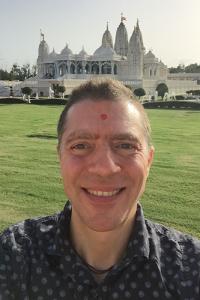
The following is an interview with Gerald Barr, a PhD student in English Literature at the University of Houston. He also performs and teaches tabla.
 How did you first get attracted to Hinduism or become aware of it?
I have been involved in Hinduism for the last twenty years. My entry into Hindu culture was through my study and performance of tabla.
I became immensely inspired by Indian Classical Music, and began learning from Ustad Zakir Hussain in 1995. He teaches not just tabla, but also how the music is connected to Hinduism. For example, he traces Indian percussion to Lord Ganesha. He once taught a tabla composition that ‘narrates’ a story of Radha and Krishna. Thus, the music and Hindu spirituality are directly linked.
I began performing tabla often while living in the San Francisco Bay Area. Many Hindu temples would invite me to perform for various programs. I was becoming more and more connected in the community. The essence of Hindu spirituality is brought out through the music I was experiencing and performing, especially in temple programs.
When and why did you first identify as Hindu?
Due to my deep connection with Hindu spirituality, I wanted to take the next step and become initiated.
In the San Francisco Bay Area, I became involved with BAPS (Bochasanwasi Akshar Purushottam Swaminarayan Sanstha). I began playing tabla for programs in the temple. I was deeply attracted to the beautifully elegant murtis. Also, the devotees strive for purity of character and conduct. Thus, I made the decision to accept the BAPS guru at the time, His Holiness Pramukh Swami Maharaj, as my guru. He gave me vartman initiation into BAPS in San Jose, CA temple in September 2007. He also gave me the tulsi necklace (kunthi) and japa mala (rosary). He told me I must go to the temple every week and do puja every morning.
Have you ever found there to be a conflict between any Western values you uphold and those of Hinduism?
Humans are social animals, and thrive in communities. In the United States, the focus is on the independent individual and self-reliance. This can lead to isolation and loneliness. Hindu and Indian culture focuses on the community. The family unit is very important, and is also rooted in Hindu traditions. Hinduism is an all-encompassing way of life. Thus, traditional Hindu families practice important rituals throughout their lives. A child undergoes specific pujas and ceremonies during specific times of their lives. Married couple follow set Hindu norms. The culture is deeply rich and complex. So, as a serious practicing Hindu, I need to accept the whole package, not just choose elements that are comfortable to me.
Thus, I underwent a full traditional Hindu samskara ceremony. In this ceremony, I became directly linked to a Hindu lineage, known as gotra. I am now in the Kashyap Gotra. I also received a Hindu name, Janardhana Bhakta. I went through rituals that a new-born child goes through, like eating for the first time, seeing the sun for the first time, etc.
Another example is the lay-out of one’s home. The Vastu Shastra has very specific instructions on how one’s home should be arranged to live a harmonious life. Certain rooms need to be in certain cardinal directions. This is deeply rooted in Hindu tradition and is still commonly followed in India. This is challenging in the US.
Being Hindu influences all aspects of life at all times. If one is serious about being Hindu, one should accept this notion. I am aspiring to this ideal, though it has difficulties. At the same time, Guru’s and God’s grace are the most important.
How does your Hindu-ness manifest?
When I became initiated into BAPS by Pramukh Swami, he gave me the agna (command) to attend the temple every week. Also, he gave me the japa mala beads, and the tulsi necklace (kunthi) that I have never removed since. I apply tilak to my forehead. I am also a vegetarian, do not drink nor smoke, and aspire toward a pure life.
Learning an Indic language is also important. One enters the complex and intricate world view of a culture through its language. Thus, I have been learning Gujarati, the dominant language of BAPS.
My Hindu-ness crosses into my academic world as well.
I am currently doing a PhD in English Literature at the University of Houston. My research involves how British literature in the nineteenth century concocted their own version of Hinduism that was suitable to domestic tastes. I look closely at interactions between British figures and Hindu culture in India.
This misrepresentation of Hinduism in popular Western media continues to this day. So, through my research, I want to show that orientalism, misappropriation of Hindu culture by the west, and even commodification of Hinduism has a long history. My overall goal is to rectify this and show Hinduism as a complex theological system that is to be taken seriously.
What’s your spiritual path like?
Music has always been connected to spirituality for me. Thus, my practice of Indian tabla is my favorite form of bhakti (devotion).
Either playing in a temple or listening to Indian classical music, I feel a deep atma connection. The bhava (divine emotion) of the ragas really moves me. It is a direct experience of the soul of Hinduism for me.
How has the Hindu community responded to you?
In India, I am met with many curious stares and questions. Since the concept of personal space is quite different in India, people have no issue coming up to me and asking about my Hindu-ness.
One recent example really stands out here. This was during my samskara puja at a Karnataka-based temple here in Houston. A sweet elderly couple from Bangalore was present. The wife could not fathom that I was a Hindu American. She was in a state of bewilderment, but also utmost respect toward me. She said that I come from the Michael Jackson tradition! She wondered how such a foreign religion and culture could appeal to me. She deeply appreciated that I have adopted Hinduism while India is turning towards Western material pleasures. I then explained that Westerners accepting Hinduism in America has a long history, back to when Swami Vivekananda came here and set the ball rolling. I am not so unusual.
Have you ever been made to feel like less of a Hindu because of your race?
In India, some temples still do not allow non-Indians inside. This is changing. One time I was in Kanchipuram at the Varadarajan Temple. A brahmin was giving me a tour, and took me inside the inner sanctum for darshan of the deity. There was a sign posted that said ‘Only Hindus Allowed’ and a crowd started making a ruckus. The brahmin yelled back at them in Tamil, something about I am a devotee of Swaminarayan, and they were quiet. I have never had any problems entering Hindu temples in India so far.
Do you think there’s a unique Western or American Hinduism developing, or will develop?
This is a tricky question. It speaks to my PhD research about appropriation of Hinduism by the west.
I think Hinduism is an alive tradition that is not frozen in ancient times. It adjusts to the time and place. However, the source must always be preserved. The New Age movement has borrowed bits and pieces from so many traditions, such as Hinduism, Buddhism, Celtic nature spirituality, Native American elements, and created a mishmash. This is an example of distillation of traditional forms, and removing them from their sources to suit the western culture. Kirtan has become quite popular in the west as well. While this is a great thing, as Hinduism teaches that singing God’s names is one form of devotion (bhakti), kirtan has become too commercial and even competitive. Thus, the essence becomes buried or even lost.
But, many authentic Hindu denominations are increasing their presence in the US. One can enter a South Indian-based temple in many major cities in the US, and experience the same rituals and pujas as one would in India. BAPS is doing an exceptional job bringing Hindu culture here as it is. The traditional temples are attracting many people.
Do you think it’s necessary for people adopting Hinduism to prioritize Indian dress or social cues? Take on a Sanskrit name?
Hindu attire signifies the subculture of India from which it comes. So, in Bengal, Hindus wear a dhoti. In parts of South India, they wear a lungi. In some South India temples, men cannot wear shirts. Also, the saris vary in style in different states of India. So, the clothing is more of a cultural signifier. But, if certain temples require a dress code, I will follow. In BAPS, we wear all white, kurta with the BAPS logo and pants.
Becoming Hindu means adopting a way of life. So, having a Hindu name is important as it will strengthen one’s identity as a Hindu, and also show the community that one is serious. When Hindu children are born, they are given a name based on many detailed factors. These include their Vedic horoscope, their samskaras, their family lineage, etc. The guru or priest gives a name accordingly. Based on such aspects, I received the name Janardhana Bhakta during my samskara ceremony. Thus, to officially become Hindu, this samskara ceremony is essential, and it includes receiving a name.
What’s your relationship with India?
Due to my involvement with Hindu culture in the United States for many years, I was able to establish many close connections and friendships in India. So, I have been nine times so far, and my tenth trip is coming this fall. I always feel it is a yatra (pilgrimage). The land is sacred. I feel a charge of spiritual energy and inspiration whenever I arrive in India. I have been to many temples, including Tirupati Balaji, Parthasarathy in Chennai, Nathdwara in Rajasthan, Kamakshi in Kanchipuram, Rancchorai in Dakor, and of course many of the major BAPS temples, including Akshardham in New Delhi. I also go for the classical music season in December.
Previous Post

July 10, 2018
Interviews with non-Indian Hindus: Allegra Lovejoy

Browse Our Archives
Select a Category Animals Culture Environment Yoga
Select a Month August 2018 July 2018 June 2018 May 2018 April 2018
Follow Us!
TAKE THE
Religious Wisdom Quiz
I am twelve men sent to explore the Promised Land, but only two gave a good report. Who are we?
Select your answer to see how you score.
Leaders of Israel Messengers Explorers The twelve spies
Related posts from Samudra
Most sinister part of Ramdev article in New...
Interviews with non-Indian Hindus: Allegra Lovejoy
In pulling photo of Nikki Haley in front...
On this International Day of Yoga, let’s commit...
TRENDING AT PATHEOS Hindu

Indian Hindu pilot’s valor in line of duty...
There is a hoary maritime tradition that the captain of the...

Movie on Neem Karoli Baba’s life is a...
Neem Karoli Baba’s life (1900-1973) is associated with miracles he made in...

20 Questions to Ask Before an Interfaith Marriage,...
Four questions every interfaith couple should discuss before marriage: Conversion. Will either...

Avadhānam: The Art of Concentration and Intellectual Mastery
What is Avadhānam? In the summer of 2015, during a three-day Sanskrit...

Jesus in the Dharma: Where Christ Fits in...
Where Does Jesus Fit in Hinduism? That’s a question I get often...

Hormuz: A Shared Hindu and Zoroastrian Heritage
Every evening, somewhere in the world, a newsreader utters the words: "The...
view all Hindu blogs
Ad-Free & Subscriber Log-In Subscription Support
- About Us
- 2026 Calendar
- Videos
- Podcasts
- Library of World Religions
- Faith In Media Tracker
- Advertise With Us
- Write for Us
- Privacy Policy
- Terms of Service
- Do Not Sell My Data
- Contact Us
- Radiant Digital
- Manage Newsletter Subscriptions
- Unsubscribe From Notifications
- Sitemap
Copyright 2008-2026, Patheos. All rights reserved.
Subscription Support Ad-Free & Subscriber Log-In
Follow Patheos