
BuddhistCatholicContemplativeEvangelicalGeneral ChristianHinduJewishLatter-day SaintMuslimNew VisionsProgressive Christian
Beliefs
- Buddhist
- Catholic
- Contemplative
- Evangelical
- General Christian
- Hindu
- Jewish
- Latter-day Saint
- More Voices
- Muslim
- New Visions
- Pagan
- Progressive Christian
Topics
- Religion News
- Food and Religion
- Sports and Religion
- Religious Art
- Religious Music and Entertainment
- Religious Events
- History and Religion
- Style and Religion
- Politics and Religion
- Women in Religion
- Recreation Outdoors and Religion
- Business Finance and Religion
- Careers Workplace and Religion
- Education and Religion
- Family Parenting and Religion
- Health Fitness and Religion
- Home and Religion
- Relationships and Religion
- Technology and Religion
- Travel and Religion
Columnists
- Buddhist Columnists
- Business Finance and Religion Columnists
- Careers Workplace and Religion Columnists
- Catholic Columnists
- Contemplative Columnists
- Education and Religion Columnists
- Evangelists Columnists
- Family Parenting and Religion Columnists
- General Christian Columnists
- Health Fitness and Religion Columnists
- Hindu Columnists
- History and Religion Columnists
- Home and Religion Columnists
- Jewish Columnists
- More Voices Columnists
- Latter Day Columnists
- Muslim Columnists
- New Visions Columnists
- Nonreligious Columnists
- Pagan Columnists
- Politics and Religion Columnists
- Progressive Columnists
- Recreation Outdoors and Religion Columnists
- Relationships and Religion Columnists
- Religion News Columnists
- Religious Art Columnists
- Religious Events Columnists
- Religious Music and Entertainment Columnists
- Sports and Religion Columnists
- Style and Religion Columnists
- Technology and Religion Columnists
- Travel and Religion Columnists
- Women in Religion Columnists
Resource Library
- 2026 Calendar
- Library of World Religions
- The 100 Most Holy Places on Earth
- Patheos Answers
- Podcasts
- Videos
- Faith Leaders Database
- Anglican Episcopalian
- Bahai
- Baptist
- Buddhism
- Christianity
- Confucianism
- Eastern Orthodoxy
- Hinduism
- Holiness and Pentecostal
- ISKCON
- Islam
- Judaism
- Lutheran
- Methodist
- The Church of Jesus Christ of Latter-day Saints
- New Age
- Paganism
- Presbytarian and Reformed
- Protestantism
- Religion Behind the Scenes
- Roman Catholic
- Scientology
- Shia Islam
- Sikhism
- Sufism
- Sunni Islam
- Taoism
- Zen
- See all religions
Research Tools
 Ad-Free & Subscriber Log-In Subscription Support
Ad-Free & Subscriber Log-In Subscription Support
Follow Patheos 

- Trending:
- Forgiveness
- |
- Marriage
- |
- Consciousness
- |
- Death Penalty
- |
- Election
- |
- Halloween
 Samudra
- Home
- Hindu
- Interviews with non-Indian Hindus: Christopher Fici
Interviews with non-Indian Hindus: Christopher Fici
Last updated on: June 2, 2018 at 5:00 am by Mat McDermott
Interviews with non-Indian Hindus: Christopher Fici 2018-06-01T14:16:11-04:00 Mat McDermott
Patheos Explore the world's faith through different perspectives on religion and spirituality! Patheos has the views of the prevalent religions and spiritualities of the world.
The phenomenon of non-Indians adopting Hinduism is not new. However, the stories of how individuals came to the religion have not been regularly recorded. I hope to rectify that by time to time publishing interviews with those people who weren’t raised Hindu but now publicly identify as such, in the hopes of shedding some light on what drew them to Sanatana Dharma.
The following is an interview with Christopher Fici, a former ISKCON monk, currently working on his doctorate at Union Theological Seminary in New York City. He’s a board member at Sadhana: Coalition of Progressive Hindus, and has done extensive work in the field of Hinduism and ecology — a topic we’ll cover in a subsequent interview.
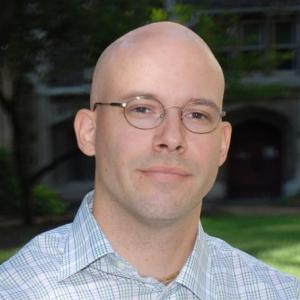 When did you get attracted to Hinduism?
I’m from Detroit, Michigan. Raised Roman Catholic. When I went to University of Michigan, in Ann Arbor, I really got attracted to Eastern spirituality. I was taking classes on Hinduism and Buddhism. It was those very heady college days when your Buddhist professor is telling you you’re going to eventually become a Buddha one day. I wanted to practice meditation. That was my desire.
A couple of the brahmachari monks that lived at the ISKCON temple in Detroit were doing programs on campus. I was walking through the campus one day and met one of the devotees, a white guy from the midwest. His name was Jagadish. I started going to these programs and started practicing the Hare Krishna mantra, started reading the Bhagavad Gita. The mantra meditation was like really what I was looking for. I really liked the active part of the practice, the chanting.
I started studying with them, going on retreats with them to different temples: the Detroit temple, the temple in West Virginia, New Vrindaban. I just became someone wanting to become a devotee of Krishna. It says in the Gita that if you’ve made a certain amount spiritual progress on the bhakti path in one lifetime, you never lose that. Everything else changes as you change bodily forms, but whatever little bits of realization you’ve gained stay with you. There was a sense that I was coming back to what I knew.
Why did you decide to become a monk?
I was very intrigued by the brahmachari life. It was so strange, but there was something that was very attractive about it. When I finished my undergraduate degree, in filmmaking, I just was never attracted to doing what you’re supposed to do: go to LA, be an intern for years and hope to get a break. I had this kind of existential crisis of ‘what do I do now?’
I remember going to the New Vrindaban temple in 2006. It just struck me: You keep dancing around this desire to practice ashram life; you’re going to have to do it.
I was a monk at New Vrindavan from 2006-2009, then at the Bhakti Center, here in New York, from 2009-2012.
Now, I primarily identify as a Vaishnav scholar-practitioner.
How does your Hindu-ness manifest and what’s your spiritual practice like?
I love to sit chanting Hare Krishna on my beads and reading a book by one of our goswamis.
One thing I struggle with though, because I’m an American, is that Vaishnav culture, having spent so much time in ashrams, feels like home. But there’s something too where I feel like I need to spend a lot more time in India before I can feel a sense of deeper grounding in my Vaishnav practice, but also within the culture of Hinduism itself.
What is your relationship with India?
I’ve only been twice. It feels like home, but it also feels like this really weird intimidating place.
I went the first time 11 years ago when I was living in New Vrindaban. We took a pilgrimage. It was intense the first time, as it is for anyone who’s never been there before. It was also really beautiful. We went to all these holy places: Vrindavan, Mayapur in Bengal, Puri. Just to go to these places you’ve spent so much time reading about and hearing about. It was a lot of travel. We were only there for 5 1/2 weeks. It was just on and off trains.
The second time was at the Govardhan Eco Village, this past December. Basically I was there for two weeks. I didn’t get a chance to really go anywhere else. But it felt like home. It felt a lot like the New Vrindaban temple that I lived in. The same kind of country living vibe.
What I’m doing for my doctoral dissertation, which I’m about to start, is on the Eco Village as an anticipatory community: these communities which are, in this moment of climate crisis, this crossroads, figuring out a way into this using eco-social practices and virtues to step out of the systems and momentums that have created climate change. They’re saying here’s an alternative, here’s a way to anticipate the way in to this very changed planet, as Bill McKibben describes it. I’ll be spending a lot of time at the Eco Village in the next couple of years. I’m planning to go back in August.
What do you think is the importance of maintaining Indian social and cultural references?
That goes to a lot of the complaints about the yoga community, when you take out this asana, this practice, and basically don’t even teach where it comes from. People who teach meditation workshops who are not Indian and don’t take people back to where it all comes from. You don’t want to be the colonial American jerk and do that.
For me, being a Hindu, I always want to be extra careful, extra considerate, to say ‘these are the roots of where these practices comes from.’ That doesn’t always manifest in the way I dress or in the way communicate, but when there’s a serious encounter with elements of the Vaishnav Hindu tradition, I always want to make sure people are aware of the roots of where this comes from.
There’s such a depth of beauty and wisdom to this spiritual culture of India that really needs to be celebrated, brought out, and given a chance to emerge. We’re making unconscious assumptions in the West that we here are the pinnacle of culture and civilization and we’re really not.
For example, the fact is this Western capitalist culture that created climate change is becoming increasingly a less and less feasible model of how to organize human communities and civilization, so where else do we look?
The spiritual culture of India, the eco-spiritual culture of India, the way that manifests in worshiping the Ganga and Yamuna, the teachings in the Gita which say to see the presence of God in every living being, those ideas are more well developed in Hindu texts and culture than elsewhere. There’s so much there in the culture of India that can help us respond to the challenges that we face now.
What’s your experience been like at Union, being a Hindu in a Christian institution?
When I first came to Union Theological Seminary, there was a course taught by Paul Knitter called ‘Double Belonging’. For a time I was kind of flirting with the idea that maybe that was me. In the course you’re talking about the concept of multiple belonging. Then you’re also talking about the concept of what belonging is. Because of that, I became even more convinced that I’m a Vaishnav. That’s who I am. I remember going to a Catholic mass, up the street at the Notre Dame church. It was beautiful, but the language of how God is described didn’t resonate anymore.
Being the first practicing Vaishnav to ever study here at Union, I began to realize all these resonances with the Christian theology that’s taught here. I read the works James Cone, who was a scholar here and recently passed away, his liberation theology, reading about who Jesus is, the liberator of the poor and the oppressed, the full mercy of God in this person for everybody. That language resonates with me almost just as much as being a devotee of Krishna.
What comes from that — and what I’m really trying to put into clearer words for myself and hopefully for others now — is that this seminary and Abrahamic traditions have this clear focus on justice. The justice of God, the mercy of God, and how those things intersect.
In Hinduism, that concept of justice, that concept of a God of the oppressed, is not so readily apparent, on the surface.
You have these kinds of tensions between the justice language in the theologies we study here and the more dharmic language of various Hindu communities and traditions.
I’ve notice Hindus get a little wary around ‘justice’. Even in acknowledging that, I think there’s some interesting creativity that can happen. There’s a dance that can happen between justice and dharma, that neither attempts to overcome the other. That’s part of the historical tension.
Anantanand Rambachan talks about this in his book A Hindu Theology of Liberation. He quotes a Christian theologian who says dana, charity, is the word that a lot of Hindus go to talking about something that resembles what justice means in a Christian context. But, charity helps the person in need, whereas justice talks about the system that has put this person in a place of need. Charity helps the person who has been out cast. Justice explores why the person has been out cast.
It’s very much about confronting the powers and principalities as it says in the Bible, the systems of oppression and evil in the world. Those systems of evil are not foreign to Hinduism. Within Hindu tradition there are these problems of patriarchal oppression, of devaluing Earth. Which, again, have specific cultural and theological references to texts and traditions, that are very similar to challenges that come from Abrahamic traditions. The caste system is an example, though the more I encounter caste the more complicated it gets — so, I’m trying to be especially careful and studious about it.
I feel like there’s a way that justice language can sometimes lose its edge a bit in encounters with dharma, in terms of the fierceness of justice that’s required to resist the kinds of evil in the world. There’s a way to not lose that fierceness, but in encountering dharma there are resources to deepen what it means to practice justice.
Part of my own work being a Vaishnav scholar and practitioner, and also identifying as a progressive Hindu, is acknowledging these tensions, trying to learn about them, trying to be fluent in them — but also letting those tensions not be the last word.
We’re just in such an urgent situation in many way. The more creative work we can do within our different spaces — Hindu spaces, Christian spaces — which gives us the means to help each other flourish, the better.
What does being a progressive Hindu mean to you? Many Hindus would say that Hinduism itself is already very progressive, unto itself.
That’s one of the most common things we get at Sadhana, people saying there’s no need for adding the ‘progressive’ term. I would agree that there is so much within Hinduism that has a progressive, justice seeking, element.
One reason for the term ‘progressive Hinduism’ is that our founder Sunita Viswanath would go into interfaith spaces here in New York City where you have progressive Christians, progressive Jews, and she would often be the only Hindu in the space. That led to the question, ‘Why aren’t Hindus being attracted to these progressive, liberal religious spaces in this country?’.
I’ve come to really come to understand progressive Hinduism as a space where justice and dharma can dance together. At Sadhana, we’re a little bit more specific about being advocates for social justice — which is not to say other Hindu groups don’t also do that too. But thinking about gender justice, sexual justice, racial justice, for us there’s no tension between marching with Black Lives Matter, for example. We’re trying to be a Hindu voice in those spaces.
For so many Hindus our spiritual practice is about achieving a spiritual liberation, moksha. What we try to practice at Sadhana is that moksha, liberation, also means liberation within this world. People are desiring liberation from the systems and structures that oppress them, preventing them from being the human beings, the spiritual beings, that they know they are.
I feel like we are not trying to be this distinctly new version of Hinduism. We’re trying to practice what we feel are the best parts of the Hindu tradition, making a particular space for people who want to seek justice on the more liberal side of the political spectrum.
Have you ever been discriminated against for being Hindu?
When I first applied to Union, coming out of the ashram, I had no idea what they were going to think. In my time here, seven years now, I’ve been fortunate that I’ve never really experienced a real ugly situation around being Hindu.
However, because this community embraces Dalit activism and scholarship, when there have been events with Dalit scholars, you sometimes have people in the audience who bring up the usual tropes about how Hinduism is irredeemable and even the concept of dharma is a problem.
Having come to an understanding about why they feel that way, I have some sympathetic knowledge of that point of view. But if people coming to a public event here said these types of things about Islam or Judaism they would not get away with it.
Do you think there’s a distinctive Western Hinduism developing or that will develop?
One easy answer to this question is ‘yes’. You see this in the yoga community, everywhere. But at the same time, obviously there’s a lot of tension between more indigenous Hindu people and the way that they feel that people who practice yoga in the West is somehow a dilution or disrespectful to the tradition.
I would also say there is a sense within the Vaishnav community, within the progressive Hindu community, that you can take so many threads of the original fabric of Hinduism and adapt them to the American context — in fact you have to do that to be able to speak to what people are concerned about here.
If you look at the Bhakti Center community here in New York, you get an example of Vaishnav spirituality that is very authentic to its roots, in terms of the temple practices, the spiritual language that is being shared, the kirtans. Everything is very much like it would have been in Bengal in the 16th century. But at the same time, there’s not a sense that you have to be particularly Indian or particularly Hindu to participate. For example, for dress, there Vaishnavs don’t have to dress in dhoti and have big tilak and all of that very traditional Vaishnav dress. Prabhupada did bring that over and people were inspired to wear that stuff, because in part it was also countercultural at the time. But if you go to the Bhakti Center today, it’s very much come as you are.
The Bhakti Center is in the middle of the East Village of New York. The East Village is where all coolness in the world comes from, in a way. To be able to have a successful temple, a spiritual community, there you have to be able to present things in a way that can speak to the hipness of the people that live in that community. And you have to be able to translate these very traditional Vaishnav Hindu spiritual concepts in a way that it makes sense to people.
Previous Post

May 22, 2018
Interviews with non-Indian Hindus: Ram Goodman
Next Post

June 5, 2018 Swimming in the Great Lakes is a Sacred Spiritual Experience
Browse Our Archives
Select a Category Animals Culture Environment Yoga
Select a Month August 2018 July 2018 June 2018 May 2018 April 2018
Follow Us!
TAKE THE
Religious Wisdom Quiz
How many books are in the New Testament?
Select your answer to see how you score.
30 13 27 21
Related posts from Samudra
Most sinister part of Ramdev article in New...
Interviews with non-Indian Hindus: Gerald Barr
Interviews with non-Indian Hindus: Allegra Lovejoy
In pulling photo of Nikki Haley in front...
TRENDING AT PATHEOS Hindu

Indian Hindu pilot’s valor in line of duty...
There is a hoary maritime tradition that the captain of the...

Movie on Neem Karoli Baba’s life is a...
Neem Karoli Baba’s life (1900-1973) is associated with miracles he made in...

20 Questions to Ask Before an Interfaith Marriage,...
Four questions every interfaith couple should discuss before marriage: Conversion. Will either...

Avadhānam: The Art of Concentration and Intellectual Mastery
What is Avadhānam? In the summer of 2015, during a three-day Sanskrit...

Jesus in the Dharma: Where Christ Fits in...
Where Does Jesus Fit in Hinduism? That’s a question I get often...

Hormuz: A Shared Hindu and Zoroastrian Heritage
Every evening, somewhere in the world, a newsreader utters the words: "The...
view all Hindu blogs
Ad-Free & Subscriber Log-In Subscription Support
- About Us
- 2026 Calendar
- Videos
- Podcasts
- Library of World Religions
- Faith In Media Tracker
- Advertise With Us
- Write for Us
- Privacy Policy
- Terms of Service
- Do Not Sell My Data
- Contact Us
- Radiant Digital
- Manage Newsletter Subscriptions
- Unsubscribe From Notifications
- Sitemap
Copyright 2008-2026, Patheos. All rights reserved.
Subscription Support Ad-Free & Subscriber Log-In
Follow Patheos