
BuddhistCatholicContemplativeEvangelicalGeneral ChristianHinduJewishLatter-day SaintMuslimNew VisionsProgressive Christian
Beliefs
- Buddhist
- Catholic
- Contemplative
- Evangelical
- General Christian
- Hindu
- Jewish
- Latter-day Saint
- More Voices
- Muslim
- New Visions
- Pagan
- Progressive Christian
Topics
- Religion News
- Food and Religion
- Sports and Religion
- Religious Art
- Religious Music and Entertainment
- Religious Events
- History and Religion
- Style and Religion
- Politics and Religion
- Women in Religion
- Recreation Outdoors and Religion
- Business Finance and Religion
- Careers Workplace and Religion
- Education and Religion
- Family Parenting and Religion
- Health Fitness and Religion
- Home and Religion
- Relationships and Religion
- Technology and Religion
- Travel and Religion
Columnists
- Buddhist Columnists
- Business Finance and Religion Columnists
- Careers Workplace and Religion Columnists
- Catholic Columnists
- Contemplative Columnists
- Education and Religion Columnists
- Evangelists Columnists
- Family Parenting and Religion Columnists
- General Christian Columnists
- Health Fitness and Religion Columnists
- Hindu Columnists
- History and Religion Columnists
- Home and Religion Columnists
- Jewish Columnists
- More Voices Columnists
- Latter Day Columnists
- Muslim Columnists
- New Visions Columnists
- Nonreligious Columnists
- Pagan Columnists
- Politics and Religion Columnists
- Progressive Columnists
- Recreation Outdoors and Religion Columnists
- Relationships and Religion Columnists
- Religion News Columnists
- Religious Art Columnists
- Religious Events Columnists
- Religious Music and Entertainment Columnists
- Sports and Religion Columnists
- Style and Religion Columnists
- Technology and Religion Columnists
- Travel and Religion Columnists
- Women in Religion Columnists
Resource Library
- 2026 Calendar
- Library of World Religions
- The 100 Most Holy Places on Earth
- Patheos Answers
- Podcasts
- Videos
- Faith Leaders Database
- Anglican Episcopalian
- Bahai
- Baptist
- Buddhism
- Christianity
- Confucianism
- Eastern Orthodoxy
- Hinduism
- Holiness and Pentecostal
- ISKCON
- Islam
- Judaism
- Lutheran
- Methodist
- The Church of Jesus Christ of Latter-day Saints
- New Age
- Paganism
- Presbytarian and Reformed
- Protestantism
- Religion Behind the Scenes
- Roman Catholic
- Scientology
- Shia Islam
- Sikhism
- Sufism
- Sunni Islam
- Taoism
- Zen
- See all religions
Research Tools
 Ad-Free & Subscriber Log-In Subscription Support
Ad-Free & Subscriber Log-In Subscription Support
Follow Patheos 

- Trending:
- Forgiveness
- |
- Marriage
- |
- Consciousness
- |
- Death Penalty
- |
- Election
- |
- Halloween
 Sam Rocha
- Home
- Catholic
- Was Baby Jesus a Refugee?
Was Baby Jesus a Refugee?
Last updated on: December 27, 2016 at 12:09 am by Sam Rocha
Was Baby Jesus a Refugee? 2016-12-27T00:09:49-06:00 Sam Rocha
Patheos Explore the world's faith through different perspectives on religion and spirituality! Patheos has the views of the prevalent religions and spiritualities of the world.
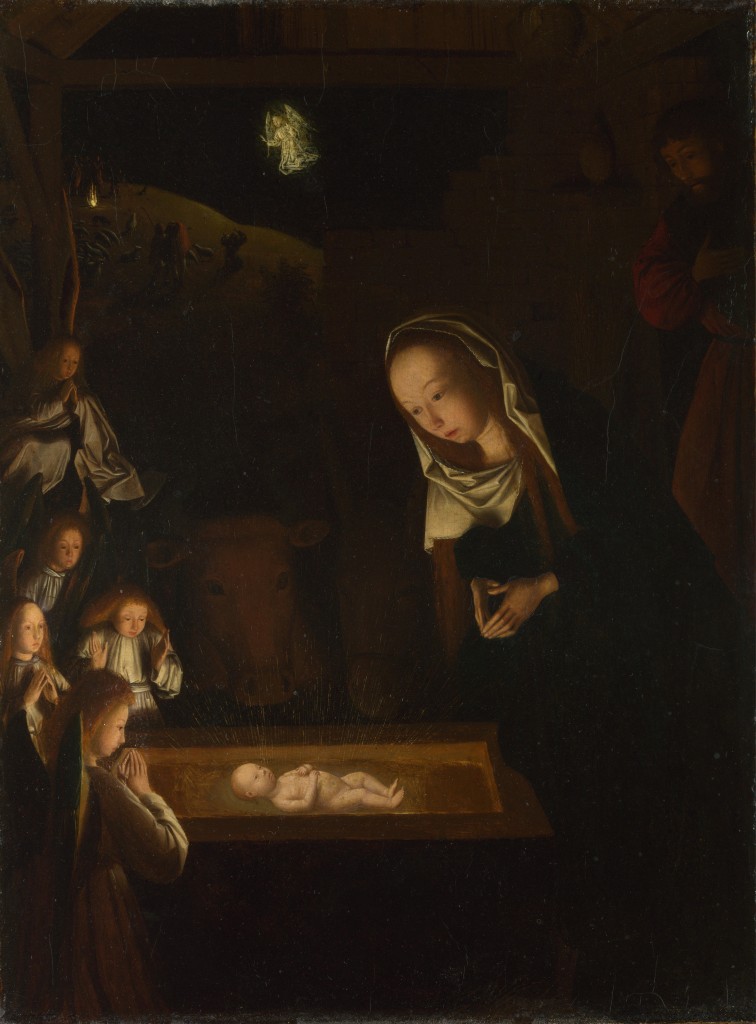
Geertgen tot Sint Jans, The Nativity at Night, c 1490. At the National Gallery. Wikimedia.
The infant Jesus we encounter in scripture is a serious and inspiring source of interpretation and celebration. I am not a Biblical scholar, but I am aware of the litany of approaches to the interpretation of scripture, from those that rely primarily on tradition and past authority to those that take a more modern historical approach. I reject none of these out of hand, but I am of course limited to what I know. The text I am using is the New Jerusalem Bible and I will mainly work from it as closely as I am able to.
Some have claimed that the Christ child we adore during the season of Christmas, from Nativity to Epiphany, is a Middle Eastern refugee and that this geopolitical identity should inspire the United States, and the global North in general, in our treatment of Middle Eastern refugees. Others have countered that this is (1) an improper characterization because it politicizes Christmas and religion and (2) is an incorrect reading of scripture.
In what follows, I hope to present replies to these two objections.
***
Reply to 1: The Incarnation matters because “the Word became flesh, he lived among us, and we saw his glory.” What this means is that “God so loved the world” (my emphasis). The amor mundi of God, God’s love of the world, is not itself worldly, but it is for the world. What this means is that we cannot make a false division between heaven and earth. We see concretely this in the presence of politics throughout the Gospels.
Rome looms heavy in the New Testament. Luke directly mentions Caesar Augustus and Quirinius, the governor of Syria, in his infancy narrative. Matthew tells us the story of Herod in his. So the idea that politics are somehow foreign to our understanding of Jesus in scripture is at odds with scripture itself.
It seems worthwhile to think that if the insights of scripture are Divine, then they share the Divine disposition of amor mundi — the Gospel is for the world and there is no good reason to exclude it from the worldly realm of politics.
***
Reply to 2: We rely on two different infancy narratives for the Christian Christmas story. There is not a single narrative. When we add historical insights we find many reasons to take these narratives seriously in a literal, historical sense, but we also find many reasons to be attentive to the mythic qualities of these stories. The census described by Luke, but not by Matthew, more likely dates to the 6 CE and the literal date of December 25 is more likely to occur in the present month of April. Nonetheless, we find enough overlap in the two narratives of Luke and Matthew, at a historical and mythic level of truth, repeat in other texts as well (the Quran, for example, which places the birth of Jesus in Egypt), to support a vast and beautiful imaginary of theological and religious insight and devotion. For instance, notice the ways Jesus is related to the typologies of the Old Testament, to Moses and, of course, to David.
In the two narratives we see Joseph and a pregnant Mary leave to Bethlehem. Luke tells us this is because of a decreed registry across the Roman Empire. This means that, in Luke, the Holy Family was a Jewish family traveling in Roman occupied Judea, to fulfill a registration mandate that would identify them religiously within Joseph’s Davidic line. Whether they ended up in a cave or a barn, there was nothing apolitical about their trip. Jesus was born in Bethlehem because of political displacement. Add to that, in Matthew, the dream where Joseph was told to flee to Egypt, because of a local Roman emperor’s political wrath — indeed, Herod saw Jesus as a manifestly political threat — and now the refugee status seems unobjectionable.
Those who would act as if there is an easy narrative of Christ’s birth that easily falsifies seeing him and his holy family as refugees, make an elementary mistake of reducing scripture — and salvation history — to a simplistic picture book. These religious illiterates also forget that Christmas is a season that includes the entire infancy narrative, everything from the census to Bethlehem, to the flight into Egypt. When we take this into account we see that the objection to Christ the Middle Eastern refugee is not only weakly argued in terms of Biblical interpretation, it is also a secular understanding of the season of Christmas.
These two replies should sufficiently refute the idea that the seeing Jesus as a Middle Eastern refugee is false. However, there is perhaps more truth to this that I have yet to allude to.
***
The incarnational wit of Christianity is most present in two places: Bethlehem and Calvary. The swaddling clothes prefigure the cloth that wrapped Christ in the tomb. (The cave as a birthplace is preferable to me for the same reason.) Myrrh is an embalming oil. The point seems to be that God so loved the world that he chose to become human and showed his humanity if the two most graphic moments of weakness: birth and death, womb to tomb.
The lesson here is not reducible to politics, but it does provide a political message about the preferential option for the poor. The incarnation of Christ is most of all poor. He is a refugee and a criminal, an outcast and a religious minority, he breaks the law to uphold the Law, he tells stories and confuses people, he grows angry in the Temple but shows mercy in the street.
The definitions of what a refugee is and is not are not useful here. What matters is that Christ is not a mere philanthropist or community organizer. He is not an altruist. He is not powerful in the temporal sense yet his weakness is our eternal strength. We do not adore a richly decorated Christ child or King — it is the Kings who adore him. We adore an infant in a manger and a young man on a Cross. A baby in a feeding trough and Jewish dissident being brutally tortured to death. This is our incarnate God and therein we find our salvation.
Anyone who settles for less than this, no matter their ideology or exegesis, is lost, false, and the poorest of all.
Previous Post
November 11, 2016
Socialism Elected Trump!
Next Post
January 10, 2017 Remember Your Promises: A Note to My Spiritual Elders
Browse Our Archives
Select a Category aesthetics audio class notes conversation Education En Español Interviews jazz jazzhop link Liturgy Music Nonsense pastoral philosophy phenomenology Philosophy philosophy of education photo Poetry Political Theology quote Race regular Schooling Uncategorized video Weekly Apocalypse
Select a Month June 2017 May 2017 April 2017 February 2017 January 2017 December 2016 November 2016 October 2016 September 2016 August 2016 July 2016 January 2015 December 2014 November 2014 October 2014 September 2014 August 2014 July 2014 June 2014 May 2014 April 2014 March 2014 February 2014 January 2014 December 2013 November 2013 October 2013 September 2013 August 2013 July 2013 June 2013 May 2013 April 2013 March 2013 February 2013 January 2013 December 2012 November 2012 October 2012 September 2012 August 2012 July 2012 June 2012 May 2012
Follow Us!
TAKE THE
Religious Wisdom Quiz
Which Christian group is associated with the "Anabaptist" tradition?
Select your answer to see how you score.
Mennonites Episcopalians Calvinists Lutherans
Related posts from Sam Rocha

BOOK RELEASE: Tell Them Something Beautiful by Sam...

By Their Fruits: A Reply to Rod Dreher

The Media Treats Trump Better Than Clinton or...

ON PROTEST (AND THOSE WHO PROTEST AGAINST THEM)
TRENDING AT PATHEOS Catholic

Rejecting Doom: Christian Hope And Human Action
Christianity is a religion of hope. We are to have hope and...

It’s What Comes From Within Which Matters
One of the most difficult things for us to understand is why...

Why I Choose the Eucharist Over the Sermon
Choose the Eucharist, Not the Sermon What are we supposed to get...

5 Design Elements Found in Spiritually Rooted Homes
Putting Spirituality Into Home Decor Our homes are more than our living...

Credo: A Story of God Told with the...
About 10 years ago, I began to imagine a personal "Credo" that...

The Anatomy of Divine Revelation in Catholic Thought
The claim that God has made Himself known to human beings is...
view all Catholic blogs
Ad-Free & Subscriber Log-In Subscription Support
- About Us
- 2026 Calendar
- Videos
- Podcasts
- Library of World Religions
- Faith In Media Tracker
- Advertise With Us
- Write for Us
- Privacy Policy
- Terms of Service
- Do Not Sell My Data
- Contact Us
- Radiant Digital
- Manage Newsletter Subscriptions
- Unsubscribe From Notifications
- Sitemap
Copyright 2008-2026, Patheos. All rights reserved.
Subscription Support Ad-Free & Subscriber Log-In
Follow Patheos