
BuddhistCatholicContemplativeEvangelicalGeneral ChristianHinduJewishLatter-day SaintMuslimNew VisionsProgressive Christian
Beliefs
- Buddhist
- Catholic
- Contemplative
- Evangelical
- General Christian
- Hindu
- Jewish
- Latter-day Saint
- More Voices
- Muslim
- New Visions
- Pagan
- Progressive Christian
Topics
- Religion News
- Food and Religion
- Sports and Religion
- Religious Art
- Religious Music and Entertainment
- Religious Events
- History and Religion
- Style and Religion
- Politics and Religion
- Women in Religion
- Recreation Outdoors and Religion
- Business Finance and Religion
- Careers Workplace and Religion
- Education and Religion
- Family Parenting and Religion
- Health Fitness and Religion
- Home and Religion
- Relationships and Religion
- Technology and Religion
- Travel and Religion
Columnists
- Buddhist Columnists
- Business Finance and Religion Columnists
- Careers Workplace and Religion Columnists
- Catholic Columnists
- Contemplative Columnists
- Education and Religion Columnists
- Evangelists Columnists
- Family Parenting and Religion Columnists
- General Christian Columnists
- Health Fitness and Religion Columnists
- Hindu Columnists
- History and Religion Columnists
- Home and Religion Columnists
- Jewish Columnists
- More Voices Columnists
- Latter Day Columnists
- Muslim Columnists
- New Visions Columnists
- Nonreligious Columnists
- Pagan Columnists
- Politics and Religion Columnists
- Progressive Columnists
- Recreation Outdoors and Religion Columnists
- Relationships and Religion Columnists
- Religion News Columnists
- Religious Art Columnists
- Religious Events Columnists
- Religious Music and Entertainment Columnists
- Sports and Religion Columnists
- Style and Religion Columnists
- Technology and Religion Columnists
- Travel and Religion Columnists
- Women in Religion Columnists
Resource Library
- 2026 Calendar
- Library of World Religions
- The 100 Most Holy Places on Earth
- Patheos Answers
- Podcasts
- Videos
- Faith Leaders Database
- Anglican Episcopalian
- Bahai
- Baptist
- Buddhism
- Christianity
- Confucianism
- Eastern Orthodoxy
- Hinduism
- Holiness and Pentecostal
- ISKCON
- Islam
- Judaism
- Lutheran
- Methodist
- The Church of Jesus Christ of Latter-day Saints
- New Age
- Paganism
- Presbytarian and Reformed
- Protestantism
- Religion Behind the Scenes
- Roman Catholic
- Scientology
- Shia Islam
- Sikhism
- Sufism
- Sunni Islam
- Taoism
- Zen
- See all religions
Research Tools
 Ad-Free & Subscriber Log-In Subscription Support
Ad-Free & Subscriber Log-In Subscription Support
Follow Patheos 

- Trending:
- Forgiveness
- |
- Marriage
- |
- Consciousness
- |
- Death Penalty
- |
- Election
- |
- Halloween
 Sam Rocha
- Home
- Catholic
- The Tenacious Wit of Shea’s Apologetics
The Tenacious Wit of Shea’s Apologetics
Last updated on: August 22, 2016 at 9:42 pm by Sam Rocha
The Tenacious Wit of Shea’s Apologetics 2016-08-22T21:42:36-05:00 Sam Rocha
Patheos Explore the world's faith through different perspectives on religion and spirituality! Patheos has the views of the prevalent religions and spiritualities of the world.
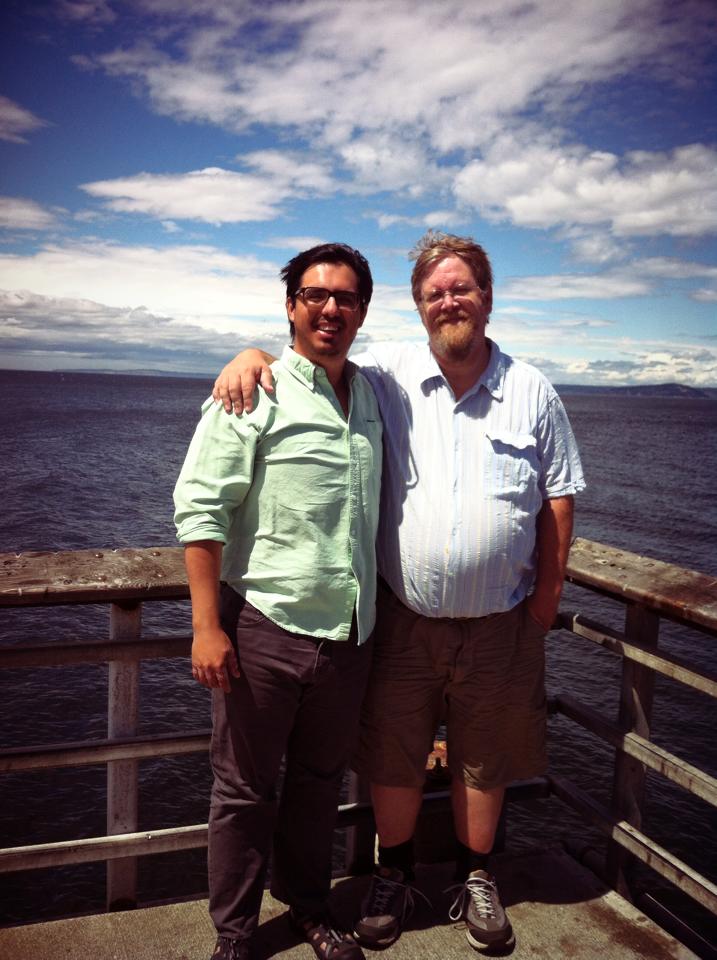
Mark and me. (Photo belongs to me.)
Mark Shea is a convert to Catholicism who has spent nearly thirty years as an apologist, author, speaker and, in the digital age, blogger and online commentator. We used to call this type of person a public intellectual, and that is what I consider Mark to be. The classic public intellectual is not like today’s version that, like me, takes refuge in an academic institution of some kind. A public intellectual lives on the back of their pen and, above all, their wits.
Shea is also a personal friend of mine, but our introduction was not perfectly friendly. In 2009, when I was writing at Vox Nova, Shea popularized the moniker, “Debate Club at Auschwitz,” for our group blog. My peers were outraged and the whole incident led to one of the larger tempests in a teakettle one finds brewing in the Catholic blogosphere, especially at that time.
My own view of the kerfuffle, which I have kept to myself until now, was quiet admiration. Shea did not coin the macabre phrase himself, but by endorsing it he managed to use it as if it was his, with plausible deniability. He outwitted Vox Nova then, and I think that his wit is precisely what makes him so controversial, no matter who the offended party may be.
···
I have written in my capacity as channel editor at The Font on the plain and public fact that Shea is welcome at Patheos Catholic as long as he’d like to stay. He joins a number of writers who distinguish themselves in their tenacity–writers of different independent viewpoints (e.g., Fr. Longenecker, Rebecca Hamilton, and Dave Armstrong). In Shea’s case this tenacity also comes with a sharp and idiosyncratic wit that, like all true wit, reveals as much as it conceals.
Shea’s brilliance is often mentioned in a begrudging way by his critics, praising his religious apologetic and devotional works to disown his political punditry. This distinction between the sacred and the secular completely misses the point. Apologetics, after all, is a polemical, dialectical, and confrontational business. It just is. Religious discourse of this sort within Roman Catholicism has been this way for millennia.
If you find Shea too hard to handle in a combox, I doubt you can stomach reading the Early Church Fathers or scholastic disputations–or even scripture for that matter. The question of tone and what is mistakenly called “charity” is really just a sense of social politeness that may have its merits but is by no means binding dogma. To hear certain accounts of it, Elizabethan social mores are the Catholic modus operandi. These folks should read more.
···
Shea actually believes this stuff! He does not argue from a pure rational position nor from the sentimentalism of private personal experience. Shea’s identity as a converted Catholic gives him a unique position from which to make his arguments, relying on tradition and personal experience, but this position also gives him the key ingredient of his voice: passion.
Shea’s apologetics are not reserved for a fragmented pastoral role, either. This, of course, is what a classic apologist does, which prevents their work from becoming logic-chopping games or religious trivia. If you look at the his punditry, his style is identical to his other works with one exception: the public political square allows for a more caustic tone. His use of monikers–like the aforementioned “Debate Club at Auschwitz”–with capitalized titles; his use of hyperbole and exaggeration; his impatience in comments with those who seem to be arguing from bad faith or reason or both: all of these characteristics are not deviations from his soaring religious prose, they are simply a sign of the range of his expression.
Shea has a temper, sure. With a last name like that, a temper is as to be expected as my love of tacos. There is nothing noble in having a temper, but there is something morally questionable about not having one. There is also a difference between righteous and self-righteous forms of anger. These two forms are impossible to distinguish sometimes, but that is the eros of anger. If we want to reduce all social relations to a bloodless fellow feeling that has no capacity for real outrage, and even for offence–even the sort that undoes itself in excess–then we should not continue looking toward Catholicism or Christianity.
Truth be told, everyone knows this. Hyperbole is recognized as unfair caricature and hurtful bluster by those who feel cut by its edge. Those who find consolation in sharp words are rarely the ones whom those words address. That Shea has aroused the anger of many Catholics in the US is especially unsurprising in the age of Pope Francis. Whether it is fair or unfair is not my tale to tell, but the tenacity to sustain the apologetics that repeat arguments centuries or days old requires all the literary strength a pen can muster: hyperbole included. The risks here are worthwhile and even necessary.
···
Ideologically speaking, Mark Shea makes for a horrible Leftist. Anyone who finds in him a Lefty should consult better sources (e.g., writers at Jacobin, Commonweal, America, Dissent and so on). His so-called liberalism in the US context is a commentary on the deformed political imagination, not on Shea’s politics.
As for his writings, one thing you will not hear is that Shea not only features his work in Catholic apologetics and political punditry, opinion, and extremely weird humour; he also frequently replies to readers, requesting prayers for them. In my case he has often promoted my work selflessly, and his collegial relations across Catholic media should not be ignored or forgotten.
The National Catholic Register has removed Shea not for his lack of orthodoxy but, instead, for his lack of charity. This is, of course, an appeal to orthodoxy–and no one should allow that explanation to pass. What it is says is that there is no place for the tenacious wit of Shea’s apologetics at NCR. That is their own problem, a problem I expect will increase as time goes on.
At Patheos Catholic, Shea will remain and we will be enriched by his presence.
···
Also read Max Lindenman’s “An Open Letter to the Editor Who Fired Mark Shea” and Timothy Putnam’s “My take on Mark Shea and Uncharitability.”
Previous Post

August 17, 2016
Voting is Immoral
Next Post

September 2, 2016 "I cannot stand and sing the anthem." - Jackie Robinson in 1972
Browse Our Archives
Select a Category aesthetics audio class notes conversation Education En Español Interviews jazz jazzhop link Liturgy Music Nonsense pastoral philosophy phenomenology Philosophy philosophy of education photo Poetry Political Theology quote Race regular Schooling Uncategorized video Weekly Apocalypse
Select a Month June 2017 May 2017 April 2017 February 2017 January 2017 December 2016 November 2016 October 2016 September 2016 August 2016 July 2016 January 2015 December 2014 November 2014 October 2014 September 2014 August 2014 July 2014 June 2014 May 2014 April 2014 March 2014 February 2014 January 2014 December 2013 November 2013 October 2013 September 2013 August 2013 July 2013 June 2013 May 2013 April 2013 March 2013 February 2013 January 2013 December 2012 November 2012 October 2012 September 2012 August 2012 July 2012 June 2012 May 2012
Follow Us!
TAKE THE
Religious Wisdom Quiz
What was the final plague that led Pharaoh to release the Israelites?
Select your answer to see how you score.
Frogs Hail Locusts Death of the firstborn
Related posts from Sam Rocha

BOOK RELEASE: Tell Them Something Beautiful by Sam...

By Their Fruits: A Reply to Rod Dreher

The Benedict Option: A Critical Review
ON PROTEST (AND THOSE WHO PROTEST AGAINST THEM)
TRENDING AT PATHEOS Catholic

Rejecting Doom: Christian Hope And Human Action
Christianity is a religion of hope. We are to have hope and...

It’s What Comes From Within Which Matters
One of the most difficult things for us to understand is why...

Why I Choose the Eucharist Over the Sermon
Choose the Eucharist, Not the Sermon What are we supposed to get...

5 Design Elements Found in Spiritually Rooted Homes
Putting Spirituality Into Home Decor Our homes are more than our living...

Credo: A Story of God Told with the...
About 10 years ago, I began to imagine a personal "Credo" that...

The Anatomy of Divine Revelation in Catholic Thought
The claim that God has made Himself known to human beings is...
view all Catholic blogs
Ad-Free & Subscriber Log-In Subscription Support
- About Us
- 2026 Calendar
- Videos
- Podcasts
- Library of World Religions
- Faith In Media Tracker
- Advertise With Us
- Write for Us
- Privacy Policy
- Terms of Service
- Do Not Sell My Data
- Contact Us
- Radiant Digital
- Manage Newsletter Subscriptions
- Unsubscribe From Notifications
- Sitemap
Copyright 2008-2026, Patheos. All rights reserved.
Subscription Support Ad-Free & Subscriber Log-In
Follow Patheos