
BuddhistCatholicContemplativeEvangelicalGeneral ChristianHinduJewishLatter-day SaintMuslimNew VisionsProgressive Christian
Beliefs
- Buddhist
- Catholic
- Contemplative
- Evangelical
- General Christian
- Hindu
- Jewish
- Latter-day Saint
- More Voices
- Muslim
- New Visions
- Pagan
- Progressive Christian
Topics
- Religion News
- Food and Religion
- Sports and Religion
- Religious Art
- Religious Music and Entertainment
- Religious Events
- History and Religion
- Style and Religion
- Politics and Religion
- Women in Religion
- Recreation Outdoors and Religion
- Business Finance and Religion
- Careers Workplace and Religion
- Education and Religion
- Family Parenting and Religion
- Health Fitness and Religion
- Home and Religion
- Relationships and Religion
- Technology and Religion
- Travel and Religion
Columnists
- Buddhist Columnists
- Business Finance and Religion Columnists
- Careers Workplace and Religion Columnists
- Catholic Columnists
- Contemplative Columnists
- Education and Religion Columnists
- Evangelists Columnists
- Family Parenting and Religion Columnists
- General Christian Columnists
- Health Fitness and Religion Columnists
- Hindu Columnists
- History and Religion Columnists
- Home and Religion Columnists
- Jewish Columnists
- More Voices Columnists
- Latter Day Columnists
- Muslim Columnists
- New Visions Columnists
- Nonreligious Columnists
- Pagan Columnists
- Politics and Religion Columnists
- Progressive Columnists
- Recreation Outdoors and Religion Columnists
- Relationships and Religion Columnists
- Religion News Columnists
- Religious Art Columnists
- Religious Events Columnists
- Religious Music and Entertainment Columnists
- Sports and Religion Columnists
- Style and Religion Columnists
- Technology and Religion Columnists
- Travel and Religion Columnists
- Women in Religion Columnists
Resource Library
- 2026 Calendar
- Library of World Religions
- The 100 Most Holy Places on Earth
- Patheos Answers
- Podcasts
- Videos
- Faith Leaders Database
- Anglican Episcopalian
- Bahai
- Baptist
- Buddhism
- Christianity
- Confucianism
- Eastern Orthodoxy
- Hinduism
- Holiness and Pentecostal
- ISKCON
- Islam
- Judaism
- Lutheran
- Methodist
- The Church of Jesus Christ of Latter-day Saints
- New Age
- Paganism
- Presbytarian and Reformed
- Protestantism
- Religion Behind the Scenes
- Roman Catholic
- Scientology
- Shia Islam
- Sikhism
- Sufism
- Sunni Islam
- Taoism
- Zen
- See all religions
Research Tools
 Ad-Free & Subscriber Log-In Subscription Support
Ad-Free & Subscriber Log-In Subscription Support
Follow Patheos 

- Trending:
- Forgiveness
- |
- Marriage
- |
- Consciousness
- |
- Death Penalty
- |
- Election
- |
- Halloween
 Sam Rocha
- Home
- Catholic
- Deschooling RED: Beyond the Fear of Failure
Deschooling RED: Beyond the Fear of Failure
Last updated on: February 4, 2015 at 5:49 pm by Sam Rocha
Deschooling RED: Beyond the Fear of Failure 2015-02-04T17:49:33-06:00 Sam Rocha
Patheos Explore the world's faith through different perspectives on religion and spirituality! Patheos has the views of the prevalent religions and spiritualities of the world.
In 1840, Horace Mann, the first Secretary of Education in the State of New Hampshire (and anywhere else in the United States), wrote these words in an article for the third volume of the newly-founded Common School Journal, on his beloved and controversial Whig project, The Common School Movement:
Let the common school be expanded to its capabilities, let it be worked to the efficiency of which it is susceptible, and nine-tenths of the crimes in the penal code would become obsolete; the long catalogue of human ills would be abridged; men would walk more safely by day; every pillow would be more inviolable by night; property, life, and character held by a stronger tenure; all rational hopes respecting the future brightened.
He was referring, of course, to what would become today’s compulsory schooling system. His appeal was rooted in fear. Mann conveyed Whig anxiety over what the combined forces of Irish-Catholic immigration, British-styled industrialization, and the subsequent urbanization would do to their Republic. The uncertainty of this period of history had other factors, too: The election of Andrew Jackson, that dogged populist Democrat; the Western expansion option, that left the doors of law and order ajar.
These were times of change, with more to come on the horizon. The compulsory school was invented as a preventive measure to control and console. It was — and still is— defensive, born from fear. To this day, secular discussions of schooling are dripping with the language of business: risk management and looming economic apocalypse. Survival.
The State asserts a now unquestioned right to act as a parent, in loco parentis, in advance of any parental mistake, through schooling. This logic is one in which the parent is equipped with a safety net, to protect the child — but, most of all, to protect the State — and to ensure security in an uncertain and changing world.
*
The history of catechetics is not my academic specialty, but I find *New Advent‘*s précis of the matter both accessible and comprehensive. It is not controversial, however, to assert the Church’s clear teaching on the primary function of parents in the education of their children, which includes catechesis.
There is an odd and ideological interpretation of this teaching that needs to be addressed plainly from the outset: To say that parents are the primary educators of their children, it does not follow to claim that they are the sole educators. The Church has been blest with great teachers, none greater than the Rabbi himself, who were not parents of anyone in a biological way.
For this reason, American-styled libertarian homeschooling school-choiced conservatives, who sometimes fawn over this idea as supportive of their political project, are simply wrong about it. It’s a stretch.
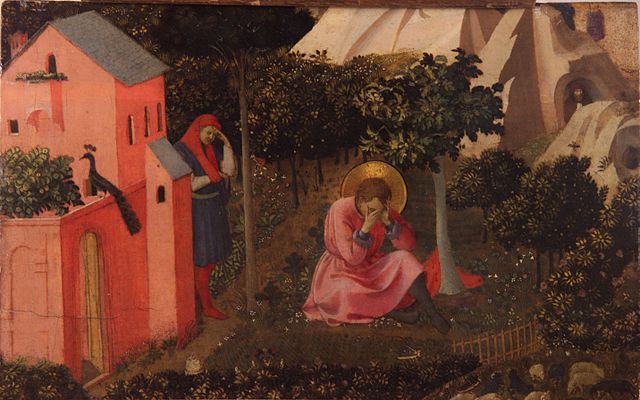
After all, Augustine was most directly converted and taught by Ambrose, not Monica, and certainly not his father.
*
For Roman Catholics, there is a primary and positive role and obligation of the parents (and, by extension, the entire nuclear family), to be sure, but there is also room for the parish and the neighbor and more. Community. Subsidiarity need not be pitted against solidarity in the crude and stupid ways that the Left and Right have become accustomed to undoing.
The questions raised by deschooling, then, cannot be reductionistic, sending everyone home to their often unwitting parents, cloistered and calloused. We need not create a culture of parental distrust, but let’s not romanticize parenting either: most of us are not very good at it.
But here is the beautiful truth. Our dignity and integrity as fathers and mothers is not threatened by admitting what is obvious: our failures and fears and weaknesses, our projections and scars, left behind by our own imperfect parents, and others.
Regardless of the quality of the parent, despite the axiomatic deficiencies of any parent, no matter the moral upstandingness of Mommy or Daddy, the Church teaches us that the parent remains and retains a special place, with a primary role, in the education of their children.
Think about this. Even the orphan and the bastard are educated firstly by their parents — even in absentia.
We are born of a Divine womb, we call out, “Our Father…”
As parents, we share in that Divine role, not because we are good or evil, but because we simply are. Being a parent is, in this educational sense, sufficient.
Freud’s sexualized psychoanalysis was surely wrong about a great many things, but it was right about the fundamentality of the earliest and most primitive familial bond.
An education this foundational and radical, rooted in an ancient rabbinic tradition of teaching and the mystogogy of religious faith, cannot be transplanted willy-nilly into the more recent political paranoias of the modern nation-state.
*
Deschooling religious education cannot be an overreaction. We keep the baby and the bathwater; we only lose the ideological bucket and return to what is. In this sense, deschooling is ontological; it is first about being, not knowing, and certainly not learning.
To deschool religious education, then, is simply to decouple education from the political economy of the compulsory school, and be circumspect about the ways that schooling has seeped into religious education. Reclaim an education that is religious. That is all.
It is not an answer or a solution because that is not the point. Mann and his Whiggish reformers were motivated by fear. Reform is metaphysically corrupt. In this sense I am an unabashed conservative.
We cannot catechize out of fear. The Gospel is not a strategy or a plan. The Church is not a school.
*
Augustine, perhaps the greatest, and certainly the most prolific, catechist of the Early Church, ended his earthly vocation in the twilight of Christendom in North Africa. To this day, that region of Christianity has been lost, in spite of all attempts to recover it.
When Fr. Conrad Harkins, OFM, my sophomore honors professor and a medieval historian, told me that, I was shocked to even consider it.
“The Gospel failed?,” I asked.
“I don’t know, Sam,” he replied, “We do not measure the Good News — it measures us and we live by it, in grace and love.”
This is the final of three posts on the subject of deschooling religious education; read the first two here and here. If you want to read more, you may be interested in my short book, A Primer for Philosophy and Education*.*
Rethinking Religious Education
Previous Post

February 11, 2014
Deschooling Religious Education, in Six Claims
Next Post
February 16, 2014 Reviewing The Faithful Traveler, on EWTN
Browse Our Archives
Select a Category aesthetics audio class notes conversation Education En Español Interviews jazz jazzhop link Liturgy Music Nonsense pastoral philosophy phenomenology Philosophy philosophy of education photo Poetry Political Theology quote Race regular Schooling Uncategorized video Weekly Apocalypse
Select a Month June 2017 May 2017 April 2017 February 2017 January 2017 December 2016 November 2016 October 2016 September 2016 August 2016 July 2016 January 2015 December 2014 November 2014 October 2014 September 2014 August 2014 July 2014 June 2014 May 2014 April 2014 March 2014 February 2014 January 2014 December 2013 November 2013 October 2013 September 2013 August 2013 July 2013 June 2013 May 2013 April 2013 March 2013 February 2013 January 2013 December 2012 November 2012 October 2012 September 2012 August 2012 July 2012 June 2012 May 2012
Follow Us!
TAKE THE
Religious Wisdom Quiz
Who said, "Let us build us a city and a tower, whose top may reach unto heaven"?
Select your answer to see how you score.
Chaldeans Egyptians People of Babel Israelites
Related posts from Sam Rocha

BOOK RELEASE: Tell Them Something Beautiful by Sam...

By Their Fruits: A Reply to Rod Dreher

The Benedict Option: A Critical Review

ON PROTEST (AND THOSE WHO PROTEST AGAINST THEM)
TRENDING AT PATHEOS Catholic

Rejecting Doom: Christian Hope And Human Action
Christianity is a religion of hope. We are to have hope and...

It’s What Comes From Within Which Matters
One of the most difficult things for us to understand is why...

Why I Choose the Eucharist Over the Sermon
Choose the Eucharist, Not the Sermon What are we supposed to get...

5 Design Elements Found in Spiritually Rooted Homes
Putting Spirituality Into Home Decor Our homes are more than our living...

Credo: A Story of God Told with the...
About 10 years ago, I began to imagine a personal "Credo" that...

The Anatomy of Divine Revelation in Catholic Thought
The claim that God has made Himself known to human beings is...
view all Catholic blogs
Ad-Free & Subscriber Log-In Subscription Support
- About Us
- 2026 Calendar
- Videos
- Podcasts
- Library of World Religions
- Faith In Media Tracker
- Advertise With Us
- Write for Us
- Privacy Policy
- Terms of Service
- Do Not Sell My Data
- Contact Us
- Radiant Digital
- Manage Newsletter Subscriptions
- Unsubscribe From Notifications
- Sitemap
Copyright 2008-2026, Patheos. All rights reserved.
Subscription Support Ad-Free & Subscriber Log-In
Follow Patheos