
BuddhistCatholicContemplativeEvangelicalGeneral ChristianHinduJewishLatter-day SaintMuslimNew VisionsProgressive Christian
Beliefs
- Buddhist
- Catholic
- Contemplative
- Evangelical
- General Christian
- Hindu
- Jewish
- Latter-day Saint
- More Voices
- Muslim
- New Visions
- Pagan
- Progressive Christian
Topics
- Religion News
- Food and Religion
- Sports and Religion
- Religious Art
- Religious Music and Entertainment
- Religious Events
- History and Religion
- Style and Religion
- Politics and Religion
- Women in Religion
- Recreation Outdoors and Religion
- Business Finance and Religion
- Careers Workplace and Religion
- Education and Religion
- Family Parenting and Religion
- Health Fitness and Religion
- Home and Religion
- Relationships and Religion
- Technology and Religion
- Travel and Religion
Columnists
- Buddhist Columnists
- Business Finance and Religion Columnists
- Careers Workplace and Religion Columnists
- Catholic Columnists
- Contemplative Columnists
- Education and Religion Columnists
- Evangelists Columnists
- Family Parenting and Religion Columnists
- General Christian Columnists
- Health Fitness and Religion Columnists
- Hindu Columnists
- History and Religion Columnists
- Home and Religion Columnists
- Jewish Columnists
- More Voices Columnists
- Latter Day Columnists
- Muslim Columnists
- New Visions Columnists
- Nonreligious Columnists
- Pagan Columnists
- Politics and Religion Columnists
- Progressive Columnists
- Recreation Outdoors and Religion Columnists
- Relationships and Religion Columnists
- Religion News Columnists
- Religious Art Columnists
- Religious Events Columnists
- Religious Music and Entertainment Columnists
- Sports and Religion Columnists
- Style and Religion Columnists
- Technology and Religion Columnists
- Travel and Religion Columnists
- Women in Religion Columnists
Resource Library
- 2026 Calendar
- Library of World Religions
- The 100 Most Holy Places on Earth
- Patheos Answers
- Podcasts
- Videos
- Faith Leaders Database
- Anglican Episcopalian
- Bahai
- Baptist
- Buddhism
- Christianity
- Confucianism
- Eastern Orthodoxy
- Hinduism
- Holiness and Pentecostal
- ISKCON
- Islam
- Judaism
- Lutheran
- Methodist
- The Church of Jesus Christ of Latter-day Saints
- New Age
- Paganism
- Presbytarian and Reformed
- Protestantism
- Religion Behind the Scenes
- Roman Catholic
- Scientology
- Shia Islam
- Sikhism
- Sufism
- Sunni Islam
- Taoism
- Zen
- See all religions
Research Tools
 Ad-Free & Subscriber Log-In Subscription Support
Follow Patheos 

- Trending:
- Advent
- |
- Forgiveness
- |
- Thanksgiving
- |
- Election
- |
- Seasonal Holidays
- |
- Marriage
 Sam Rocha
- Home
- Catholic
- GUEST POST: How David Bentley Hart Censored My Review of His New Book at First Things
GUEST POST: How David Bentley Hart Censored My Review of His New Book at First Things
Last updated on: February 4, 2015 at 6:16 pm by Sam Rocha
GUEST POST: How David Bentley Hart Censored My Review of His New Book at First Things 2015-02-04T18:16:10-06:00 Sam Rocha
Patheos Explore the world's faith through different perspectives on religion and spirituality! Patheos has the views of the prevalent religions and spiritualities of the world.
NOTE: One thing I’ve always admired about First Things is its longstanding commitment to publishing the give-and-take between its writers and its readership (and many times these categories are mutually inclusive). It was shocking, then, to find out that Stephen Webb’s recent review of David Bentley Hart’s most recent book was edited, post-publication, to satisfy Hart’s sensitive constitution. Factual corrections are one thing, but sentimental corrections are quite different.
This is unfortunate for many reasons, the most serious one being the missed intellectual exchange between two contemporary theologians who stake out such fundamentally different claims and implications. My own, inexpert, stance in this debate tends to find the spiritual vs. material binary to be shortsighted, especially when one considers the recent (and also the much older) work being done to revive materialism without being reductionistic or naive about matter.
Nonetheless, I’ve admired the work of Webb and Hart for some time now. I conversed with Hart at his fascinating talk at Wabash College in 2011, “Don Juan as Moralist;” also at Wabash, I debated Webb on Catholic Social Teaching. On those two exchanges alone, I would seem to side more with Hart than Webb; and my relationship with First Things — including a few pieces I’ve penned for their online “On the Square” column — over the past two years has been salutary on the whole.
Taking sides is not the point of hosting this guest post. This is not intended to be quarrelsome or antagonistic. But I do want to support the healthy agonism once emblematic of First Things and so richly formative in my intellectual development. My view is the following: we need more dialogue right now, not less, and the risk of personal offense in that project need not be an major influencing factor, all things considered.
SR
*
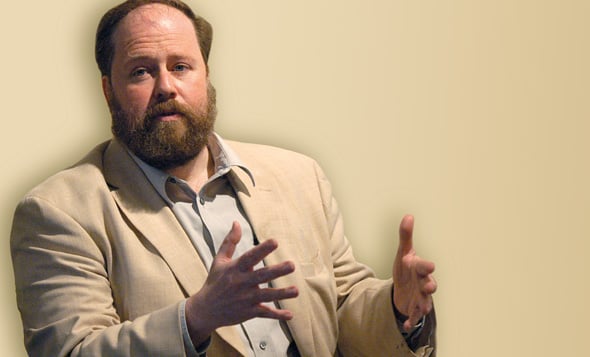
How David Bentley Hart Censored My Review of His New Book at First Things
by Stephen H. Webb
William C. Placher rarely asked me for my editorial advice. He was an impeccable stylist, modest with his use of elegance and elegant in his defense of theological moderation. One day, however, he asked me about David Hart. He was reviewing Hart’s The Beauty of the Infinite and was as impressed with Hart’s erudition as he was depressed by his condescending and brusque manner toward nearly every contemporary author he discussed. Was he like that in person? Bill asked. I explained that he was, but defended him as a wounded soul who had been denied a university professorship and made some vague reference to the burdens of genius. Bill could not get over the incongruity between Hart’s theme of sublime beauty and his frequent descent into rancorous bullying. I pleaded with him not to make too much of it in his review, and he found an elegant, moderate way to make his point: “For someone committed to moving from the rhetoric of violence to the rhetoric of peace, Hart is often oddly nasty in his own rhetoric.” It was typical Placher prose: understated but as clear as cold water on a hot day.
I recently reviewed Hart’s new book, The Experience of God, at First Things. Hart defends three basic points: First, there was a consensus among ancient philosophers and theologians regarding the simplicity of God. Divine simplicity can be stated in many ways, but it basically means that God has no parts. Or you could just say that God is immaterial (since anything material can be divided). Second, this consensus was shared by nearly all the world’s oldest religions. Third, this consensus is crucial for the Christian faith. It is, in fact, the only way to make sense of God, and thus it is fundamental for everything that Christians believe and say about the divine.
Hart explicates those points with exceptional mastery, but he shows no patience for anyone who might disagree with him. While writing my review, I wished I could have gone to Bill for advice (he died in 2008). The more I thought about Hart’s book, the less I could separate his style from his thesis. The problem isn’t just that Hart’s talk of consensus gives the impression that he thinks that every single reasonable prophet, mystic, philosopher or theologian, before the rise of the modern world, agrees with his understanding of how they agree with each other. The problem is that he thinks that without truly understanding God’s simplicity one cannot have any grasp of the beautiful, the good or the true.
So I wrote the following paragraph:
Hart has created one of the most distinctive voices in contemporary theology: a reluctant curmudgeon feigning weariness for being forced by so much foolishness to state the obvious. He is, it seems, our Christian Zarathustra, a bit annoyed for being called down from his mountain top, where he blissfully experiences the peak of divine unknowing, in order to correct “the rather inane anthropomorphisms that proliferate in contemporary debates on the matter, both among atheists and among certain kinds of religious believers.” For our sake, he is willing to “go under” by going over all the arguments of classical metaphysics that every Christian should by now know by heart.
My article passed through the usual and very fine editing process at First Things and was published on Dec. 24. Later that day, after someone had posted a comment suggesting I was being snarky to Hart, I was informed that Hart had demanded that the above paragraph be deleted, and the editors complied without consulting me. Still later, Hart posted a message in reply to my article:
My attention was called to this review a little while ago and, at my request, the ‘snarky’ paragraph has been removed. It struck me as rather childish, to be honest, and a distraction from the argument. Good-humored invective is all right, but not petulant insults.
Stephen Webb has of late developed some bizarre theory of matter that, it seems clear to me, is logically untenable and quite incompatible with the intellectual tradition of Christianity (or any other theistic creed). He also obviously does not understand the implications of the traditional claims made about the nature of divine transcendence and consequently does not grasp the implications of his own speculations (if that is not too nice a word for them). Anyway, his arguments are a mess, and I don’t think they require much refutation.
Later yet, and certainly not at my request, his post was deleted from the comment section.
I will leave it to the reader about whether my calling him a Christian Zarathustra and a reluctant curmudgeon was not good-humored and whether his calling me childish, bizarre, a mess, ignorant, and so on aren’t petulant insults. Perhaps Hart temporarily got our remarks confused with each other.
Maybe he would have found this comment, which the editors asked me to remove from an earlier version of the article, more good humored:
Who would have thought that Hart would end up becoming an Eastern Paul Tillich (or a Karl Rahner attached to Frithjof Schuon rather than Heidegger).
I will also leave it to the reader to wonder at Hart’s esteem in some camps of Easternized Romans, including his deus ex machina ability to alter other peoples’ articles after they have been published. I won’t even comment here on the sad situation that one of Christianity’s finest living theologians is so lacking in charity and so touchy to criticism. His demand for respect is so pathological that I blame his enablers more than him.
What does concern me is that such despotic disdain for all opponents is not, it seems to me, completely unrelated to the philosophical content or the ecclesial provenance of the current revival of classical theism. Eastern Orthodoxy has always had a strain of intolerance for any tampering with the patristics, and I suppose that it is inevitable to find that strain in what is otherwise today a beautiful flowering of that particular branch of Christian theology. Negative theology, which I abhor, has always struck me as an inhuman endeavor to whittle away the body of faith, leaving God in an emaciated state. It is enough to make me rethink the value of the Protestant Reformation or at least be relieved at the decline of Caesaropapism.
Let me take the reader through Hart’s position one more time. For Hart, “the argument for the reality of God from the contingency of all composite and mutable things seems unarguably true, with an almost analytic obviousness” because the religious experience he describes throughout his book is one of stepping back from the “ontological impoverishment” of the physical world. Divine simplicity is the basis for the universal experience of transcendence that functions as the philosophical equivalent of revelation. The only way to escape atheistic materialism, for Hart, is to recognize that “God can be known as God only insofar as the mind rises from beings to being, and withdraws from the objects of consciousness itself, and learns to see nature not as a close system of material forces but in light of those ultimate ends that open the mind and being each to the other.” All other modes of thought are equal parts idolatrous and illogical—indeed, inhuman.
Disagreeing with the principle of divine simplicity, for Hart, is like disagreeing with the doctrine of non-contradiction. Just as a philosopher would rightly refuse to argue with someone who does not play by the rules of non-contradiction, Hart finds it loathsome to discuss theology with someone who does not accept divine simplicity.
I disagree, for a variety of reasons, with the teaching of divine simplicity. I am not regretful that in the past decade or so a growing number of theologians have latched onto classical theism as the only way to stem the tide of philosophical confusion and moral complacency in the modern world. But I am suspicious that the classical consensus was as consensual as Hart says and that classical metaphysics can do justice to the belief that Jesus Christ is divine.
Indeed, while Hart thinks that God is beyond matter, I think that God is also beyond the immaterial. I develop my arguments in several books, including Jesus Christ, Eternal God and Mormon Christianity. But it is always good to try to try to be a simple as you can about what you believe, so here’s what I currently think about these issues.
Whatever God is, I think he is more like us than he is like anything else (because we were created to be like Jesus). I believe that our resurrected and glorified bodies will occupy a real place in the next life, no matter how hard it is for us to imagine what that place will be like. And I believe that Jesus is already there, in a body that is unimaginable greater, wilder, and more spectacular than anything we can imagine—but in a body nonetheless, one that still carries the marks of his crucifixion. I have no idea what the material of that body will be, but I believe that many people saw that body after his resurrection and even while he began his ascension.
And I am quite aware that there have long been theologians, beginning with Origen and Augustine, who are bothered by the literalism of beliefs such as mine, and who find Plato a helpful way for treating all the language I just used as metaphors in need of elaborate and careful negation. I just don’t believe their negations work in the way that they think they do. Where I do agree with Hart is that the mechanistic model of matter is wrong on many levels, but I also think that Christian metaphysics, in a dialogue with the sciences, can help us to think of matter in new ways.
Finally, what I don’t believe is that, as Hart thinks, I am as far outside of theological discussion as the denier of contradiction is outside of philosophical debate. I am not surprised that Hart believes this, though, since it is, I suppose the natural outcome of negative theology—to shame those who cannot play by its lofty rules.
Previous Post

December 24, 2013
Merry Christmas!
Next Post
December 31, 2013 Favorite Things and Not So Much: 2013 in Review
Browse Our Archives
Select a Category aesthetics audio class notes conversation Education En Español Interviews jazz jazzhop link Liturgy Music Nonsense pastoral philosophy phenomenology Philosophy philosophy of education photo Poetry Political Theology quote Race regular Schooling Uncategorized video Weekly Apocalypse
Select a Month June 2017 May 2017 April 2017 February 2017 January 2017 December 2016 November 2016 October 2016 September 2016 August 2016 July 2016 January 2015 December 2014 November 2014 October 2014 September 2014 August 2014 July 2014 June 2014 May 2014 April 2014 March 2014 February 2014 January 2014 December 2013 November 2013 October 2013 September 2013 August 2013 July 2013 June 2013 May 2013 April 2013 March 2013 February 2013 January 2013 December 2012 November 2012 October 2012 September 2012 August 2012 July 2012 June 2012 May 2012
Follow Us!
TAKE THE
Religious Wisdom Quiz
What Christian group is known for avoiding modern technology?
Select your answer to see how you score.
Amish Pentecostals Methodists Baptists
Related posts from Sam Rocha

BOOK RELEASE: Tell Them Something Beautiful by Sam...

By Their Fruits: A Reply to Rod Dreher

The Media Treats Trump Better Than Clinton or...

ON PROTEST (AND THOSE WHO PROTEST AGAINST THEM)
TRENDING AT PATHEOS Catholic

If Baptism Washes Away Sin, Why Do Catholics...
The seven sacraments stand as the foundation of Catholic ecclesial life. The...

Far from promoting indifference, inaction, or quietism, Paul consistently tells us to...

The Power of Setting a Good Example
Remember last August when the Chicago White Sox hosted a "Pope Hat...

Theology As A Way of Life, Not Mere...
I enjoy the study of dogmatic and systematic theology. I like studying...

A Catholic Critique of Biblical Unitarianism
If the statistics are to be believed, Unitarianism is rising worldwide. Although...

How Grandma Tourism Helps Grandparents Live Their Vocation
Grandma, The New Travel Influencer What started as a nostalgia-inspired social media...
view all Catholic blogs
Ad-Free & Subscriber Log-In Subscription Support
- About Us
- 2026 Calendar
- Videos
- Podcasts
- Library of World Religions
- Faith In Media Tracker
- Advertise With Us
- Write for Us
- Privacy Policy
- Terms of Service
- Do Not Sell My Data
- Contact Us
- Radiant Digital
- Manage Newsletter Subscriptions
- Unsubscribe From Notifications
- Sitemap
Copyright 2008-2026, Patheos. All rights reserved.
Subscription Support Ad-Free & Subscriber Log-In
Follow Patheos