
BuddhistCatholicContemplativeEvangelicalGeneral ChristianHinduJewishLatter-day SaintMuslimNew VisionsProgressive Christian
Beliefs
- Buddhist
- Catholic
- Contemplative
- Evangelical
- General Christian
- Hindu
- Jewish
- Latter-day Saint
- More Voices
- Muslim
- New Visions
- Pagan
- Progressive Christian
Topics
- Religion News
- Food and Religion
- Sports and Religion
- Religious Art
- Religious Music and Entertainment
- Religious Events
- History and Religion
- Style and Religion
- Politics and Religion
- Women in Religion
- Recreation Outdoors and Religion
- Business Finance and Religion
- Careers Workplace and Religion
- Education and Religion
- Family Parenting and Religion
- Health Fitness and Religion
- Home and Religion
- Relationships and Religion
- Technology and Religion
- Travel and Religion
Columnists
- Buddhist Columnists
- Business Finance and Religion Columnists
- Careers Workplace and Religion Columnists
- Catholic Columnists
- Contemplative Columnists
- Education and Religion Columnists
- Evangelists Columnists
- Family Parenting and Religion Columnists
- General Christian Columnists
- Health Fitness and Religion Columnists
- Hindu Columnists
- History and Religion Columnists
- Home and Religion Columnists
- Jewish Columnists
- More Voices Columnists
- Latter Day Columnists
- Muslim Columnists
- New Visions Columnists
- Nonreligious Columnists
- Pagan Columnists
- Politics and Religion Columnists
- Progressive Columnists
- Recreation Outdoors and Religion Columnists
- Relationships and Religion Columnists
- Religion News Columnists
- Religious Art Columnists
- Religious Events Columnists
- Religious Music and Entertainment Columnists
- Sports and Religion Columnists
- Style and Religion Columnists
- Technology and Religion Columnists
- Travel and Religion Columnists
- Women in Religion Columnists
Resource Library
- 2026 Calendar
- Library of World Religions
- The 100 Most Holy Places on Earth
- Patheos Answers
- Podcasts
- Videos
- Faith Leaders Database
- Anglican Episcopalian
- Bahai
- Baptist
- Buddhism
- Christianity
- Confucianism
- Eastern Orthodoxy
- Hinduism
- Holiness and Pentecostal
- ISKCON
- Islam
- Judaism
- Lutheran
- Methodist
- The Church of Jesus Christ of Latter-day Saints
- New Age
- Paganism
- Presbytarian and Reformed
- Protestantism
- Religion Behind the Scenes
- Roman Catholic
- Scientology
- Shia Islam
- Sikhism
- Sufism
- Sunni Islam
- Taoism
- Zen
- See all religions
Research Tools
 Ad-Free & Subscriber Log-In Subscription Support
Ad-Free & Subscriber Log-In Subscription Support
Follow Patheos 

- Trending:
- Forgiveness
- |
- Marriage
- |
- Consciousness
- |
- Death Penalty
- |
- Election
- |
- Halloween
 Sam Rocha
- Home
- Catholic
- Art Perfects Nothing: Review of “The Thorny Grace of It”
Art Perfects Nothing: Review of “The Thorny Grace of It”
Last updated on: February 4, 2015 at 6:18 pm by Sam Rocha
Art Perfects Nothing: Review of “The Thorny Grace of It” 2015-02-04T18:18:02-06:00 Sam Rocha
Patheos Explore the world's faith through different perspectives on religion and spirituality! Patheos has the views of the prevalent religions and spiritualities of the world.
Joseph Bottum puts it plainly, here at Patheos: “Forget the culture-wars crap.”
He’s right, and his urgent, huffy tone is appropriate. I wrote something similar, almost a year ago, and since then I’ve had countless conversations with likeminded Catholics who are doing the creative work it takes to move beyond the culture wars.
One such Catholic is Brian Doyle.
His recent book of essays is a pleasure to read most of all because it is refreshing to read the words of someone who clearly cares about the craft of using them. It may seem obvious and dull to praise an author’s book because it has good writing, but anyone who reads widely amongst Catholic literature (blogging included) knows that, sadly, this is noteworthy.
This sure ain’t Matthew Kelly.
No. Doyle isn’t marketing Catholicism 2.0 nor is he posing as an apologist, scrubbing, dusting, sweeping and mopping the Church’s image with cliche assertions and pep talk. Doyle is not a consultant either. He is not a self-help guru or a how-to-get-it-right-most-of-the-time motivator.
Doyle is an essayist. A writer who can stand toe-to-toe with anyone, anywhere, with all the requisite musculature, rigor and verve, who also happens to be Catholic, and is serious and devoted to that, too.
This is Flannery O’Connor kind of stuff.
*
There was a time when a Catholic aesthetic oozed out of the pores of just about everything, even by negation. Even “Shit Christ.”
I don’t think that time has entirely passed.
*
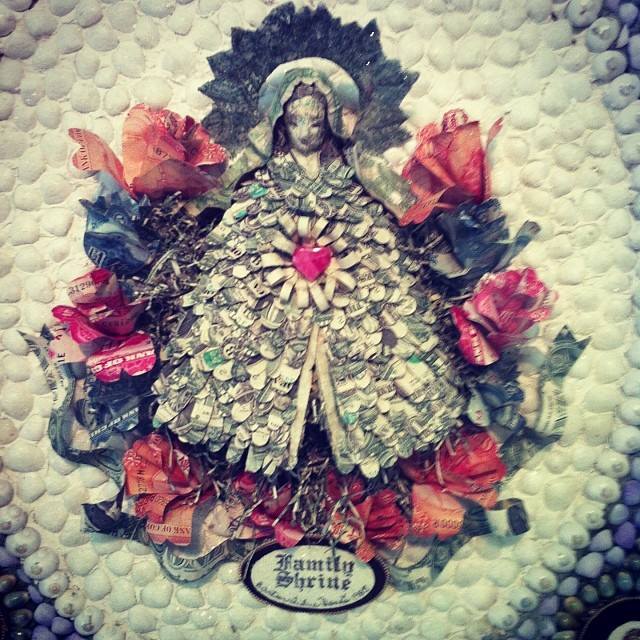
I recently played some lounge music for the opening of a new display at the North Dakota Museum of Art. The main feature is a recreation of the apartment of the late New York artist, Barton Benes. The theme described is cited as predominately African, but I saw something very different. The collection was thick and smoking with Catholicism: morbidity everywhere, relics, Mexican notes of thanksgiving to Our Lady of San Juan, a money-mâché mosaic of Our Lady (pictured above). A monstrance. This heavy sacramental sprinkling of holiness was doused all over the dead hummingbirds, a giraffe bust, voo-doo masks, ruins from disaster sites, nesting in a tiny New York-sized apartment, playing “Law and Order” on repeat.
It was in that flux of art that I understood Doyle’s book in light of Bottum’s lament.
*
The title-track of the book is a litany, a prayer. It reminds me of William James’ essay, “What Makes Life Significant,” where he describes his visit to Chatauqua Lake, a “middle class paradise.” James is initially seduced by this perfectly artificial place, where soda fountains run incessantly, but when he returns to the wild and crazy world he is surprised to find himself relieved to be back in the mess and sin of human existence.
Doyle’s wind-up is playful and light: “The house is mortgaged until the Jesus Blessed Christ returns in His Radiant Glory to resolve all mortgage payments and carry us home to his House.” The middle quickens and gets more personal, recalling lost siblings and unborn children. The ending shows the joy that can dwell in pain, and the glory that still has wounds. He testifies, “I don’t know Who set all this pain and glory in motion, but I bow in thanks for the sweet puzzle of it all.”
There is a confidence in this book that is willing to leave itself alone. Let art be sufficient. The writer’s voice knows it’s range and defects and where the good notes are. The musicality of the long, often bare, sentences, filled with description and comparison, shows an author who knows what (not) to do.
*
The culture wars were fought out of a fear of nihilism, but fighting nothingness head-on is a recipe for metaphysical disaster. It breeds fear of nothing, treating it as if it were something. You make the anti-real more than real. It also presumes to have discovered this condition recently, ignoring its history and anthropology.
Today many of our Catholic brothers and sisters live in fear of the world. Scared of all the bad things that are happening. And the people. Bad intentions, everywhere. Conspiracies. Gripping rosary beads out of fear and clinging to a well placed remote control.They want to know what to fear and how to guard against it and get the word out so share it online and pray for Jesus and the “good guys” to make it right.
We want better arguments and stories — anything and everything — and lots and lots of gotchas and wisecracks.
Reading and television and internet are tools for anxiety, dread, and scams. The art of it all, lost.
In the midst of this grim condition, there are exceptions: periodicals like Doyle’s Portland Magazine, reviews, collections, and other things not quite as paranoid or quick to deliver.
The Thorny Grace of It is one of these exceptions, piercing through the cultural battlefield and bullshit, relishing it even, unafraid, sharing the insight that “Catholicism and golf are ultimately about crazy hope.”
Previous Post

November 21, 2013
Why I'm Not Too Worked Up About Common Core
Next Post
November 26, 2013 Excellent Review of My "Primer" at First Things
Browse Our Archives
Select a Category aesthetics audio class notes conversation Education En Español Interviews jazz jazzhop link Liturgy Music Nonsense pastoral philosophy phenomenology Philosophy philosophy of education photo Poetry Political Theology quote Race regular Schooling Uncategorized video Weekly Apocalypse
Select a Month June 2017 May 2017 April 2017 February 2017 January 2017 December 2016 November 2016 October 2016 September 2016 August 2016 July 2016 January 2015 December 2014 November 2014 October 2014 September 2014 August 2014 July 2014 June 2014 May 2014 April 2014 March 2014 February 2014 January 2014 December 2013 November 2013 October 2013 September 2013 August 2013 July 2013 June 2013 May 2013 April 2013 March 2013 February 2013 January 2013 December 2012 November 2012 October 2012 September 2012 August 2012 July 2012 June 2012 May 2012
Follow Us!
TAKE THE
Religious Wisdom Quiz
Who replaced Haman as the king's chief adviser?
Select your answer to see how you score.
Mordecai Ezra Zerubbabel Sanballat
Related posts from Sam Rocha

"I'd Rather Be Whole," an Essay About Art...
Pre-Order Late to Love! UPDATED

"Musings" on LATE TO LOVE with Iguana

Don't Miss "The Image of God," Tomorrow!
TRENDING AT PATHEOS Catholic

Creation, Preservation, and Teleology in Catholic Theology
As I write this, it is very early Monday morning. Like millions...

The Parable Of The Sower And The Word...
One of Christ’s most famous parables is that of the sower who...

Rejecting Doom: Christian Hope And Human Action
Christianity is a religion of hope. We are to have hope and...

Why I Choose the Eucharist Over the Sermon
Choose the Eucharist, Not the Sermon What are we supposed to get...

5 Design Elements Found in Spiritually Rooted Homes
Putting Spirituality Into Home Decor Our homes are more than our living...

Credo: A Story of God Told with the...
About 10 years ago, I began to imagine a personal "Credo" that...
view all Catholic blogs
Ad-Free & Subscriber Log-In Subscription Support
- About Us
- 2026 Calendar
- Videos
- Podcasts
- Library of World Religions
- Faith In Media Tracker
- Advertise With Us
- Write for Us
- Privacy Policy
- Terms of Service
- Do Not Sell My Data
- Contact Us
- Radiant Digital
- Manage Newsletter Subscriptions
- Unsubscribe From Notifications
- Sitemap
Copyright 2008-2026, Patheos. All rights reserved.
Subscription Support Ad-Free & Subscriber Log-In
Follow Patheos