
BuddhistCatholicContemplativeEvangelicalGeneral ChristianHinduJewishLatter-day SaintMuslimNew VisionsProgressive Christian
Beliefs
- Buddhist
- Catholic
- Contemplative
- Evangelical
- General Christian
- Hindu
- Jewish
- Latter-day Saint
- More Voices
- Muslim
- New Visions
- Pagan
- Progressive Christian
Topics
- Religion News
- Food and Religion
- Sports and Religion
- Religious Art
- Religious Music and Entertainment
- Religious Events
- History and Religion
- Style and Religion
- Politics and Religion
- Women in Religion
- Recreation Outdoors and Religion
- Business Finance and Religion
- Careers Workplace and Religion
- Education and Religion
- Family Parenting and Religion
- Health Fitness and Religion
- Home and Religion
- Relationships and Religion
- Technology and Religion
- Travel and Religion
Columnists
- Buddhist Columnists
- Business Finance and Religion Columnists
- Careers Workplace and Religion Columnists
- Catholic Columnists
- Contemplative Columnists
- Education and Religion Columnists
- Evangelists Columnists
- Family Parenting and Religion Columnists
- General Christian Columnists
- Health Fitness and Religion Columnists
- Hindu Columnists
- History and Religion Columnists
- Home and Religion Columnists
- Jewish Columnists
- More Voices Columnists
- Latter Day Columnists
- Muslim Columnists
- New Visions Columnists
- Nonreligious Columnists
- Pagan Columnists
- Politics and Religion Columnists
- Progressive Columnists
- Recreation Outdoors and Religion Columnists
- Relationships and Religion Columnists
- Religion News Columnists
- Religious Art Columnists
- Religious Events Columnists
- Religious Music and Entertainment Columnists
- Sports and Religion Columnists
- Style and Religion Columnists
- Technology and Religion Columnists
- Travel and Religion Columnists
- Women in Religion Columnists
Resource Library
- 2026 Calendar
- Library of World Religions
- The 100 Most Holy Places on Earth
- Patheos Answers
- Podcasts
- Videos
- Faith Leaders Database
- Anglican Episcopalian
- Bahai
- Baptist
- Buddhism
- Christianity
- Confucianism
- Eastern Orthodoxy
- Hinduism
- Holiness and Pentecostal
- ISKCON
- Islam
- Judaism
- Lutheran
- Methodist
- The Church of Jesus Christ of Latter-day Saints
- New Age
- Paganism
- Presbytarian and Reformed
- Protestantism
- Religion Behind the Scenes
- Roman Catholic
- Scientology
- Shia Islam
- Sikhism
- Sufism
- Sunni Islam
- Taoism
- Zen
- See all religions
Research Tools
 Ad-Free & Subscriber Log-In Subscription Support
Ad-Free & Subscriber Log-In Subscription Support
Follow Patheos 

- Trending:
- Forgiveness
- |
- Marriage
- |
- Consciousness
- |
- Death Penalty
- |
- Election
- |
- Halloween

- Home
- Catholic
- History and Religion
- Did Jesus Have Biological Brothers And Sisters?
Did Jesus Have Biological Brothers And Sisters?
Last updated on: June 3, 2025 at 11:11 pm by Mauricio Pérez
Did Jesus Have Biological Brothers And Sisters? 2025-06-03T23:11:26-07:00 Mauricio Pérez
Patheos Explore the world's faith through different perspectives on religion and spirituality! Patheos has the views of the prevalent religions and spiritualities of the world.
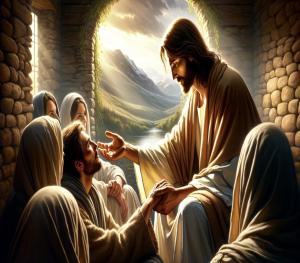
Jesus and his community of believers | IA image by Kar3nt, Pixabay
After having listened on recent Sundays to different accounts of portentous deeds by Jesus, culminating on the most-impressive revival of Jairus’ daughter, in the Gospel reading on the 14th Sunday in Ordinary Time we find Jesus back in Nazareth, unable to perform a single miracle due to the lack of faith of those of his own home [Mk 6:1-6].
As a rabbi, he preaches in the synagogue on sabbath. The crowd who listens to his words, is astonished, even offended. They simply refuse to accept that such a wisdom can come from the mouth of the “carpenter” they know, who is the son of Mary.
It is noteworthy that Joseph is not mentioned. It could be that the upset crowd didn’t mention his name because he was already dead by then. Or it could be that the Evangelist omits Joseph’s name to make the point that Jesus is the Son of God, and not of his putative father. This is an important Christological idea for Mark. We must not forget how he begins his book:
Beginning of the gospel of Jesus Christ, Son of God [1:1].
Was Jesus a carpenter?
The translation of the gospel refers of Jesus as a carpenter. We have to bear in mind that the readings in the Lectionary and the Book of Gospels have to be translated, as a liturgical norm, from the Latin text of the Neo Vulgata. If we dig deeper into the text, we have to get to the original in Greek.
οὐχ οὗτός ἐστιν ὁ τέκτων,
isn’t he the artisan?
τέκτων (tekton) means artisan, mason and builder, while carpenter corresponds to ξυλουργός or to its synonym, μαραγκός. If Jesus was a τέκτων, an office he learned from Joseph, then he did a lot more than only working with wood.
Did the Virgin Mary have other children?
But there is something even more important to understand in this pericope. The crowd is unwilling to accept the words of Jesus, who is —according to the common English translation of this pericope—, “the brother of James and Joses and Judas and Simon” [v. 3b] and “his sisters” were there with them [v. 3c].
Because of this translation of this verse, Protestant churches affirm that Mary had more children than Jesus. Yet, it is a dogma of faith in the Catholic Church that Mary is always a virgin: before, during and after the birth of Jesus.
From the earliest faith formulations the Church has confessed that Jesus was conceived solely by the power of the Holy Spirit in the womb of the Virgin Mary, without human seed. The deepening of faith in the virginal motherhood led the Church to confess Mary’s real and perpetual virginity even in the act of giving birth to the Son of God made man [Cf. DS 291; 294; 427; 442; 503; 571; 1880]. The liturgy of the Church celebrates Mary as Aειπαρθενος (Aeiparthenos), the “Ever-virgin.” [CCC 499; Cf. LG 52].
Looking at the Greek text of verse 3b-c in Mk 6, we read:
…καὶ ἀδελφὸς Ἰακώβου καὶ Ἰωσῆτος καὶ Ἰούδα καὶ Σίμωνος;
καὶ οὐκ εἰσὶν αἱ ἀδελφαὶ αὐτοῦ ὧδε πρὸς ἡμᾶς;
…and the relative of James and Joses and Judas and Simon?
And are not his female relatives here with us?”
The key word here is ἀδελφὸς (adelphos) — ἀδελφαὶ (adelphe) is the feminine in plural. This noun means “relative”, which includes brothers, sisters, cousins, aunts, nephews, grandchildren and grandparents. There is a word derived from ἀδελφὸς, αδελφοτης (adelphotees) which refers to a religious fraternity.
Therefore, the reference to these relatives does not necessarily make them Jesus’ biological brothers or sisters
In the fifth century, St. Augustine explained,
With the term “brothers” Jews usually designate their relatives, which can be verified not only among relatives with the same degree of affinity, such as the children of brothers and sisters —whom we also very often call “brothers”— but even the uncle and son of their sister, as Jacob and Laban were among themselves. All of these used to be called “brothers”. Let us not be surprised, then, that they called “brothers” to everyone related to his (Jesus’) mother’s lineage [17 Questions About the Gospel According to Matthew, n. 16].
Matthew, in his Gospel, specifies who these “brothers”, or relatives, rather, of Jesus, are sons of. In his account of the crucifixion, he mentions:
“Among them were Mary Magdalene, Mary the mother of James and Joses, and the mother of the sons of Zebedee” [Mt 27:56].
As we see, James and Joses were actually sons of a different Mary. We know from John’s account of the crucifixion that this other Mary was the wife of Clopas [Jn 19:25].
Jesus’ reaction to the unbelief of his people
Back to the episode in Galilee, we see Jesus is unable to perform any mighty deed in there, due to the lack of faith of all these people. He resolves,
“A prophet is not without honor except in his native place and among his own kin and in his own house” [Mk 6:4].
We cannot disregard the conclusion of this episode. Marveled because of their unbelief, he leaves them and goes to teach at other villages [v. 6].
Their lack of faith is not going to stop his mission. Jesus will propose his message of salvation, but will not try to convince anyone about it. He will not negotiate with the truth, and he will never impose it either.
Being himself the Truth, the Logos of the Father, Jesus will never impose his message to anyone. It is up to those who listen to him, and that includes us as well, to accept his message or to distrust him and refuse to embrace his message. But if we chose to distrust him, Jesus will just move on and go to talk to the ones who are willing to listen.
Let us ask in prayer that Jesus grants us the grace to never become ourselves an obstacle to his plan, but rather, collaborators of his salvific mission.
________________
Abbreviations
CCC – Catechism of the Catholic Church
DS – Enchiridion Symbolorum, Definitionum et Declarationum de Rebus Fidei et Morum
LG – Dogmatic Constitution Lumen Gentium
Jn – Gospel According to John
Mk – Gospel According to Mark
Mt – Gospel According to Matthew
History and Religion

About Mauricio I. Pérez
Mauricio I. Pérez is a Catholic writer, journalist and YouTuber. He has received five national journalism awards by the Catholic Media Association. Mauricio has authored 18 books on Biblical commentary, spirituality and Catholic fiction, six of them bestsellers in Amazon. He has earned a diploma in Sacred Liturgy by the Universidad Pontificia de México and has graduated from several Liturgy programs at the Pontificio Istituto Liturgico in Rome. You can read more about the author here.
Previous Post
June 30, 2024
Astonishment In The Gospel According To Mark
Next Post

July 17, 2024 The 10th National Eucharistic Congress In The United States
Browse Our Archives
Select a Category Catholic Church News Christology Easter Eucharist Exegesis Holy Week Holy Week Illness Jubilee 2025 Jubilee of Hope Lent Letters Liturgy National Eucharistic Congress National Eucharistic Revival New Testament New Testament Ordinary Jubilee 2025 Ordinary Time Pope Francis Pope Francis Pope Leo XIV Pope Leo XIV Prayer Readings Scripture Spirituality Spirituality Theology Uncategorized Vatican Year of Prayer 2024
Select a Month September 2026 November 2025 June 2025 May 2025 April 2025 March 2025 February 2025 July 2024 June 2024 May 2024 April 2024 March 2024
Follow Us!
TAKE THE
Religious Wisdom Quiz
At a well in Samaria, I asked a woman for a drink and told her about living water. How many husbands had she had?
Select your answer to see how you score.
Five Three Two Seven
Books by This Author Books by Sacred Threads
Related posts from Sacred Threads
Forgive "77" Times? The Correct Math Behind The...
The Gospel That Demands You Speak Up
The Prodigal Son: Perdition, Conversion, Forgiveness
Jubilee Of Hope: Finding Hope In The Miraculous...
TRENDING AT PATHEOS Catholic

Rejecting Doom: Christian Hope And Human Action
Christianity is a religion of hope. We are to have hope and...

It’s What Comes From Within Which Matters
One of the most difficult things for us to understand is why...

Why I Choose the Eucharist Over the Sermon
Choose the Eucharist, Not the Sermon What are we supposed to get...

5 Design Elements Found in Spiritually Rooted Homes
Putting Spirituality Into Home Decor Our homes are more than our living...

Credo: A Story of God Told with the...
About 10 years ago, I began to imagine a personal "Credo" that...

The Anatomy of Divine Revelation in Catholic Thought
The claim that God has made Himself known to human beings is...
view all Catholic blogs
Ad-Free & Subscriber Log-In Subscription Support
- About Us
- 2026 Calendar
- Videos
- Podcasts
- Library of World Religions
- Faith In Media Tracker
- Advertise With Us
- Write for Us
- Privacy Policy
- Terms of Service
- Do Not Sell My Data
- Contact Us
- Radiant Digital
- Manage Newsletter Subscriptions
- Unsubscribe From Notifications
- Sitemap
Copyright 2008-2026, Patheos. All rights reserved.
Subscription Support Ad-Free & Subscriber Log-In
Follow Patheos