
BuddhistCatholicContemplativeEvangelicalGeneral ChristianHinduJewishLatter-day SaintMuslimNew VisionsProgressive Christian
Beliefs
- Buddhist
- Catholic
- Contemplative
- Evangelical
- General Christian
- Hindu
- Jewish
- Latter-day Saint
- More Voices
- Muslim
- New Visions
- Pagan
- Progressive Christian
Topics
- Religion News
- Food and Religion
- Sports and Religion
- Religious Art
- Religious Music and Entertainment
- Religious Events
- History and Religion
- Style and Religion
- Politics and Religion
- Women in Religion
- Recreation Outdoors and Religion
- Business Finance and Religion
- Careers Workplace and Religion
- Education and Religion
- Family Parenting and Religion
- Health Fitness and Religion
- Home and Religion
- Relationships and Religion
- Technology and Religion
- Travel and Religion
Columnists
- Buddhist Columnists
- Business Finance and Religion Columnists
- Careers Workplace and Religion Columnists
- Catholic Columnists
- Contemplative Columnists
- Education and Religion Columnists
- Evangelists Columnists
- Family Parenting and Religion Columnists
- General Christian Columnists
- Health Fitness and Religion Columnists
- Hindu Columnists
- History and Religion Columnists
- Home and Religion Columnists
- Jewish Columnists
- More Voices Columnists
- Latter Day Columnists
- Muslim Columnists
- New Visions Columnists
- Nonreligious Columnists
- Pagan Columnists
- Politics and Religion Columnists
- Progressive Columnists
- Recreation Outdoors and Religion Columnists
- Relationships and Religion Columnists
- Religion News Columnists
- Religious Art Columnists
- Religious Events Columnists
- Religious Music and Entertainment Columnists
- Sports and Religion Columnists
- Style and Religion Columnists
- Technology and Religion Columnists
- Travel and Religion Columnists
- Women in Religion Columnists
Resource Library
- 2026 Calendar
- Library of World Religions
- The 100 Most Holy Places on Earth
- Patheos Answers
- Podcasts
- Videos
- Faith Leaders Database
- Anglican Episcopalian
- Bahai
- Baptist
- Buddhism
- Christianity
- Confucianism
- Eastern Orthodoxy
- Hinduism
- Holiness and Pentecostal
- ISKCON
- Islam
- Judaism
- Lutheran
- Methodist
- The Church of Jesus Christ of Latter-day Saints
- New Age
- Paganism
- Presbytarian and Reformed
- Protestantism
- Religion Behind the Scenes
- Roman Catholic
- Scientology
- Shia Islam
- Sikhism
- Sufism
- Sunni Islam
- Taoism
- Zen
- See all religions
Research Tools
 Ad-Free & Subscriber Log-In Subscription Support
Ad-Free & Subscriber Log-In Subscription Support
Follow Patheos 

- Trending:
- Forgiveness
- |
- Marriage
- |
- Consciousness
- |
- Death Penalty
- |
- Election
- |
- Halloween

- Home
- Catholic
- History and Religion
- How Did Judas Truly Die?
How Did Judas Truly Die?
Last updated on: April 21, 2024 at 12:00 am by Mauricio Pérez
How Did Judas Truly Die? 2024-04-21T00:00:17-07:00 Mauricio Pérez
Patheos Explore the world's faith through different perspectives on religion and spirituality! Patheos has the views of the prevalent religions and spiritualities of the world.

Did Judas hang himself from a tree?
The death of Judas the Iscariot, as Peter recalls it, does not coincide, from a forensic point of view, with the way the traitor ended his life according to Matthew. We tend to assume the infamous apostle took his life by hanging himself from a tree. But, is this truly how he died?
In the Acts of the Apostles, before choosing a new apostle to fill in the empty spot left by the Iscariot in the Apostolic College, Peter recounts the following:
During those days Peter stood up in the midst of the brothers (there was a group of about one hundred and twenty persons in the one place). He said, “My brothers, the scripture had to be fulfilled which the holy Spirit spoke beforehand through the mouth of David, concerning Judas, who was the guide for those who arrested Jesus. He was numbered among us and was allotted a share in this ministry. He bought a parcel of land with the wages of his iniquity, and falling headlong, he burst open in the middle, and all his insides spilled out. This became known to everyone who lived in Jerusalem, so that the parcel of land was called in their language ‘Akeldama,’ that is, Field of Blood (Acts 1:15-23).
This differs from what Matthew writes in his gospel:
Then Judas, his betrayer, seeing that Jesus had been condemned, deeply regretted what he had done. He returned the thirty pieces of silver to the chief priests and elders, saying, “I have sinned in betraying innocent blood.” They said, “What is that to us? Look to it yourself.” Flinging the money into the temple, he departed and went off and hanged himself. The chief priests gathered up the money, but said, “It is not lawful to deposit this in the temple treasury, for it is the price of blood.” After consultation, they used it to buy the potter’s field as a burial place for foreigners. That is why that field even today is called the Field of Blood (Mt 27:1-9).
Two versions that don’t match
Matthew tells us that the Iscariot hanged himself. Peter, in the Acts of the Apostles, explains that he fell upside down, burst open in the middle and his insides spilled.
If Judas hanged himself, as Matthew says, how could he have fallen upside down? Unless he had hung himself from his feet and the ropes accidentally slid, plummeting toward the ground below. But that doesn’t make sense. No one hangs himself from his feet to take his own life.
Falling upside down and the tremendous impact on the ground ending up with the insides spilled, suggests rather that Judas jumped off a cliff. According to what Peter says then, this is how the Iscariot took his life.
There are those who intend to reconcile the two stories by making Judas hang himself from a tree branch above a precipice and then a lightning bolt breaking the branch, making him fall and gutting out when hitting the ground. But hanging himself by tying the rope to a branch over a precipice would require such an acrobatic effort — it doesn’t make sense when a man is in such tremendous despair. This elaborate and very macabre ending can rather be understood as the fruit of the great common contempt that people feel for Judas, wishing that lightning bolt stroke him! When I grew up in Mexico, for instance, there was an old Holy Week popular tradition consisting on making papier-mâché dolls with the faces of famous people — preferably politicians — filled with firecrackers to make them explode on Holy Saturday. These dolls were known as “Judas”.
Why did Judas take his life?
It is clear that the versions of Matthew in his gospel and Peter in the Acts of the Apostles do not match. According to Matthew, Judas hanged himself. According to what Peter describes, he should rather have thrown himself down to the precipice.
In any case, a tragic fate as a result of his great remorse. Unlike repentance, which moves us to the will to repair the damage caused to those affected and towards the path to reconciliation, remorse remains inside the aggressor. Remorse leads to despair and this, to hopelessness. Hopelessness consists of losing hope in salvation, losing confidence in God’s merciful forgiveness — this is the sin against the Holy Spirit that Jesus warned his apostles it would be the only one they could not forgive (Mt 12:31).
Remorse, despair and hopelessness ended up leading Judas to take his own life. But did he do it by hanging himself or throwing himself off a cliff?
Is Matthew’s version connected to the Old Testament?
The Second Book of Samuel tells us the story of Ahitophel, a close friend of King David. He was one of his closest collaborators and the monarch entrusted him with all the secrets of his kingdom. But one day, Absalom and David’s enemies conspired to kill the king and Ahitophel betrayed his friend by taking sides with his adversary. He planned to launch himself in pursuit of David accompanied by a large army. He did it during the night, in order to find his friend fatigued and without strength. But Ahitophel didn’t succeed. When he saw his plans frustrated, he went home riding on his donkey and hanged himself.
As we may see, there is a very interesting connection between Judas and Ahitophel, the close friend and traitor of King David. Ahitophel was also a close collaborator of King David; Ahitophel also entrusted David with all the secrets of his kingdom; Ahitophel also betrayed his close friend; and Ahitophel hanged himself.
Matthew composes his gospel in order to evangelize and catechize the Christian converts of Judaism. It is important for him to show them that Jesus was truly the Messiah expected by the people of Israel and announced by the prophets.
One of the resources used by this evangelist is to show Jesus as the ultimate heir of King David. Matthew even begins his gospel with the words, “The book of the genealogy of Jesus Christ, the son of David, the son of Abraham” (Mt 1:1). And from there the genealogy of Jesus is listed out, with the purpose of revealing his royal lineage.
Behind Matthew’s intention to represent Jesus as the new David, it is plausible to think that the outcome he describes of Judas is one more literary resource to emphasize the resemblance between the two kings. Thus, Matthew recounted the death of Judas based on the story of Ahitophel. By reconstructing the suicide of the treacherous apostle in this way, the evangelist intends to emphasize that Jesus lived the same as David, because he himself was the Messiah and consequently: the one in whom all must believe.
Conclusion
Based on this analysis, Judas had to take his own life rather, as Peter describes, jumping off a cliff, falling upside down and with his insides coming out of his abdomen.
The fact that Peter emphasizes that all Jerusalem knew about this, reaffirms the credibility of his testimony. The suicide described by Matthew in his gospel is a literary resource to aid him in his purpose to connect Jesus, to King David, his royal ancestor, as one more proof that Jesus is indeed the Messiah the Jews were expecting for ages.
As you may see, there are things we may take for granted concerning Judas the Iscariot that, in reality, might be different. Judas can be puzzling, for sure. Why did Jesus choose him to be one of his twelve apostles? What moved him to betray his Master? Why was he paid exactly thirty pieces of silver? And more importantly, was Judas a traitor on his own accord or was he predestined by God so that his betrayal could trigger the arrest, Passion and death of Jesus on a cross, so that He could be our Savior? Only a thorough biblical analysis of this sinister apostle can lead us to the answers.
It is this analysis what I develop in my book Judas: Traitor or instrument of God? Available in paperback, Kindle and audiobook.
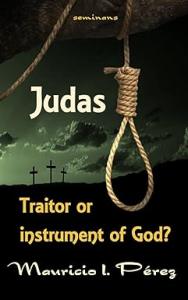
Judas: Traitor or Instrument of God?
History and Religion
Religious Events

About Mauricio I. Pérez
Mauricio I. Pérez is a Catholic writer, journalist and YouTuber. He has received five national journalism awards by the Catholic Media Association. Mauricio has authored 18 books on Biblical commentary, spirituality and Catholic fiction, six of them bestsellers in Amazon. He has earned a diploma in Sacred Liturgy by the Universidad Pontificia de México and has participated in several Liturgy programs at the Pontificio Istituto Liturgico in Rome. You can read more about the author here.
Previous Post
March 26, 2024
The Origins Of The Holy Week Liturgies
Next Post
April 7, 2024 Understanding Easter Time Through Its Liturgy
Browse Our Archives
Select a Category Catholic Church News Christology Easter Eucharist Exegesis Holy Week Holy Week Illness Jubilee 2025 Jubilee of Hope Lent Letters Liturgy National Eucharistic Congress National Eucharistic Revival New Testament New Testament Ordinary Jubilee 2025 Ordinary Time Pope Francis Pope Francis Pope Leo XIV Pope Leo XIV Prayer Readings Scripture Spirituality Spirituality Theology Uncategorized Vatican Year of Prayer 2024
Select a Month September 2026 November 2025 June 2025 May 2025 April 2025 March 2025 February 2025 July 2024 June 2024 May 2024 April 2024 March 2024
Follow Us!
TAKE THE
Religious Wisdom Quiz
True or False: Peter raised Tabitha (Dorcas) from the dead in Lydda.
Select your answer to see how you score.
TRUE FALSE
Books by This Author Books by Sacred Threads
Related posts from Sacred Threads
Forgive "77" Times? The Correct Math Behind The...
The Gospel That Demands You Speak Up

The Prodigal Son: Perdition, Conversion, Forgiveness

Paquita la del Barrio: A Voice of Heartbreak...
TRENDING AT PATHEOS Catholic

Rejecting Doom: Christian Hope And Human Action
Christianity is a religion of hope. We are to have hope and...

It’s What Comes From Within Which Matters
One of the most difficult things for us to understand is why...

Why I Choose the Eucharist Over the Sermon
Choose the Eucharist, Not the Sermon What are we supposed to get...

5 Design Elements Found in Spiritually Rooted Homes
Putting Spirituality Into Home Decor Our homes are more than our living...

Credo: A Story of God Told with the...
About 10 years ago, I began to imagine a personal "Credo" that...

The Anatomy of Divine Revelation in Catholic Thought
The claim that God has made Himself known to human beings is...
view all Catholic blogs
Ad-Free & Subscriber Log-In Subscription Support
- About Us
- 2026 Calendar
- Videos
- Podcasts
- Library of World Religions
- Faith In Media Tracker
- Advertise With Us
- Write for Us
- Privacy Policy
- Terms of Service
- Do Not Sell My Data
- Contact Us
- Radiant Digital
- Manage Newsletter Subscriptions
- Unsubscribe From Notifications
- Sitemap
Copyright 2008-2026, Patheos. All rights reserved.
Subscription Support Ad-Free & Subscriber Log-In
Follow Patheos