
BuddhistCatholicContemplativeEvangelicalGeneral ChristianHinduJewishLatter-day SaintMuslimNew VisionsProgressive Christian
Beliefs
- Buddhist
- Catholic
- Contemplative
- Evangelical
- General Christian
- Hindu
- Jewish
- Latter-day Saint
- More Voices
- Muslim
- New Visions
- Pagan
- Progressive Christian
Topics
- Religion News
- Food and Religion
- Sports and Religion
- Religious Art
- Religious Music and Entertainment
- Religious Events
- History and Religion
- Style and Religion
- Politics and Religion
- Women in Religion
- Recreation Outdoors and Religion
- Business Finance and Religion
- Careers Workplace and Religion
- Education and Religion
- Family Parenting and Religion
- Health Fitness and Religion
- Home and Religion
- Relationships and Religion
- Technology and Religion
- Travel and Religion
Columnists
- Buddhist Columnists
- Business Finance and Religion Columnists
- Careers Workplace and Religion Columnists
- Catholic Columnists
- Contemplative Columnists
- Education and Religion Columnists
- Evangelists Columnists
- Family Parenting and Religion Columnists
- General Christian Columnists
- Health Fitness and Religion Columnists
- Hindu Columnists
- History and Religion Columnists
- Home and Religion Columnists
- Jewish Columnists
- More Voices Columnists
- Latter Day Columnists
- Muslim Columnists
- New Visions Columnists
- Nonreligious Columnists
- Pagan Columnists
- Politics and Religion Columnists
- Progressive Columnists
- Recreation Outdoors and Religion Columnists
- Relationships and Religion Columnists
- Religion News Columnists
- Religious Art Columnists
- Religious Events Columnists
- Religious Music and Entertainment Columnists
- Sports and Religion Columnists
- Style and Religion Columnists
- Technology and Religion Columnists
- Travel and Religion Columnists
- Women in Religion Columnists
Resource Library
- 2026 Calendar
- Library of World Religions
- The 100 Most Holy Places on Earth
- Patheos Answers
- Podcasts
- Videos
- Faith Leaders Database
- Anglican Episcopalian
- Bahai
- Baptist
- Buddhism
- Christianity
- Confucianism
- Eastern Orthodoxy
- Hinduism
- Holiness and Pentecostal
- ISKCON
- Islam
- Judaism
- Lutheran
- Methodist
- The Church of Jesus Christ of Latter-day Saints
- New Age
- Paganism
- Presbytarian and Reformed
- Protestantism
- Religion Behind the Scenes
- Roman Catholic
- Scientology
- Shia Islam
- Sikhism
- Sufism
- Sunni Islam
- Taoism
- Zen
- See all religions
Research Tools
 Ad-Free & Subscriber Log-In Subscription Support
Ad-Free & Subscriber Log-In Subscription Support
Follow Patheos 

- Trending:
- Forgiveness
- |
- Marriage
- |
- Consciousness
- |
- Death Penalty
- |
- Election
- |
- Halloween

- Home
- Catholic
- Religious Events
- Following Jesus from Joy To Drama In The Palm Sunday Liturgy
Following Jesus from Joy To Drama In The Palm Sunday Liturgy
Last updated on: April 21, 2024 at 12:01 am by Mauricio Pérez
Following Jesus from Joy To Drama In The Palm Sunday Liturgy 2024-04-21T00:01:12-07:00 Mauricio Pérez
Patheos Explore the world's faith through different perspectives on religion and spirituality! Patheos has the views of the prevalent religions and spiritualities of the world.
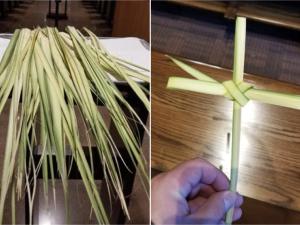
Palm leaves on Palm Sunday
Palm Sunday Mass is one of the most intense liturgies the Catholic Church celebrates every year. It makes us relive with Jesus his joy and drama from his glorious entrance to Jerusalem to his death on a cross in Calvary.
After having prepared our hearts from the beginning of Lent on Ash Wednesday and for five weeks with our penance and our works of charity, on Palm Sunday we gather to begin, united with the whole Catholic Church, the annual celebration of the Easter Mystery, that is, the passion and resurrection of our Lord Jesus Christ, mysteries that begin with his entry into Jerusalem, the holy city.
The liturgical name of this day is Palm Sunday of the Passion of the Lord. Through the anamnesis and mimesis of the sacred Liturgy, we remember and relive the entry of Christ, the Lord, into Jerusalem to consummate his Easter Mystery. The anamnesis consists of remembering an event that occurred in the past with the purpose of bringing it to the present. Mimesis consists of mimicking the gestures of a past event to relive them here and now. In this way, this liturgical memorial puts us fully in the joy of the triumphal entry of Jesus into the Holy City, especially when the liturgical celebration begins with a procession (the Missal allows two additional forms of entry: the solemn entry, without procession, inside the church; and the simple entrance in which the Mass begins, practically, as usual).
The entrance to Jerusalem
The anamnesis of the Entrance to Jerusalem is carried out by listening to the reading of the Gospel, which tells us this epic episode of the life of Jesus. In Year A, we hear the story written by Matthew (21:1-11). Jesus tells two of his disciples to go to the town in front of Bethphage and borrow an ass and a colt.
In Year B, we may listen to the account of Mark (11:1-10). He speaks only of a colt and adds that some in that town questioned the two apostles for taking it. We may also hear what John says (12:12-16). In his version, Jesus finds himself an ass and without further ado, he rides it to fulfill the Scriptures. Unlike the other evangelists, John does not detail the fact that the ass was covered with cloaks, which is a gesture reserved for a royal mount.
In Year C, we hear Luke (19:28-40) telling a version very similar to Matthew and Mark, specifying that it was the owners of the colt who questioned the two apostles who borrowed it.
The four evangelists consistently point out that Jesus was acclaimed when He entered Jerusalem, with hosannas and blessings to the King of Israel. Luke adds at the end that the Pharisees reproach Jesus by ordering Him to rebuke his disciples, to which Jesus replies by assuring them that “if they are silent, the stones will speak.”
The mimesis is carried out with the procession of the assembly into the church, each carrying olive branches or palm leaves, which are sprinkled with holy water at the beginning, and chanting songs of acclamation to Christ the King. Just as it happened in Jerusalem that glorious day, each of us feels the branches and palms in our hands, advances among the people and sings acclaiming the Lord, reliving and making present that glorious moment.
The drama of the Passion
A moment of great joy for Christ, his apostles, his disciples and for us, his Church. A joy that will soon be transformed into drama in the same liturgical celebration when the Gospel is proclaimed, which is distinguished from the gospels of the rest of the masses of the liturgical year in special ways:
- No candles or incense are used at the ambo.
- The usual greeting “The Lord be with you… ” is omitted.
- It can be read by three readers, always leaving the priest the words of Christ, or by three deacons.
- Taken from Mt, Mk or Lk depending on the corresponding year, it is the longest Gospel of all the masses of the year. It competes in extension with the Passion according to St. John, but this is proclaimed in the Liturgy of the Passion of the Lord on Good Friday which is not a Mass.
- When we hear that Jesus dies on the cross, we all kneel in silence for a moment.
A dramatic Gospel that confronts us year after year with the injustice of the trials against Jesus, the torture of his flagellation, the torment of his way to Calvary and the martyrdom of his death on the cross. A Gospel that moves even the most insensitive listener and that leaves many with a lump in the throat. The drama of the Passion unfolds, step by step, before us. Our imagination puts us right in front of the Sanhedrin, in the palace of Herod and the praetorium of Pilate, on the side of the road to Calvary and at the foot of the Cross. A Gospel that leaves us speechless and that for that reason, for the only time in the year, the Missal allows instead of a homily to remain silent if the celebrant prefers so.
But what causes that lump in our throat? What is it that leaves us speechless every year? The horror of the passion of Christ or the shame of knowing that although He has died for us, we have not been able to respond faithfully to Him? The pain of seeing Him suffer for us or recognizing that we are not worthy of such suffering?
The beginning of Holy Week
Lent is not over yet. Palm Sunday of the Passion of the Lord is, in fact, the sixth Sunday of Lent and with this celebration our Holy Week begins. It is for this moment we have prepared ourselves throughout Lent by praying more intensely, cultivating our generosity increasing our almsgiving and striving to keep the fast we traditionally observe. This week, Christ will institute the Eucharist and the priesthood on Holy Thursday, He will die for our salvation on Good Friday, from his grave He will descend to hell on Holy Saturday and will rise with all his glory on Easter Sunday. The mystery of redemption is about to be consummated and Christ invites us to witness his infinite love, living these sacred mysteries by his side.
This is my first column writing for Patheos. I appreciate the opportunity to join its team of contributors and thank the readers who have given me their confidence by reading these first lines.
Religious Events

About Mauricio I. Pérez
Mauricio I. Pérez is a Catholic writer, journalist and YouTuber. He has received five national journalism awards by the Catholic Media Association. Mauricio has authored 18 books on Biblical commentary, spirituality and Catholic fiction, six of them bestsellers in Amazon. He has earned a diploma in Sacred Liturgy by the Universidad Pontificia de México and has participated in several Liturgy programs at the Pontificio Istituto Liturgico in Rome. You can read more about the author here.
Previous Post
September 12, 2026
Forgive "77" Times? The Correct Math Behind The Parable
Next Post
March 26, 2024 The Origins Of The Holy Week Liturgies
Browse Our Archives
Select a Category Catholic Church News Christology Easter Eucharist Exegesis Holy Week Holy Week Illness Jubilee 2025 Jubilee of Hope Lent Letters Liturgy National Eucharistic Congress National Eucharistic Revival New Testament New Testament Ordinary Jubilee 2025 Ordinary Time Pope Francis Pope Francis Pope Leo XIV Pope Leo XIV Prayer Readings Scripture Spirituality Spirituality Theology Uncategorized Vatican Year of Prayer 2024
Select a Month September 2026 November 2025 June 2025 May 2025 April 2025 March 2025 February 2025 July 2024 June 2024 May 2024 April 2024 March 2024
Follow Us!
TAKE THE
Religious Wisdom Quiz
Who was the Roman governor that sentenced Jesus to be crucified?
Select your answer to see how you score.
Caesar Augustus Felix Pontius Pilate Herod
Books by This Author Books by Sacred Threads
Related posts from Sacred Threads
Forgive "77" Times? The Correct Math Behind The...
The Gospel That Demands You Speak Up
Wisdom And The Art Of Dying In Ecclesiastes
The Prodigal Son: Perdition, Conversion, Forgiveness
TRENDING AT PATHEOS Catholic

Rejecting Doom: Christian Hope And Human Action
Christianity is a religion of hope. We are to have hope and...

It’s What Comes From Within Which Matters
One of the most difficult things for us to understand is why...

Why I Choose the Eucharist Over the Sermon
Choose the Eucharist, Not the Sermon What are we supposed to get...

5 Design Elements Found in Spiritually Rooted Homes
Putting Spirituality Into Home Decor Our homes are more than our living...

Credo: A Story of God Told with the...
About 10 years ago, I began to imagine a personal "Credo" that...

The Anatomy of Divine Revelation in Catholic Thought
The claim that God has made Himself known to human beings is...
view all Catholic blogs
Ad-Free & Subscriber Log-In Subscription Support
- About Us
- 2026 Calendar
- Videos
- Podcasts
- Library of World Religions
- Faith In Media Tracker
- Advertise With Us
- Write for Us
- Privacy Policy
- Terms of Service
- Do Not Sell My Data
- Contact Us
- Radiant Digital
- Manage Newsletter Subscriptions
- Unsubscribe From Notifications
- Sitemap
Copyright 2008-2026, Patheos. All rights reserved.
Subscription Support Ad-Free & Subscriber Log-In
Follow Patheos