
BuddhistCatholicContemplativeEvangelicalGeneral ChristianHinduJewishLatter-day SaintMuslimNew VisionsProgressive Christian
Beliefs
- Buddhist
- Catholic
- Contemplative
- Evangelical
- General Christian
- Hindu
- Jewish
- Latter-day Saint
- More Voices
- Muslim
- New Visions
- Pagan
- Progressive Christian
Topics
- Religion News
- Food and Religion
- Sports and Religion
- Religious Art
- Religious Music and Entertainment
- Religious Events
- History and Religion
- Style and Religion
- Politics and Religion
- Women in Religion
- Recreation Outdoors and Religion
- Business Finance and Religion
- Careers Workplace and Religion
- Education and Religion
- Family Parenting and Religion
- Health Fitness and Religion
- Home and Religion
- Relationships and Religion
- Technology and Religion
- Travel and Religion
Columnists
- Buddhist Columnists
- Business Finance and Religion Columnists
- Careers Workplace and Religion Columnists
- Catholic Columnists
- Contemplative Columnists
- Education and Religion Columnists
- Evangelists Columnists
- Family Parenting and Religion Columnists
- General Christian Columnists
- Health Fitness and Religion Columnists
- Hindu Columnists
- History and Religion Columnists
- Home and Religion Columnists
- Jewish Columnists
- More Voices Columnists
- Latter Day Columnists
- Muslim Columnists
- New Visions Columnists
- Nonreligious Columnists
- Pagan Columnists
- Politics and Religion Columnists
- Progressive Columnists
- Recreation Outdoors and Religion Columnists
- Relationships and Religion Columnists
- Religion News Columnists
- Religious Art Columnists
- Religious Events Columnists
- Religious Music and Entertainment Columnists
- Sports and Religion Columnists
- Style and Religion Columnists
- Technology and Religion Columnists
- Travel and Religion Columnists
- Women in Religion Columnists
Resource Library
- 2026 Calendar
- Library of World Religions
- The 100 Most Holy Places on Earth
- Patheos Answers
- Podcasts
- Videos
- Faith Leaders Database
- Anglican Episcopalian
- Bahai
- Baptist
- Buddhism
- Christianity
- Confucianism
- Eastern Orthodoxy
- Hinduism
- Holiness and Pentecostal
- ISKCON
- Islam
- Judaism
- Lutheran
- Methodist
- The Church of Jesus Christ of Latter-day Saints
- New Age
- Paganism
- Presbytarian and Reformed
- Protestantism
- Religion Behind the Scenes
- Roman Catholic
- Scientology
- Shia Islam
- Sikhism
- Sufism
- Sunni Islam
- Taoism
- Zen
- See all religions
Research Tools
 Ad-Free & Subscriber Log-In Subscription Support
Ad-Free & Subscriber Log-In Subscription Support
Follow Patheos 

- Trending:
- Forgiveness
- |
- Marriage
- |
- Consciousness
- |
- Death Penalty
- |
- Election
- |
- Halloween

- Home
- Progressive Christian
- Relationships and Religion
- Wait, Did Jesus Affirm Same-Sex Intimacy?
Wait, Did Jesus Affirm Same-Sex Intimacy?
Last updated on: May 11, 2024 at 3:26 am by James Travis Young
Wait, Did Jesus Affirm Same-Sex Intimacy? 2024-05-11T03:26:57-05:00 James Travis Young
Patheos Explore the world's faith through different perspectives on religion and spirituality! Patheos has the views of the prevalent religions and spiritualities of the world.

An exchange found in more than one gospel could hold the key to loving affirmation of the LGBTQ+ community within the church. A wooden cross lies on a rainbow flag in Bonn, Germany, March 16, 2021. Photo by OSV News/Julia Steinbrecht, KNA.
There is an exchange found in more than one gospel that in recent decades some have claimed depicts Jesus affirming same-sex intimacy.
Without a doubt, many churches are divided on LGBTQ+ affirmation, and because of that, the queer community has been unfairly condemned by those who claim to love others with the love of Jesus.
Could an honest examination of this story and Jesus’s words serve to lovingly inform the minds and hearts of those who have struggled and failed to affirm the LGBTQ+ community?
It’s no secret that many in the church have misapplied other passages of scripture as “clobber” texts to condemn homosexuality. Such proof-texting is the combined result of prejudice, homophobia, outright hatred, and most of all a considerable lack of biblical scholarship. I have written both publicly and privately in passing regarding these passages and how they are commonly misunderstood today, and though I will likely write more on this later, this article has nothing to do with clobber passages specifically.
Oh, but spoiler alert: there is nowhere in the Bible where loving same-sex relationships between two committed adults are condemned in any way.
The Faith of a Centurion
Both the gospels of Matthew and Luke tell the story of a centurion whose servant was sick. When translated into English, quite a bit of nuance and detail is lost, though the narrative itself remains fairly straightforward.
While in Capernaum, Jesus was approached and asked to heal the servant of a centurion.
Scripture depicts the centurion as a man of great humility and faith. Not only did he consider himself unworthy to have Jesus even enter his house, he acknowledged Jesus’s authority, and believed that Jesus could heal his servant with just a word. “I am not worthy to have you come under my roof,” he said. “But only speak the word, and my servant will be healed.”
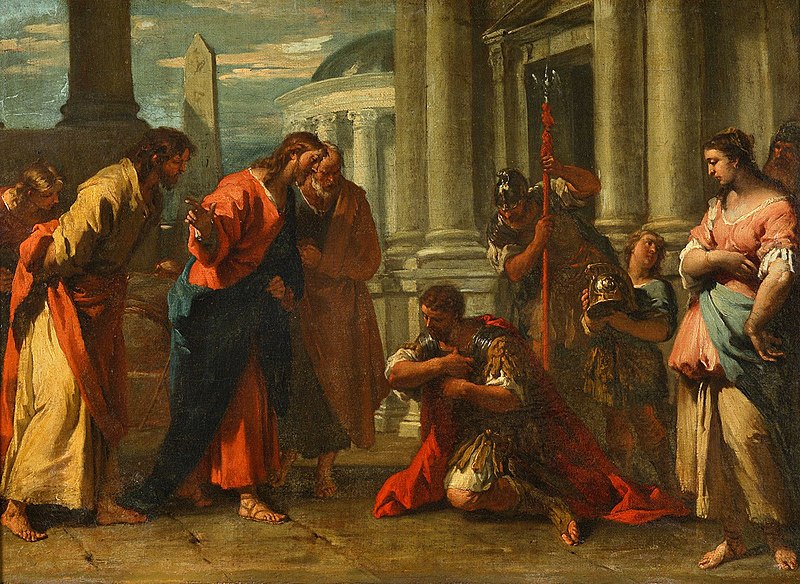
Jesus said the faith of the centurion was superior to anyone he had encountered in Israel. Christ and the Centurion by Sebastiano Ricci, circa 1726-1729. Image courtesy of the Pushkin Museum by Maltaper via Wikimedia Commons. CC-PD-Mark.

The centurion also demonstrated how he believed Jesus has the power and authority to heal by using his own position as an analogy. “For I also am a man under authority with soldiers under me,” he explained. Centurions were so named because they were in charge of approximately one hundred soldiers. He continued, “I say to one, ‘Go,’ and he goes, and to another, ‘Come,’ and he comes, and to my servant, ‘Do this,’ and he does it.”
Scripture says that Jesus was “amazed” at the faith of the centurion, and exclaimed, “not even in Israel have I found such faith.” Meanwhile, back at the centurion’s house, the servant was found to have been healed.
Jesus’s comparison of the faith of the Gentile centurion to that of all others in Israel is significant. While some scholars and authors have noted that Roman soldiers were not widely present in Galilee until later (AD 44 at the earliest), given the historical context of Roman occupation and administration in the region, it’s plausible that the centurion could have been part of Herod Agrippa’s forces, which were aligned with Roman authority. Agrippa, a client king of Rome, ruled over parts of Judea and Galilee during the first century AD, overlapping with the time period of Jesus’s ministry.
Jesus distinguished the centurion’s faith as superior to all he had encountered in Israel. This suggests that the Gentile’s faith surpassed even that of the pious who regularly attended the temple, the Pharisees, the teachers of the law, and even the priests.
At first glance, this miracle might appear to be just another story of faith rewarded. However, a closer examination of how each gospel presents the narrative has led many scholars and theologians to consider the positive implications this account could have for fully affirming the LGBTQ+ community within the church.
The Gospel of Matthew
In Matthew 8:3-15, Jesus encounters a centurion in Capernaum who approaches Him, expressing concern for his paralyzed and suffering servant. Jesus responds by asking if he should come and heal the servant.
“Servant” is not a completely inaccurate translation, but the Greek term παῖς (pais) used repeatedly in Matthew’s account of this story more specifically refers to a “boy,” making it the most accurate translation. To translate pais as “servant” is, frankly, unusual.
Typically, the ancient Greek word one would expect for “servant” is δοῦλος (doulos), meaning “slave.” Besides this story, doulos is overwhelmingly used in the gospel of Matthew to describe a servant. Interestingly, when the centurion himself refers to any servant who obeys his orders, he uses the word doulos, not pais.
Although the term pais has been used elsewhere to indicate someone who is a minor, that distinction is not supported internally anywhere in the text of this story. Indeed, it is uncommon for pais to describe someone’s offspring, which is one of several reasons why a similar account in the gospel of John about Jesus healing the son of a royal official is widely considered to be an unrelated event.

Same-sex intimacy between unmarried Roman soldiers and slaves was common in 1st century AD. Bas relief from Trajan’s Column, circa 113 AD. Original photo courtesy MCAD Library via Flickr. All rights reserved.
However, pais is commonly found in antiquity as a slang term referring to a submissive or receiving male partner in a same-sex relationship. In that context, it indicates the homosexual dynamic of the relationship rather than whether or not the “boy” in question is a minor. Though this is not a literal translation, Plato, Plutarch, and Thucydides were among those who often used pais to describe a male, even an adult, engaged in same-sex intimacy.
Societal norms and practices related to same-sex relationships in the Roman empire during antiquity were complex and differed significantly from modern understandings of homosexuality. Rather than a psychosexual identity or orientation, same-sex relations were simply considered in terms of physical acts.
In other words, there was no way to explicitly characterize ongoing same-sex relationships, so techniques such as found in Matthew’s gospel account of the centurion and his “boy” were often employed to strongly imply same-sex intimacy between partners.
There is a great deal of literary precedent for same-sex relationships within the Roman military during antiquity; certainly, same-sex intimacy between unmarried soldiers and slaves was acceptable. Numerous accounts contemporaneous with the ministry of Jesus document sexual relations exactly like what these passages in Matthew could indicate: an official who has a submissive same-sex partner.
The Gospel of Luke
While there are notable differences in the accounts between the gospels of Matthew and Luke, none of them diminish the implication that the centurion whom Jesus lauds as more faithful than anyone in Israel asked for his same-sex partner to be healed.

In 1st century AD, same-sex relationships were thought of as physical acts rather than one’s psychosexual orientation. Marble busts of Roman emperor Hadrian (left foreground) and his same-sex partner Antinous (right background). Original photo by Carole Raddato via Wikimedia Commons. CC-BY-SA-2.0.

Luke 7:1-10 tells us that when Jesus entered Capernaum, the centurion sent Jewish elders on his behalf to see if Jesus would heal his servant. Although Matthew by contrast depicts the centurion personally interacting with Jesus face to face, Luke’s narrative otherwise describes the same circumstances, uses the same word for word dialogue, and there has never been any doubt that Luke and Matthew are describing the same event.
In case you were wondering, even though “servant” in the Lukan account is translated from the Greek word δοῦλος (doulos), when the centurion himself describes the person needing to be healed, he calls him his παῖς (pais), or “boy.” Again, this possibly implies they could be same-sex partners.
There is another detail Luke’s narrative adds which even heightens this possibility: the centurion “highly valued” his servant (Luke 7:2).
While this mediocre English-language translation certainly sounds asexual, it obscures the style and detail communicated by the original ancient Greek. The term translated “highly valued” is ἔντιμος (entimos), meaning “precious, dear, or greatly prized.”
It is the source of the English word “intimate.”
If one takes the dynamic already described by the centurion and further characterizes it using (literally) intimate language, just as with the Matthean account, these verses mirror literary examples from antiquity that intentionally suggested deeply personal relationships—including sexual relationships, and instances of same-sex intimacy.
Both Sides, Now
Interestingly, in both gospel narratives, the centurion seems to be aware that according Jewish purity regulations, Jesus was not supposed to enter the home of a gentile, though the centurion does not explicitly state this. More than that, Roman officers were feared and considered “dirty” because many of their habits were offensive to the Jewish population of Palestine, and these behaviors probably included same-sex intimacy.
But Matthew depicts Jesus offering to go and heal the servant (Matthew 8:7, NIV). Meanwhile, Luke portrays Jewish elders approaching Jesus on behalf of the centurion and his intimate servant, saying, “He is worthy to have you do this for him” (Luke 7:4, NRSVue). In the end, Jesus not only healed the centurion’s servant, he praised the centurion by calling him more faithful than any others in all Israel—and that would have even included the Jews begging Jesus to help the centurion.
Was Jesus affirming same-sex intimacy?
Let’s be honest. Both gospel accounts independently and together provide strong circumstantial evidence that the centurion and his servant were sexually intimate partners. True, the text itself does not explicitly state this, but for the many reasons I have outlined, this possibility cannot and should not be excluded.
To take it even a step further, the circumstantial evidence is so convincing, I must say I would be surprised if the relationship between the centurion and his intimate servant had no sexual dynamic.
But you and I are not on a jury, and legalism has no place in making Christlike disciples.

Yes, Jesus affirmed the faith of a man who might have had a same-sex partner. Why is this controversial? The Centurion Kneeling at the Feet of Christ by Joseph-Marie Vien, circa 1752. Original image by xennex via WikiArt. PD-art.
Jesus affirmed a man of faith who was not religiously observant. He affirmed a man others would have considered unclean because of his profession, habits, and ethnicity. And Jesus affirmed a man who was probably sexually intimate with a person of the same sex.
He affirmed the centurion’s faith.
We need to keep our eye on the ball. If we are truly followers of Christ who love others the way he loves them, we should be willing to praise the faith of others regardless of sexual orientation. The legalists who proof-text scripture to clobber the dignity and worthiness of the LGBTQ+ community care about things Jesus did not, and that should tell us all we need to know.
Some could say that my theological response is weak, a cop-out. So, for the faith profiteers both within and without my denomination who exploit scripture and church policy to remove the ministerial credentials of individuals like myself, let me be crystal clear: Followers of Christ must fully and lovingly affirm the LGBTQ+ community now and forever.
Christlike love requires it.
But these scriptures reinforce this in a way that may be uncomfortable for those on either side of the issue. Jesus cared more about the faith of the centurion and the well-being of the intimate servant than anything anyone else cared about that day.
When Christ-followers adopt the same values and priorities as Jesus, the conflicts that currently divide and conquer us will transform into a love that nothing can stand against: not trouble, distress, persecution, hunger, poverty, danger, or even death.
Despite these trials, we conquer through His love. I’m certain that nothing—neither death nor life, angels nor demons, the present nor the future, nor any powers—can separate us from the love of God in Christ Jesus our Lord.
General Christian
History and Religion

About James Travis Young
James Travis Young is an ordained minister in the Church of the Nazarene making Christlike disciples alongside his spouse in Galveston, Texas, USA. Travis has served for decades in several active ministry roles including pastor, church planter, and teacher, and his writing has been featured in several books and publications. You can read more about the author here.
Previous Post

April 30, 2024
God After Deconstruction
Next Post

May 20, 2024 Shelter From the Storm
Browse Our Archives
Select a Category Art & Culture Atonement Book Review Cabrini Cancel Cuture Compassion Complementarianism Culture War Deconstruction Defending Your Life Depression Discipleship Egalitarian Essential Kenosis Evangelicals Evil Faith Faith & Doubt Faith and Mental Health Faith on Film Fear Film Review Foot Washing Fundalmentalists Fundamentalism Gaza Gender Identity Giving Gospel of John Gospel of Matthew Grace Guilt Hamas Healing History Holiness Homelessness Hope Hunger Incarnation Institutional Churches Israel January 6 Jesus Jesus' teachings Jonestown Judgment Kat Von D LGBTQ+ LGBTQ+ Affirmation Life Transformation Lost Coin Love Mercy Murder Neurodivergence Omnipotence Parables Peace Peoples Temple Persecution Personal Story Politics Poll Results Poverty Power Qualified Restoration Atonement Racism Relationships Religious Trauma SBC Schism Sermon on the Mount Sin Social Media Spirituality Suffering Thanksgiving The Exorcist The Shawshank Redemption Theology This Property Is Condemned Thomas Jay Oord Tornado Trump Uncategorized War Women
Select a Month June 2026 January 2026 December 2025 March 2025 December 2024 May 2024 April 2024 March 2024 February 2024 January 2024 December 2023 November 2023 October 2023 September 2023
Follow Us!
TAKE THE
Religious Wisdom Quiz
What does Paul teach about boasting?
Select your answer to see how you score.
Boast in the Lord Boast in riches Boast in yourself Never boast
Related posts from Sacred Outcasts

The SBC’s Genital Obsession is Idolatry


How the Titanic Sank My Understanding of Redemption

What Jeff Buckley Taught Me About Grief
TRENDING AT PATHEOS Progressive Christian

What Being a Modern-Day Apostle Means to Me
In my last column, I discussed the ins and outs of modern-day...

Did Ancient China Once Worship the God of...
Across human history, a common thread weaves through the origins of the...

Love Your Neighbor – Including Earth-Kin: Lev. 19,...
God’s command to love your neighbor means acting in an ethical and...

Lead a Church Study of “Jesus and Lao...
Guest writer Jack Thomas (The Irreverent Reverend) reflects on leading his church...

Pastoral Wisdom for Responding to Sermon Pushback
Getting sermon pushback on your social justice sermon? Learn practical, Proverbs-based strategies...

Principles for Understanding the Apostolic Ministry Today
Whenever people discover that my formal ministry title is "apostle," as in...
view all Progressive Christian blogs
Ad-Free & Subscriber Log-In Subscription Support
- About Us
- 2026 Calendar
- Videos
- Podcasts
- Library of World Religions
- Faith In Media Tracker
- Advertise With Us
- Write for Us
- Privacy Policy
- Terms of Service
- Do Not Sell My Data
- Contact Us
- Radiant Digital
- Manage Newsletter Subscriptions
- Unsubscribe From Notifications
- Sitemap
Copyright 2008-2026, Patheos. All rights reserved.
Subscription Support Ad-Free & Subscriber Log-In
Follow Patheos