
BuddhistCatholicContemplativeEvangelicalGeneral ChristianHinduJewishLatter-day SaintMuslimNew VisionsProgressive Christian
Beliefs
- Buddhist
- Catholic
- Contemplative
- Evangelical
- General Christian
- Hindu
- Jewish
- Latter-day Saint
- More Voices
- Muslim
- New Visions
- Pagan
- Progressive Christian
Topics
- Religion News
- Food and Religion
- Sports and Religion
- Religious Art
- Religious Music and Entertainment
- Religious Events
- History and Religion
- Style and Religion
- Politics and Religion
- Women in Religion
- Recreation Outdoors and Religion
- Business Finance and Religion
- Careers Workplace and Religion
- Education and Religion
- Family Parenting and Religion
- Health Fitness and Religion
- Home and Religion
- Relationships and Religion
- Technology and Religion
- Travel and Religion
Columnists
- Buddhist Columnists
- Business Finance and Religion Columnists
- Careers Workplace and Religion Columnists
- Catholic Columnists
- Contemplative Columnists
- Education and Religion Columnists
- Evangelists Columnists
- Family Parenting and Religion Columnists
- General Christian Columnists
- Health Fitness and Religion Columnists
- Hindu Columnists
- History and Religion Columnists
- Home and Religion Columnists
- Jewish Columnists
- More Voices Columnists
- Latter Day Columnists
- Muslim Columnists
- New Visions Columnists
- Nonreligious Columnists
- Pagan Columnists
- Politics and Religion Columnists
- Progressive Columnists
- Recreation Outdoors and Religion Columnists
- Relationships and Religion Columnists
- Religion News Columnists
- Religious Art Columnists
- Religious Events Columnists
- Religious Music and Entertainment Columnists
- Sports and Religion Columnists
- Style and Religion Columnists
- Technology and Religion Columnists
- Travel and Religion Columnists
- Women in Religion Columnists
Resource Library
- 2026 Calendar
- Library of World Religions
- The 100 Most Holy Places on Earth
- Patheos Answers
- Podcasts
- Videos
- Faith Leaders Database
- Anglican Episcopalian
- Bahai
- Baptist
- Buddhism
- Christianity
- Confucianism
- Eastern Orthodoxy
- Hinduism
- Holiness and Pentecostal
- ISKCON
- Islam
- Judaism
- Lutheran
- Methodist
- The Church of Jesus Christ of Latter-day Saints
- New Age
- Paganism
- Presbytarian and Reformed
- Protestantism
- Religion Behind the Scenes
- Roman Catholic
- Scientology
- Shia Islam
- Sikhism
- Sufism
- Sunni Islam
- Taoism
- Zen
- See all religions
Research Tools
 Ad-Free & Subscriber Log-In Subscription Support
Ad-Free & Subscriber Log-In Subscription Support
Follow Patheos 

- Trending:
- Forgiveness
- |
- Marriage
- |
- Consciousness
- |
- Death Penalty
- |
- Election
- |
- Halloween

- Home
- Progressive Christian
- Relationships and Religion
- Why We Need a New Atonement Theology
Why We Need a New Atonement Theology
Last updated on: April 22, 2024 at 8:23 am by James Travis Young
Why We Need a New Atonement Theology 2024-04-22T08:23:49-05:00 James Travis Young
Patheos Explore the world's faith through different perspectives on religion and spirituality! Patheos has the views of the prevalent religions and spiritualities of the world.
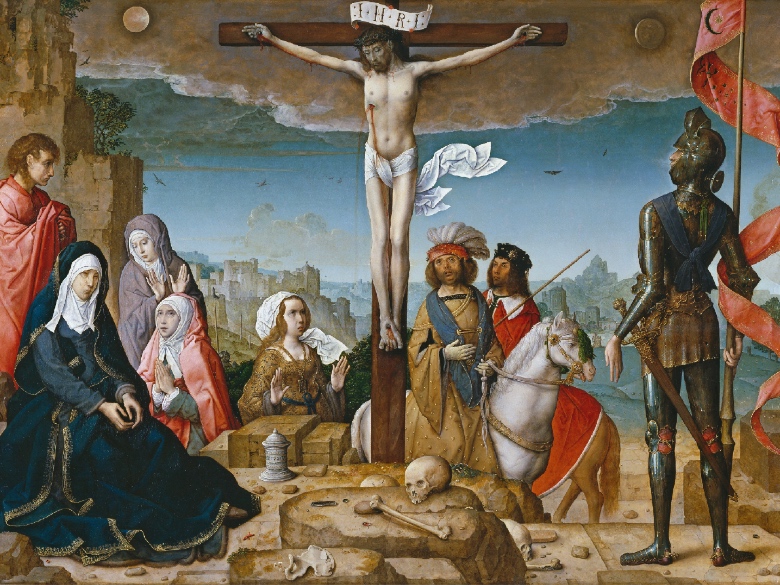
Because contemporary atonement theories are inadequate, we must form a new atonement theology. La Crucifixión by Juan de Flandes, circa 1460. Original image courtesy of Museo del Prado via Wikimedia Commons. CC-PD-Mark.

This is the second article of a three-part series proposing a brand-new atonement theology. Follow this link to read part 1.
Over the past several weeks, much of the content in the articles I have written has been tangentially connected to atonement.
Atonement is a theological explanation for how we are saved from our sins.
Last week, I explored how many contemporary atonement theories are woefully inadequate, and do not provide explanations consistent with scripture or human experience. Indeed, atonement is a confusing mystery to the average believer today, and that unfortunately includes both clergy and theologians as well.
I know this, because for the past year I have committed myself to extensive research specifically regarding what people believe and understand about atonement. From these considerations, I have formed six non-negotiables that serve to inform what a new atonement theology should and should not look like:
- A theology of atonement must fit the narrative advanced by the New Testament: A holy God acts to restore a loving relationship with his creation.
- Atonement cannot be transactional because that is inconsistent with God’s unconditional mercy, so…
- Any theology of propitiation is flawed because it presupposes God may only act in a loving way by some mechanism of human action—which is contrary to any theology of divine plenary love.
- Likewise, the relational dynamic cannot be devoid of humanity. We are not victims of circumstance, nor are we mere pawns. Atonement must require human responsiveness, or it is not relational.
- Atonement must provide a purpose for Christ’s death—otherwise his act of self-sacrifice has no purpose.
- Atonement must reckon our forgiveness in the context of Christ—otherwise, Christ could not have been who he said he was, and his actions cannot provide salvation.
Although no extant historical atonement theories fulfill all those requirements, one in particular does propose ideas that should be examined for context before proceeding to formulate a brand new atonement theology.
Irenaeus’ “Recapitulation”
An early church father just two generations removed from the apostles named Irenaeus developed a theology of atonement called Recapitulation that offers an explanation for the cross within a narrative of unlimited mercy juxtaposed against the original sin of humanity.
Classical Irenaeun Recapitulation atonement begins with envisioning Christ as the new Adam, and thus by living a sinless human existence, Jesus restores humanity from the destruction of original sin. Where humanity has been unfaithful, Christ was faithful even unto death on the cross.
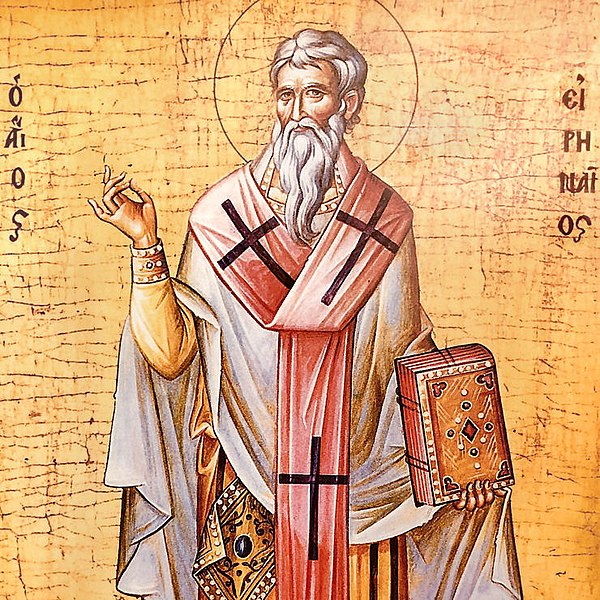
Irenaeus’ Recapitulation atonement isn’t perfect, but at least it proposed that God transformed humanity out of mercy rather than focusing on propitiation. Icon of Irenaeus by Dianelos Georgoudis via Wikimedia Commons. CC-Zero.

“Recapitulation” is an English translation of the Latinized form of anakefalaiosis (ανακεφαλαιωσης), which most literally means “to find a new head”. The implication is that humanity has a new identity in Christ as opposed to Adam. Though Iranaeus likely used the Greek ανακεφαλαιωσης, this definition is further deepened by how it is understood in Latin (and Irenaeus was fluent in both languages): “recapitulans” was a term used in rhetorical speech meant to designate a final summation, such as how an attorney employs a closing argument to conclude a case before a jury. The interesting part is not that repetition is integral to understanding the meaning of the term, but that this act finalizes or completes a process.
Irenaeus believed by Christ’s incarnation, death, and resurrection, humanity was born again. Instead of suffering death because of original sin, those who participate in new life in Christ are redeemed by the same power that resurrected Christ—that as he conquered death, so may we.
Now, Recapitulation isn’t bad theology, but it remains underdeveloped over 1800 years since it was first considered. There are also elements Irenaeus incorporated (such as comparing Mary the mother of Christ to Eve) which serve no purpose in a theology intended to address atonement alone.
Qualified Restoration Atonement
After quite a bit of study and prayer, I would like to propose an atonement theology I call Qualified Restoration that differs from and builds upon what Irenaeus advanced.
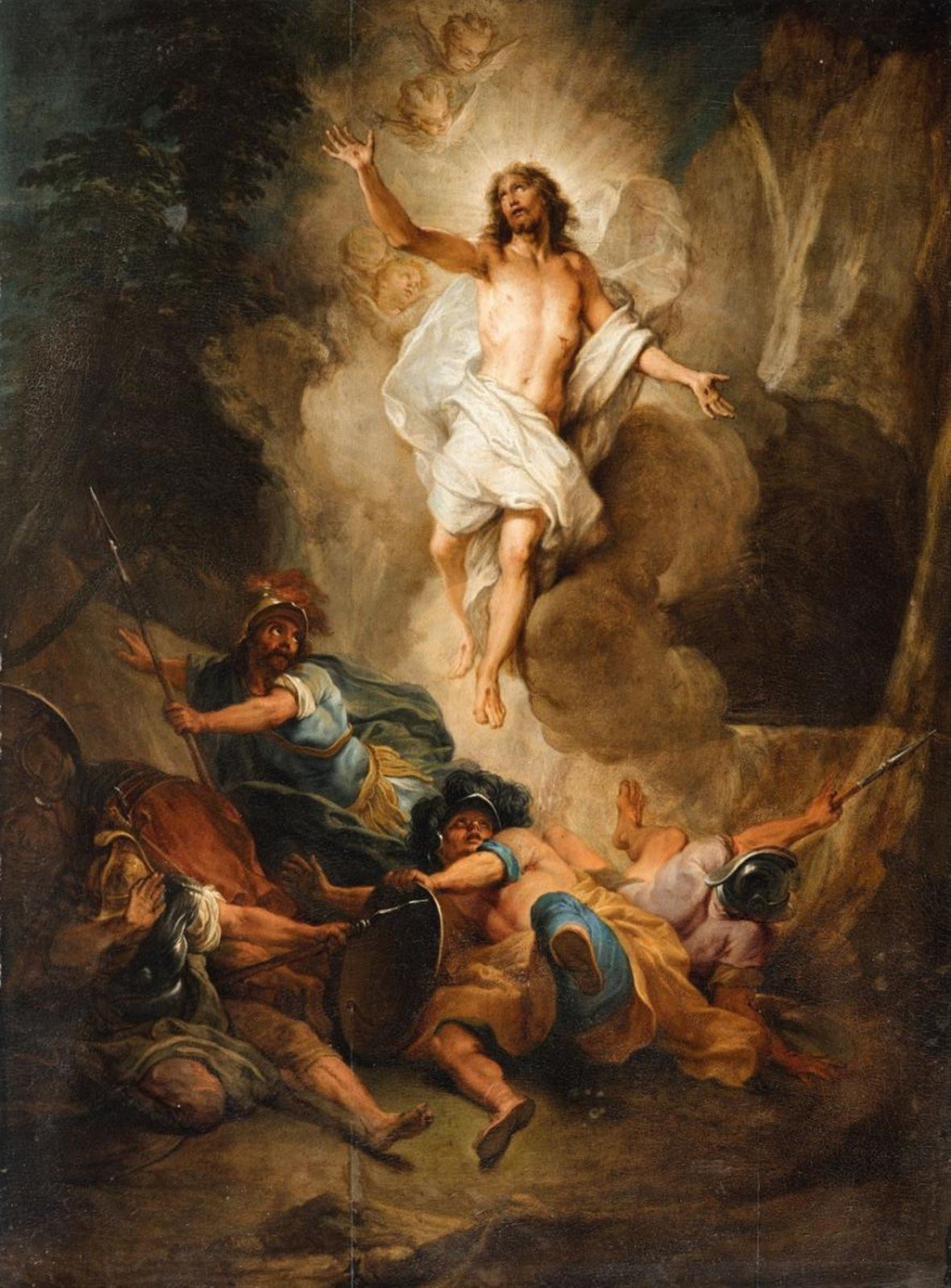
The Qualified Restoration atonement theology I propose is inspired by the Ancient Greek term apokatastasis (αποκατάστᾰσις) meaning, “restore, or re-establishment.” The Resurrection of Christ by Nicolas Bertin, circa 1730. Image by Joshua Charles via X.
Similar to anakefalaiosis (ανακεφαλαιωσης), which is an extrabiblical term, apokatastasis (αποκατάστᾰσις) means “restoration, or re-establishment.” As with recapitulation, apokatastasis is often used to communicate the concept of restitution. In fact, the word as used in the NT is translated in Latin (Vulgate) to “restitutionis,” the genitive form of a noun often defined in ancient legal documentation as, “a command given with authority by which the possession of a thing taken away is restored to a person.” The term is found in Acts 3:21 in a sermon spoken by Peter, commonly translated in English as “restore:”
“Heaven must receive him [Jesus] until the time comes for God to restore everything, as he promised long ago through his holy prophets.” (Acts 3:21, NIV)
Though the context of this usage does not specifically concern atonement, it still describes God taking restorative action for humanity.
The term apokatastasis is also found in the Septuagint (an authoritative Greek translation of the Hebrew Bible), in Malachi 4:6 replacing the Hebrew verb “shub” (שוב), which is a common word meaning “to turn back, or return.” As with its usage in Acts, though specifically unrelated to atonement, the passage describes God taking action to restore humans.
Early Church fathers actually argued about the NT context of apokatastasis because some believed it could imply universal salvation (Origen in particular). Though what I propose within the context of atonement does not address this well-documented controversy, because my intended use of the term “restoration” is wholly grounded in the biblical usage of apokatastasis, I have added the adjective “Qualified” to clearly distinguish my theology as consideration of atonement alone.
“To Finally Raise Back Up”
Apokatastasis is the inspiration for my Qualified Restoration atonement theology for other textual reasons as well.
Based on “apokathístēmi” (ἀποκαθίστημι), when we break down the word, “apo-“(ἀπο-) is a prefix meaning “to move away or apart” and also indicates the following action is “conclusive” or “finished”—that the motion is a means to an end. The next part is compound: “-kata-“ (κᾰτᾰ) means “down” or “back,” and “-hístēmi“ (ἵστημι) “to establish, set up, or cause to rise.”
As you can see, while combining these ideas does perfectly equivalate “restoration” in the most simple of terms, the word also offers a much more robust definition. I suggest “to finally raise back up” encompasses each part of the word, and (equally important) is evocative of scripture passages that describe God acting to restore humans. For example, take Psalm 40:1-2a (NIV):
“I waited patiently for the Lord;
he turned to me and heard my cry.
He lifted me out of the slimy pit, out of the mud and mire;
he set my feet on a rock and gave me a firm place to stand.”
Similarly, as Christ declared, “It is finished” on the cross according to John 19:30, my definition accounts for Qualified Restoration to finish or finalize the sin problem—without propitiation.
Atonement Is Not Propitiation
Your chosen English biblical translation has about a 50% chance of the word “propitiation” being used in 1 John 2:2 and 4:10. The Greek word “hilasmos” (ἱλασμός) that is used also has cognates that are likely similarly translated in Romans 3:25 and Hebrews 2:17. Every one of these usages regard atonement.
For better or worse, translators who believe in propitiation translate “hilasmos” and its cognates that way—and no one else anywhere does (except maybe Plutarch’s “conciliate” in one single instance). My go to Louw and Nida Greek-English Lexicon translates it as “the means of forgiveness.”
Why? Context matters.
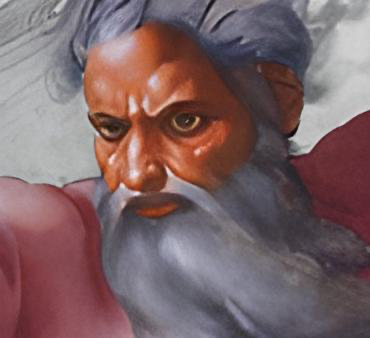
Propitiation is bad theology because it presupposes an angry God must have a change of heart rather than requiring human transformation. A cropped image of God taken from the fresco Creation of the Sun, Moon, and Planets by Michelangelo found on the Sistine Chapel ceiling, circa 1511. Original image courtesy The Web Gallery of Art via Wikimedia Commons. CC-PD-Mark.

Zero of the Septuagint (LXX) usages of hilasmos could be interpreted to mean “propitiation.” In each and every instance, it describes something that changes humans rather than something that changes God—and that is the crux of the matter:
Propitiation is bad theology because it proposes God must change due to our sin, rather than requiring human transformation.
One concept Irenaeun Recapitulation atonement suggests but never explicitly states is a foundational element of Qualified Restoration atonement: The consequences of sin (death) are not imposed by God, but naturally flow from the destructive force of sin because it is an absence of God’s holiness—the love and life he is that gives us life. Death isn’t a punitive measure by design—it is a vulnerability exposed by human knowledge of good and evil, a weakness humanity never would have encountered was it not for The Fall.
There are many scriptures in the New Testament such as Romans 5:8 and 1 John 4:9-10 which establish an atonement narrative around God’s love. Specifically, “while we were still sinners” and “this is love…that he sent his Son.”
So, what is the context of hilasmos in the New Testament?
The answer is simple: atonement.
In fact, in every case, the word could easily be translated as “atonement.” And that is exactly what the New International Version (NIV) does, along with the NLT, BSB, CSB, Par (Aramaic Bible in Plain English), ISV, MSB, NET, NRSV, WNT, WEB, and many other English translations.
More to Come
I have just scratched the surface of what I plan to share about Qualified Restoration atonement. My next article will cover more ground, and venture into deeper theological waters.
In the meantime, here is a précis of Qualified Restoration that also incorporates the definition of sin that I proposed in February:
Qualified Restoration Atonement
Knowledge of good and evil exposed humanity’s vulnerability to sin, a pervasive attraction to evil that deprives us of holy connection with God, resulting in our certain death.
In a mission of love and mercy, God sent his Son, Jesus, so that we would believe in him and be raised up from the depths of sin and death to salvation. Likewise, Jesus acted selflessly and died willingly on the cross as a holy sacrifice, then was resurrected so that we might have faith and be saved.
When we respond to Christ’s death and resurrection with faith in him, we also accept God’s graceful gift of forgiveness and everlasting life, and the Holy Spirit births in us the love of Christ. The holy presence of Christ living in us not only cleanses us from sin but also reconnects us with God, finally restoring humanity to a loving relationship with our creator as a new creation.
Follow this link to read the final article of the series and continue the conversation.
General Christian
History and Religion
Qualified Restoration Atonement

About James Travis Young
James Travis Young is an ordained minister in the Church of the Nazarene making Christlike disciples alongside his spouse in Galveston, Texas, USA. Travis has served for decades in several active ministry roles including pastor, church planter, and teacher, and his writing has been featured in several books and publications. You can read more about the author here.
Previous Post

March 31, 2024
Faith on Film: "The Shawshank Redemption"
Next Post
April 9, 2024 Introducing Qualified Restoration Atonement
Browse Our Archives
Select a Category Art & Culture Atonement Book Review Cabrini Cancel Cuture Compassion Complementarianism Culture War Deconstruction Defending Your Life Depression Discipleship Egalitarian Essential Kenosis Evangelicals Evil Faith Faith & Doubt Faith and Mental Health Faith on Film Fear Film Review Foot Washing Fundalmentalists Fundamentalism Gaza Gender Identity Giving Gospel of John Gospel of Matthew Grace Guilt Hamas Healing History Holiness Homelessness Hope Hunger Incarnation Institutional Churches Israel January 6 Jesus Jesus' teachings Jonestown Judgment Kat Von D LGBTQ+ LGBTQ+ Affirmation Life Transformation Lost Coin Love Mercy Murder Neurodivergence Omnipotence Parables Peace Peoples Temple Persecution Personal Story Politics Poll Results Poverty Power Qualified Restoration Atonement Racism Relationships Religious Trauma SBC Schism Sermon on the Mount Sin Social Media Spirituality Suffering Thanksgiving The Exorcist The Shawshank Redemption Theology This Property Is Condemned Thomas Jay Oord Tornado Trump Uncategorized War Women
Select a Month June 2026 January 2026 December 2025 March 2025 December 2024 May 2024 April 2024 March 2024 February 2024 January 2024 December 2023 November 2023 October 2023 September 2023
Follow Us!
TAKE THE
Religious Wisdom Quiz
Who said, "Shall we accept good from God, and not trouble?"
Select your answer to see how you score.
Jeremiah Job Moses Solomon
Related posts from Sacred Outcasts

How the Titanic Sank My Understanding of Redemption

What Jeff Buckley Taught Me About Grief
The Hidden Connection Between Zacchaeus and Jesus's Parable

Faith on Film: "Defending Your Life"
TRENDING AT PATHEOS Progressive Christian

Why Christians Have a Sacred Duty to Vote:...
The Bible offers strong support for the sacred duty to vote. Here...

What Being a Modern-Day Apostle Means to Me
In my last column, I discussed the ins and outs of modern-day...

Did Ancient China Once Worship the God of...
Across human history, a common thread weaves through the origins of the...

Love Your Neighbor – Including Earth-Kin: Lev. 19,...
God’s command to love your neighbor means acting in an ethical and...

Lead a Church Study of “Jesus and Lao...
Guest writer Jack Thomas (The Irreverent Reverend) reflects on leading his church...

Principles for Understanding the Apostolic Ministry Today
Whenever people discover that my formal ministry title is "apostle," as in...
view all Progressive Christian blogs
Ad-Free & Subscriber Log-In Subscription Support
- About Us
- 2026 Calendar
- Videos
- Podcasts
- Library of World Religions
- Faith In Media Tracker
- Advertise With Us
- Write for Us
- Privacy Policy
- Terms of Service
- Do Not Sell My Data
- Contact Us
- Radiant Digital
- Manage Newsletter Subscriptions
- Unsubscribe From Notifications
- Sitemap
Copyright 2008-2026, Patheos. All rights reserved.
Subscription Support Ad-Free & Subscriber Log-In
Follow Patheos