
BuddhistCatholicContemplativeEvangelicalGeneral ChristianHinduJewishLatter-day SaintMuslimNew VisionsProgressive Christian
Beliefs
- Buddhist
- Catholic
- Contemplative
- Evangelical
- General Christian
- Hindu
- Jewish
- Latter-day Saint
- More Voices
- Muslim
- New Visions
- Pagan
- Progressive Christian
Topics
- Religion News
- Food and Religion
- Sports and Religion
- Religious Art
- Religious Music and Entertainment
- Religious Events
- History and Religion
- Style and Religion
- Politics and Religion
- Women in Religion
- Recreation Outdoors and Religion
- Business Finance and Religion
- Careers Workplace and Religion
- Education and Religion
- Family Parenting and Religion
- Health Fitness and Religion
- Home and Religion
- Relationships and Religion
- Technology and Religion
- Travel and Religion
Columnists
- Buddhist Columnists
- Business Finance and Religion Columnists
- Careers Workplace and Religion Columnists
- Catholic Columnists
- Contemplative Columnists
- Education and Religion Columnists
- Evangelists Columnists
- Family Parenting and Religion Columnists
- General Christian Columnists
- Health Fitness and Religion Columnists
- Hindu Columnists
- History and Religion Columnists
- Home and Religion Columnists
- Jewish Columnists
- More Voices Columnists
- Latter Day Columnists
- Muslim Columnists
- New Visions Columnists
- Nonreligious Columnists
- Pagan Columnists
- Politics and Religion Columnists
- Progressive Columnists
- Recreation Outdoors and Religion Columnists
- Relationships and Religion Columnists
- Religion News Columnists
- Religious Art Columnists
- Religious Events Columnists
- Religious Music and Entertainment Columnists
- Sports and Religion Columnists
- Style and Religion Columnists
- Technology and Religion Columnists
- Travel and Religion Columnists
- Women in Religion Columnists
Resource Library
- 2026 Calendar
- Library of World Religions
- The 100 Most Holy Places on Earth
- Patheos Answers
- Podcasts
- Videos
- Faith Leaders Database
- Anglican Episcopalian
- Bahai
- Baptist
- Buddhism
- Christianity
- Confucianism
- Eastern Orthodoxy
- Hinduism
- Holiness and Pentecostal
- ISKCON
- Islam
- Judaism
- Lutheran
- Methodist
- The Church of Jesus Christ of Latter-day Saints
- New Age
- Paganism
- Presbytarian and Reformed
- Protestantism
- Religion Behind the Scenes
- Roman Catholic
- Scientology
- Shia Islam
- Sikhism
- Sufism
- Sunni Islam
- Taoism
- Zen
- See all religions
Research Tools
 Ad-Free & Subscriber Log-In Subscription Support
Ad-Free & Subscriber Log-In Subscription Support
Follow Patheos 

- Trending:
- Forgiveness
- |
- Marriage
- |
- Consciousness
- |
- Death Penalty
- |
- Election
- |
- Halloween

- Home
- Progressive Christian
- Relationships and Religion
- We Need to Talk About Atonement
We Need to Talk About Atonement
Last updated on: April 4, 2024 at 11:35 pm by James Travis Young
We Need to Talk About Atonement 2024-04-04T23:35:54-05:00 James Travis Young
Patheos Explore the world's faith through different perspectives on religion and spirituality! Patheos has the views of the prevalent religions and spiritualities of the world.
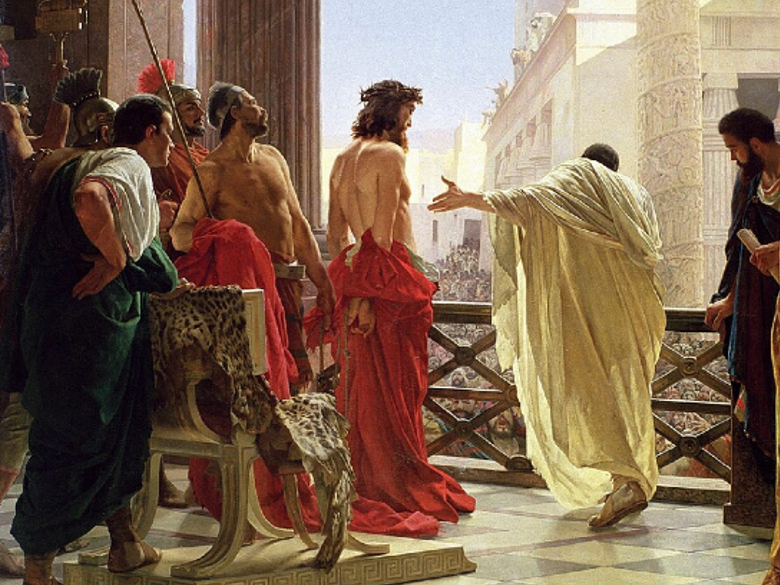
Many Christians do not understand atonement, and contemporary atonement theories are inadequate. Ecce Homo by Antonio Ciseri, circa 1862. Image by Wikijeff via Wikimedia Commons. CC-PD-Mark.

Atonement lies at the heart of Christian faith, bridging the problem of humanity’s brokenness with God’s redeeming love. Unfortunately, many Christians, even theologians, have great difficulty articulating how we are saved.
Sure, there are simplistic pat answers, like by faith or by grace… Okay, but how does that work*?*
Shouldn’t we at least have a simple understanding of how we are saved that is consistent with not only scripture, but our experience in relationship with God?
Over the past year, I have informally asked that question to hundreds of Christians, including lay people, pastors, theologians, and people from just about every major denomination including Evangelicals, Catholics, and those that don’t really fit in such categories. And most people have more questions than answers.
Defining Atonement
Merriam-Webster defines atonement as “reparation for an offense or injury: satisfaction.” For me, that conjures cartoon images of Homer Simpson demanding satisfaction and punctuating his ultimatum with a glove slap.

Homer Simpson demanded satisfaction. Some Christians view atonement in similar terms. Original image © 20th Television Animation. All rights reserved.
An older synonym for atonement is “reconciliation,” but for me the concept of reconciliation imposes a symmetry of some kind, or at least the achievement of balance. This understanding doesn’t quite fit because Christ’s sacrifice was holy and humanity’s initial response could not possibly be…nothing is ever equal.
Connected to but distinct from reconciliation is the more antiquated/obsolete term “reckoning.” Reckoning acknowledges the monstrous proportional difference between the sins of all humanity and Christ’s sacrifice. More than a mere accounting, the word reckoning communicates true comprehension, an acceptance of the dichotomy.
Contemporary Atonement Theories
For me, framing the purpose of atonement as a reckoning informs the theological validity of extant atonement theories. For example, probably the most common atonement explanation is the “Penal Substitution” theory Reformed theologians offer. It is puerile and just plain dumb.
Penal substitution atonement theory proposes Jesus Christ, through his death on the cross, bore the punishment deserved by humanity for their sins, thereby satisfying the demands of justice required by God.
According to this theory, humanity’s sinfulness incurred a debt that needed to be paid, and Jesus, as a sinless sacrifice, offered himself as a substitute to endure the penalty on behalf of humanity. This understanding emphasizes the necessity of Jesus’ death as a means of reconciling humanity with God, restoring the broken relationship caused by sin. Advocates of penal substitution view it as a central aspect of Christ’s redemptive work, highlighting the divine justice and sacrificial love demonstrated through Jesus’ sacrifice.
Penal Substitution is a corruption of Anselm’s Satisfaction theory, which itself is embraced in Catholicism. Though Athanasius and Augustine had already articulated substitutional atonement based on Christ ransoming humanity from the clutches of Satan, Satisfaction as developed by Anselm and improved upon by Aquinas theorizes that no debt could be owed to Satan, however original sin endebts humanity to God, and Christ’s sacrifice satisfies the debt.
Unlike Anselem’s Satisfaction, Penal Substitution transforms the concept of a penalty into justice, and debt to punishment. These legalistic terms were introduced primarily by Calvin, undoubtedly because of his experiences as a lawyer. According to this theory, humanity’s agency is minimized (due to Calvin’s fascination with election), and the mechanics of forgiveness are almost entirely dependent upon divine action.
Penal Substitution is patently ridiculous despite its rising popularity over the past six hundred years. How could God, who is love, demand a blood sacrifice to satisfy his grace?

Many modern atonement theories are derivative of Anselm’s proposed Satisfaction theology. A mid 17th century line engraving George Glover. Image courtesy National Portrait Gallery via Wikimedia Commons. CC-PD-Mark.

The main issue with this and related concepts of atonement is propitiation: that God must be appeased by sacrifice. This of course flies in the face of mercy, particularly parables of Christ such as the unmerciful servant, and with the very character of a forgiving God who doesn’t condemn us to begin with, and his Son who loves sinners.
Matthew 9 narrates how Pharisees didn’t get Jesus’s solidarity with sinners, and made it a point to question some of his converts about it: “Why does your teacher eat with tax collectors and sinners?” Jesus himself overheard the question, and responded, “It is not the healthy who need a doctor, but the sick. Go and learn what this means: ‘I desire mercy, not sacrifice.’” Quoting Hosea 6, Jesus was boldly making the point that atonement has nothing to do with offerings that cut deep…true forgiveness is non-transactional, therefore sacrifice is not a condition of God’s forgiveness.
An alternative to penal substitution that is widely accepted in Wesleyan circles is also devoid of supportive biblical precedent: Governmental Atonement. Predicated upon systematic approaches within Methodism, this idea is based on false syllogisms.
According to Governmental atonement theory, Jesus’ death serves as a public display of God’s displeasure toward sin and his commitment to uphold justice, while also providing a means for forgiveness and reconciliation for those who repent and believe. Jesus’ sacrifice is a symbolic act that satisfies the demands of divine justice and allows God to extend mercy to humanity without compromising his moral standards. Unlike penal substitution, which emphasizes the payment of a debt, governmental atonement highlights the moral influence and example of Jesus’ sacrifice, inviting individuals to respond in faith and repentance.
This is equally dumb, mostly because it lessens Christ’s death on the cross to a sacrifice made only to prove a point.
That God would absolve humans of sin by the sacrifice of Jesus does incorporate mercy into a matrix of atonement, but here propitiation unfortunately remains elemental: Jesus died, so now God’s anger is quelled, otherwise he would have seemed like a softie.
It’s a fascist wet dream that makes RoboCop and Dirty Harry look like liberal snowflakes by comparison. I am quite saddened that several theologians I admire and personally know ever found this or any substitutionary theory plausible.
Non-Negotiables
Penal substitution reduces the cross to a transactional event, while governmental atonement emphasizes divine justice at the expense of mercy. These theories fail to resonate with the overarching narrative of God’s relentless pursuit of reconciliation with humanity, condemned by original sin.

Atonement is about grace, not punishment. Image via PXHere. CC0 Public Domain.
Of course, everything Jesus did had a purpose, specifically a loving purpose, even in death. Thus, atonement cannot emphasize sacrifice, but redemption…restoration.
The purpose of atonement is to restore humanity from the consequences of sin. In February, I proposed a definition of sin that is dynamic, comprehensive, and scripturally founded:
Sin is a pervasive attraction to evil that deprives us of holy connection with God, resulting in our certain death.
With this in mind, based on what other atonement theories lack, here are non-negotiables that inform what a new atonement theology should and should not look like:
- A theology of atonement must fit the narrative advanced by the New Testament: A holy God acts to restore a loving relationship with his creation.
- Atonement cannot be transactional because that is inconsistent with God’s unconditional mercy, so…
- Any theology of propitiation is flawed because it presupposes God may only act in a loving way by some mechanism of human action—which is contrary to any theology of divine plenary love.
- Likewise, the relational dynamic cannot be devoid of humanity. We are not victims of circumstance, nor are we mere pawns. Atonement must require human responsiveness, or it is not relational.
- Atonement must provide a purpose for Christ’s death—otherwise his act of self-sacrifice has no purpose.
- Atonement must reckon our forgiveness in the context of Christ—otherwise, Christ could not have been who he said he was, and his actions cannot provide salvation.
We must reframe atonement as an act of divine grace rather than divine retribution. At its core, Christ’s sacrificial death and resurrection serve as the catalyst for restoring humanity to our intended relationship with God. By embracing the concept of restoration rather than mere satisfaction of divine wrath, atonement must emphasize God’s boundless mercy and love as the driving forces behind reconciliation.
In coming articles, I will propose a new atonement theology which will synthesize what other theologians have historically suggested with scripture and the above considerations. I have spent the past year researching and shaping my proposal, and have dialogued with several prominent theologians whose insights have contributed to my theory.
Follow this link to read the second article in this three-part series, where I propose Qualified Restoration atonement.
General Christian
History and Religion

About James Travis Young
James Travis Young is an ordained minister in the Church of the Nazarene making Christlike disciples alongside his spouse in Galveston, Texas, USA. Travis has served for decades in several active ministry roles including pastor, church planter, and teacher, and his writing has been featured in several books and publications. You can read more about the author here.
Previous Post

March 18, 2024
Why You Must See “Cabrini”
Next Post

March 31, 2024 Faith on Film: "The Shawshank Redemption"
Browse Our Archives
Select a Category Art & Culture Atonement Book Review Cabrini Cancel Cuture Compassion Complementarianism Culture War Deconstruction Defending Your Life Depression Discipleship Egalitarian Essential Kenosis Evangelicals Evil Faith Faith & Doubt Faith and Mental Health Faith on Film Fear Film Review Foot Washing Fundalmentalists Fundamentalism Gaza Gender Identity Giving Gospel of John Gospel of Matthew Grace Guilt Hamas Healing History Holiness Homelessness Hope Hunger Incarnation Institutional Churches Israel January 6 Jesus Jesus' teachings Jonestown Judgment Kat Von D LGBTQ+ LGBTQ+ Affirmation Life Transformation Lost Coin Love Mercy Murder Neurodivergence Omnipotence Parables Peace Peoples Temple Persecution Personal Story Politics Poll Results Poverty Power Qualified Restoration Atonement Racism Relationships Religious Trauma SBC Schism Sermon on the Mount Sin Social Media Spirituality Suffering Thanksgiving The Exorcist The Shawshank Redemption Theology This Property Is Condemned Thomas Jay Oord Tornado Trump Uncategorized War Women
Select a Month June 2026 January 2026 December 2025 March 2025 December 2024 May 2024 April 2024 March 2024 February 2024 January 2024 December 2023 November 2023 October 2023 September 2023
Follow Us!
TAKE THE
Religious Wisdom Quiz
My beloved is mine and I am his; he browses among these flowers. What flowers represent purity and beauty?
Select your answer to see how you score.
Crocus Wildflowers Lilies Roses
Related posts from Sacred Outcasts


How the Titanic Sank My Understanding of Redemption

What Jeff Buckley Taught Me About Grief

The Hidden Connection Between Zacchaeus and Jesus's Parable
TRENDING AT PATHEOS Progressive Christian

Why Christians Have a Sacred Duty to Vote:...
The Bible offers strong support for the sacred duty to vote. Here...

What Being a Modern-Day Apostle Means to Me
In my last column, I discussed the ins and outs of modern-day...

Did Ancient China Once Worship the God of...
Across human history, a common thread weaves through the origins of the...

Love Your Neighbor – Including Earth-Kin: Lev. 19,...
God’s command to love your neighbor means acting in an ethical and...

Lead a Church Study of “Jesus and Lao...
Guest writer Jack Thomas (The Irreverent Reverend) reflects on leading his church...

Principles for Understanding the Apostolic Ministry Today
Whenever people discover that my formal ministry title is "apostle," as in...
view all Progressive Christian blogs
Ad-Free & Subscriber Log-In Subscription Support
- About Us
- 2026 Calendar
- Videos
- Podcasts
- Library of World Religions
- Faith In Media Tracker
- Advertise With Us
- Write for Us
- Privacy Policy
- Terms of Service
- Do Not Sell My Data
- Contact Us
- Radiant Digital
- Manage Newsletter Subscriptions
- Unsubscribe From Notifications
- Sitemap
Copyright 2008-2026, Patheos. All rights reserved.
Subscription Support Ad-Free & Subscriber Log-In
Follow Patheos