
BuddhistCatholicContemplativeEvangelicalGeneral ChristianHinduJewishLatter-day SaintMuslimNew VisionsProgressive Christian
Beliefs
- Buddhist
- Catholic
- Contemplative
- Evangelical
- General Christian
- Hindu
- Jewish
- Latter-day Saint
- More Voices
- Muslim
- New Visions
- Pagan
- Progressive Christian
Topics
- Religion News
- Food and Religion
- Sports and Religion
- Religious Art
- Religious Music and Entertainment
- Religious Events
- History and Religion
- Style and Religion
- Politics and Religion
- Women in Religion
- Recreation Outdoors and Religion
- Business Finance and Religion
- Careers Workplace and Religion
- Education and Religion
- Family Parenting and Religion
- Health Fitness and Religion
- Home and Religion
- Relationships and Religion
- Technology and Religion
- Travel and Religion
Columnists
- Buddhist Columnists
- Business Finance and Religion Columnists
- Careers Workplace and Religion Columnists
- Catholic Columnists
- Contemplative Columnists
- Education and Religion Columnists
- Evangelists Columnists
- Family Parenting and Religion Columnists
- General Christian Columnists
- Health Fitness and Religion Columnists
- Hindu Columnists
- History and Religion Columnists
- Home and Religion Columnists
- Jewish Columnists
- More Voices Columnists
- Latter Day Columnists
- Muslim Columnists
- New Visions Columnists
- Nonreligious Columnists
- Pagan Columnists
- Politics and Religion Columnists
- Progressive Columnists
- Recreation Outdoors and Religion Columnists
- Relationships and Religion Columnists
- Religion News Columnists
- Religious Art Columnists
- Religious Events Columnists
- Religious Music and Entertainment Columnists
- Sports and Religion Columnists
- Style and Religion Columnists
- Technology and Religion Columnists
- Travel and Religion Columnists
- Women in Religion Columnists
Resource Library
- 2026 Calendar
- Library of World Religions
- The 100 Most Holy Places on Earth
- Patheos Answers
- Podcasts
- Videos
- Faith Leaders Database
- Anglican Episcopalian
- Bahai
- Baptist
- Buddhism
- Christianity
- Confucianism
- Eastern Orthodoxy
- Hinduism
- Holiness and Pentecostal
- ISKCON
- Islam
- Judaism
- Lutheran
- Methodist
- The Church of Jesus Christ of Latter-day Saints
- New Age
- Paganism
- Presbytarian and Reformed
- Protestantism
- Religion Behind the Scenes
- Roman Catholic
- Scientology
- Shia Islam
- Sikhism
- Sufism
- Sunni Islam
- Taoism
- Zen
- See all religions
Research Tools
 Ad-Free & Subscriber Log-In Subscription Support
Follow Patheos 

- Trending:
- Advent
- |
- Forgiveness
- |
- Thanksgiving
- |
- Election
- |
- Seasonal Holidays
- |
- Marriage

- Home
- Progressive Christian
- Relationships and Religion
- Why Our New Year Must Include One Another
Why Our New Year Must Include One Another
Last updated on: December 30, 2023 at 2:49 pm by James Travis Young
Why Our New Year Must Include One Another 2023-12-30T14:49:05-06:00 James Travis Young
Patheos Explore the world's faith through different perspectives on religion and spirituality! Patheos has the views of the prevalent religions and spiritualities of the world.

The church must join together despite our differences to love a diverse world. Image via PickPik.
The novelist John Irving once wrote, “An epilogue, in the disguise of wrapping up the past, is really a way of warning us about the future.” I found myself reflecting upon this as I considered everything that has impacted my relationship with God and others over the past calendar year.
There are critics who I am positive would rush to comment that God is unchanging. Without immediately addressing that digression, I will simply maintain that there will never be a day when any Christ-follower is finished growing in grace, and there should never be a single moment when we can no longer learn even more on our loving journey with God and all creation.
We are stretched, we struggle, we bend and even sometimes we break, but the pieces of our hearts are more than just beautiful to our creator, they serve as a reflection of divine love intended to shine upon a world that is also broken.
Personally, this has been yet another year that my family and I have grappled with social exclusion from within the church at large because I have vocalized opinions some term progressive. Unfortunately, it seems as if the more polarized Evangelicals become, the more narcissistic fear-mongering church leaders have adopted a conform or be cast out mentality.
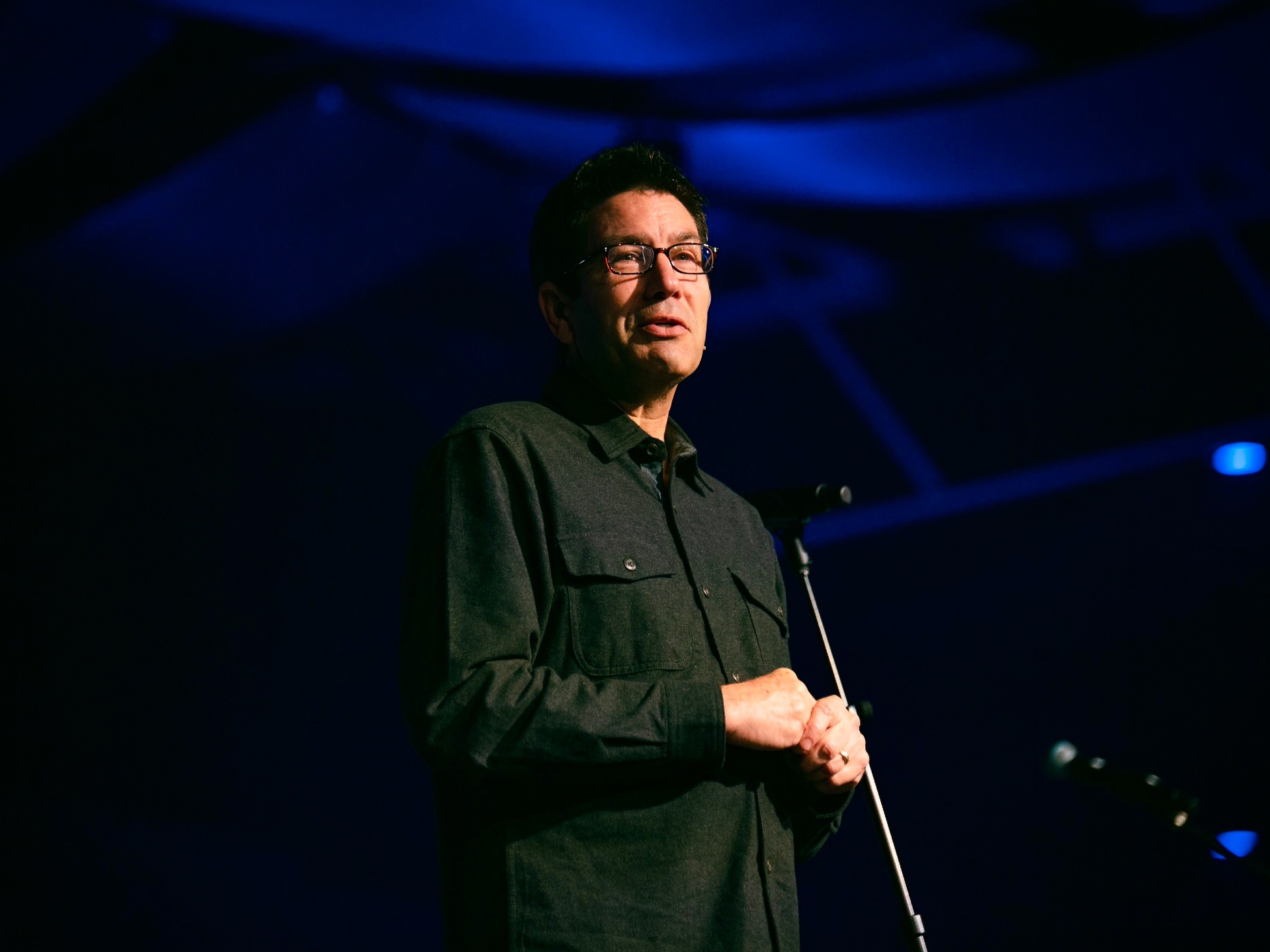
Rev. Dee Kelley was put on trial in his denomination because he wrote that the church should engage in conversation with the LGBTQ+ community. Photo by @Trevecca via X.
For example, in my own denomination, a pastor named Dee Kelley was actually put on trial because he merely suggested that the church should engage in dialogue with the LGBTQ+ community. Kelley was accused of teaching doctrines out of harmony with the church and conduct unbecoming a minister. Despite significant public outcry against the exploitation and abuse he suffered, Kelley was found guilty on all counts. Although his last appeal has not yet been exhausted, he has resigned from the church he served as pastor for seventeen years.
Unfortunately, there are many others in several denominations facing such scrutiny for similar reasons. The problem isn’t the mechanism of action itself—surely there exists those in the church who harm others, and they must be held accountable—both by law enforcement where applicable and within the church as well. But when the church becomes the thought police, it is not God’s love at work, but rather a spiteful legalism fueled by fear and often prejudice and hatred.
The Table
To accept relationship with Christ incarnationally is also accepting those he loves, those he calls his own, those who are known by his love (and certainly, acceptance isn’t necessarily agreement). According to the gospel of John, Jesus delivered this powerful teaching the night he was betrayed as he gathered his disciples together to share a Passover meal. When we ourselves come to the table, we are connected to one another and to Christ by taking the bread and the cup, joining with him and one another as disciples in love.
It is the very mission of the church: to make Christlike disciples in the nations, to cultivate this loving connection we have with Christ in one another. This includes anyone at the table—even those we may not understand or agree with—seeking to do good by loving one another as we love ourselves. Jesus said this is like loving the Lord your God with all your heart and with all your soul and with all your mind.
All my life, I have seen Jesus in so many people, but so many of those I have known seem to reflect him less and less.

Fewer people seem to reflect Christlike love, even within the church. Photo by Tuur Tisseghem via Pexels.
For me, it has become harder and harder to recognize Jesus in what others call the traditional church. I searched for familiar patterns to just catch a glimpse of his face hidden somewhere in the crowd, but mixed in with often laudable humanitarian aid, most of what I see today are events, lectures that amount to pop psychology, concerts, food, faith profiteering, deception, iconoclasm disguised as tradition, and almost no relationship, no discipleship.
The Christlike reflections are becoming rare enough that the world seems to be getting darker and darker—if there is more light than I can see, my eyes have not adjusted yet.
The sacred connection of the bread and the cup we were created to share relationally seems infinitely harder when I realize so many have left the table to sit elsewhere. It’s not possible to have a great relationship with God and hate his creation. And as your love for others reflects your love for God, your connection with other disciples reflects your connection to Jesus.
Today, many have forsaken connection with individuals and groups of different colors, different politics, and different pronouns to find themselves at tables where their only mutual connections are fear and prejudice—tables that will eventually be overturned.
I write this with great deliberation: if there are those with whom you are unwilling to share the bread and the cup, perhaps you should consider whether or not what you offer at your table actually represents the body and blood of a Savior who promised his disciples at his last supper, “Very truly I tell you, whoever accepts anyone I send accepts me” (John 13:20a, NIV).
Certainly, I am not the first or the only Christ-follower who has found the “table analogy” apt, although others in ministry whom I highly respect have made comments eschewing such ideas: “Any table can become an echo chamber devoid of reality. Any table can give into the temptation of creating straw-man villains of anyone who doesn’t sit at that table. Any table can become an enemy-making-machine.”
I disagree, because I don’t believe it is that complicated.
Every kingdom divided against itself will be destroyed, but Christ is not divided. At his table, there is no room for hatred or injustice.
That doesn’t mean that there will never be differences of opinion, only that the differences we have should unify us rather than divide us.
Unity Through Diversity
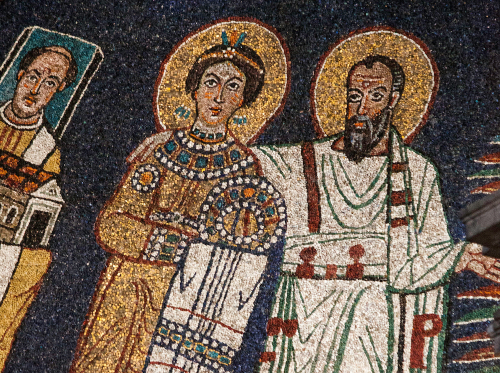
The early church was more diverse than most congregations are today. The Apostle Paul embracing a female Saint. 9th century mosaic, basilica of Santa Prassede. Photo by Lawrence Lew. CC-PD-Mark.
Scripture admonishes us to forgive grievances (Colossians 3:13), to live in harmony, be sympathetic, compassionate, and humble (1 Peter 3:8), to keep the unity of the Spirit through the bond of peace (Ephesians 4:3), and from Christ be joined and held together, growing and building up one another in love (Ephesians 4:16). Therefore, we must embrace the diversity of opinion that truly makes Christianity unique among the global religious landscape and maintain unity by engaging a lost and hopeless world in transformational dialogue.
In 1 Corinthians 12, the Apostle Paul writes,
“But God has put the body together…so that there should be no division in the body, but that it’s parts should have equal concern for each other. If one part suffers, every part suffers with it; if one part is honored, every part rejoices with it” (1 Corinthians 12:24b, 25-26, NIV).
Where there is suffering, the body responds with compassion; therefore, loving unity within the body means we have compassion for one another. Certainly within the issues that potentially divide Christians, much compassion for those whom we do not agree is needed.
It is the very essence of Christlike discipleship. It is also why we should celebrate and rejoice in our diversity, for when we honor a member of the body we are exalting Christ himself.
Beyond the Table
Perhaps it is true that the body of Christ is like a dysfunctional family—that we all sit around the same communion table as Jesus, and despite our grudging hostilities and disagreements, when we join together and take the bread and the cup, we are connected in love with one another and with Jesus.
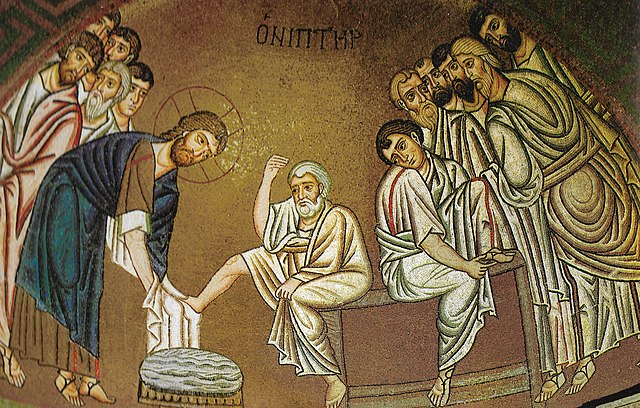
Jesus humbled himself as a servant, and so should we. Mosaic depicting Jesus washing the feet of his disciples, 1100 AD, Monastery of Hosios Loukas, Greece. CC-PD-Mark.
But the time Jesus spent at the table with his disciples only reflects a small portion of his experiences with them. For example, before Jesus served as a host at the table, he first humbled himself by taking the basin and the towel, kneeling to wash the dirty feet of his disciples, including the one he already knew would betray him. Jesus actually says,
“Now that I, your Lord and Teacher, have washed your feet, you also should wash one another’s feet. I have set you an example that you should do as I have done for you. Very truly I tell you, no servant is greater than his master, nor is a messenger greater than the one who sent him.” (John 13:14-16, NIV)
When Christians believe that we are somehow better than those who do not know Jesus, not only are we dead wrong, but we are rejecting the very nature of Jesus. He spent years of his life serving individuals that no one else in their society would even acknowledge.
Beyond the table, Jesus forgave everyone and condemned no one. He rose from the table to accept death on the cross, and rose from the grave to provide hope, love, and actual life to all who believe.
A Prayer for the New Year
I grew up in the church. Like perhaps some of you, the church was my family, and it seemed like a home.

Jesus left behind the shroud that covered his dead body, and we should do the same. Photo © Om Shivay Enterprises.
But what I thought was the church was actually an institution, an organization that like any other can be used for good or bad.
I fell in love with what I thought was the body, but it was just a fancy covering, like a garment. A shroud.
You know, the thing Jesus left behind in the tomb.
Some of you reading must decide if you are willing to unite and be joined together as the living resurrected body of Christ, or if you shall remain a remnant of the past, a covering for the dead, cast off and left behind in a lifeless tomb.
On our mutual journeys throughout this coming new year, it is my hope and prayer that we may find connection in Christlike love with one another and share that unconditional love with a world in desperate need of it.
General Christian
Politics and Religion

About James Travis Young
James Travis Young is an ordained minister in the Church of the Nazarene making Christlike disciples alongside his spouse in Galveston, Texas, USA. Travis has served for decades in several active ministry roles including pastor, church planter, and teacher, and his writing has been featured in several books and publications. You can read more about the author here.
Previous Post

December 22, 2023
When the Church Attacks Its Own: Part 2
Next Post

January 11, 2024 What Is Holiness (And What It’s Not)
Browse Our Archives
Select a Category Art & Culture Atonement Book Review Cabrini Cancel Cuture Compassion Complementarianism Culture War Deconstruction Defending Your Life Depression Discipleship Egalitarian Essential Kenosis Evangelicals Evil Faith Faith & Doubt Faith and Mental Health Faith on Film Fear Film Review Foot Washing Fundalmentalists Fundamentalism Gaza Gender Identity Giving Gospel of John Gospel of Matthew Grace Guilt Hamas Healing History Holiness Homelessness Hope Hunger Incarnation Institutional Churches Israel January 6 Jesus Jesus' teachings Jonestown Judgment Kat Von D LGBTQ+ LGBTQ+ Affirmation Life Transformation Lost Coin Love Mercy Murder Neurodivergence Omnipotence Parables Peace Peoples Temple Persecution Personal Story Politics Poll Results Poverty Power Qualified Restoration Atonement Racism Relationships Religious Trauma SBC Schism Sermon on the Mount Sin Social Media Spirituality Suffering Thanksgiving The Exorcist The Shawshank Redemption Theology This Property Is Condemned Thomas Jay Oord Tornado Trump Uncategorized War Women
Select a Month June 2026 January 2026 December 2025 March 2025 December 2024 May 2024 April 2024 March 2024 February 2024 January 2024 December 2023 November 2023 October 2023 September 2023
Follow Us!
TAKE THE
Religious Wisdom Quiz
What does "Hosanna" mean in Hebrew?
Select your answer to see how you score.
Save us now Holy One The Lord reigns Praise be to God
Related posts from Sacred Outcasts
The SBC’s Genital Obsession is Idolatry

The Hidden Connection Between Zacchaeus and Jesus's Parable

We Are Never Ever Getting Back Together

Faith on Film: "Defending Your Life"
TRENDING AT PATHEOS Progressive Christian

The Secret behind A Charlie Brown Thanksgiving
Do you know the secret behind A Charlie Brown Thanksgiving? Sparky was...

Bridging the Gap Between God and Man
From Far Off to the Ultimate Embrace “God is a Spirit: and...

Let Matthew 25 Guide You to a Greater...
With the crisp feel of fall in the air, our minds quickly...

Can a Chatbot Touch Your Soul?
Can a chatbot offer genuine spiritual counsel? One conversation brought me to...

Religion and Politics: How Should We Then Live?
Two cultural axioms get repeated in polite company. Don't mix religion and...

7 Things We Get Wrong About Giving Thanks
It's a time of year when many of us turn to the...
view all Progressive Christian blogs
Ad-Free & Subscriber Log-In Subscription Support
- About Us
- 2026 Calendar
- Videos
- Podcasts
- Library of World Religions
- Faith In Media Tracker
- Advertise With Us
- Write for Us
- Privacy Policy
- Terms of Service
- Do Not Sell My Data
- Contact Us
- Radiant Digital
- Manage Newsletter Subscriptions
- Unsubscribe From Notifications
- Sitemap
Copyright 2008-2026, Patheos, part of the Radiant Digital network of media brands. All rights reserved.
Subscription Support Ad-Free & Subscriber Log-In
Follow Patheos