
BuddhistCatholicContemplativeEvangelicalGeneral ChristianHinduJewishLatter-day SaintMuslimNew VisionsProgressive Christian
Beliefs
- Buddhist
- Catholic
- Contemplative
- Evangelical
- General Christian
- Hindu
- Jewish
- Latter-day Saint
- More Voices
- Muslim
- New Visions
- Pagan
- Progressive Christian
Topics
- Religion News
- Food and Religion
- Sports and Religion
- Religious Art
- Religious Music and Entertainment
- Religious Events
- History and Religion
- Style and Religion
- Politics and Religion
- Women in Religion
- Recreation Outdoors and Religion
- Business Finance and Religion
- Careers Workplace and Religion
- Education and Religion
- Family Parenting and Religion
- Health Fitness and Religion
- Home and Religion
- Relationships and Religion
- Technology and Religion
- Travel and Religion
Columnists
- Buddhist Columnists
- Business Finance and Religion Columnists
- Careers Workplace and Religion Columnists
- Catholic Columnists
- Contemplative Columnists
- Education and Religion Columnists
- Evangelists Columnists
- Family Parenting and Religion Columnists
- General Christian Columnists
- Health Fitness and Religion Columnists
- Hindu Columnists
- History and Religion Columnists
- Home and Religion Columnists
- Jewish Columnists
- More Voices Columnists
- Latter Day Columnists
- Muslim Columnists
- New Visions Columnists
- Nonreligious Columnists
- Pagan Columnists
- Politics and Religion Columnists
- Progressive Columnists
- Recreation Outdoors and Religion Columnists
- Relationships and Religion Columnists
- Religion News Columnists
- Religious Art Columnists
- Religious Events Columnists
- Religious Music and Entertainment Columnists
- Sports and Religion Columnists
- Style and Religion Columnists
- Technology and Religion Columnists
- Travel and Religion Columnists
- Women in Religion Columnists
Resource Library
- 2026 Calendar
- Library of World Religions
- The 100 Most Holy Places on Earth
- Patheos Answers
- Podcasts
- Videos
- Faith Leaders Database
- Anglican Episcopalian
- Bahai
- Baptist
- Buddhism
- Christianity
- Confucianism
- Eastern Orthodoxy
- Hinduism
- Holiness and Pentecostal
- ISKCON
- Islam
- Judaism
- Lutheran
- Methodist
- The Church of Jesus Christ of Latter-day Saints
- New Age
- Paganism
- Presbytarian and Reformed
- Protestantism
- Religion Behind the Scenes
- Roman Catholic
- Scientology
- Shia Islam
- Sikhism
- Sufism
- Sunni Islam
- Taoism
- Zen
- See all religions
Research Tools
 Ad-Free & Subscriber Log-In Subscription Support
Ad-Free & Subscriber Log-In Subscription Support
Follow Patheos 

- Trending:
- Forgiveness
- |
- Marriage
- |
- Consciousness
- |
- Death Penalty
- |
- Election
- |
- Halloween

- Home
- Progressive Christian
- Relationships and Religion
- “The Exorcist: Believer” Film Review
“The Exorcist: Believer” Film Review
Last updated on: October 22, 2023 at 8:29 pm by James Travis Young
“The Exorcist: Believer” Film Review 2023-10-22T20:29:07-05:00 James Travis Young
Patheos Explore the world's faith through different perspectives on religion and spirituality! Patheos has the views of the prevalent religions and spiritualities of the world.

Lidya Jewett and Olivia O’Neill in “The Exorcist: Believer.” © 2023 Universal Pictures/Everett Collection
THIS REVIEW CONTAINS SPOILERS FOR THE EXORCIST: BELIEVER
William Friedkin‘s 1973 film, The Exorcist, is the best Christian movie of all time.
The fact that The Exorcist (1973) is an R-rated horror film produced and distributed by a major Hollywood studio does not change that fact in any way. In The Exorcist (1973), individuals with and without faith face unspeakable evil, and the conflict is resolved through a sacrificial act of Christlike love. Not only is it perhaps the most accurate depiction of educated clergy I have observed in a work of fiction (even in “Christian” films), but it also takes both faith and evil seriously, not avoiding scientific or theological issues that arise when one questions why possession could possibly occur.
The Exorcist: Believer does not have any of those qualities, and indeed rests in another category of film altogether: the legacyquel cash-grab.
The plot follows single-parent Victor Fielding (Leslie Odom Jr.) and his daughter, Angela (Lidya Jewett). She is an average middle schooler who seems to enjoy their life in Georgia, although she is preoccupied with finding some sort of connection with her mother, who died thirteen years ago in an earthquake while pregnant with Angela. One day after school, Angela and her friend Katherine (Olivia O’Neill) decide to go play in the woods and then, mysteriously, they vanish.
We are introduced to Katherine’s parents, who embody every stereotypical characteristic of conservative evangelical Christians. We also meet Victor and Angela’s neighbor, Ann (Ann Dowd), who will play a significant role in the plot, along with a surprisingly large cast of other supporting characters who are all completely disposable.
Three days later when the girls are discovered thirty miles away, they have superficial injuries but no explanation or recollection of any events after they wandered into the woods. In ways that could be called anything but subtle, both girls over the next few days begin to exhibit troubling behavior that seems oddly religious—which in any other movie might seem totally unpredictable, but here it is expected to say the least.

Leslie Odom Jr. as Victor Fielding in “The Exorcist: Believer”
© 2023 Universal Pictures/Everett Collection
Victor is pointedly non-religious, a lazy plot contrivance attributed to the tragic loss of his wife, and has not imposed any faith construct upon Angela. However, he is surrounded by a Greek chorus of characters who are devout. The filmmakers obviously intended these characters to represent a diversity of religions, but by the end of the film, they all huddle together ecumenically beneath a large umbrella of Christianity.
From that point on, the plot is predictable to say the least. Everyone in the theater knew what we were in for when we bought a ticket, but after the first third of the film, we also knew the experience would be far from satisfying.
It is impossible to not judge a legacyquel by its parent film, and admittedly, The Exorcist (1973) leaves enormous shoes to fill. William Friedkin, director of the 1973 film, was foremost an artist with uncompromising vision and a virtuoso technician. In contrast, David Gordon Green, director of Believer, is none of those things, although he can usually be counted on for uneven films that are competently assembled and seem professional.
But one thing that no one upon first viewing The Exorcist (1973) would ever do is snicker at any scene playing out on the screen—the audience is filled with intense feelings of suspense and horror from the first frame until long after the credits roll. It isn’t a good thing when there are multiple moments where audience members laugh at a film such as Believer that takes itself so seriously.
What it does not take seriously is faith or evil. In this movie, evil is manifested as a symptom indicating a lack of faith. By contrast, in the original, evil has its own motives to steal, kill, and destroy, and that drives the characters (and the plot) to discover or deepen their faith in God. In that film, mother Chris McNeil (Ellen Burstyn) witnesses unspeakably evil acts inflicted upon her sweet, vulnerable child, which in the absence of any substantive medical solution, motivates her character to seek the help of a Catholic priest to perform an exorcism—or as she describes him, “a witch doctor.”

Leslie Odom Jr. and Ellen Burstyn in “The Exorcist: Believer”
© 2023 Universal Pictures/Everett Collection
In Believer, Victor decides to enlist the help of an exorcist (and legacy character, Chris McNeil) in a 30 second montage showing him reading her autobiography, focusing on words and phrases that seem similar to his daughter’s plight, and driving to her house. Though she gives a wonderful performance, Ellen Burstyn’s character is totally unnecessary, and obviously just an element shoehorned in to attract fans of the original.
Equally unnecessary is the entire storyline or existence of Katherine and her entire evangelical family. Young actress Olivia O’Neill seems to have been cast because of a passing resemblance to Linda Blair, who as a child portrayed Regan, the possessed girl in the 1973 film. That they look remarkably similar has everything to do with marketing and nothing to do with the plot itself.

Olivia O’Neill in “The Exorcist: Believer.”
© 2023 Universal Pictures/Everett Collection
Every time there was a scene with Katherine or her family, I couldn’t stop thinking about how safe it is to have another white girl get possessed and do dirty things to herself in acts of sacrilege. I didn’t realize until the end of the film that the outcome of the exorcism is intended to make a statement about the hazards of evangelicalism, and the entire purpose for her character and her entire family is entirely symbolic.
Here is wisdom: not only is it dumb to insert major characters only to kill them off to make allegorical statements about the lack of true faith of evangelicals, it is exceptionally bad storytelling too.
The Exorcist (1973) is aptly named, because we are compelled to care about many supporting characters beyond the story of Regan suffering possession, how her mother Chris deals with it every step of the way, the tension between a scientific vs. religious explanation, or even the question of whether an exorcism is a valid ritual or an autosuggestive psychological cure, and the exorcists themselves. But Believer’s only interesting characters are Victor and Angela, and to a lesser degree, neighbor Ann. So much more could/should have been done with her character.
The subtitle “Believer” is apparently intended to indicate that, unlike the original, one of the victims of possession comes from a Christian home, and given the changing landscape of Christianity in the United States, it is a valid progression to focus on evangelicalism rather than catholicism. Indeed, Katherine’s family goes every Sunday to a traditional evangelical church with hard wooden pews, hymnals, communion, and a smiling pastor in a tailored suit delivering what is likely a three-point sermon. His character has no other defining attributes, including personality, backstory, or wardrobe. When he is later pulled into an ecumenical exorcist gang/team, his main contribution is to appear serious and quote the KJV Lord’s Prayer.
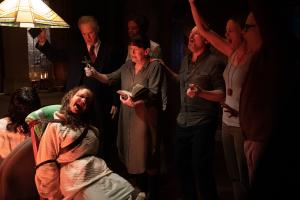
An Ecumenical Exorcism
© 2023 Universal Pictures/Everett Collection
There is a wonderful moment when an almost nameless Catholic priest tells Ann the Catholic church will not sanction an exorcism so he cannot participate. Indeed, the ecumenical approach forwarded by characters in the film (in which everyone surprisingly still generally acknowledges Jesus as Lord) also has elements no Catholic priest or Christian clergy of almost any denomination would willingly condone—notwithstanding the abuse of lashing children to chairs bolted to the floor and shouting at them for hours on end. Then the priest reminds Ann of how Jesus sent the twelve disciples as mere ordinary men to heal the sick and cast out demons, and then on the spot commissioned her as a true disciple equipped with the full power of God.
Based on that scene, my heart was filled with great hope for the ending. That soon deflated when the same almost anonymous priest decided to join in anyway only to be quickly dispatched seconds after he arrives by a supernatural headspin delivered by a cackling demon. His death doesn’t serve the plot, but it certainly makes a statement, perhaps about the patriarchy, perhaps about Catholicism. And again, his isn’t the only death in this film written solely to send a message about the insufficiency of some Christian faiths.
Leslie Odom Jr. and Ann Dowd give top notch performances, but I wish they had been given better material to work with. I suspect Universal’s 400 million dollar gamble to buy the film rights to this franchise will not pay off. If this were yet another weak chapter in The Conjuring saga, the lack of quality could be forgiven. Not that this is a terrible movie; it just isn’t near as good as it should have been. Just as director David Gordon Green’s 2022 Halloween Ends was really two movies with two divergent plots—one that is good and one that is stupid—so this movie could have been good as well, had the legacy elements and the evangelicals never been added.
Just as some might compare The Exorcist (1973) to the perfection of Mozart’s Great G minor symphony, The Exorcist: Believer would in that case be analogous to Falco’s “Rock Me Amadeus.” Though it may have the same elements of what is an amazing work of art, it is insignificant in comparison, though undoubtedly enjoyable to some.
★★½
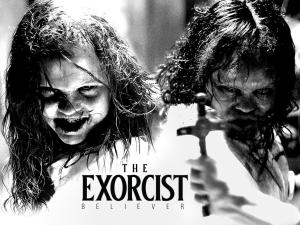
The Exorcist: Believer
© 2023 Universal Pictures/Everett Collection
Religious Music and Entertainment

About James Travis Young
James Travis Young is an ordained minister in the Church of the Nazarene making Christlike disciples alongside his spouse in Galveston, Texas, USA. Travis has served for decades in several active ministry roles including pastor, church planter, and teacher, and his writing has been featured in several publications. You can read more about the author here.
Previous Post

October 3, 2023
Uprooting the Racism of American Churches
Next Post

October 9, 2023 How Giving to the Church Increases Poverty
Browse Our Archives
Select a Category Art & Culture Atonement Book Review Cabrini Cancel Cuture Compassion Complementarianism Culture War Deconstruction Defending Your Life Depression Discipleship Egalitarian Essential Kenosis Evangelicals Evil Faith Faith & Doubt Faith and Mental Health Faith on Film Fear Film Review Foot Washing Fundalmentalists Fundamentalism Gaza Gender Identity Giving Gospel of John Gospel of Matthew Grace Guilt Hamas Healing History Holiness Homelessness Hope Hunger Incarnation Institutional Churches Israel January 6 Jesus Jesus' teachings Jonestown Judgment Kat Von D LGBTQ+ LGBTQ+ Affirmation Life Transformation Lost Coin Love Mercy Murder Neurodivergence Omnipotence Parables Peace Peoples Temple Persecution Personal Story Politics Poll Results Poverty Power Qualified Restoration Atonement Racism Relationships Religious Trauma SBC Schism Sermon on the Mount Sin Social Media Spirituality Suffering Thanksgiving The Exorcist The Shawshank Redemption Theology This Property Is Condemned Thomas Jay Oord Tornado Trump Uncategorized War Women
Select a Month June 2026 January 2026 December 2025 March 2025 December 2024 May 2024 April 2024 March 2024 February 2024 January 2024 December 2023 November 2023 October 2023 September 2023
Follow Us!
TAKE THE
Religious Wisdom Quiz
What sign did Jesus compare to Jonah's three days in the fish?
Select your answer to see how you score.
His resurrection The flood The creation His miracles
Related posts from Sacred Outcasts

Faith on Film: "Defending Your Life"

Wait, Did Jesus Affirm Same-Sex Intimacy?

Faith on Film: “This Property Is Condemned”
TRENDING AT PATHEOS Progressive Christian

Why Christians Have a Sacred Duty to Vote:...
The Bible offers strong support for the sacred duty to vote. Here...

What Being a Modern-Day Apostle Means to Me
In my last column, I discussed the ins and outs of modern-day...

Did Ancient China Once Worship the God of...
Across human history, a common thread weaves through the origins of the...

Love Your Neighbor – Including Earth-Kin: Lev. 19,...
God’s command to love your neighbor means acting in an ethical and...

Lead a Church Study of “Jesus and Lao...
Guest writer Jack Thomas (The Irreverent Reverend) reflects on leading his church...

Principles for Understanding the Apostolic Ministry Today
Whenever people discover that my formal ministry title is "apostle," as in...
view all Progressive Christian blogs
Ad-Free & Subscriber Log-In Subscription Support
- About Us
- 2026 Calendar
- Videos
- Podcasts
- Library of World Religions
- Faith In Media Tracker
- Advertise With Us
- Write for Us
- Privacy Policy
- Terms of Service
- Do Not Sell My Data
- Contact Us
- Radiant Digital
- Manage Newsletter Subscriptions
- Unsubscribe From Notifications
- Sitemap
Copyright 2008-2026, Patheos. All rights reserved.
Subscription Support Ad-Free & Subscriber Log-In
Follow Patheos