
BuddhistCatholicContemplativeEvangelicalGeneral ChristianHinduJewishLatter-day SaintMuslimNew VisionsProgressive Christian
Beliefs
- Buddhist
- Catholic
- Contemplative
- Evangelical
- General Christian
- Hindu
- Jewish
- Latter-day Saint
- More Voices
- Muslim
- New Visions
- Pagan
- Progressive Christian
Topics
- Religion News
- Food and Religion
- Sports and Religion
- Religious Art
- Religious Music and Entertainment
- Religious Events
- History and Religion
- Style and Religion
- Politics and Religion
- Women in Religion
- Recreation Outdoors and Religion
- Business Finance and Religion
- Careers Workplace and Religion
- Education and Religion
- Family Parenting and Religion
- Health Fitness and Religion
- Home and Religion
- Relationships and Religion
- Technology and Religion
- Travel and Religion
Columnists
- Buddhist Columnists
- Business Finance and Religion Columnists
- Careers Workplace and Religion Columnists
- Catholic Columnists
- Contemplative Columnists
- Education and Religion Columnists
- Evangelists Columnists
- Family Parenting and Religion Columnists
- General Christian Columnists
- Health Fitness and Religion Columnists
- Hindu Columnists
- History and Religion Columnists
- Home and Religion Columnists
- Jewish Columnists
- More Voices Columnists
- Latter Day Columnists
- Muslim Columnists
- New Visions Columnists
- Nonreligious Columnists
- Pagan Columnists
- Politics and Religion Columnists
- Progressive Columnists
- Recreation Outdoors and Religion Columnists
- Relationships and Religion Columnists
- Religion News Columnists
- Religious Art Columnists
- Religious Events Columnists
- Religious Music and Entertainment Columnists
- Sports and Religion Columnists
- Style and Religion Columnists
- Technology and Religion Columnists
- Travel and Religion Columnists
- Women in Religion Columnists
Resource Library
- 2026 Calendar
- Library of World Religions
- The 100 Most Holy Places on Earth
- Patheos Answers
- Podcasts
- Videos
- Faith Leaders Database
- Anglican Episcopalian
- Bahai
- Baptist
- Buddhism
- Christianity
- Confucianism
- Eastern Orthodoxy
- Hinduism
- Holiness and Pentecostal
- ISKCON
- Islam
- Judaism
- Lutheran
- Methodist
- The Church of Jesus Christ of Latter-day Saints
- New Age
- Paganism
- Presbytarian and Reformed
- Protestantism
- Religion Behind the Scenes
- Roman Catholic
- Scientology
- Shia Islam
- Sikhism
- Sufism
- Sunni Islam
- Taoism
- Zen
- See all religions
Research Tools
 Ad-Free & Subscriber Log-In Subscription Support
Ad-Free & Subscriber Log-In Subscription Support
Follow Patheos 

- Trending:
- Forgiveness
- |
- Marriage
- |
- Consciousness
- |
- Death Penalty
- |
- Election
- |
- Halloween

- Home
- Progressive Christian
- Relationships and Religion
- How Giving to the Church Increases Poverty
How Giving to the Church Increases Poverty
Last updated on: December 1, 2023 at 9:30 pm by James Travis Young
How Giving to the Church Increases Poverty 2023-12-01T21:30:41-06:00 James Travis Young
Patheos Explore the world's faith through different perspectives on religion and spirituality! Patheos has the views of the prevalent religions and spiritualities of the world.

Your offerings should transform lives. Image by Jeff Jacobs from Pixabay
One thing Christian churches of all denominations, sizes, and structures have in common is that they accept tithes and offerings.
Some are more assumptive in their approach by leaving giving envelopes strategically all around the sanctuary as well as the foyer, then at least once per scheduled service passing offering plates. Others have boxes either at the front or back where individuals can nonchalantly slip in their offerings.
Of course, those techniques have now existed for centuries. Today, a growing number have someone charismatic give a direct appeal as a QR code is displayed on a huge screen, or people can opt-in to SMS messages that relay a giving link.
Often, a prayer is invoked at some point to suggest giving is a pious and reverent activity, that the offerings serve a higher purpose.
How Churches Spend Tithes and Offerings
On average, churches spend 49% of their money on salaries, and after facilities, dues, and other minutiae, only 11% is spent on missions, and 10% on programs.

Yes, clergy deserve pay.
Image by Jenny Friedrichs from Pixabay
Don’t get me wrong: I am sympathetic to the financial needs of clergy. They sacrifice for others, yet their needs are often not met. Our broken system pays clergy wildly differently, with many underpaid. I have personally served as a pastor for a church that was unable to provide any financial compensation.
There are a variety of other means to support clergy other than offerings, including stipends/salary paid by a denomination centrally; revenue from endowments, trusts, and other investments; property rental income; and bi-vocational opportunities.
None of these are easy or especially popular, so the problem remains: when people give at church, very little if any actually goes to those in the community who need the most help.
Even if the ones who need help are clergy.
What is interesting to me is when people drive their shiny cars to a church and give more or less faithfully, and church leaders argue about the landscaping, or the songs selected by their paid musicians, or which new game system they should buy their youth group. Meanwhile, two hundred feet away are hungry and homeless people who have no idea when or where they will have a meal.
Have you paid attention to the needs of those in your community? If you are the church, that’s not someone else’s job, it’s yours.
Jesus Christ: Financial Advisor
Jesus had a lot to say about how his followers should spend money. Here are a few examples:
-
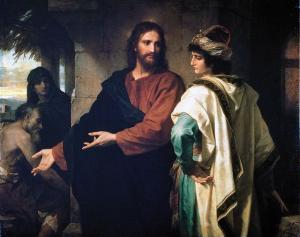
Heinrich Hofmann, “Christ and the Rich Young Ruler”, 1889/Public domain.
“You say, ‘I am rich; I have acquired wealth and do not need a thing.’ But you do not realize that you are wretched, pitiful, poor, blind and naked.” (Revelation 3:17, NIV)
Money can’t buy the things that matter most in life, like love, joy, and peace.
- “No one can serve two masters. Either you will hate the one and love the other, or you will be devoted to the one and despise the other. You cannot serve both God and money.” (Matthew 6:24, NIV)
If we put money before God, it will control us.
- “I tell you, use worldly wealth to gain friends for yourselves, so that when it is gone, you will be welcomed into eternal dwellings.” (Luke 16:9, NIV)
Money is a tool for God’s kingdom to be built relationally.
- “If you want to be perfect, go, sell your possessions and give to the poor, and you will have treasure in heaven. Then come, follow me.” (Matthew 19:21, NIV)
When we give to the poor, we are investing in eternity.
- “Give to the one who asks you, and do not turn away from the one who wants to borrow from you.” (Matthew 5:42, NIV)
How we spend our money shows what is truly important to us.
- “So when you give to the needy, do not announce it with trumpets, as the hypocrites do in the synagogues and on the streets, to be honored by others. Truly I tell you, they have received their reward in full.” (Matthew 6:2, NIV)
Giving in secret protects our hearts from pride and self-seeking.
Money is a valuable resource that can be used for good or evil. When we align our financial priorities with those Jesus voiced, not only can we change the lives of those in our communities who need help, we are investing relationally in God’s kingdom on earth and in eternity.
What would it look like if instead of offering money to a local church, we actually became the church, and gave generously to those with the most need?
Cutting Out the Middleman
Despite Christ teaching to give to anyone who asks, and even instructing the rich young ruler to sell possessions so he can give to the poor, there remain those who are reluctant giving directly to others in need. Many worry or assume street people will take whatever cash they receive and buy drugs or alcohol.
A non-profit based in Canada studied a group of fifty individuals chosen at random whom were given a single lump-sum cash payment of $7,500, which was compared to the annual income assistance rate in British Columbia.
In the first month of the program, the cash group saw a significant drop in homelessness from 77% down to 49%, while the non-cash group’s homelessness increased from 64% to 78%. Cash recipients found homes faster by a margin of a whole year.

Dirty hands are the real offering plate.
Image by Myriams-Fotos from Pixabay
Over the course of 12 months, the cash group spent 4,396 fewer nights homeless, which would suggest giving cash to the poor prevents homelessness.
The study also demonstrated that cash recipients used what they were given primarily towards rent, food, and essential bills, while some spent a portion to feed and clothe their children.
This is not just some isolated experiment. The city of Stockton, California has a program called SEED that gave 125 residents selected at random $500 per month for two years. There were no set parameters or conditions: the participants could spend the money however they saw fit—there wasn’t even a work requirement.
The unconditional cash transfers reduced monthly income fluctuations by 31%, increased full-time employment by 12%, reduced anxiety and depression, and empowered individuals to have more control of their finances, improve goal-setting opportunities, and be better prepared for unexpected expenses. Only 1% was spent on alcohol or tobacco. The program was even shown to improve the health of the participants and their families during the Covid-19 pandemic.
So, obviously, this works.
Some would argue that whatever funds Christ followers would have to offer would just be a drop in the bucket, but that is also false.

Your generosity can transform lives.
/Pexels
In 2021, people in the United States donated $135.78 billion to churches. How different could the world within the reach of our arms look if we started putting our money where our mouths are?
One more question: if the result of giving to the church the way you currently do is the poverty-stricken world we live in, then how could direct giving not be an improvement?
Are You Helping or Hurting?
Our choices have consequences. Passing the plate in whatever form may serve some sort of higher purpose, but not only is it the very least we can do, by giving what we can to the church rather than directly to those who need it, we are increasing poverty.
We must challenge ourselves to break free from the traditional patterns and embrace a new way of giving. The power to change lives, to make a real difference, is within our grasp.
And if we fail to do it, are we really the hands and feet of Jesus?
Business, Finance and Religion

About James Travis Young
James Travis Young is an ordained minister in the Church of the Nazarene making Christlike disciples alongside his spouse in Galveston, Texas, USA. Travis has served for decades in several active ministry roles including pastor, church planter, and teacher, and his writing has been featured in several publications. You can read more about the author here.
Previous Post

October 6, 2023
"The Exorcist: Believer" Film Review
Next Post

October 13, 2023 What Christians Must Know About the Israel-Hamas War
Browse Our Archives
Select a Category Art & Culture Atonement Book Review Cabrini Cancel Cuture Compassion Complementarianism Culture War Deconstruction Defending Your Life Depression Discipleship Egalitarian Essential Kenosis Evangelicals Evil Faith Faith & Doubt Faith and Mental Health Faith on Film Fear Film Review Foot Washing Fundalmentalists Fundamentalism Gaza Gender Identity Giving Gospel of John Gospel of Matthew Grace Guilt Hamas Healing History Holiness Homelessness Hope Hunger Incarnation Institutional Churches Israel January 6 Jesus Jesus' teachings Jonestown Judgment Kat Von D LGBTQ+ LGBTQ+ Affirmation Life Transformation Lost Coin Love Mercy Murder Neurodivergence Omnipotence Parables Peace Peoples Temple Persecution Personal Story Politics Poll Results Poverty Power Qualified Restoration Atonement Racism Relationships Religious Trauma SBC Schism Sermon on the Mount Sin Social Media Spirituality Suffering Thanksgiving The Exorcist The Shawshank Redemption Theology This Property Is Condemned Thomas Jay Oord Tornado Trump Uncategorized War Women
Select a Month June 2026 January 2026 December 2025 March 2025 December 2024 May 2024 April 2024 March 2024 February 2024 January 2024 December 2023 November 2023 October 2023 September 2023
Follow Us!
TAKE THE
Religious Wisdom Quiz
I found the Book of the Law in the temple during repairs and wept when it was read to me. Who am I?
Select your answer to see how you score.
Josiah Asa Hezekiah Joash
Related posts from Sacred Outcasts

We Are Never Ever Getting Back Together


Faith on Film: “This Property Is Condemned”

TRENDING AT PATHEOS Progressive Christian

Why Christians Have a Sacred Duty to Vote:...
The Bible offers strong support for the sacred duty to vote. Here...

What Being a Modern-Day Apostle Means to Me
In my last column, I discussed the ins and outs of modern-day...

Did Ancient China Once Worship the God of...
Across human history, a common thread weaves through the origins of the...

Love Your Neighbor – Including Earth-Kin: Lev. 19,...
God’s command to love your neighbor means acting in an ethical and...

Lead a Church Study of “Jesus and Lao...
Guest writer Jack Thomas (The Irreverent Reverend) reflects on leading his church...

Principles for Understanding the Apostolic Ministry Today
Whenever people discover that my formal ministry title is "apostle," as in...
view all Progressive Christian blogs
Ad-Free & Subscriber Log-In Subscription Support
- About Us
- 2026 Calendar
- Videos
- Podcasts
- Library of World Religions
- Faith In Media Tracker
- Advertise With Us
- Write for Us
- Privacy Policy
- Terms of Service
- Do Not Sell My Data
- Contact Us
- Radiant Digital
- Manage Newsletter Subscriptions
- Unsubscribe From Notifications
- Sitemap
Copyright 2008-2026, Patheos. All rights reserved.
Subscription Support Ad-Free & Subscriber Log-In
Follow Patheos