
BuddhistCatholicContemplativeEvangelicalGeneral ChristianHinduJewishLatter-day SaintMuslimNew VisionsProgressive Christian
Beliefs
- Buddhist
- Catholic
- Contemplative
- Evangelical
- General Christian
- Hindu
- Jewish
- Latter-day Saint
- More Voices
- Muslim
- New Visions
- Pagan
- Progressive Christian
Topics
- Religion News
- Food and Religion
- Sports and Religion
- Religious Art
- Religious Music and Entertainment
- Religious Events
- History and Religion
- Style and Religion
- Politics and Religion
- Women in Religion
- Recreation Outdoors and Religion
- Business Finance and Religion
- Careers Workplace and Religion
- Education and Religion
- Family Parenting and Religion
- Health Fitness and Religion
- Home and Religion
- Relationships and Religion
- Technology and Religion
- Travel and Religion
Columnists
- Buddhist Columnists
- Business Finance and Religion Columnists
- Careers Workplace and Religion Columnists
- Catholic Columnists
- Contemplative Columnists
- Education and Religion Columnists
- Evangelists Columnists
- Family Parenting and Religion Columnists
- General Christian Columnists
- Health Fitness and Religion Columnists
- Hindu Columnists
- History and Religion Columnists
- Home and Religion Columnists
- Jewish Columnists
- More Voices Columnists
- Latter Day Columnists
- Muslim Columnists
- New Visions Columnists
- Nonreligious Columnists
- Pagan Columnists
- Politics and Religion Columnists
- Progressive Columnists
- Recreation Outdoors and Religion Columnists
- Relationships and Religion Columnists
- Religion News Columnists
- Religious Art Columnists
- Religious Events Columnists
- Religious Music and Entertainment Columnists
- Sports and Religion Columnists
- Style and Religion Columnists
- Technology and Religion Columnists
- Travel and Religion Columnists
- Women in Religion Columnists
Resource Library
- 2026 Calendar
- Library of World Religions
- The 100 Most Holy Places on Earth
- Patheos Answers
- Podcasts
- Videos
- Faith Leaders Database
- Anglican Episcopalian
- Bahai
- Baptist
- Buddhism
- Christianity
- Confucianism
- Eastern Orthodoxy
- Hinduism
- Holiness and Pentecostal
- ISKCON
- Islam
- Judaism
- Lutheran
- Methodist
- The Church of Jesus Christ of Latter-day Saints
- New Age
- Paganism
- Presbytarian and Reformed
- Protestantism
- Religion Behind the Scenes
- Roman Catholic
- Scientology
- Shia Islam
- Sikhism
- Sufism
- Sunni Islam
- Taoism
- Zen
- See all religions
Research Tools
 Ad-Free & Subscriber Log-In Subscription Support
Ad-Free & Subscriber Log-In Subscription Support
Follow Patheos 

- Trending:
- Forgiveness
- |
- Marriage
- |
- Consciousness
- |
- Death Penalty
- |
- Election
- |
- Halloween

- Home
- History and Religion
- The Problem with Faith
The Problem with Faith
Last updated on: June 26, 2026 at 11:08 am by Alexander Koritz
The Problem with Faith 2026-06-26T11:08:16-06:00 Alexander Koritz
Patheos Explore the world's faith through different perspectives on religion and spirituality! Patheos has the views of the prevalent religions and spiritualities of the world.
The Problem with Faith
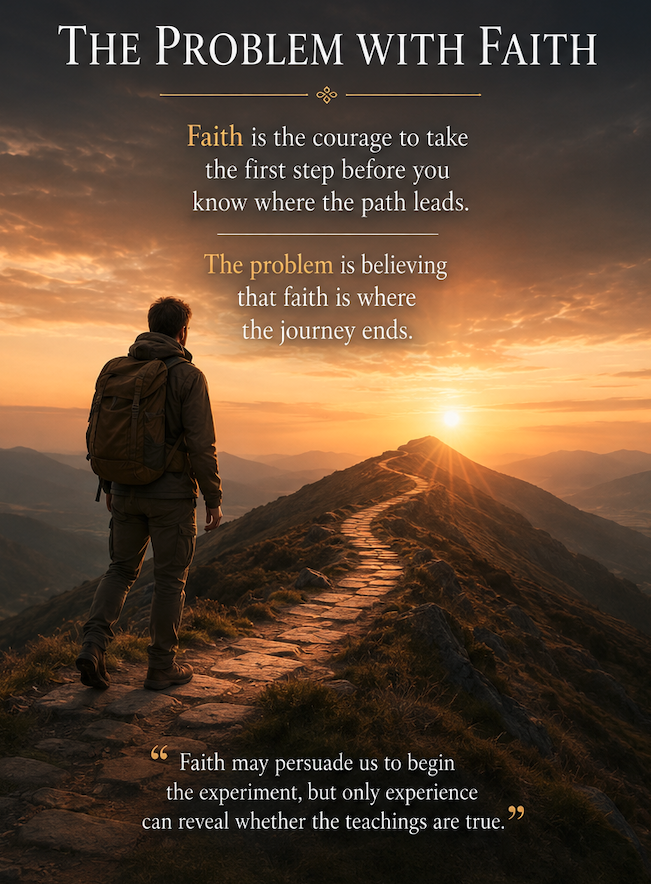
If you asked most religious people to name the highest spiritual virtue, many would answer with a single word: faith. It is praised from pulpits, woven throughout sacred texts and treated as the foundation of the spiritual life. In many ways, that is exactly what faith is. It gives us the courage to take the first step before we know where the path leads. It persuades us to pray before we’ve received an answer, to meditate before we’ve tasted real stillness and to trust that reality extends beyond what our senses can measure. Faith belongs at the beginning of the journey. The mistake is assuming it belongs at the end as well.
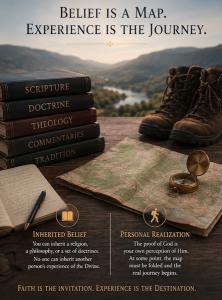
Imagine spending twenty years studying Italy. You know the history of Rome, the architecture of Florence and the paintings of Venice. You can recommend restaurants, discuss regional wines and quote travel guides from memory. Friends ask where to stay in Florence, and you confidently tell them. Someone wants the best neighborhood in Rome, and you have an opinion. Yet you’ve never set foot in the country. However much you’ve learned, Italy remains an idea until you’ve actually been there. Spiritual life can suffer from the same illusion. A person may spend decades studying scripture, memorizing doctrine and defending theology without ever asking the question that matters most: What have I actually experienced? Beliefs can be inherited. Rituals can be inherited. Traditions can be inherited. Experience cannot. No one has ever inherited another person’s encounter with the Divine.
What the Mystics Knew
This isn’t a new criticism of religion. More than 2,500 years ago, the Buddha urged his listeners not to accept a teaching simply because it had been handed down by tradition, preserved in scripture or spoken by respected authorities. In the Kalama Sutta, he invited them to discover for themselves whether a teaching proved true in experience. Centuries later, William James arrived at much the same conclusion after studying religious traditions around the world. In The Varieties of Religious Experience, he described religion primarily as “the feelings, acts, and experiences of individual men in their solitude.” Paramahansa Yogananda made the point even more directly: “The proof of God is your own perception of Him.” These voices came from different cultures, different centuries and different religious traditions, yet all of them pointed toward the same conclusion. Faith may begin the search, but it cannot substitute for the thing being sought.
Certainty, Not Doubt, Is the Enemy
That is why I have never been persuaded that doubt is faith’s greatest enemy. Doubt still asks questions. Doubt still searches. The greater danger is the quiet certainty that tells us there is nothing left to discover. Once that happens, curiosity begins to disappear, and spiritual life slowly gives way to defending conclusions instead of pursuing truth. It is difficult to miss how often the world’s great mystics refused to stop there. Christian contemplatives wrote of union with God. Yogis described samadhi. Jewish mystics sought devekut, an intimate cleaving to the Divine. They disagreed on theology, symbolism and practice, but they shared one remarkable conviction: belief alone was never enough. They expected the spiritual path to culminate in a direct encounter.
A Practice, Not a Proposition
Seen in that light, meditation, contemplation, prayer and self-examination become something more than religious obligations. They are methods of inquiry. Every serious contemplative tradition eventually hands the student a practice rather than another proposition. Sit quietly. Watch the breath. Pray without ceasing. Enter silence. Observe the mind. The invitation is always the same. Stop relying exclusively on what others have reported and begin investigating for yourself. In that respect, spirituality has more in common with science than many people realize. Science asks us to test a hypothesis rather than accept it on authority. The contemplative traditions make a remarkably similar request. Their claims are not meant to be admired from a distance. They are meant to be lived.
Every journey begins with a map. Without one, we rarely know where to start. But no traveler confuses the map with the country itself. At some point it is folded, slipped into a backpack and replaced by dusty roads, unexpected conversations, aching feet and landscapes no drawing could fully capture. Faith deserves its honored place for exactly that reason. It gives us the courage to begin. The journey itself must do the rest.
Previous Post

April 29, 2026
Yeats vs. Crowley: Poetry, Magick and Desire
Next Post
September 7, 2026 My Michigan Relics Story - Part 2
Recent Comments
"Important perspective if you are conscious about God."
Archetypes or God? The Spiritual Cost ..."
"Greetings from the Patheos Pagan channel, where about ten years ago there was a major ..."
Archetypes or God? The Spiritual Cost ..."
"https://uploads.disquscdn.c... The Michigan Tablets and artifacts are authentic. They were found across about 28 Michigan ..."
The Michigan Relics: A Controversial Family ..."
"This is a beautiful and insightful exploration of the concept of divine duality across different ..."
The Cosmic Dance of the Divine ..."
Browse Our Archives
Select a Category Anthroposophy Buddhism Celtic Spirituality Chakras Christmas Concert Contemplative Christianity Early Christianity Entertainment and Spirituality Esoteric Christianity Hinduism Judaism Michigan Relics Native American Mound Builders Politics Psychedelics Rudolf Steiner Sacred Geometry Spirituality of Work Stylianos Atteshlis The Nativity Theosophical Society Transhumanism Uncategorized
Select a Month October 2026 September 2026 June 2026 April 2026 March 2026 February 2026 September 2025 August 2025 May 2025 March 2025 February 2025 December 2024 November 2024 September 2024 July 2024 June 2024 May 2024 April 2024 March 2024 February 2024 January 2024 December 2023 November 2023
TAKE THE
Religious Wisdom Quiz
Nahum describes the Lord as riding in the whirlwind and storms. What does he say are the clouds?
Select your answer to see how you score.
His glory His chariot The dust of his feet His covering
Related posts from Sacred Kaleidoscope
A Weekend With Father Seán ÓLaoire
The Cosmic Dance of the Divine Feminine and...

Mother Mary’s “White Marriage" and the Divine Womb...

Interview with Daniel Joseph - A Researcher of...
TRENDING AT PATHEOS History and Religion

Methodist Central Hall and Westminster Abbey
Situated on the same square is Methodist Central Hall and Westminster Abbey. ...

57th Dove Awards Honor Dolly Parton, Crown New...
On gospel music’s biggest night, the 57th annual GMA Dove Awards honored...

The First Eucharistic Controversy: Christ’s Real Presence
For Catholics, the Eucharist is the source and summit of the Christian...

What a Stop Sign Can Teach Us About...
How to Make a Decision When You Can't Hear God Main point:...

Archdiocese Hosts Military Marriage Retreat in Germany
RASTATT, Germany — The transient military lifestyle, with its frequent deployments and...

Nearly every morning, I make the drive to Detroit with my high-school-age...
view all History and Religion blogs
What Are Your Thoughts?leave a comment
Ad-Free & Subscriber Log-In Subscription Support
- About Us
- 2026 Calendar
- Videos
- Podcasts
- Library of World Religions
- Faith In Media Tracker
- Advertise With Us
- Write for Us
- Privacy Policy
- Terms of Service
- Do Not Sell My Data
- Contact Us
- Radiant Digital
- Manage Newsletter Subscriptions
- Unsubscribe From Notifications
- Sitemap
Copyright 2008-2026, Patheos. All rights reserved.
Subscription Support Ad-Free & Subscriber Log-In
Follow Patheos