
BuddhistCatholicContemplativeEvangelicalGeneral ChristianHinduJewishLatter-day SaintMuslimNew VisionsProgressive Christian
Beliefs
- Buddhist
- Catholic
- Contemplative
- Evangelical
- General Christian
- Hindu
- Jewish
- Latter-day Saint
- More Voices
- Muslim
- New Visions
- Pagan
- Progressive Christian
Topics
- Religion News
- Food and Religion
- Sports and Religion
- Religious Art
- Religious Music and Entertainment
- Religious Events
- History and Religion
- Style and Religion
- Politics and Religion
- Women in Religion
- Recreation Outdoors and Religion
- Business Finance and Religion
- Careers Workplace and Religion
- Education and Religion
- Family Parenting and Religion
- Health Fitness and Religion
- Home and Religion
- Relationships and Religion
- Technology and Religion
- Travel and Religion
Columnists
- Buddhist Columnists
- Business Finance and Religion Columnists
- Careers Workplace and Religion Columnists
- Catholic Columnists
- Contemplative Columnists
- Education and Religion Columnists
- Evangelists Columnists
- Family Parenting and Religion Columnists
- General Christian Columnists
- Health Fitness and Religion Columnists
- Hindu Columnists
- History and Religion Columnists
- Home and Religion Columnists
- Jewish Columnists
- More Voices Columnists
- Latter Day Columnists
- Muslim Columnists
- New Visions Columnists
- Nonreligious Columnists
- Pagan Columnists
- Politics and Religion Columnists
- Progressive Columnists
- Recreation Outdoors and Religion Columnists
- Relationships and Religion Columnists
- Religion News Columnists
- Religious Art Columnists
- Religious Events Columnists
- Religious Music and Entertainment Columnists
- Sports and Religion Columnists
- Style and Religion Columnists
- Technology and Religion Columnists
- Travel and Religion Columnists
- Women in Religion Columnists
Resource Library
- 2026 Calendar
- Library of World Religions
- The 100 Most Holy Places on Earth
- Patheos Answers
- Podcasts
- Videos
- Faith Leaders Database
- Anglican Episcopalian
- Bahai
- Baptist
- Buddhism
- Christianity
- Confucianism
- Eastern Orthodoxy
- Hinduism
- Holiness and Pentecostal
- ISKCON
- Islam
- Judaism
- Lutheran
- Methodist
- The Church of Jesus Christ of Latter-day Saints
- New Age
- Paganism
- Presbytarian and Reformed
- Protestantism
- Religion Behind the Scenes
- Roman Catholic
- Scientology
- Shia Islam
- Sikhism
- Sufism
- Sunni Islam
- Taoism
- Zen
- See all religions
Research Tools
 Ad-Free & Subscriber Log-In Subscription Support
Ad-Free & Subscriber Log-In Subscription Support
Follow Patheos 

- Trending:
- Forgiveness
- |
- Marriage
- |
- Consciousness
- |
- Death Penalty
- |
- Election
- |
- Halloween

- Home
- Pagan
- History and Religion
- Yeats vs. Crowley: Poetry, Magick and Desire
Yeats vs. Crowley: Poetry, Magick and Desire
Last updated on: April 29, 2026 at 3:34 pm by Alexander Koritz
Yeats vs. Crowley: Poetry, Magick and Desire 2026-04-29T15:34:39-06:00 Alexander Koritz
Patheos Explore the world's faith through different perspectives on religion and spirituality! Patheos has the views of the prevalent religions and spiritualities of the world.
Some rivalries make sense when you look back on them. Others feel destined. The conflict between Aleister Crowley and W. B. Yeats falls into that second category. It wasn’t just a disagreement over personality or ideas. There was more behind it—a real divide over what the unseen world was, and what you were supposed to do with it once you touched it. A divide that may have felt at home in the worlds of The Lord of the Rings or Harry Potter.
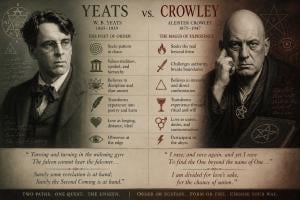
They crossed paths inside the Hermetic Order of the Golden Dawn, a strange meeting ground for poets, mystics, and people convinced there was something just out of reach. Yeats had already found his footing there. He took the system seriously—the symbols, the rituals, the slow progression through its structure. For him, magic wasn’t something you rushed. It was something you learned to hear, the way a poem changes the longer you sit with it.
Crowley arrived with a very different instinct. He wasn’t there to inherit anything. He wanted to push at it, test it, see where it broke. Where Yeats leaned toward refinement, Crowley leaned toward intensity. At first it sat in the background. It didn’t stay there.
By 1900, the order was already coming apart, and that tension gave Crowley an opening. Backed by Samuel Liddell MacGregor Mathers, he tried to assert authority over the London temple. The story has been told so often it feels half-real, half-performed: Crowley arriving in ceremonial dress, expecting to be recognized, only to be met at the door.
Yeats refused to let him in.
However it unfolded in detail, the moment stuck. Crowley turned away. Yeats holding his ground. One man trying to force his way forward, the other insisting there were still lines that couldn’t be crossed.
It wasn’t really about control of the order. It was about what the work itself demanded.
You can hear it in their writing. In The Second Coming, Yeats stands back just far enough to shape what he sees:
“Turning and turning in the widening gyre
The falcon cannot hear the falconer…”
Even as things fall apart, he’s looking for pattern. There’s distance in it, and a kind of restraint. The world may be breaking, but he refuses to let it dissolve completely.
Crowley doesn’t hold that distance. He moves straight into the experience:
“I rave; and rave again, and yet I rave
To find the One beyond the name of One…”
There’s no effort to contain it. He isn’t observing the edge—he’s trying to push through it.

The same split shows up in how they lived. Crowley chased altered states wherever he could find them—ritual, sex, drugs. Heroin and cocaine became part of that pursuit. He believed if you went far enough, something would give, something real would break through. Sometimes it seemed like it did. Other times, the cost was obvious.
Yeats didn’t trust that path. He wasn’t less interested in transcendence, but he approached it differently. Discipline, for him, wasn’t a barrier. It was the method. You didn’t tear yourself open to reach something higher. You built toward it, carefully, piece by piece.
Their relationships followed the same pattern. Yeats’s connection to Maud Gonne carried a kind of distance, a sense that the feeling itself mattered more than its outcome. Love, in his world, often stayed just out of reach, shaped into something that could live inside language.
Crowley closed that distance. He moved directly into experience, folding desire into his philosophy and his practice. They moved through overlapping circles where attention and admiration carried weight, and it’s not hard to imagine how that difference added another layer to the tension between them.
Even with all that, their stories stay tied together. Yeats became a central literary figure, eventually winning the Nobel Prize and helping shape a cultural identity through his work. Crowley moved in a different direction, becoming a figure people either followed or warned against, depending on where they stood. Still, each reflects something the other refused to become. Yeats holds the line, giving form to something that might otherwise scatter. Crowley keeps pressing against it, unwilling to accept that any boundary is final.
What sits underneath their rivalry hasn’t really gone away. Both were trying to reach beyond ordinary experience, to touch something they believed was real. They just couldn’t agree on how far you were supposed to go.
Yeats, still searching for order even at the edge of collapse, writes:
“Surely some revelation is at hand;
Surely the Second Coming is at hand.”
There’s patience in that voice, a sense that meaning arrives when it’s ready.
Crowley answers in a different tone:
“I am divided for love’s sake, for the chance of union.”
He doesn’t wait for anything to arrive. He moves toward it, even if it means breaking himself along the way.
Put them next to each other and their epic difference is hard to miss. Yeats keeps his distance, waiting for meaning to take shape while standing in the light. Crowley doesn’t wait. He steps straight into darkness, convinced that whatever matters is on the other side.
Pagan
Progressive Christian
Hermetic Order of the Golden Dawn
Previous Post
March 12, 2026
Was James the Just Jesus' True Successor?
Next Post

June 24, 2026 The Problem with Faith
Recent Comments
"Important perspective if you are conscious about God."
Archetypes or God? The Spiritual Cost ..."
"Greetings from the Patheos Pagan channel, where about ten years ago there was a major ..."
Archetypes or God? The Spiritual Cost ..."
"https://uploads.disquscdn.c... The Michigan Tablets and artifacts are authentic. They were found across about 28 Michigan ..."
The Michigan Relics: A Controversial Family ..."
"This is a beautiful and insightful exploration of the concept of divine duality across different ..."
The Cosmic Dance of the Divine ..."
Browse Our Archives
Select a Category Anthroposophy Buddhism Celtic Spirituality Chakras Christmas Concert Contemplative Christianity Early Christianity Entertainment and Spirituality Esoteric Christianity Hinduism Judaism Michigan Relics Native American Mound Builders Politics Psychedelics Rudolf Steiner Sacred Geometry Spirituality of Work Stylianos Atteshlis The Nativity Theosophical Society Transhumanism Uncategorized
Select a Month October 2026 September 2026 June 2026 April 2026 March 2026 February 2026 September 2025 August 2025 May 2025 March 2025 February 2025 December 2024 November 2024 September 2024 July 2024 June 2024 May 2024 April 2024 March 2024 February 2024 January 2024 December 2023 November 2023
TAKE THE
Religious Wisdom Quiz
Who parted the Red Sea for the Israelites?
Select your answer to see how you score.
Jacob Moses Aaron God
Related posts from Sacred Kaleidoscope
Was James the Just Jesus' True Successor?
Café Central: A Quiet Stage for the Crossroads...
Did the Nazis Kill Rudolf Steiner? Exploring the...
The Cosmic Dance of the Divine Feminine and...
TRENDING AT PATHEOS History and Religion

In "Irreplaceable," our book on vocation and technology, Trevor Sutton and I...

I was strolling through the top floor of the brand new Parthenon...

What Does Gêvâh Mean For Kimberley Guifoyle &...
This week, a lot of the news is focused on Kimberly Guilfoyle....

INNER CIRCLE: Profound Mystery (Of Christ In All...
Ephesians 5:31-32 “For this reason, a man will leave his father and...

Do Not Rejoice When Your Enemy Falls: The...
Turning an execution into a public spectacle is a disturbing expression of...

'The Chosen' S6 Trailer: The Passion Gets Very...
Not many watching 'The Chosen' worry about spoilers, but just because they...
view all History and Religion blogs
What Are Your Thoughts?leave a comment
Ad-Free & Subscriber Log-In Subscription Support
- About Us
- 2026 Calendar
- Videos
- Podcasts
- Library of World Religions
- Faith In Media Tracker
- Advertise With Us
- Write for Us
- Privacy Policy
- Terms of Service
- Do Not Sell My Data
- Contact Us
- Radiant Digital
- Manage Newsletter Subscriptions
- Unsubscribe From Notifications
- Sitemap
Copyright 2008-2026, Patheos. All rights reserved.
Subscription Support Ad-Free & Subscriber Log-In
Follow Patheos