
BuddhistCatholicContemplativeEvangelicalGeneral ChristianHinduJewishLatter-day SaintMuslimNew VisionsProgressive Christian
Beliefs
- Buddhist
- Catholic
- Contemplative
- Evangelical
- General Christian
- Hindu
- Jewish
- Latter-day Saint
- More Voices
- Muslim
- New Visions
- Pagan
- Progressive Christian
Topics
- Religion News
- Food and Religion
- Sports and Religion
- Religious Art
- Religious Music and Entertainment
- Religious Events
- History and Religion
- Style and Religion
- Politics and Religion
- Women in Religion
- Recreation Outdoors and Religion
- Business Finance and Religion
- Careers Workplace and Religion
- Education and Religion
- Family Parenting and Religion
- Health Fitness and Religion
- Home and Religion
- Relationships and Religion
- Technology and Religion
- Travel and Religion
Columnists
- Buddhist Columnists
- Business Finance and Religion Columnists
- Careers Workplace and Religion Columnists
- Catholic Columnists
- Contemplative Columnists
- Education and Religion Columnists
- Evangelists Columnists
- Family Parenting and Religion Columnists
- General Christian Columnists
- Health Fitness and Religion Columnists
- Hindu Columnists
- History and Religion Columnists
- Home and Religion Columnists
- Jewish Columnists
- More Voices Columnists
- Latter Day Columnists
- Muslim Columnists
- New Visions Columnists
- Nonreligious Columnists
- Pagan Columnists
- Politics and Religion Columnists
- Progressive Columnists
- Recreation Outdoors and Religion Columnists
- Relationships and Religion Columnists
- Religion News Columnists
- Religious Art Columnists
- Religious Events Columnists
- Religious Music and Entertainment Columnists
- Sports and Religion Columnists
- Style and Religion Columnists
- Technology and Religion Columnists
- Travel and Religion Columnists
- Women in Religion Columnists
Resource Library
- 2026 Calendar
- Library of World Religions
- The 100 Most Holy Places on Earth
- Patheos Answers
- Podcasts
- Videos
- Faith Leaders Database
- Anglican Episcopalian
- Bahai
- Baptist
- Buddhism
- Christianity
- Confucianism
- Eastern Orthodoxy
- Hinduism
- Holiness and Pentecostal
- ISKCON
- Islam
- Judaism
- Lutheran
- Methodist
- The Church of Jesus Christ of Latter-day Saints
- New Age
- Paganism
- Presbytarian and Reformed
- Protestantism
- Religion Behind the Scenes
- Roman Catholic
- Scientology
- Shia Islam
- Sikhism
- Sufism
- Sunni Islam
- Taoism
- Zen
- See all religions
Research Tools
 Ad-Free & Subscriber Log-In Subscription Support
Ad-Free & Subscriber Log-In Subscription Support
Follow Patheos 

- Trending:
- Forgiveness
- |
- Marriage
- |
- Consciousness
- |
- Death Penalty
- |
- Election
- |
- Halloween

- Home
- General Christian
- History and Religion
- Did the Nazis Kill Rudolf Steiner? Exploring the Conspiracy
Did the Nazis Kill Rudolf Steiner? Exploring the Conspiracy
Last updated on: December 19, 2025 at 11:54 am by Alexander Koritz
Did the Nazis Kill Rudolf Steiner? Exploring the Conspiracy 2025-12-19T11:54:00-07:00 Alexander Koritz
Patheos Explore the world's faith through different perspectives on religion and spirituality! Patheos has the views of the prevalent religions and spiritualities of the world.
As I’ve continued to study Rudolf Steiner’s life and work, one question keeps resurfacing in discussions among his followers and students of spiritual history: the unusual circumstances around his death.
Rudolf Steiner (1861–1925) was one of the most influential spiritual figures of the early 20th century. A philosopher, educator, and mystic, he inspired movements as varied as Waldorf education, biodynamic farming, and the spiritual practice known as anthroposophy. His ideas reached beyond the intellectual, aiming to uncover deeper layers of human experience and development.
But Steiner’s message was not universally welcomed. In the years after World War I, Central Europe was roiled by rising nationalism, racist ideologies, and authoritarian movements. Steiner stood firmly against ethnonationalism and doctrines that divided people by race or class. That stance drew sharp criticism from emerging right‑wing voices, including some who would later shape extremist politics. His public opposition to these currents put him in the crosshairs of critics who saw his work as a threat to their worldview.
Steiner passed away on March 30, 1925, after suffering from a prolonged illness. Yet in certain spiritual and esoteric circles, there remains an enduring question: was his passing truly the result of natural causes—or was it something more intentional, tied to the tumultuous forces of the era?

Voices of Speculation and Interpretation
In the early 1920s, Steiner did not shy away from speaking against the steep turn toward nationalism and intolerance. He was openly criticized in right‑leaning publications; one critic, Dietrich Eckart, even referred to Steiner using anti‑Semitic slurs, and Adolf Hitler dismissed his work as “Jewish methods.” On one occasion, a Munich lecture was interrupted with stink bombs and disruptive tactics. That same week marked the assassination of Steiner’s friend and German Foreign Minister, Walther Rathenau, by nationalist extremists.
Steiner himself acknowledged that powerful opposition existed. He once remarked that certain forces did not want “this work to continue,” though he never explicitly named those forces.
As his health declined in late 1924, contemporaries described his illness as sudden and dramatic. Some accounts from those close to him describe an episode after sharing tea with friends, after which he became severely unwell. He continued to work despite his condition, driven by a deep sense of purpose. Such details have fueled speculation in some circles that he might have been poisoned, even though there is no physical or forensic evidence to support this idea.
Among those who explore these questions from within the anthroposophical tradition, a range of interpretations has emerged:
Thomas Meyer a contemporary writer, has suggested that Steiner’s death may have involved deliberate poisoning. Meyer draws on personal recollections from those who were with Steiner late in his life, noting mysterious symptoms and the beliefs of Steiner’s inner circle. While he does not claim hard proof, Meyer frames the discussion as part of a larger spiritual struggle.
Emanuel Zeylmans van Emmichoven, a physician connected with Steiner’s circle, also recorded that figures like Steiner’s wife, Marie, and close collaborator Ita Wegman privately held the belief that Steiner was poisoned. For Zeylmans, this idea was not a literal accusation so much as a reflection of the spiritual conflict they sensed around Steiner’s work.
Peter Tradowsky in his writings, touches on how Steiner stood in ideological tension with rising authoritarian currents, suggesting that Steiner’s path was opposed by forces hostile to his message. He stops short of naming a specific culprits but speaks to the broader spiritual and cultural pushback Steiner faced.
Sergei O. Prokofieff and other commentators expand on the notion that the emerging fascist mentality represented a kind of spiritual resistance to Steiner’s vision, although they do not present poisoning as a verified fact.
What History Says
From a conventional historical perspective, Steiner’s death is attributed to natural causes. He suffered from chronic stomach ailments for years, and the rigors of his schedule and health struggles likely contributed to his decline. There is no record of an autopsy or toxicology report, and no contemporary medical professionals publicly suggested foul play at the time.
Most mainstream historians see his passing as the culmination of prolonged illness and exhaustion rather than the result of a targeted act.
A Personal Take
Within esoteric communities, the question lingers—not always as a literal claim, but as a symbol of the larger challenges Steiner faced. That Marie Steiner and Ita Wegman continued to speak of poisoning through their lives is a testament to how deeply they felt his loss and how hard they believed he worked until the end.
But perhaps the deeper significance lies not in proving a specific cause, but in understanding what Steiner’s life and final days represent to those who see his work as part of a larger spiritual journey. Whether or not there was any malicious force involved, his death came at a moment when the world was tilting toward ideologies that would bring immense suffering.
In that sense, his passing feels less like an isolated event and more like a turning point in a broader cultural and spiritual struggle. It invites us to reflect not just on the circumstances of his death, but on the values he championed—and how those values resonate in a world still grappling with conflict, meaning, and human purpose.
An enemy of Nazism
Mainstream Historical View vs. Speculative Theory
Most traditional historians agree that Steiner’s death was the result of natural causes—likely stemming from chronic stomach issues that had plagued him for years. They point to his intense workload, stress, and self-imposed exhaustion as sufficient explanation for his physical collapse. There are no records of an autopsy or toxicological investigation, nor any contemporary accusations of foul play from medical personnel.
My Conclusion
In esoteric circles, the question of Steiner’s death still lingers. We should take very seriously the fast that Marie Steiner and Ita Wegman (the former Steiner’s wife and the latter his physician) believe he was poisoned, holding that view for the rest of their lives.
That being said, Steiner’s death feels less like the end of a biography and more like a moment within a larger spiritual conflict—one between the forces of evolution and those that would pull humanity backward. In that sense, whether or not Steiner was physically poisoned becomes less central than what his death symbolized to those who saw in him a kind of spiritual illusionary—someone who stood himself as a Guardian of the Threshold in a changing world, confronting the destructive ideologies that were giving birth to the calamities of the 20th century.
General Christian
Contemplative
Education and Religion
Previous Post

May 23, 2025
The Cosmic Dance of the Divine Feminine and Masculine
Next Post

September 1, 2025 Café Central: A Quiet Stage for the Crossroads of History
Recent Comments
"Important perspective if you are conscious about God."
Archetypes or God? The Spiritual Cost ..."
"Greetings from the Patheos Pagan channel, where about ten years ago there was a major ..."
Archetypes or God? The Spiritual Cost ..."
"https://uploads.disquscdn.c... The Michigan Tablets and artifacts are authentic. They were found across about 28 Michigan ..."
The Michigan Relics: A Controversial Family ..."
"This is a beautiful and insightful exploration of the concept of divine duality across different ..."
The Cosmic Dance of the Divine ..."
Browse Our Archives
Select a Category Anthroposophy Buddhism Celtic Spirituality Chakras Christmas Concert Contemplative Christianity Early Christianity Entertainment and Spirituality Esoteric Christianity Hinduism Judaism Michigan Relics Native American Mound Builders Politics Psychedelics Rudolf Steiner Sacred Geometry Spirituality of Work Stylianos Atteshlis The Nativity Theosophical Society Transhumanism Uncategorized
Select a Month October 2026 September 2026 June 2026 April 2026 March 2026 February 2026 September 2025 August 2025 May 2025 March 2025 February 2025 December 2024 November 2024 September 2024 July 2024 June 2024 May 2024 April 2024 March 2024 February 2024 January 2024 December 2023 November 2023
TAKE THE
Religious Wisdom Quiz
Why were the plagues significant against Egyptian beliefs?
Select your answer to see how you score.
Each plague targeted an Egyptian god They were random acts of nature They were meant to test Pharaoh’s patience Pharaoh had offended the Hebrew people
Related posts from Sacred Kaleidoscope
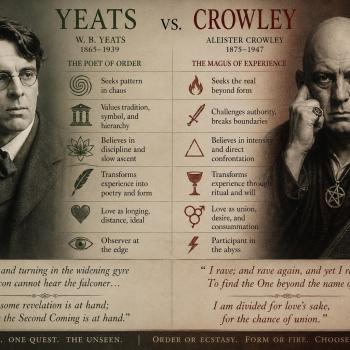
Yeats vs. Crowley: Poetry, Magick and Desire

Was James the Just Jesus' True Successor?
Café Central: A Quiet Stage for the Crossroads...
The Cosmic Dance of the Divine Feminine and...
TRENDING AT PATHEOS History and Religion

I was strolling through the top floor of the brand new Parthenon...

What Does Gêvâh Mean For Kimberley Guifoyle &...
This week, a lot of the news is focused on Kimberly Guilfoyle....

INNER CIRCLE: Profound Mystery (Of Christ In All...
Ephesians 5:31-32 “For this reason, a man will leave his father and...

Do Not Rejoice When Your Enemy Falls: The...
Turning an execution into a public spectacle is a disturbing expression of...

'The Chosen' S6 Trailer: The Passion Gets Very...
Not many watching 'The Chosen' worry about spoilers, but just because they...

The purpose-driven labor priest
A labor activist reads Rick Warren and it gets me wondering about...
view all History and Religion blogs
What Are Your Thoughts?leave a comment
Ad-Free & Subscriber Log-In Subscription Support
- About Us
- 2026 Calendar
- Videos
- Podcasts
- Library of World Religions
- Faith In Media Tracker
- Advertise With Us
- Write for Us
- Privacy Policy
- Terms of Service
- Do Not Sell My Data
- Contact Us
- Radiant Digital
- Manage Newsletter Subscriptions
- Unsubscribe From Notifications
- Sitemap
Copyright 2008-2026, Patheos. All rights reserved.
Subscription Support Ad-Free & Subscriber Log-In
Follow Patheos