
BuddhistCatholicContemplativeEvangelicalGeneral ChristianHinduJewishLatter-day SaintMuslimNew VisionsProgressive Christian
Beliefs
- Buddhist
- Catholic
- Contemplative
- Evangelical
- General Christian
- Hindu
- Jewish
- Latter-day Saint
- More Voices
- Muslim
- New Visions
- Pagan
- Progressive Christian
Topics
- Religion News
- Food and Religion
- Sports and Religion
- Religious Art
- Religious Music and Entertainment
- Religious Events
- History and Religion
- Style and Religion
- Politics and Religion
- Women in Religion
- Recreation Outdoors and Religion
- Business Finance and Religion
- Careers Workplace and Religion
- Education and Religion
- Family Parenting and Religion
- Health Fitness and Religion
- Home and Religion
- Relationships and Religion
- Technology and Religion
- Travel and Religion
Columnists
- Buddhist Columnists
- Business Finance and Religion Columnists
- Careers Workplace and Religion Columnists
- Catholic Columnists
- Contemplative Columnists
- Education and Religion Columnists
- Evangelists Columnists
- Family Parenting and Religion Columnists
- General Christian Columnists
- Health Fitness and Religion Columnists
- Hindu Columnists
- History and Religion Columnists
- Home and Religion Columnists
- Jewish Columnists
- More Voices Columnists
- Latter Day Columnists
- Muslim Columnists
- New Visions Columnists
- Nonreligious Columnists
- Pagan Columnists
- Politics and Religion Columnists
- Progressive Columnists
- Recreation Outdoors and Religion Columnists
- Relationships and Religion Columnists
- Religion News Columnists
- Religious Art Columnists
- Religious Events Columnists
- Religious Music and Entertainment Columnists
- Sports and Religion Columnists
- Style and Religion Columnists
- Technology and Religion Columnists
- Travel and Religion Columnists
- Women in Religion Columnists
Resource Library
- 2026 Calendar
- Library of World Religions
- The 100 Most Holy Places on Earth
- Patheos Answers
- Podcasts
- Videos
- Faith Leaders Database
- Anglican Episcopalian
- Bahai
- Baptist
- Buddhism
- Christianity
- Confucianism
- Eastern Orthodoxy
- Hinduism
- Holiness and Pentecostal
- ISKCON
- Islam
- Judaism
- Lutheran
- Methodist
- The Church of Jesus Christ of Latter-day Saints
- New Age
- Paganism
- Presbytarian and Reformed
- Protestantism
- Religion Behind the Scenes
- Roman Catholic
- Scientology
- Shia Islam
- Sikhism
- Sufism
- Sunni Islam
- Taoism
- Zen
- See all religions
Research Tools
 Ad-Free & Subscriber Log-In Subscription Support
Ad-Free & Subscriber Log-In Subscription Support
Follow Patheos 

- Trending:
- Forgiveness
- |
- Marriage
- |
- Consciousness
- |
- Death Penalty
- |
- Election
- |
- Halloween

- Home
- Progressive Christian
- History and Religion
- Who Were the Three Wise Men? Unraveling Centuries of Myth and Tradition
Who Were the Three Wise Men? Unraveling Centuries of Myth and Tradition
Last updated on: December 7, 2023 at 10:42 pm by Alexander Koritz
Who Were the Three Wise Men? Unraveling Centuries of Myth and Tradition 2023-12-07T22:42:18-07:00 Alexander Koritz
Patheos Explore the world's faith through different perspectives on religion and spirituality! Patheos has the views of the prevalent religions and spiritualities of the world.
I’ve always been fascinated with the Three Wise Men of the Nativity Story. While growing up, my family maintained a Christmas Eve tradition of gathering around the fireplace and reading The Story of the Other Wise Man, a fictional tale written by Henry Van Dyke. The touching story features a Magi named Artaban who sees a sign in the heavens that he hopes will lead him to the Messiah. Artaban takes with him three precious gifts to present to the Messiah only to miss Him at every turn. For 33 years Artaban pursued Jesus, and ultimately the Lord appeared to him as he lay dying.
The identities of the Three Wise Men, also known as the Magi or Kings, have been a subject of speculation, legend, and literature since the early days of Christianity. The biblical account of these visitors can be found in the Gospel of Matthew, where they are described as “wise men from the East”, who followed a star that led them to Bethlehem to pay homage to the newborn Jesus. The gospel does not provide their names or backgrounds, but over time, various Christian traditions have eagerly filled in these details.
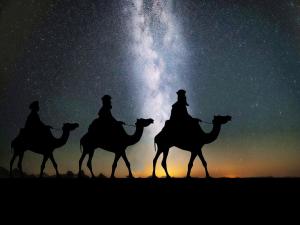
The Three Wise Men – Pixabay
Stemming from tradition, the most commonly accepted names of the Three Wise Men are Caspar, Melchior, and Balthazar. These names and identities appear to have originated in the Western Christian church during the medieval period and have no foundation in the biblical texts. Their supposed origins are as follows:
- Melchior is often depicted as an elderly man, sometimes with a white beard, representing the Magi of Persia. He is traditionally said to have brought gold to Jesus, which is symbolic of Jesus’ royal standing.
- Caspar is usually shown as younger, beardless, and sometimes as a man of Indian or occasionally Ethiopian descent. Caspar’s gift of frankincense is symbolic of Jesus’ divinity and the worship due to Him.
- Balthazar is frequently depicted as a middle-aged man with a dark beard, representing the Arabian Magi. His gift, myrrh, is a resin used for anointing the dead, perhaps foreshadowing Jesus’ death and embalming.
The origins of these names are shrouded in mystery and seem to have been a result of a confluence of Christian tradition, myth, and literature rather than historical documentation. The early Christian church father Tertullian suggested that these men were kings because the Old Testament had prophesied that kings would come to worship the Messiah. This interpretation led to the portrayal of the Magi as kings in Western art and Christian culture.
It is also believed that these three gifts had prophetic significance beyond their material value. Gold was a gift for a king; frankincense, as a perfume or incense, was associated with deity; and myrrh, an embalming oil, was a symbol of death.
Throughout the Christian world, the identities of the Three Wise Men are celebrated in various ways. In Western Christianity, the Feast of the Epiphany on January 6th marks their visit. In some cultures, this day is celebrated with gift-giving, in memory of the gifts brought to Jesus. The Eastern Orthodox Church, on the other hand, tends to emphasize the baptism of Jesus in their celebration of the Epiphany and does not give as much attention to the Magi.

The Nativity – Pixabay
Veering a bit from history and into the esoteric, Paramhansa Yogananda, a preeminent spiritual figure and founder of the Self-Realization Fellowship, offered a unique interpretation of the Christmas story’s Three Wise Men. In his teachings, he claims that these biblical sages were none other than his own lineage of gurus in previous incarnations: Mahavatar Babaji, Lahiri Mahasaya, and Sri Yukteswar. According to Yogananda, these gurus have guided humanity across ages, assuming different forms to impart spiritual wisdom.
Lahiri Mahasaya, a householder guru, played a pivotal role in the revival of Kriya Yoga, a sacred meditation technique aimed at hastening spiritual development. Sri Yukteswar, Yogananda’s direct guru, was known for his deep astrological understanding and spiritual insight. Babaji, who is considered an immortal yogi and a divine incarnation who resides in the deep Himalayas, is said to have retained his physical form for centuries and is believed by Yogananda’s followers to be a manifestation of the divine who comes to help humanity in times of great need. We hear echoes of this “divine assistance” from Krishna’s life mission as told in the Bhagavad Gita and within the Bodhisattva tradition found within Buddhism.
Yogananda’s assertion that these three served as the Magi offers a mystical bridge between Christian and Eastern traditions, symbolizing a universal quest for enlightenment that transcends the boundaries of time and religion. This perspective is detailed in his seminal work, “Autobiography of a Yogi“, where he explores the deeper spiritual connections and meanings behind such stories, suggesting an intertwining of spiritual paths and a shared divine heritage.
Dr. Stylianos Atteshlis, typically known by his spiritual name Daskalos (meaning “teacher” in Greek), offered an eclectic blend of teachings that drew upon Christian mysticism, esoteric doctrines, and insights from his own spiritual development. Among his many intriguing teachings, he presented an alternative perspective on the narrative of the Three Wise Men. Daskalos identified these figures not merely as anonymous wise men but as prominent figures from diverse cultural backgrounds, each representing a distinct lineage of wisdom and spirituality.
According to Daskalos, the first of these was the Bedouin Shakh Baal-das-Aaussar, “The Servant of Osiris,” suggesting a link to Egyptian mysticism and the worship of Osiris, an Egyptian deity associated with the afterlife, resurrection, and the cycle of Nile floods that Egypt relied upon. The second figure was described as a king from India, the Maharajah Rama Tavaivahan. Upon seeing the Christ Child he reportedly exclaimed “Ham El Khior,” interpreted by Daskalos as “I see God” in Sanskrit, symbolizing the recognition of divinity. This profound declaration led to the Indian king becoming known as Maharajah Ham El Khio, a title that reflected his spiritual epiphany. Lastly, Daskalos spoke of the Armenian King Gaspar, integrating the Christian tradition with Armenian royal lineage, thereby weaving a rich tapestry of intercultural spiritual leadership converging to honor the birth of Christ. Daskalos’ teachings aimed to synchronize various spiritual paths and promote a universal quest for the divine.
The enduring mystery and allure of the Three Wise Men from the Nativity Story, transcending centuries of myth and tradition, continues to inspire and intrigue. From the traditional Christian names of Caspar, Melchior, and Balthazar to the esoteric interpretations by figures like Paramhansa Yogananda and Daskalos, these enigmatic figures embody a rich confluence of history, spirituality, and culture. Whether viewed as symbolic emissaries in a religious narrative or as a metaphorical bridge connecting diverse spiritual paths, their story invites us to explore deeper meanings and universal truths found in the Nativity story.
Progressive Christian
Jewish

About Alex Koritz
Alex is a student of various esoteric traditions found within Buddhism, Christianity, Hinduism, Shamanism and more. You can read more about the author here.
Previous Post

November 28, 2023
The Divine Blueprint: Sacred Geometry and the Spiritual Journey
Next Post

December 12, 2023 Can Buddhism Save the World?
Recent Comments
"Important perspective if you are conscious about God."
Archetypes or God? The Spiritual Cost ..."
"Greetings from the Patheos Pagan channel, where about ten years ago there was a major ..."
Archetypes or God? The Spiritual Cost ..."
"https://uploads.disquscdn.c... The Michigan Tablets and artifacts are authentic. They were found across about 28 Michigan ..."
The Michigan Relics: A Controversial Family ..."
"This is a beautiful and insightful exploration of the concept of divine duality across different ..."
The Cosmic Dance of the Divine ..."
Browse Our Archives
Select a Category Anthroposophy Buddhism Celtic Spirituality Chakras Christmas Concert Contemplative Christianity Early Christianity Entertainment and Spirituality Esoteric Christianity Hinduism Judaism Michigan Relics Native American Mound Builders Politics Psychedelics Rudolf Steiner Sacred Geometry Spirituality of Work Stylianos Atteshlis The Nativity Theosophical Society Transhumanism Uncategorized
Select a Month October 2026 September 2026 June 2026 April 2026 March 2026 February 2026 September 2025 August 2025 May 2025 March 2025 February 2025 December 2024 November 2024 September 2024 July 2024 June 2024 May 2024 April 2024 March 2024 February 2024 January 2024 December 2023 November 2023
TAKE THE
Religious Wisdom Quiz
What Christian group believes in the doctrine of transubstantiation?
Select your answer to see how you score.
Protestants Baptists Catholics Pentecostals
Related posts from Sacred Kaleidoscope
Mother Mary’s “White Marriage" and the Divine Womb...
Voices from the Hills: The Tabernacle Choir's Welsh...

A Weekend With Father Seán ÓLaoire
My Michigan Relics Story - Part 2
TRENDING AT PATHEOS History and Religion

I was strolling through the top floor of the brand new Parthenon...

What Does Gêvâh Mean For Kimberley Guifoyle &...
This week, a lot of the news is focused on Kimberly Guilfoyle....

INNER CIRCLE: Profound Mystery (Of Christ In All...
Ephesians 5:31-32 “For this reason, a man will leave his father and...

Do Not Rejoice When Your Enemy Falls: The...
Turning an execution into a public spectacle is a disturbing expression of...

'The Chosen' S6 Trailer: The Passion Gets Very...
Not many watching 'The Chosen' worry about spoilers, but just because they...

The purpose-driven labor priest
A labor activist reads Rick Warren and it gets me wondering about...
view all History and Religion blogs
What Are Your Thoughts?leave a comment
Ad-Free & Subscriber Log-In Subscription Support
- About Us
- 2026 Calendar
- Videos
- Podcasts
- Library of World Religions
- Faith In Media Tracker
- Advertise With Us
- Write for Us
- Privacy Policy
- Terms of Service
- Do Not Sell My Data
- Contact Us
- Radiant Digital
- Manage Newsletter Subscriptions
- Unsubscribe From Notifications
- Sitemap
Copyright 2008-2026, Patheos. All rights reserved.
Subscription Support Ad-Free & Subscriber Log-In
Follow Patheos