
BuddhistCatholicContemplativeEvangelicalGeneral ChristianHinduJewishLatter-day SaintMuslimNew VisionsProgressive Christian
Beliefs
- Buddhist
- Catholic
- Contemplative
- Evangelical
- General Christian
- Hindu
- Jewish
- Latter-day Saint
- More Voices
- Muslim
- New Visions
- Pagan
- Progressive Christian
Topics
- Religion News
- Food and Religion
- Sports and Religion
- Religious Art
- Religious Music and Entertainment
- Religious Events
- History and Religion
- Style and Religion
- Politics and Religion
- Women in Religion
- Recreation Outdoors and Religion
- Business Finance and Religion
- Careers Workplace and Religion
- Education and Religion
- Family Parenting and Religion
- Health Fitness and Religion
- Home and Religion
- Relationships and Religion
- Technology and Religion
- Travel and Religion
Columnists
- Buddhist Columnists
- Business Finance and Religion Columnists
- Careers Workplace and Religion Columnists
- Catholic Columnists
- Contemplative Columnists
- Education and Religion Columnists
- Evangelists Columnists
- Family Parenting and Religion Columnists
- General Christian Columnists
- Health Fitness and Religion Columnists
- Hindu Columnists
- History and Religion Columnists
- Home and Religion Columnists
- Jewish Columnists
- More Voices Columnists
- Latter Day Columnists
- Muslim Columnists
- New Visions Columnists
- Nonreligious Columnists
- Pagan Columnists
- Politics and Religion Columnists
- Progressive Columnists
- Recreation Outdoors and Religion Columnists
- Relationships and Religion Columnists
- Religion News Columnists
- Religious Art Columnists
- Religious Events Columnists
- Religious Music and Entertainment Columnists
- Sports and Religion Columnists
- Style and Religion Columnists
- Technology and Religion Columnists
- Travel and Religion Columnists
- Women in Religion Columnists
Resource Library
- 2026 Calendar
- Library of World Religions
- The 100 Most Holy Places on Earth
- Patheos Answers
- Podcasts
- Videos
- Faith Leaders Database
- Anglican Episcopalian
- Bahai
- Baptist
- Buddhism
- Christianity
- Confucianism
- Eastern Orthodoxy
- Hinduism
- Holiness and Pentecostal
- ISKCON
- Islam
- Judaism
- Lutheran
- Methodist
- The Church of Jesus Christ of Latter-day Saints
- New Age
- Paganism
- Presbytarian and Reformed
- Protestantism
- Religion Behind the Scenes
- Roman Catholic
- Scientology
- Shia Islam
- Sikhism
- Sufism
- Sunni Islam
- Taoism
- Zen
- See all religions
Research Tools
 Ad-Free & Subscriber Log-In Subscription Support
Ad-Free & Subscriber Log-In Subscription Support
Follow Patheos 

- Trending:
- Forgiveness
- |
- Marriage
- |
- Consciousness
- |
- Death Penalty
- |
- Election
- |
- Halloween

- Home
- Progressive Christian
- History and Religion
- Can Buddhism Save the World?
Can Buddhism Save the World?
Last updated on: December 12, 2023 at 10:36 pm by Alexander Koritz
Can Buddhism Save the World? 2023-12-12T22:36:34-07:00 Alexander Koritz
Patheos Explore the world's faith through different perspectives on religion and spirituality! Patheos has the views of the prevalent religions and spiritualities of the world.
Admittedly, the title of this piece is a little hyperbolic, but hear me out. Deep polarization is the driving force in today’s politics and its accompanying cultural debates. And that’s not just confined to the United States. According to Pew Research, we’re seeing deep political divides in the Netherlands, Canada, the United Kingdom, Germany, Singapore, Spain, France, Sweden and Belgium. In addition, Pew found that many traditionally democratic countries are growing deeply dissatisfied with their governments, and large democracies like India (the world’s largest) are systematically removing basic freedoms from their people.
The philosophical and spiritual teachings of Siddhartha Gautama, the Buddha, has long been a beacon of wisdom and serenity in a tumultuous world. As global societies grapple with the increasing polarization within politics and social issues, Buddhism’s central tenet of the Middle Way offers a timely remedy to the world’s growing divisions.

– Flickr
Majjhima Patipada, or the Middle Way, is fundamental to Buddhist thought. It advocates for a balanced approach to life, eschewing extremes of self-indulgence and promoting moderation as a virtue. Buddha’s teachings guide us towards a path of balance, advocating for a middle ground. To avoid unnecessary suffering in our pursuit of goals, it’s essential not to veer towards extremes. This means, for example, engaging in enjoyment in moderation and refraining from overly harsh physical deprivation.
The Buddha identified himself as a vibhajyavādin, someone who adopts a conditional stance on propositions, as opposed to an ekāntavādin who holds an unwavering, absolute viewpoint. The vibhajyavādin can then extend this philosophy to social and political issues as well. In a world rife with environmental degradation, human rights abuses and oppressive governments, the Middle Way encourages a path that neither ignores these problems nor approaches them with counterproductive zeal. Apathy won’t solve any problems and too often protests inadvertently match the anger and hatred in which they are protesting. The Middle Way, on the other hand, promotes compassionate action that is grounded in realistic assessments of situations, advocating for solutions that benefit the greatest number without causing harm.

-Flickr
Moreover, Buddhism’s concept of Pratītyasamutpāda, or dependent origination, underscores the interconnectedness of all things. This understanding fosters a sense of responsibility towards others and the environment, encouraging actions that support the well-being of all beings. The Middle Way makes Pratītyasamutpāda psychologically, morally and practically possible to implement.
Implementing Pratītyasamutpāda then leads to the Buddhist concept and teaching of compassion and loving-kindness. Metta (loving-kindness) meditation as a spiritual practice cultivates an attitude of benevolence and goodwill towards all interconnected beings. This practice softens the hardened positions that often characterize political and social discourse, opening the way for more constructive interactions. There is no reason anyone should have to die on their metaphorical hill.
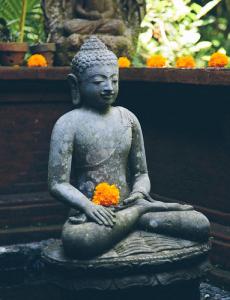
-Flickr
Increasing one’s practice of loving-kindness and mindfulness, another key aspect of Buddhism, fosters a heightened awareness of one’s thoughts, emotions, and surroundings. In a polarized world, such awareness is vital and can lead to greater empathy and understanding, reducing conflict and promoting cooperative problem-solving.
As the world becomes increasingly polarized and the pendulum of our political discourse continues to swing between extremes, Buddhism’s teachings on the Middle Way, compassion, loving-kindness and interdependence offers a pathway for those seeking compromise and ultimately peace. Buddhism provides tools for navigating and resolving these complex issues of our time, reminding us that ancient wisdom can indeed offer solutions for modern problems.
Progressive Christian
Buddhism
Politics and Religion

Next Post

December 27, 2023 Voices from the Hills: The Tabernacle Choir's Welsh Roots
Recent Comments
"Important perspective if you are conscious about God."
Archetypes or God? The Spiritual Cost ..."
"Greetings from the Patheos Pagan channel, where about ten years ago there was a major ..."
Archetypes or God? The Spiritual Cost ..."
"https://uploads.disquscdn.c... The Michigan Tablets and artifacts are authentic. They were found across about 28 Michigan ..."
The Michigan Relics: A Controversial Family ..."
"This is a beautiful and insightful exploration of the concept of divine duality across different ..."
The Cosmic Dance of the Divine ..."
Browse Our Archives
Select a Category Anthroposophy Buddhism Celtic Spirituality Chakras Christmas Concert Contemplative Christianity Early Christianity Entertainment and Spirituality Esoteric Christianity Hinduism Judaism Michigan Relics Native American Mound Builders Politics Psychedelics Rudolf Steiner Sacred Geometry Spirituality of Work Stylianos Atteshlis The Nativity Theosophical Society Transhumanism Uncategorized
Select a Month October 2026 September 2026 June 2026 April 2026 March 2026 February 2026 September 2025 August 2025 May 2025 March 2025 February 2025 December 2024 November 2024 September 2024 July 2024 June 2024 May 2024 April 2024 March 2024 February 2024 January 2024 December 2023 November 2023
TAKE THE
Religious Wisdom Quiz
What does James say we should be quick to do and slow to do?
Select your answer to see how you score.
Quick to listen, slow to speak and slow to become angry Quick to obey, slow to question Quick to pray, slow to doubt Quick to forgive, slow to judge
Related posts from Sacred Kaleidoscope

Café Central: A Quiet Stage for the Crossroads...
Meditation: President McKay’s “Secret Doorway to the Lord”

May The Fourth Be With You: Dharma, Karma...

The Workplace as a Spiritual Practice
TRENDING AT PATHEOS History and Religion

Janie Learns the Way of the Cross: A...
Teaching children about Jesus' Passion can be challenging. Many parents and educators...

Looking For Good Catholic Writing - October 2026
He alone extends the heavens, and he walks upon the waves of...

In "Irreplaceable," our book on vocation and technology, Trevor Sutton and I...

I was strolling through the top floor of the brand new Parthenon...

What Does Gêvâh Mean For Kimberley Guifoyle &...
This week, a lot of the news is focused on Kimberly Guilfoyle....

INNER CIRCLE: Profound Mystery (Of Christ In All...
Ephesians 5:31-32 “For this reason, a man will leave his father and...
view all History and Religion blogs
What Are Your Thoughts?leave a comment
Ad-Free & Subscriber Log-In Subscription Support
- About Us
- 2026 Calendar
- Videos
- Podcasts
- Library of World Religions
- Faith In Media Tracker
- Advertise With Us
- Write for Us
- Privacy Policy
- Terms of Service
- Do Not Sell My Data
- Contact Us
- Radiant Digital
- Manage Newsletter Subscriptions
- Unsubscribe From Notifications
- Sitemap
Copyright 2008-2026, Patheos. All rights reserved.
Subscription Support Ad-Free & Subscriber Log-In
Follow Patheos