
BuddhistCatholicContemplativeEvangelicalGeneral ChristianHinduJewishLatter-day SaintMuslimNew VisionsProgressive Christian
Beliefs
- Buddhist
- Catholic
- Contemplative
- Evangelical
- General Christian
- Hindu
- Jewish
- Latter-day Saint
- More Voices
- Muslim
- New Visions
- Pagan
- Progressive Christian
Topics
- Religion News
- Food and Religion
- Sports and Religion
- Religious Art
- Religious Music and Entertainment
- Religious Events
- History and Religion
- Style and Religion
- Politics and Religion
- Women in Religion
- Recreation Outdoors and Religion
- Business Finance and Religion
- Careers Workplace and Religion
- Education and Religion
- Family Parenting and Religion
- Health Fitness and Religion
- Home and Religion
- Relationships and Religion
- Technology and Religion
- Travel and Religion
Columnists
- Buddhist Columnists
- Business Finance and Religion Columnists
- Careers Workplace and Religion Columnists
- Catholic Columnists
- Contemplative Columnists
- Education and Religion Columnists
- Evangelists Columnists
- Family Parenting and Religion Columnists
- General Christian Columnists
- Health Fitness and Religion Columnists
- Hindu Columnists
- History and Religion Columnists
- Home and Religion Columnists
- Jewish Columnists
- More Voices Columnists
- Latter Day Columnists
- Muslim Columnists
- New Visions Columnists
- Nonreligious Columnists
- Pagan Columnists
- Politics and Religion Columnists
- Progressive Columnists
- Recreation Outdoors and Religion Columnists
- Relationships and Religion Columnists
- Religion News Columnists
- Religious Art Columnists
- Religious Events Columnists
- Religious Music and Entertainment Columnists
- Sports and Religion Columnists
- Style and Religion Columnists
- Technology and Religion Columnists
- Travel and Religion Columnists
- Women in Religion Columnists
Resource Library
- 2026 Calendar
- Library of World Religions
- The 100 Most Holy Places on Earth
- Patheos Answers
- Podcasts
- Videos
- Faith Leaders Database
- Anglican Episcopalian
- Bahai
- Baptist
- Buddhism
- Christianity
- Confucianism
- Eastern Orthodoxy
- Hinduism
- Holiness and Pentecostal
- ISKCON
- Islam
- Judaism
- Lutheran
- Methodist
- The Church of Jesus Christ of Latter-day Saints
- New Age
- Paganism
- Presbytarian and Reformed
- Protestantism
- Religion Behind the Scenes
- Roman Catholic
- Scientology
- Shia Islam
- Sikhism
- Sufism
- Sunni Islam
- Taoism
- Zen
- See all religions
Research Tools
 Ad-Free & Subscriber Log-In Subscription Support
Follow Patheos 

- Trending:
- Advent
- |
- Forgiveness
- |
- Thanksgiving
- |
- Election
- |
- Seasonal Holidays
- |
- Marriage

- Home
- Catholic
- History and Religion
- To Kneel or Stand?
To Kneel or Stand?
Last updated on: November 23, 2026 at 6:04 pm by Jennifer Newsom
To Kneel or Stand? 2026-11-23T18:04:56-05:00 Jennifer Newsom
Patheos Explore the world's faith through different perspectives on religion and spirituality! Patheos has the views of the prevalent religions and spiritualities of the world.
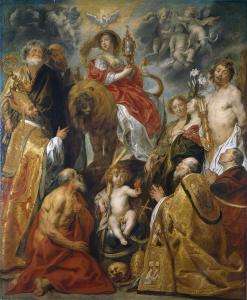
The Veneration of the Eucharist, early 1630s, Artist: Jacob Jordaens.
For many years, Catholicism has been caught up in division over the Liturgy and what it ‘should’ look like. Many misunderstandings abound since Vatican II and catechesis surrounding what the council actually said is sparse. The documents are freely available online and in book form as well but the average Catholic has not accessed these. Many formation programs choose other things to focus on rather than a council we are not even 100 years removed from. Is it our attention span or is it just freely trusting what we were taught–is it easier to just listen to media voices summarizing?
Recently, the Vatican upheld the decision of the bishop of the Charlotte, NC diocese’s decision to ban the use of altar rails and kneeling at them during communion. In a country that prides itself on religious freedom, one must ask where did this come from and why? According to the actual response, kneeling in and of itself was not denied just the use of the already present altar rail. The Dicastery referred to universal and particular liturgical norms…and this is where things get foggy. Although liturgical books do not prescribe altar rail usage in the ordinary form of the Mass, it does allow for bishops to regulate how communion is received. To muddy the water even more, the USCCB upholds the right of the communicant to receive Jesus whether kneeling or standing and states that they cannot be denied the sacrament. So why was this father and his family repeatedly passed by and not given communion? Does the individual bishop’s regulation hold ‘rank’ over the entirety of the USCCB’s protection?
Liturgy in History
The elevation of the consecrated host did not begin until the 12th century so referring to practices, comments and councils prior to that doesn’t translate over as much to today. Tertullian not only spoke out against kneeling on the Lord’s Day, but also the practice of fasting on that day. Most Catholics will tell you that it is now required to fast for one hour prior to receiving our Lord in the Eucharist. According to the Code of Canon Law 919:
A person who is to receive the Most Holy Eucharist is to abstain for at least one hour before holy communion from any food and drink, except for only water and medicine.
Dogmas within the Church do not change but doctrine and practice can develop in accordance to our time. Just as with fasting, so too with kneeling. Why does this matter? Does the letter of the law or the spirit of the law matter most?
Recent Developments
Depending on which study you read, research between 2019-2026 shows that somewhere between only 29-30% of Catholics believe in the Real Presence of Jesus in the Eucharist. Again, one must ask why? What happened? This is a dogmatic teaching of the church which means it is a divinely inspired and required belief of the faithful. Those same numbers also show that Mass attendance is way down. Seven out of ten Catholics believe it is a symbol even though there is NO Biblical or historical evidence for this belief.
Does that translate to how Jesus is received? Many pro-kneelers will express that this is a sign of deep reverence for the Real Presence of Jesus; a recognition of the WHO not WHAT is contained in that piece of bread or chalice.
9 Therefore God has highly exalted him and bestowed on him the name which is above every name, 10 that at the name of Jesus every knee should bow, in heaven and on earth and under the earth, 11 and every tongue confess that Jesus Christ is Lord, to the glory of God the Father. (Phil. 2:9-11)
If, at his name, every knee shall bow–how much more so in his actual presence–if that is what the Church divinely teaches and believes? If we bow before entering our pew towards the altar, towards the tabernacle where the Eucharist is contained, in the communion line, at his name during Mass, at his Incarnation during the Creed and Angelus, how much more so in his actual presence at Mass? People kneel for much smaller things and less ranking people. Why not Jesus?
The Issue at Hand
This issue is so much more than a ‘preference’ or a ‘rubric.’ It is catechesis, reverence and implementation of the actual dogma of the real presence we are supposed to believe. Removing altar rails and moveable kneelers is far more than architectural or bishop choice, rather can be seen as an infringement on the rights of those who want to kneel but due to age or medical complications cannot. Catholics don’t merely do gestures for the sake of the gesture, rather it points to the unseen reality of what is occurring during the Mass–the sacrifice of our Lord and savior at the foot of Calvary.
Now What?
The opening lines to a prayer said hourly by the Nuns, and the Adoration Sodality, at the Shrine of the Most Blessed Sacrament speaks to this issue of indifference:
I adore Thee, O Jesus, God of Love, truly present in the Most Holy Sacrament. I adore Thee, Who hast come to Thine own, but wast not received by them. I adore Thee, Whom the majority of mankind reject and despise. I adore Thee, Whom the impious incessantly offend by their sacrileges and blasphemies. I adore Thee, Who art grieved by the coldness and indifference even of a vast number of Christians…
Lord, increase charity and reverence in the hearts of the faithful…Amen.
Here is another article by the author on the Mass.
General Christian
Previous Post
April 2, 2026
A Night That Changed It All: Holy Thursday & the Priesthood
Browse Our Archives
Select a Category Liturgy Science Uncategorized
Select a Month November 2026 April 2026 April 2025 March 2025 October 2024 September 2024 August 2024
Follow Us!
TAKE THE
Religious Wisdom Quiz
What language was the New Testament originally written in?
Select your answer to see how you score.
Greek Hebrew Latin Syriac
Related posts from Sacred Heritage
A Night That Changed It All: Holy Thursday...
This Side of Easter: A Journey of Reflection...

5 Lenten Lessons from the Desert
4 Milestones You Should Know about John Paul...
TRENDING AT PATHEOS Catholic

'Statements of Faith' never get shorter
Nothing demonstrates a conservative commitment to faith and faithfulness like a "statement...

Michele's Reviews - Future Grace by John Piper
In God's Place, at God's Pace, by Future Grace Impatience is...

Bama Gramma's Blackout Christmas: the Power of Light...
Another Christmas Skit: I have an alter ego: Bama Gramma. She shows...

Thanksgiving as a Way of Life: A Christian...
Each year, Thanksgiving brings families and friends together to share meals, stories,...

Two Women Doctors Who Went Against the Current
Women physicians who transformed healthcare for "Indians" “I shall have an advantage...
Reading Culture Through Scripture, Not the Other Way...
A Radix Teleology and Faith Before Seeing: Essentialism “For we also have...
view all Catholic blogs
Ad-Free & Subscriber Log-In Subscription Support
- About Us
- 2026 Calendar
- Videos
- Podcasts
- Library of World Religions
- Faith In Media Tracker
- Advertise With Us
- Write for Us
- Privacy Policy
- Terms of Service
- Do Not Sell My Data
- Contact Us
- Radiant Digital
- Manage Newsletter Subscriptions
- Unsubscribe From Notifications
- Sitemap
Copyright 2008-2026, Patheos, part of the Radiant Digital network of media brands. All rights reserved.
Subscription Support Ad-Free & Subscriber Log-In
Follow Patheos