
BuddhistCatholicContemplativeEvangelicalGeneral ChristianHinduJewishLatter-day SaintMuslimNew VisionsProgressive Christian
Beliefs
- Buddhist
- Catholic
- Contemplative
- Evangelical
- General Christian
- Hindu
- Jewish
- Latter-day Saint
- More Voices
- Muslim
- New Visions
- Pagan
- Progressive Christian
Topics
- Religion News
- Food and Religion
- Sports and Religion
- Religious Art
- Religious Music and Entertainment
- Religious Events
- History and Religion
- Style and Religion
- Politics and Religion
- Women in Religion
- Recreation Outdoors and Religion
- Business Finance and Religion
- Careers Workplace and Religion
- Education and Religion
- Family Parenting and Religion
- Health Fitness and Religion
- Home and Religion
- Relationships and Religion
- Technology and Religion
- Travel and Religion
Columnists
- Buddhist Columnists
- Business Finance and Religion Columnists
- Careers Workplace and Religion Columnists
- Catholic Columnists
- Contemplative Columnists
- Education and Religion Columnists
- Evangelists Columnists
- Family Parenting and Religion Columnists
- General Christian Columnists
- Health Fitness and Religion Columnists
- Hindu Columnists
- History and Religion Columnists
- Home and Religion Columnists
- Jewish Columnists
- More Voices Columnists
- Latter Day Columnists
- Muslim Columnists
- New Visions Columnists
- Nonreligious Columnists
- Pagan Columnists
- Politics and Religion Columnists
- Progressive Columnists
- Recreation Outdoors and Religion Columnists
- Relationships and Religion Columnists
- Religion News Columnists
- Religious Art Columnists
- Religious Events Columnists
- Religious Music and Entertainment Columnists
- Sports and Religion Columnists
- Style and Religion Columnists
- Technology and Religion Columnists
- Travel and Religion Columnists
- Women in Religion Columnists
Resource Library
- 2026 Calendar
- Library of World Religions
- The 100 Most Holy Places on Earth
- Patheos Answers
- Podcasts
- Videos
- Faith Leaders Database
- Anglican Episcopalian
- Bahai
- Baptist
- Buddhism
- Christianity
- Confucianism
- Eastern Orthodoxy
- Hinduism
- Holiness and Pentecostal
- ISKCON
- Islam
- Judaism
- Lutheran
- Methodist
- The Church of Jesus Christ of Latter-day Saints
- New Age
- Paganism
- Presbytarian and Reformed
- Protestantism
- Religion Behind the Scenes
- Roman Catholic
- Scientology
- Shia Islam
- Sikhism
- Sufism
- Sunni Islam
- Taoism
- Zen
- See all religions
Research Tools
 Ad-Free & Subscriber Log-In Subscription Support
Ad-Free & Subscriber Log-In Subscription Support
Follow Patheos 

- Trending:
- Forgiveness
- |
- Marriage
- |
- Consciousness
- |
- Death Penalty
- |
- Election
- |
- Halloween
 The Sacred Art of Living
- Home
- Progressive Christian
- The Feast of St. Brigid
The Feast of St. Brigid
Last updated on: February 4, 2016 at 10:32 am by Christine Valters Paintner
The Feast of St. Brigid 2016-02-04T10:32:54-06:00 Christine Valters Paintner
Patheos Explore the world's faith through different perspectives on religion and spirituality! Patheos has the views of the prevalent religions and spiritualities of the world.
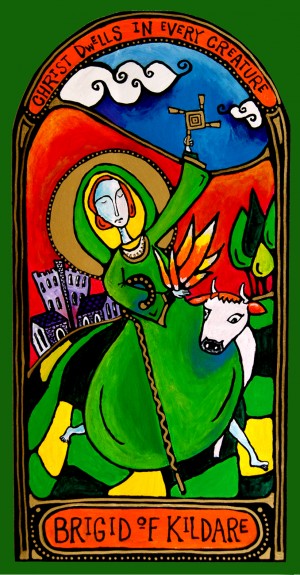 Most of what we know about St. Brigid comes from the Life of Brigid written by the monk Cogitosis in the second half of the seventh century. The Life emphasizes her healings, her kinship with animals, her profound sense of hospitality and generosity, and her concern for those oppressed. These stories of the saints are not meant to be literal or historical, but spiritual, mythical, archetypal, and psychological, resonating with the deepest parts of our souls.
Her feast day is February 1 which in the Celtic calendar is also the feast of Imbolc and the very beginning of springtime. It is the time when the ewes begin to give birth and give forth their milk, and heralds the coming of longer and warmer days. She is the first sign of life after the long dark nights of winter. She breathes into the landscape so that it begins to awaken. Snowdrops, the first flowers of spring are one of her symbols.
On the eve of January 31 it is traditional to leave a piece of cloth or ribbon outside the house. It was believed that St Brigid’s spirit traveled across the land and left her curative powers in the brat Bride (Brigid’s Mantle or cloth). It was then used throughout the year as a healing from sickness and protection from harm.
Brigid’s feast day is also connected to the Christian liturgical year, followed by the Feast of the Presentation of Jesus on February 2. Spiritual writer and teacher Jan Richardson describes how this day invites us to “remember Mary and Joseph’s visit to the Temple to present their child Jesus on the fortieth day following his birth, as Jewish law required, and for Mary to undergo the postpartum rites of cleansing. Luke’s Gospel tells us that the prophets Anna and Simeon immediately recognize and welcome Jesus. Taking the child into his arms, Simeon turns his voice toward God and offers praise for the ‘light for revelation’ that has come into the world.”
Jan goes on to write that inspired by Simeon’s words, “some churches began to mark the day with a celebration of light: the Candle Mass, during which priests would bless the candles to be used in the year to come. Coinciding with the turn toward spring and lengthening of light in the Northern Hemisphere, Candlemas offers a liturgical celebration of the renewing of light and life that comes to us in the natural world at this time of year, as well as in the story of Jesus. As we emerge from the deep of winter, the feast reminds us of the perpetual presence of Christ our Light in every season.”*
In Ireland Brigid is even called Mary of the Gaels and was said to be present as a midwife to Mary at the birth of Jesus. She crosses thresholds of time and space and these stories often break the boundaries of linearity. It is said that she was born as her mother crossed the threshold of a doorway. Women giving birth often stand on the threshold of a doorway and call out her name.
Brigid was a powerful leader and one of the founders of monasticism in Ireland. She was an abbess, healer, soul-friend, prophet, and more. Many miracles are connected to her, especially related to milk. She had a white cow who could give as much milk as needed. A small amount of her butter miraculously feeds many guests. There is a sense of lavish hospitality and generosity connected to the spirit of Brigid. Many of the stories connected to her, reflect the dignity of the ordinary tasks, especially in the home. No more divisions between what is worthy of grace and beyond the scope.
To celebrate the feast of Imbolc, which in the Celtic calendar is the very early beginnings of spring, I have a gift of a free mini-retreat which is a part of our Sacred Seasons self-study journey through the Celtic wheel of the year. Go to this link and scroll down to the heading Seasonal Themes and you will see the first retreat offered there to try for yourself. Reflections by John Valters Paintner and myself, invitations to meditation and creative practice, a song about Brigid, and a dance led by Betsey Beckman are some of the treats waiting for you there.
Brigid icon is (c) Marcy Hall at Rabbit Room Arts
*from Jan Richardson’s reflection Feast of the Presentation/Candlemas
Previous Post

January 25, 2016
Welcome to The Sacred Art of Living
Next Post
February 7, 2016 A Different Kind of Fast: A Seven-Part Series for Lent
Browse Our Archives
Select a Category Easter Lent Uncategorized
Select a Month May 2016 April 2016 March 2016 February 2016 January 2016 September 2015 June 2015 May 2015 February 2015
Follow Us!
TAKE THE
Religious Wisdom Quiz
Where did Elisha perform many miracles?
Select your answer to see how you score.
Jericho Samaria Bethel Shunem
Related posts from The Sacred Art of Living
Practicing Resurrection: The Gift of Holy Surprise

Practicing Resurrection: The Journey Home
Practicing Resurrection: Love and Peace as Holy Direction

Practicing Resurrection: Love One Another
TRENDING AT PATHEOS Progressive Christian

Why Christians Have a Sacred Duty to Vote:...
The Bible offers strong support for the sacred duty to vote. Here...

What Being a Modern-Day Apostle Means to Me
In my last column, I discussed the ins and outs of modern-day...

Did Ancient China Once Worship the God of...
Across human history, a common thread weaves through the origins of the...

Love Your Neighbor – Including Earth-Kin: Lev. 19,...
God’s command to love your neighbor means acting in an ethical and...

Lead a Church Study of “Jesus and Lao...
Guest writer Jack Thomas (The Irreverent Reverend) reflects on leading his church...

Principles for Understanding the Apostolic Ministry Today
Whenever people discover that my formal ministry title is "apostle," as in...
view all Progressive Christian blogs
Ad-Free & Subscriber Log-In Subscription Support
- About Us
- 2026 Calendar
- Videos
- Podcasts
- Library of World Religions
- Faith In Media Tracker
- Advertise With Us
- Write for Us
- Privacy Policy
- Terms of Service
- Do Not Sell My Data
- Contact Us
- Radiant Digital
- Manage Newsletter Subscriptions
- Unsubscribe From Notifications
- Sitemap
Copyright 2008-2026, Patheos. All rights reserved.
Subscription Support Ad-Free & Subscriber Log-In
Follow Patheos