
BuddhistCatholicContemplativeEvangelicalGeneral ChristianHinduJewishLatter-day SaintMuslimNew VisionsProgressive Christian
Beliefs
- Buddhist
- Catholic
- Contemplative
- Evangelical
- General Christian
- Hindu
- Jewish
- Latter-day Saint
- More Voices
- Muslim
- New Visions
- Pagan
- Progressive Christian
Topics
- Religion News
- Food and Religion
- Sports and Religion
- Religious Art
- Religious Music and Entertainment
- Religious Events
- History and Religion
- Style and Religion
- Politics and Religion
- Women in Religion
- Recreation Outdoors and Religion
- Business Finance and Religion
- Careers Workplace and Religion
- Education and Religion
- Family Parenting and Religion
- Health Fitness and Religion
- Home and Religion
- Relationships and Religion
- Technology and Religion
- Travel and Religion
Columnists
- Buddhist Columnists
- Business Finance and Religion Columnists
- Careers Workplace and Religion Columnists
- Catholic Columnists
- Contemplative Columnists
- Education and Religion Columnists
- Evangelists Columnists
- Family Parenting and Religion Columnists
- General Christian Columnists
- Health Fitness and Religion Columnists
- Hindu Columnists
- History and Religion Columnists
- Home and Religion Columnists
- Jewish Columnists
- More Voices Columnists
- Latter Day Columnists
- Muslim Columnists
- New Visions Columnists
- Nonreligious Columnists
- Pagan Columnists
- Politics and Religion Columnists
- Progressive Columnists
- Recreation Outdoors and Religion Columnists
- Relationships and Religion Columnists
- Religion News Columnists
- Religious Art Columnists
- Religious Events Columnists
- Religious Music and Entertainment Columnists
- Sports and Religion Columnists
- Style and Religion Columnists
- Technology and Religion Columnists
- Travel and Religion Columnists
- Women in Religion Columnists
Resource Library
- 2026 Calendar
- Library of World Religions
- The 100 Most Holy Places on Earth
- Patheos Answers
- Podcasts
- Videos
- Faith Leaders Database
- Anglican Episcopalian
- Bahai
- Baptist
- Buddhism
- Christianity
- Confucianism
- Eastern Orthodoxy
- Hinduism
- Holiness and Pentecostal
- ISKCON
- Islam
- Judaism
- Lutheran
- Methodist
- The Church of Jesus Christ of Latter-day Saints
- New Age
- Paganism
- Presbytarian and Reformed
- Protestantism
- Religion Behind the Scenes
- Roman Catholic
- Scientology
- Shia Islam
- Sikhism
- Sufism
- Sunni Islam
- Taoism
- Zen
- See all religions
Research Tools
 Ad-Free & Subscriber Log-In Subscription Support
Ad-Free & Subscriber Log-In Subscription Support
Follow Patheos 

- Trending:
- Forgiveness
- |
- Marriage
- |
- Consciousness
- |
- Death Penalty
- |
- Election
- |
- Halloween
 The Vatican II Lutheran
- Home
- Catholic
- What the Church Fathers Had to Figure Out
What the Church Fathers Had to Figure Out
Last updated on: August 10, 2022 at 1:03 pm by Russell E. Saltzman
What the Church Fathers Had to Figure Out 2022-08-10T13:03:41-06:00 Russell E. Saltzman
Patheos Explore the world's faith through different perspectives on religion and spirituality! Patheos has the views of the prevalent religions and spiritualities of the world.
When I was a Lutheran seminarian we rarely looked at the Church Fathers, almost never. So it was not surprising when a Lutheran bishop, slated to preach on the feast day of the Cappadocian Fathers before a Lutheran gathering of pastors who had invited him, opened his remarks saying he literally did not know who they were, but he’d make the best of it anyway.
He should have read Rod Bennett’s two books (Four Witnesses: The Early Church in Her Own Words and Four More Witnesses: Further Testimony from Christians Before Constantine). Of course Bennett had yet to write them, though, so maybe the bishop gets a pass.
But still, if any Protestant community should be reading the Church Fathers with deference and appreciation it is the Lutherans. The Lutheran defense for their reforms (the term “reform” of course is disputed) was premised on their intention to restore the Church to her original simplicity.
For every assertion made in the Augsburg Confession of 1530, they usually found and footnoted a Church Father who had their back, someone they believed bolstered the very thing the Reformers were saying. To read the Confession, so said Lutheran apologists, was to read in part a commentary on the early Fathers.
The Lutheran bishop noted above, with or without Bennett, betrayed his ignorance not only of early Church history, but also of the founding document of his own denomination. But if Lutherans are neglectful of the Church Fathers (and they are), lay Catholics (I’m now one of them) in many ways probably match the Lutherans today.
We just don’t know enough of our own Church history and we certainly know too little of the Fathers. The Church Fathers are that array of pastors, bishops, and theologians writing after the Apostles but before the 32 5, the year the Nicene Creed was formulated. They are also known as the Ante-Nicene Fathers. Generally speaking, they are the “second generation” of Christians. Their writings can be accessed through a simple Google search and their work is published in several collected volumes available at, say, Amazon.
Some of the Fathers are very close to the original witnesses. Ignatius of Antioch was said to have been mentored by the Apostle John. As a defense against those few contemporary outlier historians who make a career of questioning the historical existence of Jesus, I have yet to see even one of them deal with the historicity of actual as well as immediate second-hand witnesses as reported in history outside the Gospels.
And what we read from the Fathers is what the Early Church was saying about itself and how it came to terms with what had happened in Jesus, and what it meant for the life of the world, and how to say all that in ways faithful to their memory of Christ s they received it.
There were a thousand things they had to figure out, like first inventing a vocabulary to describe who they were and what they did and how they went about doing it. By the close of the 1st century they certainly knew they were a Church and that it was Catholic. But to arrive at this they first had to distinguish themselves from what they were not.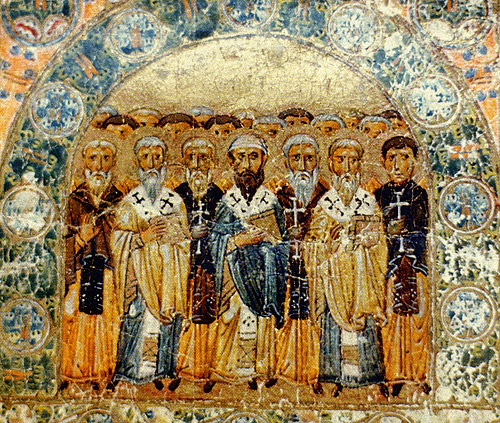
They were not a Roman burial and funeral society. Such groups met periodically, shared meals, administered internal discipline, and debated what to do with non-paying members who reneged on their pledge to aid fellow society members in burial expenses. Or how were Christians different from Roman supper clubs, for that matter? Tertullian (not in either book; that’s another story) preferred that Christians simply call themselves a collegium (or “association”; even “club” would do). Tertullian wanted common words that were intelligible even to anyone not a Christian. By and large though, the Church chose to distinguish herself from the culture.
When Pliny the Younger, governor of Bithynia-Pontus (modern Turkey) in 125 AD, was confronted with a strange group of people who refused to give honor to the emperor, Trajan, by burning a pinch of incense, he didn’t know who they were or what they did or what to do with them. They met, ate a meal, and sang a few hymns to someone called Christ “as to a god.” He questioned some under torture (including a couple of women called deaconesses) and gave the whole group of them three opportunities to disavow Christ. Those who refused were executed. These things had to be worked out.
We also find from the Fathers the earliest discussions of the nature and relationship between the Father, the Son, and the Holy Spirit; about the particular character and nature of Jesus; about church structure and governance. All these things and more flow down to us, but they began with the Fathers. From the Church Fathers we know of prayers for the dead, a beginning development of a doctrine of purgatory, the early reverence for Mary, Mother of Our Lord, and the absolute insistence on the Real Presence of Christ in the Eucharist. Mostly, everything that is the Catholic Church today traces its earliest roots to the Church Fathers.
Rod Bennett’s two books are an introduction to a few of the most important Church Fathers.
He includes Clement of Rome, Ignatius of Antioch (who made first real argument for a single office of bishop as Catholics have since come to understand it), and Justin, called the Martyr (for reasons you should be able to figure out), who gave us a very early description of Christian worship (155 AD) which I find not at all dissimilar to the Mass of today; and Irenaeus of Lyons, the legendary slayer of heresies, who was noted especially for combating a whack-a-mole heresy called Gnosticism (actually a collection of heresies still around).
Bennett’s second volume (written nearly 20 years after his first — he was writing other things between the two) introduces Clement of Rome, perhaps the first bishop following Peter or maybe the fourth, sources differ. He is the is the author of the first and second Letters of Clement to the Corinthians. They were reprimands, actually, which gives us still more insight into the many Corinthian squabbles that so annoyed St. Paul in his two letters to Corinth.
Bennett includes another Clement, this one of Alexandria (look him up). Another is Hermes, author of the Shepherd of Hermes. The Shepherd was a popular book and a contender for inclusion in the New Testament. His use of Greek grammar was as unlearned as it was, um, inventive. His writing is long-winded and repetitive. I find him difficult to read whether in Greek or in English. What he produced, though, might be called the first spiritual how-to book (my phrase) for successful Christian living. It’s full of allegedly helpful commandments (12 as I recall), parables, warnings, and advice. It is heavy in prophetic allegory and, despite its many weaknesses, it was popular in the Church well into the 4th century, largely I suppose because was simple and direct.
Bennett also includes Hippolytus of Rome, the first antipope. That’s an embarrassing tale. Hippolytus was passed over for election as bishop and the job went to an ex-slave, Callistus (who was also an ex-con having once been imprisoned embezzlement). Hippolytus went off in a huff, or in the words of a perhaps contemporary ditty, “had a cow when Callistus took the prow.”
Of Callistus the First (there was another one later) we know little of his history and he left no writing that survived. What is known was recorded largely by his critics, few of whom even pretended to objectivity. He became an archdeacon in Rome, manager of the church cemeteries, and was made bishop of the Roman church when the post fell vacant. His main trouble came from Hippolytus and Tertullian, others too, who took strong objection to Callistus having granted communion to those who had committed adultery and fornication, after due penance. Hippolytus reconciled with the Church before his martyrdom, an automatic conferral of sainthood.
Hippolytus’ real contribution, and the reason he’s included among the Church Fathers, was his liturgical work for the Church, not only the Mass but also for occasional services like baptism, ordination (deacon, presbyter, and bishop), and others. To look at his liturgies is to see real theological elegance, a smooth, sleek, and unadorned Latin. His work is still revered and still in use. Hippolytus’ Eucharistic Prayer (c.215 AD) is the foundation for Eucharistic Prayer II in today’s Roman Rite, and Lutherans included the Hippolytian prayer in the Lutheran Book of Worship (1978) for optional use. As a Lutheran parish pastor I used it every Christmas Eve. Some things just sound like Christmas, you know, and Hippolytus nailed the wonder of incarnation.
Bennett has produced a remarkable and accessible introduction to the Church Fathers and he chose his subjects wisely, each being a theologian still quoted by today’s theologians. Bennett started his Christian life as a Baptist and while still a Baptist fell in love with the Church Fathers. It was the weight of their witness that ultimately swayed him to the Church. He should write a third book. And when that is done, he can pick up some of the Post-Nicene Fathers.
Here are some further resources:
The Augsburg Confession of 1530
The Christians as the Romans Saw Them by Robert Wilkins (Yale University Press, 1984, 2003)
Before entering seminary and becoming a Lutheran pastor (before becoming Roman Catholic), Russell E. Saltzman was a newspaper reporter, press secretary to a member of Congress, and deputy secretary of the state of Kansas. He is a member of St. Theresa North, Kansas City, MO. This piece originally appeared at Aleteia.
Photo Public Domain
Previous Post
March 28, 2022
The Grace of Humor
Next Post

September 14, 2022 Divorce and Dogs and Nobody Cares About the Cats
Browse Our Archives
Select a Category AIDS American Social Life American Solidarity Party Ash Wednesday Books Consciousness Death Penalty Diabetes Early Christianity End of Life Ethics Family inheritance Funeral Sermons God as Other Immigration Luther's Reformation March for Life Pagans v. Christians Pandemic Pets Politics Presidential Reporting Pro-Life LIterature Remembrance Richard Neuhaus Science Fiction The Devil The Our Father Uncategorized Watergate Wild life
Select a Month September 2022 August 2022 March 2022 November 2021 July 2021 September 2020 June 2020 February 2020 January 2020 October 2019 September 2019 August 2019 July 2019 April 2019 March 2019 February 2019 January 2019
Follow Us!
TAKE THE
Religious Wisdom Quiz
What does "forgive us our trespasses as we forgive"" mean in the Lord's Prayer?
Select your answer to see how you score.
We should forgive others Hold grudges Ask for wealth Pray for revenge
Related posts from The Vatican II Lutheran


Divorce and Dogs and Nobody Cares About the...
Phillip K. Dick, a Charleston tour guide, and...
TRENDING AT PATHEOS Catholic

Creation, Preservation, and Teleology in Catholic Theology
As I write this, it is very early Monday morning. Like millions...

The Parable Of The Sower And The Word...
One of Christ’s most famous parables is that of the sower who...

Rejecting Doom: Christian Hope And Human Action
Christianity is a religion of hope. We are to have hope and...

Why I Choose the Eucharist Over the Sermon
Choose the Eucharist, Not the Sermon What are we supposed to get...

5 Design Elements Found in Spiritually Rooted Homes
Putting Spirituality Into Home Decor Our homes are more than our living...

Credo: A Story of God Told with the...
About 10 years ago, I began to imagine a personal "Credo" that...
view all Catholic blogs
Ad-Free & Subscriber Log-In Subscription Support
- About Us
- 2026 Calendar
- Videos
- Podcasts
- Library of World Religions
- Faith In Media Tracker
- Advertise With Us
- Write for Us
- Privacy Policy
- Terms of Service
- Do Not Sell My Data
- Contact Us
- Radiant Digital
- Manage Newsletter Subscriptions
- Unsubscribe From Notifications
- Sitemap
Copyright 2008-2026, Patheos. All rights reserved.
Subscription Support Ad-Free & Subscriber Log-In
Follow Patheos