
BuddhistCatholicContemplativeEvangelicalGeneral ChristianHinduJewishLatter-day SaintMuslimNew VisionsProgressive Christian
Beliefs
- Buddhist
- Catholic
- Contemplative
- Evangelical
- General Christian
- Hindu
- Jewish
- Latter-day Saint
- More Voices
- Muslim
- New Visions
- Pagan
- Progressive Christian
Topics
- Religion News
- Food and Religion
- Sports and Religion
- Religious Art
- Religious Music and Entertainment
- Religious Events
- History and Religion
- Style and Religion
- Politics and Religion
- Women in Religion
- Recreation Outdoors and Religion
- Business Finance and Religion
- Careers Workplace and Religion
- Education and Religion
- Family Parenting and Religion
- Health Fitness and Religion
- Home and Religion
- Relationships and Religion
- Technology and Religion
- Travel and Religion
Columnists
- Buddhist Columnists
- Business Finance and Religion Columnists
- Careers Workplace and Religion Columnists
- Catholic Columnists
- Contemplative Columnists
- Education and Religion Columnists
- Evangelists Columnists
- Family Parenting and Religion Columnists
- General Christian Columnists
- Health Fitness and Religion Columnists
- Hindu Columnists
- History and Religion Columnists
- Home and Religion Columnists
- Jewish Columnists
- More Voices Columnists
- Latter Day Columnists
- Muslim Columnists
- New Visions Columnists
- Nonreligious Columnists
- Pagan Columnists
- Politics and Religion Columnists
- Progressive Columnists
- Recreation Outdoors and Religion Columnists
- Relationships and Religion Columnists
- Religion News Columnists
- Religious Art Columnists
- Religious Events Columnists
- Religious Music and Entertainment Columnists
- Sports and Religion Columnists
- Style and Religion Columnists
- Technology and Religion Columnists
- Travel and Religion Columnists
- Women in Religion Columnists
Resource Library
- 2026 Calendar
- Library of World Religions
- The 100 Most Holy Places on Earth
- Patheos Answers
- Podcasts
- Videos
- Faith Leaders Database
- Anglican Episcopalian
- Bahai
- Baptist
- Buddhism
- Christianity
- Confucianism
- Eastern Orthodoxy
- Hinduism
- Holiness and Pentecostal
- ISKCON
- Islam
- Judaism
- Lutheran
- Methodist
- The Church of Jesus Christ of Latter-day Saints
- New Age
- Paganism
- Presbytarian and Reformed
- Protestantism
- Religion Behind the Scenes
- Roman Catholic
- Scientology
- Shia Islam
- Sikhism
- Sufism
- Sunni Islam
- Taoism
- Zen
- See all religions
Research Tools
 Ad-Free & Subscriber Log-In Subscription Support
Ad-Free & Subscriber Log-In Subscription Support
Follow Patheos 

- Trending:
- Forgiveness
- |
- Marriage
- |
- Consciousness
- |
- Death Penalty
- |
- Election
- |
- Halloween
 The Vatican II Lutheran
- Home
- Catholic
- Standard Pagans
Standard Pagans
Last updated on: July 29, 2019 at 11:39 am by Russell E. Saltzman
Standard Pagans 2019-07-29T11:39:20-06:00 Russell E. Saltzman
Patheos Explore the world's faith through different perspectives on religion and spirituality! Patheos has the views of the prevalent religions and spiritualities of the world.
James J. O’Donnell’s Pagans: The End of Traditional Religion and the Rise of Christianity (2015) is not a silly book, but it is superficial. O’Donnell is said to have written a contrarian book on pagans and early Christians. We’ll see.
He does well describing the nature of traditional religion as Christianity (oddball and very non-traditional) arose in all its varied forms in its first three centuries to challenge traditional Roman religion.
What is amazing to me, now that I’ve brought it up, is how swiftly the variants of Christianity, generally known as “Gnostics,” became serious competitors to Catholic Christianity in the early years. What came to be known as “catholic” Christianity was obviously very different from the Gnostic alternatives. Though each was declared heretic (though more as a warning to Catholic Christians than as a threat of burning), some sects persisted for centuries and, with different names still persist. But in O’Donnell’s handling the Gnostics gets but a footnote. As he is writing about the demise of paganism, that’s not my real complaint.
What O’Donnell also does well in presenting the gods as they were known by the people themselves – in their piety and in their worship, in the practices of animal sacrifice and the exacting examination of their guts for portents and their deaths as offerings to the gods. There were then the home altars and all the wayside shrines. O’Donnell convincingly shows how all this gave shape to ordinary Roman life. But this is known too; there is nothing new.
Even less surprising is his assertion that “the pagans” was a term invented by Christians. “Pagan” originally referred to anyone who did not live in a city; it was the “Bubba” designation of its day used by the more urbane. It was even used as “civilian,” whenever the military got around to noticing there were civilians.
As religion goes, however, there were no pagans before Christians came along to say there were. “Pagan” cannot be defined except as against “Christian,” and even then it is doubtful if an actual pagan would be able to see himself as pagan.
Christians didn’t much use the word before 300 AD, is my impression. When it did come into common use by the fifth century, it was a matter of recognizing who practiced animal sacrifice (while pouring over their livers for signs of the gods’ favor) and who did not. (Jewish temple sacrifice fell with the Jerusalem temple and had been practiced only there.) So, no, that is hardly a shock; even less is it contrarian.
The standard Christian storyline, heavily dependent upon Eusebius’ The Church History, presents a “triumph of the Church” sort of tale, said to be about plucky people dedicated to the one God of the Jews who sent Christ, who were hunted and persecuted, becoming lion fodder day in and day out as they bravely evangelized and made a Christian world from their underground catacombs. They persevered in faith and devotion, until at last, the old gods were vanquished and Christ ruled the hearts of all and the worship of the true God was everywhere. God at every turn favored the Church until at last, by God’s privilege, Constantine became God’s servant.
Naw. It wasn’t like that.
O’Donnell is right to the extent that history is never as much “standard” as we might like, but Church historians have been on to Eusebius and the “standard” story for long, long time. O’Donnell is catching up.
As it happens, though, O’Donnell himself adopts a “standard” telling of the rise of Christianity. What, or who, really accounts for the rise of Christianity?
If Pagans was a whodunit, all fingers would point at the Emperor Constantine as the prime culprit. He did it. In extreme telling, Constantine decreed the canon of Scripture and wrote the Nicene Creed himself single-handedly, and forced the bishops to swallow it, homoousios and all. O’Donnell never approaches that. Still, he – and most historians – will say Constantine’s unexpected favor tipped the Church toward becoming the Church we all know and love today.
Oh, I do not think otherwise. There is no denying what imperial favor did do. But few have ever argued, alternatively, that the Church was doing just fine without Constantine and, very likely, might have done better without him in the longer run.
What O’Donnell misses is the growth of the Church over three centuries without Constantine. By 300 AD it was perhaps as little as ten percent of the over-all population (estimates vary). But there were some urban regions where Christians had come to comprise at least a quarter of the population and perhaps a bit more. They were, without even trying, a social force in the empire.
In its first three centuries the Church had successfully self-organized around the ministry bishops; a hierarchy was recognized. Even among rank and file Romans, bishops had become familiar public figures and some were hugely respected. There were no empire-wide persecutions underway, and really had not been until Diocletian’s rule upset the Little Peace of the Church when the emperor Gallienus (253–268) issued the first official declaration of tolerance regarding Christians.
While some local areas had experienced punctuated persecutions, for most part for most of the history of the Church in this era, Christians quietly went about their business in public unhindered. The peace of the Church meant the growth of the Church.
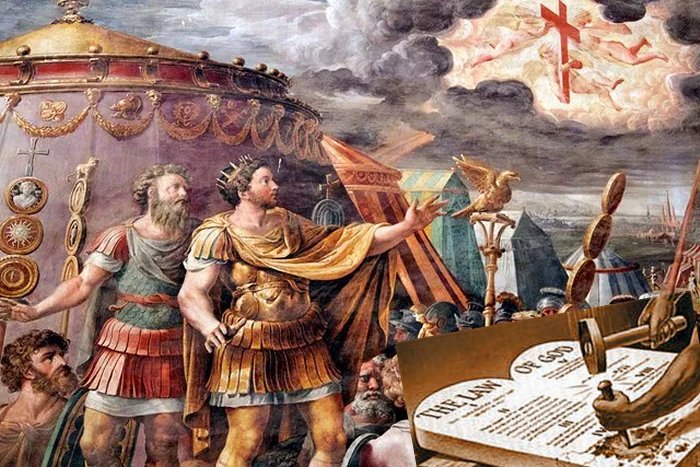
Public Domain, Emperor Constantine
The Church grew as a statistical inevitably (which isn’t to say statistics can never be used miraculously). Start with, say, one hundred followers in 33 AD and sustain a three percent annual growth rate and pretty soon you will find Christians everywhere in the Mediterranean. The rate was probably larger.
There were other factors to Christian growth. For instance, they did not in general abandon their sick when facing the Plague of Cyprian (named for the bishop of Carthage because of the account he left) 250-270 AD. More victims survived with Christian care than not, meaning there were more Christians to make more Christians. They did not abandon their children to exposure, and no doubt added to their numbers by seeking out foundlings who had been abandoned. Christian ethical teaching was not unattractive, nor unremarked.
Christians also had a history, pegged to Bethlehem, to Jerusalem, to a provincial governor of recorded name, and actual witnesses to Jesus who left records. It was there, Christians said, that God intervened in world history.
Paganism had no history. Pagan gods did not mess with history. Paganism was a collection of stories of this god doing this, that goddess doing something else. Christianity gave human beings a history, one in which their own origins and their individual actions figured prominently and with purpose.
These are only a few of the attractors O’Donnell omits in the history of how the traditional religions gave way.
Sure, the Church got Constantine and conversions exploded, but didn’t need him. Without Constantine the Church would have continued its steady growth simply by being there. Without Constantine the Church might have experienced less politicization and a more tempered relationship to the Roman state, and some Christians may have restrained themselves in persecuting the pagans.
From the second century on, when Rome was first becoming aware of Christians, the Church by simply existing, was a disruptive influence in Roman life. But it was a disruption aimed at persuasion. Its authority was based not on state coercion but on the Word it preached.
History is as history is. On the whole, I do not think the Christianity we have is altogether a bad one, nor do I think that it went off the rails, not for the most part.
But to say Constantine “did it” is a fast shortcut that skips at lot of crucial tourist sites along the way, and it does not account for the three previous centuries of the Church. Pagans is an entertaining book, sometimes insightful, but it could have been more imaginative.
Russell E. Saltzman lives in Kansas City, Missouri. His latest book is Speaking of the Dead. He can be reached at [email protected] and on Twitter @RESaltzman.
Previous Post

April 30, 2019
Part 8 - What Are We Asking For In the Our Father
Next Post

July 29, 2019 Fido at the Communion Rail
Browse Our Archives
Select a Category AIDS American Social Life American Solidarity Party Ash Wednesday Books Consciousness Death Penalty Diabetes Early Christianity End of Life Ethics Family inheritance Funeral Sermons God as Other Immigration Luther's Reformation March for Life Pagans v. Christians Pandemic Pets Politics Presidential Reporting Pro-Life LIterature Remembrance Richard Neuhaus Science Fiction The Devil The Our Father Uncategorized Watergate Wild life
Select a Month September 2022 August 2022 March 2022 November 2021 July 2021 September 2020 June 2020 February 2020 January 2020 October 2019 September 2019 August 2019 July 2019 April 2019 March 2019 February 2019 January 2019
Follow Us!
TAKE THE
Religious Wisdom Quiz
Who was Boaz's kinsman-redeemer?
Select your answer to see how you score.
Unnamed relative Naomi Elimelech Ruth
Related posts from The Vatican II Lutheran

What the Church Fathers Had to Figure Out

Divorce and Dogs and Nobody Cares About the...

Phillip K. Dick, a Charleston tour guide, and...
TRENDING AT PATHEOS Catholic

Rejecting Doom: Christian Hope And Human Action
Christianity is a religion of hope. We are to have hope and...

It’s What Comes From Within Which Matters
One of the most difficult things for us to understand is why...

Why I Choose the Eucharist Over the Sermon
Choose the Eucharist, Not the Sermon What are we supposed to get...

5 Design Elements Found in Spiritually Rooted Homes
Putting Spirituality Into Home Decor Our homes are more than our living...

Credo: A Story of God Told with the...
About 10 years ago, I began to imagine a personal "Credo" that...

The Anatomy of Divine Revelation in Catholic Thought
The claim that God has made Himself known to human beings is...
view all Catholic blogs
Ad-Free & Subscriber Log-In Subscription Support
- About Us
- 2026 Calendar
- Videos
- Podcasts
- Library of World Religions
- Faith In Media Tracker
- Advertise With Us
- Write for Us
- Privacy Policy
- Terms of Service
- Do Not Sell My Data
- Contact Us
- Radiant Digital
- Manage Newsletter Subscriptions
- Unsubscribe From Notifications
- Sitemap
Copyright 2008-2026, Patheos. All rights reserved.
Subscription Support Ad-Free & Subscriber Log-In
Follow Patheos