
BuddhistCatholicContemplativeEvangelicalGeneral ChristianHinduJewishLatter-day SaintMuslimNew VisionsProgressive Christian
Beliefs
- Buddhist
- Catholic
- Contemplative
- Evangelical
- General Christian
- Hindu
- Jewish
- Latter-day Saint
- More Voices
- Muslim
- New Visions
- Pagan
- Progressive Christian
Topics
- Religion News
- Food and Religion
- Sports and Religion
- Religious Art
- Religious Music and Entertainment
- Religious Events
- History and Religion
- Style and Religion
- Politics and Religion
- Women in Religion
- Recreation Outdoors and Religion
- Business Finance and Religion
- Careers Workplace and Religion
- Education and Religion
- Family Parenting and Religion
- Health Fitness and Religion
- Home and Religion
- Relationships and Religion
- Technology and Religion
- Travel and Religion
Columnists
- Buddhist Columnists
- Business Finance and Religion Columnists
- Careers Workplace and Religion Columnists
- Catholic Columnists
- Contemplative Columnists
- Education and Religion Columnists
- Evangelists Columnists
- Family Parenting and Religion Columnists
- General Christian Columnists
- Health Fitness and Religion Columnists
- Hindu Columnists
- History and Religion Columnists
- Home and Religion Columnists
- Jewish Columnists
- More Voices Columnists
- Latter Day Columnists
- Muslim Columnists
- New Visions Columnists
- Nonreligious Columnists
- Pagan Columnists
- Politics and Religion Columnists
- Progressive Columnists
- Recreation Outdoors and Religion Columnists
- Relationships and Religion Columnists
- Religion News Columnists
- Religious Art Columnists
- Religious Events Columnists
- Religious Music and Entertainment Columnists
- Sports and Religion Columnists
- Style and Religion Columnists
- Technology and Religion Columnists
- Travel and Religion Columnists
- Women in Religion Columnists
Resource Library
- 2026 Calendar
- Library of World Religions
- The 100 Most Holy Places on Earth
- Patheos Answers
- Podcasts
- Videos
- Faith Leaders Database
- Anglican Episcopalian
- Bahai
- Baptist
- Buddhism
- Christianity
- Confucianism
- Eastern Orthodoxy
- Hinduism
- Holiness and Pentecostal
- ISKCON
- Islam
- Judaism
- Lutheran
- Methodist
- The Church of Jesus Christ of Latter-day Saints
- New Age
- Paganism
- Presbytarian and Reformed
- Protestantism
- Religion Behind the Scenes
- Roman Catholic
- Scientology
- Shia Islam
- Sikhism
- Sufism
- Sunni Islam
- Taoism
- Zen
- See all religions
Research Tools
 Ad-Free & Subscriber Log-In Subscription Support
Ad-Free & Subscriber Log-In Subscription Support
Follow Patheos 

- Trending:
- Forgiveness
- |
- Marriage
- |
- Consciousness
- |
- Death Penalty
- |
- Election
- |
- Halloween
 The Vatican II Lutheran
- Home
- Catholic
- Part 2 – What Are We Asking In the Our Father?
Part 2 – What Are We Asking In the Our Father?
Last updated on: April 15, 2019 at 12:42 pm by Russell E. Saltzman
Part 2 – What Are We Asking In the Our Father? 2019-04-15T12:42:48-06:00 Russell E. Saltzman
Patheos Explore the world's faith through different perspectives on religion and spirituality! Patheos has the views of the prevalent religions and spiritualities of the world.
Your kingdom come.
We are looking again at the Our Father, the Lord’s Prayer. So far Jesus has urged us to call the Lord Most High God of Israel “Father” and more particularly, “Our Father.”
Right away, Jesus has told us something about the Gospel, the good news of the Father’s unconditional commitment to humanity through Christ. To call God our Father is a summarization of our need and of his abiding promise.
In calling on God, we have also asked for his Word. We are praying that amid all the words that crowd upon us and swirl around us, distracting and misdirecting, the Father will speak to us clearly in a voice of truth that is all Truth.
Thy kingdom come, the next petition, flows from the first.
When we ask “Thy kingdom come,” what are we finally asking of God? Well, just that: we want his kingdom to come to us to control us, to claim our allegiance against all other claims. That means we want no other kingdom but his.
A problem, though. Kingdoms in our American experience are few, and the history we had with the last king of America proved disagreeable. Here, we Americans speak of the people reigning, sovereign in their own power. A king in his kingdom speaks of power, dominion, where we are in the grip of an authority outside of us, an old fashioned anti-democratic kingdom.
So, I’d guess, in the deepest or even the most shallow recesses of the human heart, we do not pray “Thy” but “My kingdom come.” We want sovereignty over our own lives; a life where nobody is the boss of me.
I want my kingdom where my name is hallowed, where my will is done. In my kingdom all those people in my house would turn out unnecessary lights and I’d never get stuck behind somebody with 20 items in the 12 item checkout at the grocery, and if it was my 20 items, no one would complain. That’s really pretty modest, isn’t it? If I get that much under control I might expand my ambitions.
But it is the Father’s kingdom for which I pray; not my own. That is what we pray when we pray “Thy kingdom come.” We seek his kingdom in opposition to all others, and especially in opposition to our own. Well, crud.
But now, the good news – maybe it’s good news – is we can hardly prevent the Father’s kingdom from coming in any case. As Tertullian (d. 240) not unreasonably pointed out, God’s kingdom will come whether we pray for it or not. So there.
If that’s the case, why pray it at all? This is easy. We pray that his kingdom will come also for us. We pray that we will have the faith to recognize it and welcome it when it does.
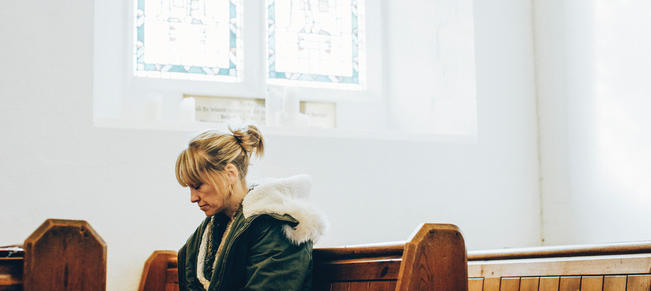
Photo Credit: Premier Christianity
We ask that the Father’s kingdom will come to us in a clear conclusive way so that we are grasped by it tightly, protectively. More especially that we are grasped and held by no other. So we pray, “Thy kingdom come.”
All too frequently, however, the Father’s kingdom looks scrawny. There are other powers loosed around us, other allegiances vying for our hearts, some in fact are more to our liking. Against these, a distant kingdom coming is too easily overcome by our despair, fear, confusion; our conceits, vanity, pride. God’s kingdom, this life says, cannot be relied upon, not for the real things we finally need. Besides, nobody can be the boss of me.
So there are other powers eager to dominate our thoughts and hearts, other powers jeopardizing our hope of the kingdom for which we prayed. You don’t have to look far. Looking closely inside of us we sometimes find nothing but our own fears, our own struggles, our own crises and cries, our own denials and addictions, our own bitterness and unfilled wants.
These are not the devil’s snares; life itself provides them. They bubble up from within us, literally moment to moment in every day. Something wicked may exploit them, but they belong first to our selves. We get caught by these, paralyzed in faith, and we are not able to find within us the hope, the faith, or the courage to move.
Here, in that captivity is when we must pray, “Thy kingdom come!” It is a prayer wrung from life itself, a cry for the clarity of our Father’s kingdom rushing in upon us.
You, dear Father, is what we pray, you take hold of my life now in such a way that I can count on you in every faltering doubt, in every low and frantic moment. You, Father, you take hold of my heart now and wrest it to your control, because as you take hold of me, then I know I shall be free.
And he comes ― gently, lavishly in his Word, comes in the memory of Baptism, comes to us by those treasured words “The body of Christ,” comes in such a way that once again our unsteady, wavering, and anxious heart — so easily dominated by all the threats of life — might once again find safety and surety in the hands of Christ.
“Our hearts are restless,” St. Augustine put it, “until they find rest in you.”
Russell E. Saltzman lives in Kansas City, Missouri. His latest book is Speaking of the Dead. He can be reached at [email protected], on Twitter @RESaltzman*, and on Facebook as* Russ Saltzman.
Previous Post
April 4, 2019
Part 1 - What Are We Asking in the Our Father
Next Post

April 11, 2019 Part 3 - What Are We Asking In the Our Father
Browse Our Archives
Select a Category AIDS American Social Life American Solidarity Party Ash Wednesday Books Consciousness Death Penalty Diabetes Early Christianity End of Life Ethics Family inheritance Funeral Sermons God as Other Immigration Luther's Reformation March for Life Pagans v. Christians Pandemic Pets Politics Presidential Reporting Pro-Life LIterature Remembrance Richard Neuhaus Science Fiction The Devil The Our Father Uncategorized Watergate Wild life
Select a Month September 2022 August 2022 March 2022 November 2021 July 2021 September 2020 June 2020 February 2020 January 2020 October 2019 September 2019 August 2019 July 2019 April 2019 March 2019 February 2019 January 2019
Follow Us!
TAKE THE
Religious Wisdom Quiz
Each chapter except one is an acrostic poem following the Hebrew alphabet. How many chapters make up this book of mourning?
Select your answer to see how you score.
Seven Three Twelve Five
Related posts from The Vatican II Lutheran
Part 8 - What Are We Asking For...
Part 7 - What Are We Asking In...
Part 5 - What Are We Asking In...
Part 6 - What Are We Asking In...
TRENDING AT PATHEOS Catholic

Creation, Preservation, and Teleology in Catholic Theology
As I write this, it is very early Monday morning. Like millions...

The Parable Of The Sower And The Word...
One of Christ’s most famous parables is that of the sower who...

Rejecting Doom: Christian Hope And Human Action
Christianity is a religion of hope. We are to have hope and...

Why I Choose the Eucharist Over the Sermon
Choose the Eucharist, Not the Sermon What are we supposed to get...

5 Design Elements Found in Spiritually Rooted Homes
Putting Spirituality Into Home Decor Our homes are more than our living...

Credo: A Story of God Told with the...
About 10 years ago, I began to imagine a personal "Credo" that...
view all Catholic blogs
Ad-Free & Subscriber Log-In Subscription Support
- About Us
- 2026 Calendar
- Videos
- Podcasts
- Library of World Religions
- Faith In Media Tracker
- Advertise With Us
- Write for Us
- Privacy Policy
- Terms of Service
- Do Not Sell My Data
- Contact Us
- Radiant Digital
- Manage Newsletter Subscriptions
- Unsubscribe From Notifications
- Sitemap
Copyright 2008-2026, Patheos. All rights reserved.
Subscription Support Ad-Free & Subscriber Log-In
Follow Patheos