
BuddhistCatholicContemplativeEvangelicalGeneral ChristianHinduJewishLatter-day SaintMuslimNew VisionsProgressive Christian
Beliefs
- Buddhist
- Catholic
- Contemplative
- Evangelical
- General Christian
- Hindu
- Jewish
- Latter-day Saint
- More Voices
- Muslim
- New Visions
- Pagan
- Progressive Christian
Topics
- Religion News
- Food and Religion
- Sports and Religion
- Religious Art
- Religious Music and Entertainment
- Religious Events
- History and Religion
- Style and Religion
- Politics and Religion
- Women in Religion
- Recreation Outdoors and Religion
- Business Finance and Religion
- Careers Workplace and Religion
- Education and Religion
- Family Parenting and Religion
- Health Fitness and Religion
- Home and Religion
- Relationships and Religion
- Technology and Religion
- Travel and Religion
Columnists
- Buddhist Columnists
- Business Finance and Religion Columnists
- Careers Workplace and Religion Columnists
- Catholic Columnists
- Contemplative Columnists
- Education and Religion Columnists
- Evangelists Columnists
- Family Parenting and Religion Columnists
- General Christian Columnists
- Health Fitness and Religion Columnists
- Hindu Columnists
- History and Religion Columnists
- Home and Religion Columnists
- Jewish Columnists
- More Voices Columnists
- Latter Day Columnists
- Muslim Columnists
- New Visions Columnists
- Nonreligious Columnists
- Pagan Columnists
- Politics and Religion Columnists
- Progressive Columnists
- Recreation Outdoors and Religion Columnists
- Relationships and Religion Columnists
- Religion News Columnists
- Religious Art Columnists
- Religious Events Columnists
- Religious Music and Entertainment Columnists
- Sports and Religion Columnists
- Style and Religion Columnists
- Technology and Religion Columnists
- Travel and Religion Columnists
- Women in Religion Columnists
Resource Library
- 2026 Calendar
- Library of World Religions
- The 100 Most Holy Places on Earth
- Patheos Answers
- Podcasts
- Videos
- Faith Leaders Database
- Anglican Episcopalian
- Bahai
- Baptist
- Buddhism
- Christianity
- Confucianism
- Eastern Orthodoxy
- Hinduism
- Holiness and Pentecostal
- ISKCON
- Islam
- Judaism
- Lutheran
- Methodist
- The Church of Jesus Christ of Latter-day Saints
- New Age
- Paganism
- Presbytarian and Reformed
- Protestantism
- Religion Behind the Scenes
- Roman Catholic
- Scientology
- Shia Islam
- Sikhism
- Sufism
- Sunni Islam
- Taoism
- Zen
- See all religions
Research Tools
 Ad-Free & Subscriber Log-In Subscription Support
Ad-Free & Subscriber Log-In Subscription Support
Follow Patheos 

- Trending:
- Forgiveness
- |
- Marriage
- |
- Consciousness
- |
- Death Penalty
- |
- Election
- |
- Halloween
 The Vatican II Lutheran
- Home
- Catholic
- Part 1 – What Are We Asking in the Our Father
Part 1 – What Are We Asking in the Our Father
Last updated on: April 15, 2019 at 12:40 pm by Russell E. Saltzman
Part 1 – What Are We Asking in the Our Father 2019-04-15T12:40:24-06:00 Russell E. Saltzman
Patheos Explore the world's faith through different perspectives on religion and spirituality! Patheos has the views of the prevalent religions and spiritualities of the world.
When you pray, say “Father.”
The Our Father is an old familiar friend to us. It may have been the first full paragraph any of us ever memorized. This usually was by mimicking the grownups, our child voices trailing a beat behind, piping up on the last syllable. But that’s how we learned it.
I also know it may well be the last full paragraph to leave our consciousness. While tending the dying as a pastor, I have seen the lips of the comatose move silent cadence as the prayer was spoken.
So this prayer is an old, old familiar friend, in good times and bad. There’s the trouble. Old reliable friends are very familiar friends; we think we already know everything there is to know. But we shall shake it up in this series and see if something new falls out.
So we stop to ask: “What are we praying for when we pray the Our Father?”
The very first thing we learn is who it is to whom we are praying. The answer is astonishing. “When you pray, say ‘Father.'” (Lk. 11:2).
Jesus encourages us to speak to the Lord Most High God of Israel as Father from the intimacy of childhood. Jesus would have said Abba in Aramaic; in Greek, the language of the New Testament, it becomes Pater, and to English, Father. The name is warm, intimate, cozy, suggesting tenderness, affection, accessibility, strength.
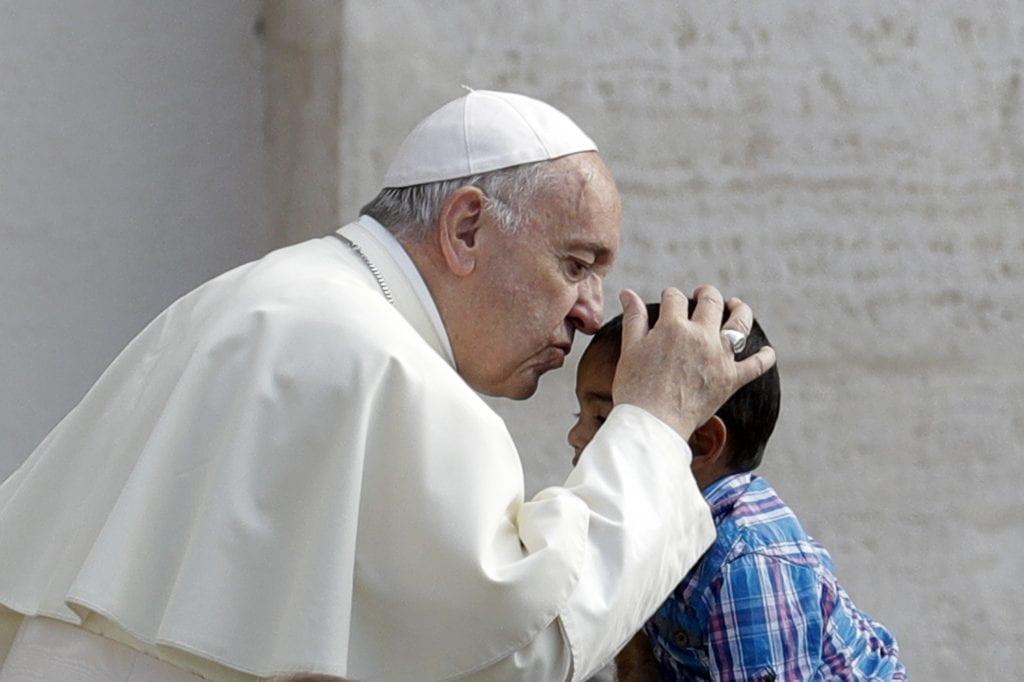
Credit: AP Press
“When you pray, say Father” and then we know the Lord Most High God of Israel is our Father, with whom we may curl up in safety, whose arm is ever-ready for our strength, and chasing the monsters of life from under the bed.
As Pope Francis put it, “calling him ‘Father’ puts us in His confidence, like a child talking to his dad, knowing that he is loved and cared for by him.”
We learn next, this father’s name is a holy name. That’s troubling. “Holy” sometimes isn’t anything we really want, and we don’t like it much in anybody else either. Holy Joes never have any fun; neither do Holy Janes. Worse, “holy” can become self-righteousness, a brittle piousness, or sanctimoniousness, or moral superiority. “Holy” used this way are they of the tisk-tisk Tweet and the virtue signal on Facebook, with eyebrows hoisted looking down on the rest of us struggling with our wants and our problems and our temptations. “Holy” sometimes isn’t holiness at all.
Real holiness is intended to do something and do it perfectly. An engine finely tuned, woodwork turned to exacting specification ― these things do as they ought. They are at peak potential, exactly as intended, and with smooth, unfettered effectiveness they fulfill their purpose.
When we declare that Our Father’s name is holy, hallowed, we’re hardly telling God something he doesn’t already know. Instead, we are asking that God’s name will work among us as a holy name ought to work. The literal Greek reads “let it be-being holyized the name of you.” “Let it be always becoming holy.”
We ask for his name “holyized” among us; that it will do for us and in us what his holy name is supposed to do, that we may hear his voice in clarity and truth.
We want this hallowed name to clear away the noise and speak above clutter and debris in our lives, so that we will hear his Word when we use his name, that God’s name will do among us his hallowed purpose without hindrance, that we may know he is our Father.
God’s name, thus, is linked to God’s Word. This is important. It means that when we call God’s name, we are also asking for God’s Word.
We ask for an authentic Word in this world where we are daily assaulted by words that finally mean so little. We are asking God, by praying God’s name, for a Word, his Word, a clarion Word rising above above all the nattering clatter filling life.
What is God’s Word? God’s Word is a story. It is the story of Jesus. It is a true story.
My youngest son when little liked me to sing while driving. He’s 32 now doesn’t ask for that quite as frequently. His favorite, though, when he was 4, 5, or 6, was The Wreck of Old 97, that song about the brave engineer crossing the White Oak Mountain “doing ninety miles an hour.”
And he always asked, “Is that a true story?” Yes, as it happens. But he understood even then when he was little, a true story, it means something. It means we’ve heard something more than just a tale, more than a rumor, but something fundamental about the world, about the people in the story, and about ourselves.
We Christians assert that the truest story ever told is also the greatest story ever told. So when we pray God’s name, that’s the story we seek.
We pray, “Our Father in heaven, hallowed be thy name.” What we ask is: Father, let your name work in us as it should, as we ask it to; give us your Word, tell us a story, tell us a True story.
And the Lord Most High God of Israel scoops us up in his arms, dangles us on his lap as Father, and tells us a story that really has but one word: “Jesus.”
Russell E. Saltzman lives in Kansas City, Missouri. His latest book is Speaking of the Dead. He can be reached at [email protected], on Twitter @RESaltzman*, and on Facebook as* Russ Saltzman.
Previous Post

April 2, 2019
Satan Rebrands Temptation
Next Post

April 9, 2019 Part 2 - What Are We Asking In the Our Father?
Browse Our Archives
Select a Category AIDS American Social Life American Solidarity Party Ash Wednesday Books Consciousness Death Penalty Diabetes Early Christianity End of Life Ethics Family inheritance Funeral Sermons God as Other Immigration Luther's Reformation March for Life Pagans v. Christians Pandemic Pets Politics Presidential Reporting Pro-Life LIterature Remembrance Richard Neuhaus Science Fiction The Devil The Our Father Uncategorized Watergate Wild life
Select a Month September 2022 August 2022 March 2022 November 2021 July 2021 September 2020 June 2020 February 2020 January 2020 October 2019 September 2019 August 2019 July 2019 April 2019 March 2019 February 2019 January 2019
Follow Us!
TAKE THE
Religious Wisdom Quiz
Which epistle focuses on joy and is addressed to believers in Macedonia?
Select your answer to see how you score.
Philippians Colossians Ephesians Galatians
Related posts from The Vatican II Lutheran
Part 8 - What Are We Asking For...
Part 7 - What Are We Asking In...

Part 5 - What Are We Asking In...

Part 6 - What Are We Asking In...
TRENDING AT PATHEOS Catholic

Rejecting Doom: Christian Hope And Human Action
Christianity is a religion of hope. We are to have hope and...

It’s What Comes From Within Which Matters
One of the most difficult things for us to understand is why...

Why I Choose the Eucharist Over the Sermon
Choose the Eucharist, Not the Sermon What are we supposed to get...

5 Design Elements Found in Spiritually Rooted Homes
Putting Spirituality Into Home Decor Our homes are more than our living...

Credo: A Story of God Told with the...
About 10 years ago, I began to imagine a personal "Credo" that...

The Anatomy of Divine Revelation in Catholic Thought
The claim that God has made Himself known to human beings is...
view all Catholic blogs
Ad-Free & Subscriber Log-In Subscription Support
- About Us
- 2026 Calendar
- Videos
- Podcasts
- Library of World Religions
- Faith In Media Tracker
- Advertise With Us
- Write for Us
- Privacy Policy
- Terms of Service
- Do Not Sell My Data
- Contact Us
- Radiant Digital
- Manage Newsletter Subscriptions
- Unsubscribe From Notifications
- Sitemap
Copyright 2008-2026, Patheos. All rights reserved.
Subscription Support Ad-Free & Subscriber Log-In
Follow Patheos