
BuddhistCatholicContemplativeEvangelicalGeneral ChristianHinduJewishLatter-day SaintMuslimNew VisionsProgressive Christian
Beliefs
- Buddhist
- Catholic
- Contemplative
- Evangelical
- General Christian
- Hindu
- Jewish
- Latter-day Saint
- More Voices
- Muslim
- New Visions
- Pagan
- Progressive Christian
Topics
- Religion News
- Food and Religion
- Sports and Religion
- Religious Art
- Religious Music and Entertainment
- Religious Events
- History and Religion
- Style and Religion
- Politics and Religion
- Women in Religion
- Recreation Outdoors and Religion
- Business Finance and Religion
- Careers Workplace and Religion
- Education and Religion
- Family Parenting and Religion
- Health Fitness and Religion
- Home and Religion
- Relationships and Religion
- Technology and Religion
- Travel and Religion
Columnists
- Buddhist Columnists
- Business Finance and Religion Columnists
- Careers Workplace and Religion Columnists
- Catholic Columnists
- Contemplative Columnists
- Education and Religion Columnists
- Evangelists Columnists
- Family Parenting and Religion Columnists
- General Christian Columnists
- Health Fitness and Religion Columnists
- Hindu Columnists
- History and Religion Columnists
- Home and Religion Columnists
- Jewish Columnists
- More Voices Columnists
- Latter Day Columnists
- Muslim Columnists
- New Visions Columnists
- Nonreligious Columnists
- Pagan Columnists
- Politics and Religion Columnists
- Progressive Columnists
- Recreation Outdoors and Religion Columnists
- Relationships and Religion Columnists
- Religion News Columnists
- Religious Art Columnists
- Religious Events Columnists
- Religious Music and Entertainment Columnists
- Sports and Religion Columnists
- Style and Religion Columnists
- Technology and Religion Columnists
- Travel and Religion Columnists
- Women in Religion Columnists
Resource Library
- 2026 Calendar
- Library of World Religions
- The 100 Most Holy Places on Earth
- Patheos Answers
- Podcasts
- Videos
- Faith Leaders Database
- Anglican Episcopalian
- Bahai
- Baptist
- Buddhism
- Christianity
- Confucianism
- Eastern Orthodoxy
- Hinduism
- Holiness and Pentecostal
- ISKCON
- Islam
- Judaism
- Lutheran
- Methodist
- The Church of Jesus Christ of Latter-day Saints
- New Age
- Paganism
- Presbytarian and Reformed
- Protestantism
- Religion Behind the Scenes
- Roman Catholic
- Scientology
- Shia Islam
- Sikhism
- Sufism
- Sunni Islam
- Taoism
- Zen
- See all religions
Research Tools
 Ad-Free & Subscriber Log-In Subscription Support
Ad-Free & Subscriber Log-In Subscription Support
Follow Patheos 

- Trending:
- Forgiveness
- |
- Marriage
- |
- Consciousness
- |
- Death Penalty
- |
- Election
- |
- Halloween
 The Vatican II Lutheran
- Home
- Catholic
- Part 7 – What Are We Asking In the Our Father
Part 7 – What Are We Asking In the Our Father
Last updated on: April 25, 2019 at 10:39 am by Russell E. Saltzman
Part 7 – What Are We Asking In the Our Father 2019-04-25T10:39:17-06:00 Russell E. Saltzman
Patheos Explore the world's faith through different perspectives on religion and spirituality! Patheos has the views of the prevalent religions and spiritualities of the world.
Save us from the time of trial and deliver us from evil.
Though Christ has been raised from death, we still are confronted with evil and, worse, temptation. We continue to deal with the reality of sin, death, and the world. So we turn to our risen Lord in these two petitions and we ask, first: “Do not lead us into temptation.”
Say what? We have to ask: God, don’t do that?
Every catechism I dig through – Catholic or Protestant – stumbles over itself assuring us that God, the Father of our Lord Jesus Christ, does not lead, lure, entice, or otherwise discourage his lambs by dangling temptation before their innocent eyes. The Letter of James 1:13, quoted in the Catechism of the Catholic Church, explains “God cannot be tempted by evil and he himself tempts no one.”
Okay, good enough. But it is awkward phrasing and it must be explained, sometimes with equal awkwardness. There is an alternative, the contemporary English translation: “Save us from the time of trial.” This is the rendering by the Consultation on English Texts. I like it for a lot reasons, mostly because “a time of trial” proposes in my mind something vastly more serious than mere temptation.
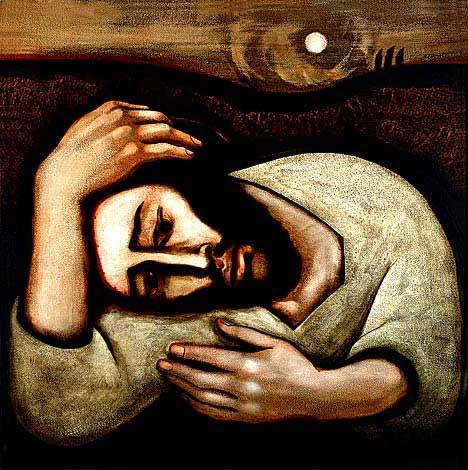
We think too small in any case. We like our temptations miniaturized. We are too likely to talk about the refrigerator door, or the jump we made with glee on that left turn. As misattributed to Mae West (d. 1980), “’Lead me not into temptation?’ I can find it on my own.”
She actually did not say that, great line though it is. No, what she did say, more or less speaking for all of us: “I generally avoid temptation unless I can’t resist it.”
So, no; it was neither God nor devil that tempted you into blowing your diet at the restaurant. That’s all on you.
We can win the food fight if we wish; piece of cake (so to speak). The fridge is a tiny temptation. The big ones, they strike hardest and with greater potential for damage. Those are the trials.
We live in an postmodern nihilistic age, daily exposed to the proposition that human life has no intrinsic meaning and humanity is an earth-borne blight. Ask the New York congressgirl whether it is wise to have children. She is representative of a large swath of people who, at heart, have given up on the future. There might be a lot of us like her. This just occurred to me: Have you ever once in your life heard a prayer of thanks for the children born in a UN refugee center?
The edges of our humanity have been fraying for a long time. We will fray even more, I fear, for a devalued, unrecognized life will make us all vulnerable. Many live now knowing only cynicism or materialist acquisition, or both.
This means the greatest trials of our time, then, are false belief and despair. These two ride tandem.
False belief denies a merciful God of grace. It begins from questioning whether there is or is not a god. But the answer is it doesn’t matter. It is immaterial. Live with guilt if you must, if you have some of those residual feelings, but do not think there is someone to give absolution. We deceive ourselves into helplessness.
Patti Smith’s rock lyric still stings: Jesus died for somebody’s sins, but he didn’t die for mine. Living as if we are abandoned by God, who in any case makes no difference in our living, this is false belief. It affects our culture; also our Christian lives.
From false belief arises despair. It rolls in like fog, silent as cat’s paws, involving everything, gripping everything, holding everything, things that cannot always be defined. If there is no gracious God for my life, what is my life?
Despair is not depression; that is a medical issue for which there is a medical treatment. Despair, instead, is a spiritual affliction threatening us individually and through us, our families, our society, living as if life has no final meaning, a belief saturating us culturally.
But here it is essential to see how swiftly, gently Christ comes as remedy for us. “Cast your burdens upon him,” instructs 1 Peter 5:7. That word “cast” suggests force. It carries a sense of a violent, angry, slam-the-door-behind-you as walk away from that burden. It is almost a challenge. Here, take it! You said you’d take it, now take it! We say it that way because we are confident he will do it.
So it is to him we pray “Save us from the time of trial, deliver us from evil.” Our Lord does two things. First, he shatters the illusion that we are somehow strong enough, or brainy enough, or talented enough to put an end to our despondency.
Second, that illusion shattered, he teaches us to put all into his care, and to do so expecting that he will exercise his power on our behalf.
Our job? Repeat as necessary. After all, it is not for nothing Christians sing that 19th-century hymn I need thee every hour.
For Christ is raised from the dead. He has taken to himself all the powers poised against this life and he will bring them under his control. He is the one ― as St. Paul told the Colossians ― “in whom all things hold together.” He holds us, as well.
Russell E. Saltzman lives in Kansas City, Missouri. His latest book is Speaking of the Dead. He can be reached at [email protected] and on Twitter @RESaltzman.
Previous Post

April 23, 2019
Part 6 - What Are We Asking In the Our Father
Next Post

April 30, 2019 Part 8 - What Are We Asking For In the Our Father
Browse Our Archives
Select a Category AIDS American Social Life American Solidarity Party Ash Wednesday Books Consciousness Death Penalty Diabetes Early Christianity End of Life Ethics Family inheritance Funeral Sermons God as Other Immigration Luther's Reformation March for Life Pagans v. Christians Pandemic Pets Politics Presidential Reporting Pro-Life LIterature Remembrance Richard Neuhaus Science Fiction The Devil The Our Father Uncategorized Watergate Wild life
Select a Month September 2022 August 2022 March 2022 November 2021 July 2021 September 2020 June 2020 February 2020 January 2020 October 2019 September 2019 August 2019 July 2019 April 2019 March 2019 February 2019 January 2019
Follow Us!
TAKE THE
Religious Wisdom Quiz
Which prophet predicted God would pour out His Spirit on all people?
Select your answer to see how you score.
Joel Micah Amos Hosea
Related posts from The Vatican II Lutheran
Part 8 - What Are We Asking For...

Part 5 - What Are We Asking In...

Part 6 - What Are We Asking In...
Part 4 - What Are We Asking In...
TRENDING AT PATHEOS Catholic

The Parable Of The Sower And The Word...
One of Christ’s most famous parables is that of the sower who...

Rejecting Doom: Christian Hope And Human Action
Christianity is a religion of hope. We are to have hope and...

Why I Choose the Eucharist Over the Sermon
Choose the Eucharist, Not the Sermon What are we supposed to get...

5 Design Elements Found in Spiritually Rooted Homes
Putting Spirituality Into Home Decor Our homes are more than our living...

Credo: A Story of God Told with the...
About 10 years ago, I began to imagine a personal "Credo" that...

The Anatomy of Divine Revelation in Catholic Thought
The claim that God has made Himself known to human beings is...
view all Catholic blogs
Ad-Free & Subscriber Log-In Subscription Support
- About Us
- 2026 Calendar
- Videos
- Podcasts
- Library of World Religions
- Faith In Media Tracker
- Advertise With Us
- Write for Us
- Privacy Policy
- Terms of Service
- Do Not Sell My Data
- Contact Us
- Radiant Digital
- Manage Newsletter Subscriptions
- Unsubscribe From Notifications
- Sitemap
Copyright 2008-2026, Patheos. All rights reserved.
Subscription Support Ad-Free & Subscriber Log-In
Follow Patheos