
BuddhistCatholicContemplativeEvangelicalGeneral ChristianHinduJewishLatter-day SaintMuslimNew VisionsProgressive Christian
Beliefs
- Buddhist
- Catholic
- Contemplative
- Evangelical
- General Christian
- Hindu
- Jewish
- Latter-day Saint
- More Voices
- Muslim
- New Visions
- Pagan
- Progressive Christian
Topics
- Religion News
- Food and Religion
- Sports and Religion
- Religious Art
- Religious Music and Entertainment
- Religious Events
- History and Religion
- Style and Religion
- Politics and Religion
- Women in Religion
- Recreation Outdoors and Religion
- Business Finance and Religion
- Careers Workplace and Religion
- Education and Religion
- Family Parenting and Religion
- Health Fitness and Religion
- Home and Religion
- Relationships and Religion
- Technology and Religion
- Travel and Religion
Columnists
- Buddhist Columnists
- Business Finance and Religion Columnists
- Careers Workplace and Religion Columnists
- Catholic Columnists
- Contemplative Columnists
- Education and Religion Columnists
- Evangelists Columnists
- Family Parenting and Religion Columnists
- General Christian Columnists
- Health Fitness and Religion Columnists
- Hindu Columnists
- History and Religion Columnists
- Home and Religion Columnists
- Jewish Columnists
- More Voices Columnists
- Latter Day Columnists
- Muslim Columnists
- New Visions Columnists
- Nonreligious Columnists
- Pagan Columnists
- Politics and Religion Columnists
- Progressive Columnists
- Recreation Outdoors and Religion Columnists
- Relationships and Religion Columnists
- Religion News Columnists
- Religious Art Columnists
- Religious Events Columnists
- Religious Music and Entertainment Columnists
- Sports and Religion Columnists
- Style and Religion Columnists
- Technology and Religion Columnists
- Travel and Religion Columnists
- Women in Religion Columnists
Resource Library
- 2026 Calendar
- Library of World Religions
- The 100 Most Holy Places on Earth
- Patheos Answers
- Podcasts
- Videos
- Faith Leaders Database
- Anglican Episcopalian
- Bahai
- Baptist
- Buddhism
- Christianity
- Confucianism
- Eastern Orthodoxy
- Hinduism
- Holiness and Pentecostal
- ISKCON
- Islam
- Judaism
- Lutheran
- Methodist
- The Church of Jesus Christ of Latter-day Saints
- New Age
- Paganism
- Presbytarian and Reformed
- Protestantism
- Religion Behind the Scenes
- Roman Catholic
- Scientology
- Shia Islam
- Sikhism
- Sufism
- Sunni Islam
- Taoism
- Zen
- See all religions
Research Tools
 Ad-Free & Subscriber Log-In Subscription Support
Ad-Free & Subscriber Log-In Subscription Support
Follow Patheos 

- Trending:
- Forgiveness
- |
- Marriage
- |
- Consciousness
- |
- Death Penalty
- |
- Election
- |
- Halloween
 The Vatican II Lutheran
- Home
- Catholic
- Part 5 – What Are We Asking In the Our Father?
Part 5 – What Are We Asking In the Our Father?
Last updated on: April 19, 2019 at 7:55 pm by Russell E. Saltzman
Part 5 – What Are We Asking In the Our Father? 2019-04-19T19:55:24-06:00 Russell E. Saltzman
Patheos Explore the world's faith through different perspectives on religion and spirituality! Patheos has the views of the prevalent religions and spiritualities of the world.
Forgive us our sins
This petition in the Our Father comes in two halves. The first half deals with us. The second half deals with us dealing with others. Not unreasonably, I’ll dig into first half first.
We ask here “Forgive us our trespasses,” and there is language problem. Catholics use the word “trespasses,” as do many Protestant denominations. Some Protestants, largely Reformed, use “debts.” The Gospels Luke and Matthew dither between both words.
Trouble is both are legal phrases. For contemporary understanding, to my mind, they do not capture the sense of what we are asking. “Trespass” is going beyond one’s rights, like deliberately jumping a fence marking posted land and getting caught where you shouldn’t be. “Debt” doesn’t strike me as any better. It suggests something legal gone amiss.
“Sins” is the rendering in contemporary English, produced by the Consultation on English Texts, representing 22 Protestant denominations in the U.S. and Canada, plus the conferences of Catholic bishops in Canada and in the U.S.. But just because almost everyone agrees to “sins” doesn’t mean everybody actually uses it. “Trespasses” by far is favored most, except in those places where “debt” yet rules. It does get complicated.
But I like “sins.” There is no mistaking what that word means.
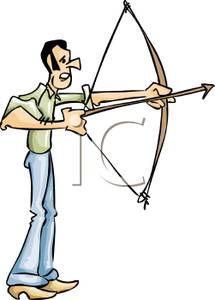
Public Domain
At its Hebrew root “sin” means “to miss the mark.” It evokes an archer aiming carefully at what should be an easy target. You take your best shot and, stupidly, somehow you missed. “All have sinned and fall short of the glory of God,” as St. Paul has it. (Rm. 3:23)
If we were talking about bowling, missing a strike is watching your ball veer straight for the gutter. There it rumbles mocking all your careful preparation and everybody can see it. Nice, huh?
A little while before in the mass we were made to confess our sins “to God Almighty, before the whole company of heaven, and to you, my brothers and sisters.” As if we need any more gawkers, huh?
Thankfully, the language is formally ritualized. Otherwise it would be a downright red-faced embarrassment.
The fracture of sin is relational. Unlike the legalities of debt or trespass, sin fundamentally indicates a rupture of trust. The relationships that are most dearly betrayed are entangled and almost always they involve people we know best and should love most. A harsh word, a mistaken intent, a belittling, things do boil over. This is where sin cuts deepest: between you with God, between you with neighbor and God.
Equally and perhaps more personally devastating than any other sin, we may also talk of that betrayal of one’s self, that time when fear or shame or both drove you to abandon your own best principles.
To ask forgiveness under those conditions is to seek relief from guilt. There’s another thing. Guilt isn’t very popular. Pop therapists tell us guilt will unfavorably impact our sense of self, and we wouldn’t want that, now would we? We don’t like guilt any more than we like admitting the sin that produced it.
We could skip both, you know. People do. Since everybody knows that guilt lowers self-esteem, don’t you really need therapy more than forgiveness, therapy to overcome low self-esteem caused by guilt from sin? Detach the guilt from the act, or the act from the guilt, and you can get on with the business of living a guilt-free life. No guilt = no sin. See, all fixed.
If you are in that situation (and honest, who isn’t), denying the reality guilt due to sin, try this. Tune in any country “somebody-done-somebody-wrong” song. There you’ll find ample helpings of both for most of the year. If we had ways of turning all that anguish and angst into an energy source, we’d be done with fossil fuels by next weekend.
So sin is real, and so is guilt, but life in Christ is more than either.
There is a higher reality. The resurrection of Christ shows us a new world. We begin to look at ourselves ― our sin and our guilt ― in the light of the risen Christ.
An ancient prophetic promise stirs to life and we get a look at our new reality: “I will forgive their iniquity, and their sin I will remember no more.” (Jer. 31:34b) The Eucharistic remembrance (anamnesis) of Christ’s sacrifice for our sin becomes God’s forgetfulness (amnesia).
Christ is raised. Whatever the sin, however deep the guilt, we are embraced and from within that embrace Christ once more launches us as a New Creation. We turn once more and ever again to the life God desires for us. For a plain old fashioned word like sin, there’s nothing more refreshing than a plain old fashioned forgiveness. Repeat as necessary.
Russell E. Saltzman lives in Kansas City, Missouri. His latest book is Speaking of the Dead*.* http://alpb.org/books/speaking-of-the-dead/ He can be reached at [email protected] [email protected] and on Twitter @RESaltzman. https://twitter.com/RESaltzman
Previous Post
April 16, 2019
Part 4 - What Are We Asking In the Our Father
Next Post

April 23, 2019 Part 6 - What Are We Asking In the Our Father
Browse Our Archives
Select a Category AIDS American Social Life American Solidarity Party Ash Wednesday Books Consciousness Death Penalty Diabetes Early Christianity End of Life Ethics Family inheritance Funeral Sermons God as Other Immigration Luther's Reformation March for Life Pagans v. Christians Pandemic Pets Politics Presidential Reporting Pro-Life LIterature Remembrance Richard Neuhaus Science Fiction The Devil The Our Father Uncategorized Watergate Wild life
Select a Month September 2022 August 2022 March 2022 November 2021 July 2021 September 2020 June 2020 February 2020 January 2020 October 2019 September 2019 August 2019 July 2019 April 2019 March 2019 February 2019 January 2019
Follow Us!
TAKE THE
Religious Wisdom Quiz
Which prophet predicted God would pour out His Spirit on all people?
Select your answer to see how you score.
Joel Micah Amos Hosea
Related posts from The Vatican II Lutheran
Part 8 - What Are We Asking For...
Part 7 - What Are We Asking In...

Part 6 - What Are We Asking In...
Part 4 - What Are We Asking In...
TRENDING AT PATHEOS Catholic

The Parable Of The Sower And The Word...
One of Christ’s most famous parables is that of the sower who...

Rejecting Doom: Christian Hope And Human Action
Christianity is a religion of hope. We are to have hope and...

Why I Choose the Eucharist Over the Sermon
Choose the Eucharist, Not the Sermon What are we supposed to get...

5 Design Elements Found in Spiritually Rooted Homes
Putting Spirituality Into Home Decor Our homes are more than our living...

Credo: A Story of God Told with the...
About 10 years ago, I began to imagine a personal "Credo" that...

The Anatomy of Divine Revelation in Catholic Thought
The claim that God has made Himself known to human beings is...
view all Catholic blogs
Ad-Free & Subscriber Log-In Subscription Support
- About Us
- 2026 Calendar
- Videos
- Podcasts
- Library of World Religions
- Faith In Media Tracker
- Advertise With Us
- Write for Us
- Privacy Policy
- Terms of Service
- Do Not Sell My Data
- Contact Us
- Radiant Digital
- Manage Newsletter Subscriptions
- Unsubscribe From Notifications
- Sitemap
Copyright 2008-2026, Patheos. All rights reserved.
Subscription Support Ad-Free & Subscriber Log-In
Follow Patheos