
BuddhistCatholicContemplativeEvangelicalGeneral ChristianHinduJewishLatter-day SaintMuslimNew VisionsProgressive Christian
Beliefs
- Buddhist
- Catholic
- Contemplative
- Evangelical
- General Christian
- Hindu
- Jewish
- Latter-day Saint
- More Voices
- Muslim
- New Visions
- Pagan
- Progressive Christian
Topics
- Religion News
- Food and Religion
- Sports and Religion
- Religious Art
- Religious Music and Entertainment
- Religious Events
- History and Religion
- Style and Religion
- Politics and Religion
- Women in Religion
- Recreation Outdoors and Religion
- Business Finance and Religion
- Careers Workplace and Religion
- Education and Religion
- Family Parenting and Religion
- Health Fitness and Religion
- Home and Religion
- Relationships and Religion
- Technology and Religion
- Travel and Religion
Columnists
- Buddhist Columnists
- Business Finance and Religion Columnists
- Careers Workplace and Religion Columnists
- Catholic Columnists
- Contemplative Columnists
- Education and Religion Columnists
- Evangelists Columnists
- Family Parenting and Religion Columnists
- General Christian Columnists
- Health Fitness and Religion Columnists
- Hindu Columnists
- History and Religion Columnists
- Home and Religion Columnists
- Jewish Columnists
- More Voices Columnists
- Latter Day Columnists
- Muslim Columnists
- New Visions Columnists
- Nonreligious Columnists
- Pagan Columnists
- Politics and Religion Columnists
- Progressive Columnists
- Recreation Outdoors and Religion Columnists
- Relationships and Religion Columnists
- Religion News Columnists
- Religious Art Columnists
- Religious Events Columnists
- Religious Music and Entertainment Columnists
- Sports and Religion Columnists
- Style and Religion Columnists
- Technology and Religion Columnists
- Travel and Religion Columnists
- Women in Religion Columnists
Resource Library
- 2026 Calendar
- Library of World Religions
- The 100 Most Holy Places on Earth
- Patheos Answers
- Podcasts
- Videos
- Faith Leaders Database
- Anglican Episcopalian
- Bahai
- Baptist
- Buddhism
- Christianity
- Confucianism
- Eastern Orthodoxy
- Hinduism
- Holiness and Pentecostal
- ISKCON
- Islam
- Judaism
- Lutheran
- Methodist
- The Church of Jesus Christ of Latter-day Saints
- New Age
- Paganism
- Presbytarian and Reformed
- Protestantism
- Religion Behind the Scenes
- Roman Catholic
- Scientology
- Shia Islam
- Sikhism
- Sufism
- Sunni Islam
- Taoism
- Zen
- See all religions
Research Tools
 Ad-Free & Subscriber Log-In Subscription Support
Ad-Free & Subscriber Log-In Subscription Support
Follow Patheos 

- Trending:
- Forgiveness
- |
- Marriage
- |
- Consciousness
- |
- Death Penalty
- |
- Election
- |
- Halloween
 The Vatican II Lutheran
- Home
- Catholic
- St. Joseph’s No-Name Angel
St. Joseph’s No-Name Angel
Last updated on: March 12, 2019 at 10:58 am by Russell E. Saltzman
St. Joseph’s No-Name Angel 2019-03-12T10:58:06-06:00 Russell E. Saltzman
Patheos Explore the world's faith through different perspectives on religion and spirituality! Patheos has the views of the prevalent religions and spiritualities of the world.
The Feast of St. Joseph, Guardian of Our Lord, is an orphan solemnity in the Church (discounting Lenten St. Joseph Tables). Not much is made of it, not really. Right now it just hangs around in the middle of Lent, March 19, pretty much as it has since the 15th century.
I blame St. Matthew for that. It is Matthew who first introduces us to the man later generations, including our generation, calls the Guardian of Our Lord. After that, Joseph drops away.
Precious little is known about Joseph. Even the oral tradition — the tradition outside scripture — hasn’t got much to say about him. There is a lot of invented “history” but little that is real.
We know only that he was a “joiner,” a carpenter, a tekton in Greek (which today gives us words like technician and technology). We know that much only because it is a criticism made of Jesus, muttered by a voice in a crowd (Mt. 13:55), and Matthew repeated it.
But Matthew does drop a hint of what sort of man was Joseph. Matthew lets it slip that Joseph was a “righteous” man (1:19), and Joseph’s “righteousness” wasn’t necessarily a good thing for Mary.
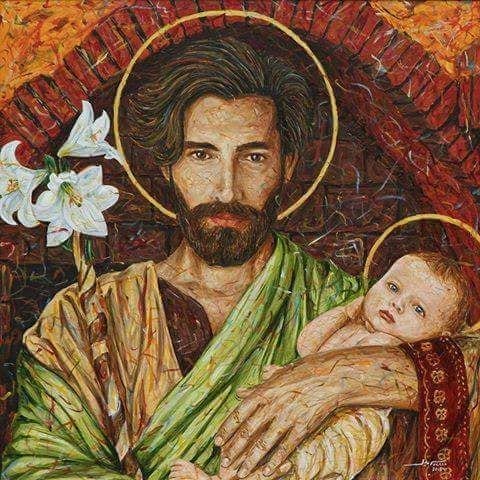
Photo: Every Thing Catholic
We know this because Matthew tells us Joseph was quite prepared to deal with a pregnant Mary according to the demands of righteousness, understood through Jewish law and custom. He was prepared to renounce his betrothal, to “put her aside” as was said, when he discovered she was pregnant.
That is what “righteousness” demanded from a “righteous” man. The one concession he made was to do it quietly.
Joseph, make no mistake, was a “righteous” man, but not without some little consideration.
After deciding upon this, an angelic visitor slips in his dream, straightens him out, and even prescribes the name by which Joseph is to name the child. Yeshua in Hebrew, Jesus as it gets translated, “God is our help.”
As visits with angels run, Joseph gets slighted. There is no other way to put it. Compared to the others in the Nativity story, Joseph gets the shortest of short straws.
When it came time to announce the birth of John the Baptist, Zechariah gets a visit from an archangel, no less than Gabriel himself. He tells Zechariah that he, Gabriel himself, “stands in the presence of God” and it was he, Gabriel, who specifically was told to deliver the message to Zechariah. Important stuff for an angel who makes certain Zechariah knows how important it was that Gabriel, himself, was chosen to do it. (Lk 1:19)
When it came time for Mary’s assignment in the salvation drama, once more, it is the Archangel Gabriel who declares her pregnancy is by God’s choice through the Holy Spirit.
And, gee whiz, even hired shepherds outside Bethlehem get better than Joseph, a whole lot better. They get a flash-mob chorus from heaven chanting the Gloria.
But Joseph; what does Joseph get? Joseph got some no-name angel and no face-time, only a dream. No flapping wings, no dazzling light, no tune for him to hum on the way to work – he gets a whisper from a lower-echelon angel.
And Joseph acts on the basis of a dream. There is a brave man, especially after this no-name angel says, “Do not be afraid.” The angel wouldn’t have said that unless there was plenty to fear.
If a betrothed woman became pregnant, it was regarded as adultery, if not harlotry. Deuteronomy spells it out. She shall be “brought to the doorway of her father’s house, and the men of her city shall stone her to death . . . thus you shall purge the evil from among you.” (Deut 22:21) It was, at worst, an honor killing Mary faced.
Joseph does not put Mary aside quietly or any other way. He does not claim to be the child’s father; but by his actions he claims only to be Mary’s sentinel.
Joseph risks his “righteousness” for a dream, and, come time for the child to be born, he remembers what name to give.
Here is a “righteous” man by religious law and Jewish custom. For a woman, and for a child not his own, on the soft word of an anonymous angel, he discards his lawful righteousness. He tosses it for an uncertain if not perilous future. The public disgrace that would have fallen upon Mary, Joseph accepts it for his own.
St. Paul once called himself a “Pharisee of Pharisees,” so zealously did he seek the righteousness of observing the traditions. But all he was doing, so he said, was picking through trash compared to the Good News of the Messiah.
St. Paul said it. But it was Joseph who first lived it. The story of Joseph reminds us that what is yet honored best are words like courage, duty, love, devotion, faith — words that every father, even a foster father, should seek for his own.
Even though we really know so little about Joseph, thanks to a no-name angel, we know enough to call him Guardian of Our Lord.
Russell E. Saltzman publishes every Tuesday and Thursday usually by noon Central Time. He can be reached on Twitter as @RESaltzman, on Facebook as Russ Saltzman, and by email: [email protected]. Earlier versions of this piece have appeared at Aleteia and at The Catholic Key*, the newspaper of the Kansas City–St. Joseph Missouri diocese.***
Previous Post
March 7, 2019
An Indictment of God
Next Post
March 19, 2019 Water You Can’t Carry in a Bucket
Browse Our Archives
Select a Category AIDS American Social Life American Solidarity Party Ash Wednesday Books Consciousness Death Penalty Diabetes Early Christianity End of Life Ethics Family inheritance Funeral Sermons God as Other Immigration Luther's Reformation March for Life Pagans v. Christians Pandemic Pets Politics Presidential Reporting Pro-Life LIterature Remembrance Richard Neuhaus Science Fiction The Devil The Our Father Uncategorized Watergate Wild life
Select a Month September 2022 August 2022 March 2022 November 2021 July 2021 September 2020 June 2020 February 2020 January 2020 October 2019 September 2019 August 2019 July 2019 April 2019 March 2019 February 2019 January 2019
Follow Us!
TAKE THE
Religious Wisdom Quiz
How many "types" of Psalms are often recognized (e.g., praise, lament, wisdom)?
Select your answer to see how you score.
Ten only Fifty One Five or more
Related posts from The Vatican II Lutheran

Divorce and Dogs and Nobody Cares About the...

What the Church Fathers Had to Figure Out

Phillip K. Dick, a Charleston tour guide, and...
TRENDING AT PATHEOS Catholic

Rejecting Doom: Christian Hope And Human Action
Christianity is a religion of hope. We are to have hope and...

It’s What Comes From Within Which Matters
One of the most difficult things for us to understand is why...

Why I Choose the Eucharist Over the Sermon
Choose the Eucharist, Not the Sermon What are we supposed to get...

5 Design Elements Found in Spiritually Rooted Homes
Putting Spirituality Into Home Decor Our homes are more than our living...

Credo: A Story of God Told with the...
About 10 years ago, I began to imagine a personal "Credo" that...

The Anatomy of Divine Revelation in Catholic Thought
The claim that God has made Himself known to human beings is...
view all Catholic blogs
Ad-Free & Subscriber Log-In Subscription Support
- About Us
- 2026 Calendar
- Videos
- Podcasts
- Library of World Religions
- Faith In Media Tracker
- Advertise With Us
- Write for Us
- Privacy Policy
- Terms of Service
- Do Not Sell My Data
- Contact Us
- Radiant Digital
- Manage Newsletter Subscriptions
- Unsubscribe From Notifications
- Sitemap
Copyright 2008-2026, Patheos. All rights reserved.
Subscription Support Ad-Free & Subscriber Log-In
Follow Patheos