
BuddhistCatholicContemplativeEvangelicalGeneral ChristianHinduJewishLatter-day SaintMuslimNew VisionsProgressive Christian
Beliefs
- Buddhist
- Catholic
- Contemplative
- Evangelical
- General Christian
- Hindu
- Jewish
- Latter-day Saint
- More Voices
- Muslim
- New Visions
- Pagan
- Progressive Christian
Topics
- Religion News
- Food and Religion
- Sports and Religion
- Religious Art
- Religious Music and Entertainment
- Religious Events
- History and Religion
- Style and Religion
- Politics and Religion
- Women in Religion
- Recreation Outdoors and Religion
- Business Finance and Religion
- Careers Workplace and Religion
- Education and Religion
- Family Parenting and Religion
- Health Fitness and Religion
- Home and Religion
- Relationships and Religion
- Technology and Religion
- Travel and Religion
Columnists
- Buddhist Columnists
- Business Finance and Religion Columnists
- Careers Workplace and Religion Columnists
- Catholic Columnists
- Contemplative Columnists
- Education and Religion Columnists
- Evangelists Columnists
- Family Parenting and Religion Columnists
- General Christian Columnists
- Health Fitness and Religion Columnists
- Hindu Columnists
- History and Religion Columnists
- Home and Religion Columnists
- Jewish Columnists
- More Voices Columnists
- Latter Day Columnists
- Muslim Columnists
- New Visions Columnists
- Nonreligious Columnists
- Pagan Columnists
- Politics and Religion Columnists
- Progressive Columnists
- Recreation Outdoors and Religion Columnists
- Relationships and Religion Columnists
- Religion News Columnists
- Religious Art Columnists
- Religious Events Columnists
- Religious Music and Entertainment Columnists
- Sports and Religion Columnists
- Style and Religion Columnists
- Technology and Religion Columnists
- Travel and Religion Columnists
- Women in Religion Columnists
Resource Library
- 2026 Calendar
- Library of World Religions
- The 100 Most Holy Places on Earth
- Patheos Answers
- Podcasts
- Videos
- Faith Leaders Database
- Anglican Episcopalian
- Bahai
- Baptist
- Buddhism
- Christianity
- Confucianism
- Eastern Orthodoxy
- Hinduism
- Holiness and Pentecostal
- ISKCON
- Islam
- Judaism
- Lutheran
- Methodist
- The Church of Jesus Christ of Latter-day Saints
- New Age
- Paganism
- Presbytarian and Reformed
- Protestantism
- Religion Behind the Scenes
- Roman Catholic
- Scientology
- Shia Islam
- Sikhism
- Sufism
- Sunni Islam
- Taoism
- Zen
- See all religions
Research Tools
 Ad-Free & Subscriber Log-In Subscription Support
Ad-Free & Subscriber Log-In Subscription Support
Follow Patheos 

- Trending:
- Forgiveness
- |
- Marriage
- |
- Consciousness
- |
- Death Penalty
- |
- Election
- |
- Halloween
 The Vatican II Lutheran
- Home
- Catholic
- Artificial Consciousness
Artificial Consciousness
Last updated on: February 13, 2019 at 2:52 pm by Russell E. Saltzman
Artificial Consciousness 2019-02-13T14:52:52-06:00 Russell E. Saltzman
Patheos Explore the world's faith through different perspectives on religion and spirituality! Patheos has the views of the prevalent religions and spiritualities of the world.
Autonomous self-driving Ubers won’t be taking you on shopping trips or cross-country vacations before 2030. That is because “artificial intelligence” is only one of those things, artificial. It is not the other.
Oh, I’m not a Luddite, but I do think I’m something of a realist. They have basic operational shortcomings that make them dangerous:
- They go blind in bad weather. Cameras can be obscured by rain, snow, dust. When lane lines disappear the vehicles don’t know where they are and when snowflakes bounce off laser sensors, they appear as obstacles to be dodged.
- Absent lane lines and curbs, travel turns into a negotiation between algorithms.
- Lacking volitional will, driverless vehicles must deal with humans who are better at driving and less predictable.
- Left turns are inherently chancy for any driver, artificial or not.
- They have killed five people: one Arizona pedestrian, three drivers in the U.S; one driver in China. That’s not as many as vending machines kill every year, but then there are fewer driverless cars.
Those problems may be solved, of course, but algorithmic programs are layered within programs buried under levels of endless code. A driverless car confronts many things unanticipated. An algorithm is really at its best when designed only for one thing: beating a chess champion or a Go prodigy comes to mind. Design one for both chess and Go it will probably need a toggle switch.
But this is called an artificial intelligence, which is little more than clever marketing. My AI robotic vacuum barely finds its way back to the charging station; 8 times out of 10 I have to carry the poor beeping thing to its home.
And here we move ourselves into the arena of consciousness; specifically the notion of artificial consciousness where, it appears, an artificial intelligence awakens to itself or is nudged into wakefulness.
I watched an episode of Star Trek Voyager (1995-2001). The holographic doctor is essentially ignored by human crew members. People do not talk to him directly in sick bay. He will seek a symptom and the patient will invariably reply not to him but to his pretty alien but flesh and blood (oh, wow. is she flesh and blood) assistant. She feels badly for the doctor (who, incidentally, can walk through walls). He is not regarded for his talent and medical skill. He is a mere computer simulation, who does surgery and other trivial things, like wave medical tricorders.
His assistant insists to him and to the captain, he should be made crew; he has “feelings.” Why, the captain asks? He is a programmatic hologram, his feelings are machine-made and he is a rather caustic hologram at that, according to the crew. It’s just programming; that can be corrected.
It all gets fixed without programming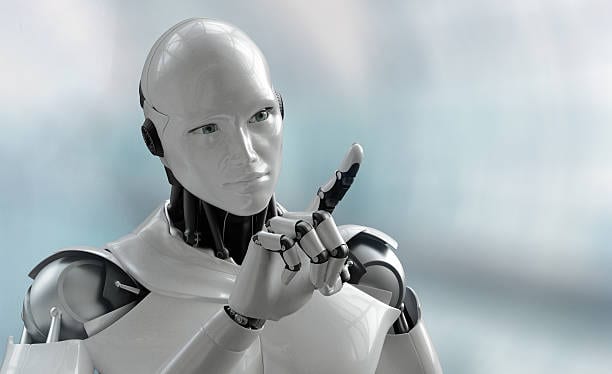 when he is permitted to deactivate himself when he needs quiet time, and activate himself as he chooses. He becomes volitional (save for doing evil) within the boundaries of his programming and is told he needs a name.
Ah, but is he now conscious, as if “consciousness” finally is lodged only as a physical element of the brain?
The consensus of science and much of contemporary philosophy says human consciousness is all biological, all material. Our random-firing neurons fire only in response to the urges of eons of evolutionary development.
When we can figure out where it is ultimately located, how it really works, we can map it, code it, box it up, and put it in a computer to drive cars.
But the problem to explain is the human experience of the brain. Why, as a machine, does the brain persistently insist to itself that it possesses something more, that we have a nonphysical reality and the potentiality of soul? If self-consciousness is only an evolutionary element, I do not see how conscious awareness of death is any sort of benefit. It does not require intelligence or self-conscious awareness to be a successful species.
Short answer: we are more than our parts.
The Hard Problem has boyfriend and girlfriend arguing the nature of consciousness. She, unlike her thoroughly materialist boyfriend, aches to believe that people are more than the mere summation of their biological components. “When you come right down to it,” says the girlfriend, “the body is made of things, and things don’t have thoughts.”
She is not far from Ecclesiastes, I think.
“God has made everything beautiful in its time. He has also set eternity in the human heart…” (3:11)
Russell E. Saltzman publishes every Tuesday and Thursday at noon Central Time. He can be reached on Twitter as @RESaltzman, on Facebook as Russ Saltzman, and by email: [email protected]
Photo: iStock
Previous Post

February 5, 2019
About the Animals
Next Post

February 12, 2019 Ash Wednesday's Death
Browse Our Archives
Select a Category AIDS American Social Life American Solidarity Party Ash Wednesday Books Consciousness Death Penalty Diabetes Early Christianity End of Life Ethics Family inheritance Funeral Sermons God as Other Immigration Luther's Reformation March for Life Pagans v. Christians Pandemic Pets Politics Presidential Reporting Pro-Life LIterature Remembrance Richard Neuhaus Science Fiction The Devil The Our Father Uncategorized Watergate Wild life
Select a Month September 2022 August 2022 March 2022 November 2021 July 2021 September 2020 June 2020 February 2020 January 2020 October 2019 September 2019 August 2019 July 2019 April 2019 March 2019 February 2019 January 2019
Follow Us!
TAKE THE
Religious Wisdom Quiz
True or False: Animals that chew the cud but do not have split hooves are considered clean to eat.
Select your answer to see how you score.
FALSE TRUE
Related posts from The Vatican II Lutheran


Divorce and Dogs and Nobody Cares About the...

What the Church Fathers Had to Figure Out

TRENDING AT PATHEOS Catholic

Rejecting Doom: Christian Hope And Human Action
Christianity is a religion of hope. We are to have hope and...

It’s What Comes From Within Which Matters
One of the most difficult things for us to understand is why...

Why I Choose the Eucharist Over the Sermon
Choose the Eucharist, Not the Sermon What are we supposed to get...

5 Design Elements Found in Spiritually Rooted Homes
Putting Spirituality Into Home Decor Our homes are more than our living...

Credo: A Story of God Told with the...
About 10 years ago, I began to imagine a personal "Credo" that...

The Anatomy of Divine Revelation in Catholic Thought
The claim that God has made Himself known to human beings is...
view all Catholic blogs
Ad-Free & Subscriber Log-In Subscription Support
- About Us
- 2026 Calendar
- Videos
- Podcasts
- Library of World Religions
- Faith In Media Tracker
- Advertise With Us
- Write for Us
- Privacy Policy
- Terms of Service
- Do Not Sell My Data
- Contact Us
- Radiant Digital
- Manage Newsletter Subscriptions
- Unsubscribe From Notifications
- Sitemap
Copyright 2008-2026, Patheos. All rights reserved.
Subscription Support Ad-Free & Subscriber Log-In
Follow Patheos