
BuddhistCatholicContemplativeEvangelicalGeneral ChristianHinduJewishLatter-day SaintMuslimNew VisionsProgressive Christian
Beliefs
- Buddhist
- Catholic
- Contemplative
- Evangelical
- General Christian
- Hindu
- Jewish
- Latter-day Saint
- More Voices
- Muslim
- New Visions
- Pagan
- Progressive Christian
Topics
- Religion News
- Food and Religion
- Sports and Religion
- Religious Art
- Religious Music and Entertainment
- Religious Events
- History and Religion
- Style and Religion
- Politics and Religion
- Women in Religion
- Recreation Outdoors and Religion
- Business Finance and Religion
- Careers Workplace and Religion
- Education and Religion
- Family Parenting and Religion
- Health Fitness and Religion
- Home and Religion
- Relationships and Religion
- Technology and Religion
- Travel and Religion
Columnists
- Buddhist Columnists
- Business Finance and Religion Columnists
- Careers Workplace and Religion Columnists
- Catholic Columnists
- Contemplative Columnists
- Education and Religion Columnists
- Evangelists Columnists
- Family Parenting and Religion Columnists
- General Christian Columnists
- Health Fitness and Religion Columnists
- Hindu Columnists
- History and Religion Columnists
- Home and Religion Columnists
- Jewish Columnists
- More Voices Columnists
- Latter Day Columnists
- Muslim Columnists
- New Visions Columnists
- Nonreligious Columnists
- Pagan Columnists
- Politics and Religion Columnists
- Progressive Columnists
- Recreation Outdoors and Religion Columnists
- Relationships and Religion Columnists
- Religion News Columnists
- Religious Art Columnists
- Religious Events Columnists
- Religious Music and Entertainment Columnists
- Sports and Religion Columnists
- Style and Religion Columnists
- Technology and Religion Columnists
- Travel and Religion Columnists
- Women in Religion Columnists
Resource Library
- 2026 Calendar
- Library of World Religions
- The 100 Most Holy Places on Earth
- Patheos Answers
- Podcasts
- Videos
- Faith Leaders Database
- Anglican Episcopalian
- Bahai
- Baptist
- Buddhism
- Christianity
- Confucianism
- Eastern Orthodoxy
- Hinduism
- Holiness and Pentecostal
- ISKCON
- Islam
- Judaism
- Lutheran
- Methodist
- The Church of Jesus Christ of Latter-day Saints
- New Age
- Paganism
- Presbytarian and Reformed
- Protestantism
- Religion Behind the Scenes
- Roman Catholic
- Scientology
- Shia Islam
- Sikhism
- Sufism
- Sunni Islam
- Taoism
- Zen
- See all religions
Research Tools
 Ad-Free & Subscriber Log-In Subscription Support
Ad-Free & Subscriber Log-In Subscription Support
Follow Patheos 

- Trending:
- Forgiveness
- |
- Marriage
- |
- Consciousness
- |
- Death Penalty
- |
- Election
- |
- Halloween
 The Vatican II Lutheran
- Home
- Catholic
- About the Animals
About the Animals
Last updated on: February 5, 2019 at 12:16 pm by Russell E. Saltzman
About the Animals 2019-02-05T12:16:17-06:00 Russell E. Saltzman
Patheos Explore the world's faith through different perspectives on religion and spirituality! Patheos has the views of the prevalent religions and spiritualities of the world.
I like the animals. I take note of all the critters that amble through our yard and I delight in the encounters. There’s something enchanting about it, as if I have unexpectedly bumped into the numinous.
We live in an urban subdivision in Kansas City, Missouri bounded by some major streets. Still, I have encountered a deer on the porch, peering in through the front door. Her two fawns were lazing on the lawn. My daughter driving home from school that day texted me to shoo the napping deer off the driveway so she could get in.
I have seen several walk down the middle of the street at 3 a.m.; adolescents looking for mischief is my guess. We find their tracks in the snow.
Driving the short 1.2 miles to the grocery I have observed deer, of course, but also fox, wild turkey, buzzards named for turkeys, rabbit, and, naturally, Canada geese. These are animals so habituated to suburban living cars dodge them, not the other way around.
Our back yard has hosted possum, raccoons under the deck, and rabbit. One of those ended up half eaten. I was fond of that one; we had watched it grow up over the summer. I left the carcass and in a day or two it was all gone. Oh, and a wood rat lived with us for a time one summer, strictly outdoors. It played well with the squirrels at the ground feeder.
For several years we had mourning doves nesting on the top shelf of an open cabinet. They were eye-level and our traffic pattern went right next to them. Male and female traded nesting duty but neither one would budge from the nest as we went by. We tried exchanging 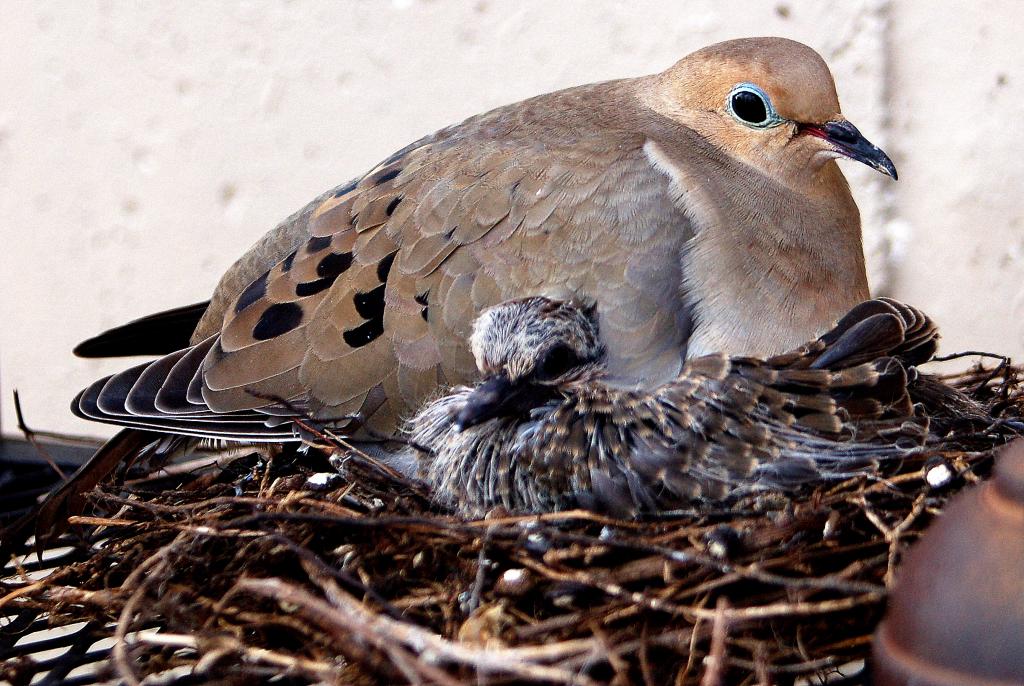 pleasantries, but they never paid us any attention at all. I did give myself permission to sometimes stroke their tail feathers, which is how I learned a dove will growl low and insistently just before lashing out with its beak, and do that without abandoning the nest.
Though the dog will chase squirrels ― and the squirrels give many indications they like being chased (why else would they hang around so enticingly close?) ― the dog will also rise to their defense against an intruding hawk. Squirrels belong to the dog and the hawk hasn’t been back. Interestingly, on a walk she ignores foreign squirrels and they ignore her. But in our back yard, they belong to each other and have achieved symbiosis.
One summer we raised orphan robin. It was a loud, voracious eater. Needing professional help, I took myself to a bait shop every two or three days for night crawlers. The robin fledged, learned to fly, and stayed around into the fall. When my wife was out weeding, though, it would occasionally flop down next to her and demand all the bugs and crawlies she could dig up. If she didn’t respond fast enough, the bird would peck at her bracelet.
This was the year for squirrels, though. Too lazy to build their own nests, a half dozen or so assumed squatters rights in the attic. “Squirrels in the attic” is not a metaphor, it is a mess. We called exterminators. The squirrels are gone but live trapping wasn’t an option and I do feel a sad for it, made all the worse by the bill I got.
It should not be thought unusual that we have an innate affection for animals, domestic and wild. Humanity was formed from the dust of the ground (Gen 2:7); so, too, were the animals (2:19). God’s breath of spirit animates humanity, though not the animals. Yet both are related to the dust of the earth and thereby divinely related as well, and just as clearly they are separate. In the Edenic account animals arose by God’s will because Adam was alone and needed helpers.
But then, so did the animals. Adam’s task was naming them. The force of the text suggests that God did not know their names until Adam named them: “[God] brought them to the man to see what he would name them.” Adam naming the creatures revealed them to God, and by naming the things of creation, Adam also assumed care and responsibility for them. The creatures revealed are Adam’s helpers in his loneliness, though not completely fit helpers until Man and Woman were given to each other.
Outside of Genesis some of our oldest myths say Man and Animal could talk together, and even cooperate: one giving life as food, the other marking the sacrifice given. Shamans painting cave walls, almost always depicting prey animals, simultaneously named an animal in their representations and at the same time, summoned it to give its life for humans.
Were the Yahwist writers and redactors of Genesis drawing on snatches of surviving memory from Paleolithic myth? I just speculate, that’s all, and hope the squirrels are really gone from the attic.
Russell E. Saltzman publishes every Tuesday and Thursday at noon Central Time. He can be reached on Twitter as @RESaltzman, on Facebook as Russ Saltzman, and by email: [email protected]
Photo: by the author
Previous Post

January 31, 2019
Things Martin Luther Never Did
Next Post

February 7, 2019 Artificial Consciousness
Browse Our Archives
Select a Category AIDS American Social Life American Solidarity Party Ash Wednesday Books Consciousness Death Penalty Diabetes Early Christianity End of Life Ethics Family inheritance Funeral Sermons God as Other Immigration Luther's Reformation March for Life Pagans v. Christians Pandemic Pets Politics Presidential Reporting Pro-Life LIterature Remembrance Richard Neuhaus Science Fiction The Devil The Our Father Uncategorized Watergate Wild life
Select a Month September 2022 August 2022 March 2022 November 2021 July 2021 September 2020 June 2020 February 2020 January 2020 October 2019 September 2019 August 2019 July 2019 April 2019 March 2019 February 2019 January 2019
Follow Us!
TAKE THE
Religious Wisdom Quiz
What does Jesus say about loving only those who love you?
Select your answer to see how you score.
It's most important It's required It's hard to do Even sinners do that
Related posts from The Vatican II Lutheran

Divorce and Dogs and Nobody Cares About the...

What the Church Fathers Had to Figure Out


Phillip K. Dick, a Charleston tour guide, and...
TRENDING AT PATHEOS Catholic

Rejecting Doom: Christian Hope And Human Action
Christianity is a religion of hope. We are to have hope and...

It’s What Comes From Within Which Matters
One of the most difficult things for us to understand is why...

Why I Choose the Eucharist Over the Sermon
Choose the Eucharist, Not the Sermon What are we supposed to get...

5 Design Elements Found in Spiritually Rooted Homes
Putting Spirituality Into Home Decor Our homes are more than our living...

Credo: A Story of God Told with the...
About 10 years ago, I began to imagine a personal "Credo" that...

The Anatomy of Divine Revelation in Catholic Thought
The claim that God has made Himself known to human beings is...
view all Catholic blogs
Ad-Free & Subscriber Log-In Subscription Support
- About Us
- 2026 Calendar
- Videos
- Podcasts
- Library of World Religions
- Faith In Media Tracker
- Advertise With Us
- Write for Us
- Privacy Policy
- Terms of Service
- Do Not Sell My Data
- Contact Us
- Radiant Digital
- Manage Newsletter Subscriptions
- Unsubscribe From Notifications
- Sitemap
Copyright 2008-2026, Patheos. All rights reserved.
Subscription Support Ad-Free & Subscriber Log-In
Follow Patheos