
BuddhistCatholicContemplativeEvangelicalGeneral ChristianHinduJewishLatter-day SaintMuslimNew VisionsProgressive Christian
Beliefs
- Buddhist
- Catholic
- Contemplative
- Evangelical
- General Christian
- Hindu
- Jewish
- Latter-day Saint
- More Voices
- Muslim
- New Visions
- Pagan
- Progressive Christian
Topics
- Religion News
- Food and Religion
- Sports and Religion
- Religious Art
- Religious Music and Entertainment
- Religious Events
- History and Religion
- Style and Religion
- Politics and Religion
- Women in Religion
- Recreation Outdoors and Religion
- Business Finance and Religion
- Careers Workplace and Religion
- Education and Religion
- Family Parenting and Religion
- Health Fitness and Religion
- Home and Religion
- Relationships and Religion
- Technology and Religion
- Travel and Religion
Columnists
- Buddhist Columnists
- Business Finance and Religion Columnists
- Careers Workplace and Religion Columnists
- Catholic Columnists
- Contemplative Columnists
- Education and Religion Columnists
- Evangelists Columnists
- Family Parenting and Religion Columnists
- General Christian Columnists
- Health Fitness and Religion Columnists
- Hindu Columnists
- History and Religion Columnists
- Home and Religion Columnists
- Jewish Columnists
- More Voices Columnists
- Latter Day Columnists
- Muslim Columnists
- New Visions Columnists
- Nonreligious Columnists
- Pagan Columnists
- Politics and Religion Columnists
- Progressive Columnists
- Recreation Outdoors and Religion Columnists
- Relationships and Religion Columnists
- Religion News Columnists
- Religious Art Columnists
- Religious Events Columnists
- Religious Music and Entertainment Columnists
- Sports and Religion Columnists
- Style and Religion Columnists
- Technology and Religion Columnists
- Travel and Religion Columnists
- Women in Religion Columnists
Resource Library
- 2026 Calendar
- Library of World Religions
- The 100 Most Holy Places on Earth
- Patheos Answers
- Podcasts
- Videos
- Faith Leaders Database
- Anglican Episcopalian
- Bahai
- Baptist
- Buddhism
- Christianity
- Confucianism
- Eastern Orthodoxy
- Hinduism
- Holiness and Pentecostal
- ISKCON
- Islam
- Judaism
- Lutheran
- Methodist
- The Church of Jesus Christ of Latter-day Saints
- New Age
- Paganism
- Presbytarian and Reformed
- Protestantism
- Religion Behind the Scenes
- Roman Catholic
- Scientology
- Shia Islam
- Sikhism
- Sufism
- Sunni Islam
- Taoism
- Zen
- See all religions
Research Tools
 Ad-Free & Subscriber Log-In Subscription Support
Ad-Free & Subscriber Log-In Subscription Support
Follow Patheos 

- Trending:
- Forgiveness
- |
- Marriage
- |
- Consciousness
- |
- Death Penalty
- |
- Election
- |
- Halloween

- Home
- Family, Parenting and Religion
- What We Must Learn From the Last Temptation of Matt Lauer
What We Must Learn From the Last Temptation of Matt Lauer
Last updated on: December 7, 2017 at 2:07 pm by Roland Warren
What We Must Learn From the Last Temptation of Matt Lauer 2017-12-07T14:07:58-05:00 Roland Warren
Patheos Explore the world's faith through different perspectives on religion and spirituality! Patheos has the views of the prevalent religions and spiritualities of the world.
 In 1982, there was a popular off-Broadway musical called “Little Shop of Horrors” that presented an entertaining and accurate allegory about the consequences of not dealing properly and promptly with temptations to do evil. The main character in the play was Seymour Krelborn, a hapless fellow who worked at a skid row flower shop. He was frustrated with his lot in life and the only bright spot was a pretty co-worker named Audrey. Seymour was in love with Audrey, but, although she was nice to him, she showed no romantic interest in him.
Well, Seymour is walking along one day, and he comes across a small, mysterious plant that looks like a Venus flytrap. He decides to keep the plant and, due to his love for Audrey, names it “Audrey II.” Seymour soon discovers that the plant doesn’t thrive on water and sunlight, but on blood, forcing Seymour to constantly feed Audrey II a steady diet of his own blood.
The unique plant turns the flower shop into a major attraction, turns Seymour into a celebrity, and causes Audrey to show more interest in Seymour; he becomes addicted to the attention. But soon, a predictable problem arises. The growing plant needs more blood and even begins to speak to Seymour, demanding more and more from him. It even promises to help him win Audrey’s heart. It also convinces Seymour that Audrey’s abusive boyfriend would make good plant food, so Seymour sets out to kill the boyfriend. As fate would have it, the boyfriend accidently kills himself, although Seymour could have intervened to prevent his death. In any case, Seymour feeds the boyfriend to the delighted plant.
As the play progresses, the plant continues to make increasingly aggressive demands on Seymour and declares, “Feed me!” In time, Seymour kills the shop owner and feeds him to the plant; eventually the plant kills Audrey and eats her, too. Seymour finally wises up and sees the plant for the evil that it is, so he tries to kill it. But, alas, it has grown too powerful. In the last scene, Seymour meets his tragic fate as well. In an effort to finally free himself from this plant he once controlled but now controls him, he runs into its open jaws with a machete, in hopes of killing the plant from inside. But he fails and the plant eats him, too.
There is a saying about the difference between a habit and an addiction. A habit is something that you have; an addiction is something that has you. As Seymour learned, big addictions always start as small habits. But they always lead to one’s destruction and death.
As I considered Seymour’s sad tale, I was reminded of news reports about Matt Lauer, Harvey Weinstein, and a cast of other notables who have fallen as a result of sexual harassment and/or sexual assault claims in the last few months. No doubt, their “habits” started small but eventually grew so powerful that they consumed them and the people and things that mattered to them most. That said, it’s pretty easy to consume the salacious details that the press serves up daily. But a better course is to remember that although the wise learn from their mistakes, the wisest learn from the mistakes of others.
And, there are lessons aplenty here.
For starters, there are key things that we can and must learn about how do handle temptations to do evil. You see, every choice we make is preceded by two things: looking, which is to direct your action or consideration to something, and longing, which is a strong, persistent desire to get what you are looking at. Looking and longing are morally neutral actions; their morality is determined by what you are looking at and longing for. This is where temptation comes into play.
You see, temptation seeks to control our looking and longing in a way that leads us to succumb and to ultimately sin. Of course, temptation is not a sin. After all, temptation existed before sin and even Jesus Christ was tempted. Indeed, I once heard an old pastor say regarding temptation that you may not be able to stop a bird from landing on your head, but you can certainly stop it from building a nest.
In any case, when we are tempted, we come to a decision point and it seems intuitive that we should ask ourselves if it’s right to do what we are tempted to do. However, this is the wrong question to ask. The better question is: “Who do you love?” Why? Because how you answer that question will determine the path you choose and the consequences you may face.
For example, if you say that you love yourself above all others to the point that your needs and wants are your sole concern, it will be easy for you to use and abuse others for your pleasure. In fact, like Seymour, you become dangerously deceived and self-centered and, ultimately, will be so consumed by a lust to please yourself that you will destroy yourself and all that you hold dear.
In contrast, from a Christian perspective, we are challenged to answer the “Who do you love?” question differently. For example, when Jesus was asked what the greatest commandment was, he responded to first love God with all our heart, mind, and soul and then to love our neighbors as ourselves. Both of these loves are other-centered. Moreover, love for our neighbor is linked to love for our self because we generally have no problem making sure that our needs and wants are a priority, even if it’s at the expense of others. Therefore, the only way to ensure that we don’t make idols of ourselves and think of ourselves more highly than we ought is to connect love for our self with love for others.
In short, the diagram below clearly lays out the two paths that flow from our looking and longing when they are framed by temptation. When we love God and obey the immutable and unchanging command to love our neighbor as ourselves, we are on a life-giving path. In contrast, when we succumb to evil temptations that yell, “Feed me!” and are consumed by lust, we eventually lose and are destined to face a not-so-little shop of horrors of our own making. Unfortunately, this is the path that news reports suggest Matt Lauer often took, and it led to predictable negative consequences.
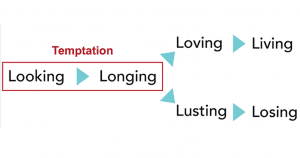
That said, before we cast too many stones at the dying career of Matt Lauer, we should be sobered by the fact that there but for the grace of God go any of us. As scripture says, no temptation to do evil of any kind will seize us, except what is common to mankind. And, if we don’t take the right path—the way out—early and often, we will surely be devoured, too.

Next Post

December 22, 2017 One Christmas Gift That Must Be "Regifted"
Browse Our Archives
Select a Category Abortion Culture Faith Family Fatherhood Marriage Men Parenting Politics Uncategorized
Select a Month October 2024 May 2024 March 2024 December 2023 August 2023 July 2023 June 2023 April 2023 March 2023 April 2022 March 2022 August 2021 May 2021 March 2021 January 2021 December 2020 November 2020 July 2020 April 2020 February 2020 January 2020 August 2019 July 2019 December 2018 November 2018 September 2018 August 2018 July 2018 June 2018 April 2018 March 2018 February 2018 January 2018 December 2017 October 2017 September 2017 July 2017 June 2017 May 2017 April 2017 March 2017 February 2017 January 2017 December 2016 November 2016 October 2016 September 2016 August 2016 July 2016 June 2016 May 2016 April 2016 March 2016
Follow Us!
TAKE THE
Religious Wisdom Quiz
What does "Tetragrammaton" refer to in biblical studies?
Select your answer to see how you score.
The four-letter name of God The first four commandments The first four books of the Bible The four Gospels
Related posts from Roland Warren

Dred Scott and Abortion: Different Circumstances, Same Sin

There are 6 Things Good Dads Do. Here's...

Here's How Jesus Calls Us to Engaged a...

Are Christians Called to Be Tolerant? What would...
TRENDING AT PATHEOS Family, Parenting and Religion

'Super Scam Me' Exposes AI Jon Bon Jovi...
Leslie Pickett believed she was in a relationship with Jon Bon Jovi....

The Brazilian Remake of Kendricks' 'Flywheel' Opens in...
“Flywheel,” the story that launched the Kendrick Brothers’ filmmaking career is getting...

The Dangers of Gradual Accommodation (Winking at Sin)
Recently, the “law of gradualness” resurfaced during the opening of a weeklong,...

The Iron Gates and the Lion of the...
Yesterday, I didn't finish my report about, well, yesterday. So I'll...

The Image: On the Horror of Capitalism and...
The Image Then went the Pharisees, and took counsel how they might...

We are approaching the date of our new American national holiday: October...
view all Family, Parenting and Religion blogs
Ad-Free & Subscriber Log-In Subscription Support
- About Us
- 2026 Calendar
- Videos
- Podcasts
- Library of World Religions
- Faith In Media Tracker
- Advertise With Us
- Write for Us
- Privacy Policy
- Terms of Service
- Do Not Sell My Data
- Contact Us
- Radiant Digital
- Manage Newsletter Subscriptions
- Unsubscribe From Notifications
- Sitemap
Copyright 2008-2026, Patheos. All rights reserved.
Subscription Support Ad-Free & Subscriber Log-In
Follow Patheos