
BuddhistCatholicContemplativeEvangelicalGeneral ChristianHinduJewishLatter-day SaintMuslimNew VisionsProgressive Christian
Beliefs
- Buddhist
- Catholic
- Contemplative
- Evangelical
- General Christian
- Hindu
- Jewish
- Latter-day Saint
- More Voices
- Muslim
- New Visions
- Pagan
- Progressive Christian
Topics
- Religion News
- Food and Religion
- Sports and Religion
- Religious Art
- Religious Music and Entertainment
- Religious Events
- History and Religion
- Style and Religion
- Politics and Religion
- Women in Religion
- Recreation Outdoors and Religion
- Business Finance and Religion
- Careers Workplace and Religion
- Education and Religion
- Family Parenting and Religion
- Health Fitness and Religion
- Home and Religion
- Relationships and Religion
- Technology and Religion
- Travel and Religion
Columnists
- Buddhist Columnists
- Business Finance and Religion Columnists
- Careers Workplace and Religion Columnists
- Catholic Columnists
- Contemplative Columnists
- Education and Religion Columnists
- Evangelists Columnists
- Family Parenting and Religion Columnists
- General Christian Columnists
- Health Fitness and Religion Columnists
- Hindu Columnists
- History and Religion Columnists
- Home and Religion Columnists
- Jewish Columnists
- More Voices Columnists
- Latter Day Columnists
- Muslim Columnists
- New Visions Columnists
- Nonreligious Columnists
- Pagan Columnists
- Politics and Religion Columnists
- Progressive Columnists
- Recreation Outdoors and Religion Columnists
- Relationships and Religion Columnists
- Religion News Columnists
- Religious Art Columnists
- Religious Events Columnists
- Religious Music and Entertainment Columnists
- Sports and Religion Columnists
- Style and Religion Columnists
- Technology and Religion Columnists
- Travel and Religion Columnists
- Women in Religion Columnists
Resource Library
- 2026 Calendar
- Library of World Religions
- The 100 Most Holy Places on Earth
- Patheos Answers
- Podcasts
- Videos
- Faith Leaders Database
- Anglican Episcopalian
- Bahai
- Baptist
- Buddhism
- Christianity
- Confucianism
- Eastern Orthodoxy
- Hinduism
- Holiness and Pentecostal
- ISKCON
- Islam
- Judaism
- Lutheran
- Methodist
- The Church of Jesus Christ of Latter-day Saints
- New Age
- Paganism
- Presbytarian and Reformed
- Protestantism
- Religion Behind the Scenes
- Roman Catholic
- Scientology
- Shia Islam
- Sikhism
- Sufism
- Sunni Islam
- Taoism
- Zen
- See all religions
Research Tools
 Ad-Free & Subscriber Log-In Subscription Support
Ad-Free & Subscriber Log-In Subscription Support
Follow Patheos 

- Trending:
- Forgiveness
- |
- Marriage
- |
- Consciousness
- |
- Death Penalty
- |
- Election
- |
- Halloween

- Home
- Family, Parenting and Religion
- Lessons we learn from the Apostle Peter’s “Abortion” Decision
Lessons we learn from the Apostle Peter’s “Abortion” Decision
Last updated on: November 30, 2017 at 2:49 pm by Roland Warren
Lessons we learn from the Apostle Peter’s “Abortion” Decision 2017-11-30T14:49:30-05:00 Roland Warren
Patheos Explore the world's faith through different perspectives on religion and spirituality! Patheos has the views of the prevalent religions and spiritualities of the world.
 As one who is against abortion, I often have difficulty understanding why someone would make the decision to end a baby’s life. The realities of what science reveals about life are on our side. For example, at conception, a unique individual comes into existence. Their hair and eye color, and to some extent, personality and intelligence are established. Also, we know that a baby’s heartbeat starts at just 22 days after fertilization. Moreover, we have the wonder of the ultrasound, the modern window into the womb, which clearly shows that there is life growing inside of a pregnant woman.
Yet, knowing this and seeing this, many folks just don’t get it. And, of course, when they don’t, we diligently double down on presenting more compelling information. Indeed, we believe that if they could just see the truth that the baby is a life, there is no way that they could sacrifice the little one. In short, we are convinced that seeing what is true will lead them to doing what is right.
Well, as I was pondering this dilemma recently I was reminded of another life and death situation that is certainly instructive for us: the Apostle Peter’s denial of Jesus Christ.
No doubt, Peter had been one of Jesus’ earliest and most committed followers. In fact, he was part of a select inner circle, along with James and John, who experienced things that the other disciples didn’t. Moreover, he displayed moments of remarkable faith, such as when he left the safety of a boat in the midst of a storm to walk on water to reach Jesus. But, most importantly, in Matthew 16:16, he answered rightly when Jesus asked Peter who he believed he was. Without hesitation, Peter responded, “You are the Messiah, the Son of the living God.” Then Jesus bestowed the highest compliment on Peter; Jesus promised to build his church on the kind of rock solid faith that Peter demonstrated.
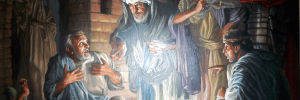
Despite all this, in Matthew 26:69-75, after Jesus has been arrested, we find Peter sitting around a fire warming himself as Jesus is being interrogated. He had followed Jesus at a distance because he did not want to be exposed. But, he was. A servant girl noticed him and accused him of being one of Jesus’s followers. Peter firmly denies it. Then, when Peter was heading out of the city gateway, another servant girl saw him and said that he was with Jesus. Peter denies it again. Then, a little while later, a group approached Peter and they attested that surely he was a follower of Jesus. For a third time, this time with a curse, Peter denies it. Then, when a rooster crowed, Jesus looked straight at Peter. Their eyes locked. And Peter was reminded of Jesus’ words, “Before the rooster crows, you will disown me three times.”
Peter fled in despair. Peter had “aborted” Jesus.
You see, abortion, at its essence, is not just a physical act. It’s a reflection of a worldview that is as old as sin. That’s why I have always considered Eve and Adam’s first sin to be the first “abortion.” Indeed, Eve, with a silent Adam complicit at her side, essentially declared, “My Body, My Choice!” as she tasted sin and then passed the fruit to her husband to consume. With the juice of the fruit still moist on their lips, they declared in unison to the Creator of life, “I know what is better for my life and for my future than you do!” With this act, despite having an intimacy with God that no one had until Peter and the other disciples walked with Jesus, Eve and Adam rejected their relationship with God, despite knowing the truth of who He was.
Peter, as he sat by the fire, knew who Jesus was too. He knew Jesus was not just a life, but, the Way, the Truth, and the Life. But at that moment, Jesus was a life worth sacrificing.
Why?
First, Peter was afraid; the circumstances surely made him so. Peter knew well that Jesus faced a situation that would change his life. If Peter was exposed as a follower, his life would be changed too. Undoubtedly, he still held a deeply embedded notion that Jesus was going to be a warrior King, not a suffering King. As a key follower of Jesus, he desired to share in the temporal victory that Jesus would triumphantly usher in. Peter had hopes and dreams for his life and his life with Jesus, but he was not willing to sacrifice of his own life by acknowledging Jesus’ life.
Second, Peter was alone. Just imagine if Peter, a man who had demonstrated considerable boldness and courage, even drawing his sword to protect Jesus when he was arrested, was at the fire with his 11 brothers in Christ. Proverbs 11:14 declares that “in the abundance of counselors there is safety.” And there is courage too. On the other hand, when one is isolated and alone, especially when one is afraid, it is much easier to deny what one knows to be true.
Over the years, I have spoken to countless women and men who have aborted their little ones. Not surprisingly, when they recount their stories, they have much in common with Peter’s dilemma. Despite the pro-choice messaging that often declares that the life in the womb is just a “glob of cells,” they didn’t really believe this when they had their abortions. They knew that the baby was a life. But the baby was a life worth sacrificing because to them, at the time, the circumstances of their pregnancy made it so. Moreover, especially in the case of the women, they were often alone. Sadly, the pro-choice rhetoric “My Body, My Choice” worked. Often, the women retreated into isolation. And the men, like Adam, remained silent because they were not encouraged to understand that although it was legally her choice, it was still his responsibility morally. Indeed, like Adam, these men will have to live with the consequences of their inaction.
That said, it’s instructive for us all that when Jesus restored Peter, his apologetic was not, “Am I a life?” It was, “Am I the love of your life.” You see, Jesus did not just seek to appeal to reason. He appealed to a covenant relationship that is very similar to that which parents should and must have with their children, especially in the womb. Moreover, Jesus’ words were anchored in the Greatest Commandment — to love your neighbor as yourself. Of course, Peter was tutored well enough by the story of the Good Samaritan to know that your neighbor is the one who is the most vulnerable and at risk. Indeed, once restored, Peter never aborted Jesus again. In fact, he steadfastly fulfilled the Great Commission and sacrificed his life, even to a cross, to make disciples for Jesus Christ.
In Peter’s story and example lie the hope and the model for us as we lovingly reach out to those who are still like we all once were until, by God’s grace, our eyes were opened. Yes, we must appeal to reason because God is a God of reason. But, as restorers like Jesus, we must also appeal to relationships — most importantly the covenant relationship between parents and the baby that is a blessing from above. For we too, like Peter, were once deniers of the Way, the Truth and the Life…until we weren’t.
Previous Post

March 19, 2017
Family Trees and the Troubling Problem of Absent Fathers
Next Post

May 20, 2017 Want to Be a Better Dad? Here's How to "Remodel" Your Fathering!
Browse Our Archives
Select a Category Abortion Culture Faith Family Fatherhood Marriage Men Parenting Politics Uncategorized
Select a Month October 2024 May 2024 March 2024 December 2023 August 2023 July 2023 June 2023 April 2023 March 2023 April 2022 March 2022 August 2021 May 2021 March 2021 January 2021 December 2020 November 2020 July 2020 April 2020 February 2020 January 2020 August 2019 July 2019 December 2018 November 2018 September 2018 August 2018 July 2018 June 2018 April 2018 March 2018 February 2018 January 2018 December 2017 October 2017 September 2017 July 2017 June 2017 May 2017 April 2017 March 2017 February 2017 January 2017 December 2016 November 2016 October 2016 September 2016 August 2016 July 2016 June 2016 May 2016 April 2016 March 2016
Follow Us!
TAKE THE
Religious Wisdom Quiz
What sea bordered the land of Canaan to the west?
Select your answer to see how you score.
Dead Sea Mediterranean Sea Red Sea Sea of Galilee
Related posts from Roland Warren

Is a 15-Week Abortion Ban Actually Pro-Choice?
Mary's pregnancy and how it relates to the...

Uncertainty of when life begins and the abortion...
When did Jesus’s human life begin and how...
TRENDING AT PATHEOS Family, Parenting and Religion

Emotion in Early Christianity by Andrew Crislip
Andrew Crislip’s Emotion in Early Christianity examines an often overlooked dimension of...

16 Spiritual Touchstones for a More Grounded Life
After decades of spiritual study, here are 16 principles I try...

Catholic Evangelization: Sharing Your Faith Every Day
Welcome back to the Graceful Awakening mini-series called, “From Faith to Mission.” ...

The Pillar of the Boatmen: the Ancient Monument...
The Pillar of the Boatmen is a Romano-Gaulish sculpture that dates from...

In one sense walking into Westminster Abbey is like walking down the...

'Super Scam Me' Exposes AI Jon Bon Jovi...
Leslie Pickett believed she was in a relationship with Jon Bon Jovi....
view all Family, Parenting and Religion blogs
Ad-Free & Subscriber Log-In Subscription Support
- About Us
- 2026 Calendar
- Videos
- Podcasts
- Library of World Religions
- Faith In Media Tracker
- Advertise With Us
- Write for Us
- Privacy Policy
- Terms of Service
- Do Not Sell My Data
- Contact Us
- Radiant Digital
- Manage Newsletter Subscriptions
- Unsubscribe From Notifications
- Sitemap
Copyright 2008-2026, Patheos. All rights reserved.
Subscription Support Ad-Free & Subscriber Log-In
Follow Patheos