
BuddhistCatholicContemplativeEvangelicalGeneral ChristianHinduJewishLatter-day SaintMuslimNew VisionsProgressive Christian
Beliefs
- Buddhist
- Catholic
- Contemplative
- Evangelical
- General Christian
- Hindu
- Jewish
- Latter-day Saint
- More Voices
- Muslim
- New Visions
- Pagan
- Progressive Christian
Topics
- Religion News
- Food and Religion
- Sports and Religion
- Religious Art
- Religious Music and Entertainment
- Religious Events
- History and Religion
- Style and Religion
- Politics and Religion
- Women in Religion
- Recreation Outdoors and Religion
- Business Finance and Religion
- Careers Workplace and Religion
- Education and Religion
- Family Parenting and Religion
- Health Fitness and Religion
- Home and Religion
- Relationships and Religion
- Technology and Religion
- Travel and Religion
Columnists
- Buddhist Columnists
- Business Finance and Religion Columnists
- Careers Workplace and Religion Columnists
- Catholic Columnists
- Contemplative Columnists
- Education and Religion Columnists
- Evangelists Columnists
- Family Parenting and Religion Columnists
- General Christian Columnists
- Health Fitness and Religion Columnists
- Hindu Columnists
- History and Religion Columnists
- Home and Religion Columnists
- Jewish Columnists
- More Voices Columnists
- Latter Day Columnists
- Muslim Columnists
- New Visions Columnists
- Nonreligious Columnists
- Pagan Columnists
- Politics and Religion Columnists
- Progressive Columnists
- Recreation Outdoors and Religion Columnists
- Relationships and Religion Columnists
- Religion News Columnists
- Religious Art Columnists
- Religious Events Columnists
- Religious Music and Entertainment Columnists
- Sports and Religion Columnists
- Style and Religion Columnists
- Technology and Religion Columnists
- Travel and Religion Columnists
- Women in Religion Columnists
Resource Library
- 2026 Calendar
- Library of World Religions
- The 100 Most Holy Places on Earth
- Patheos Answers
- Podcasts
- Videos
- Faith Leaders Database
- Anglican Episcopalian
- Bahai
- Baptist
- Buddhism
- Christianity
- Confucianism
- Eastern Orthodoxy
- Hinduism
- Holiness and Pentecostal
- ISKCON
- Islam
- Judaism
- Lutheran
- Methodist
- The Church of Jesus Christ of Latter-day Saints
- New Age
- Paganism
- Presbytarian and Reformed
- Protestantism
- Religion Behind the Scenes
- Roman Catholic
- Scientology
- Shia Islam
- Sikhism
- Sufism
- Sunni Islam
- Taoism
- Zen
- See all religions
Research Tools
 Ad-Free & Subscriber Log-In Subscription Support
Ad-Free & Subscriber Log-In Subscription Support
Follow Patheos 

- Trending:
- Forgiveness
- |
- Marriage
- |
- Consciousness
- |
- Death Penalty
- |
- Election
- |
- Halloween
 The Holy Kiss
- Home
- Progressive Christian
- Not a Maze, a Labyrinth. 3 Things for the New Year.
Not a Maze, a Labyrinth. 3 Things for the New Year.
Last updated on: October 1, 2019 at 12:56 am by Roger Wolsey
Not a Maze, a Labyrinth. 3 Things for the New Year. 2019-10-01T00:56:31-07:00 Roger Wolsey
Patheos Explore the world's faith through different perspectives on religion and spirituality! Patheos has the views of the prevalent religions and spiritualities of the world.
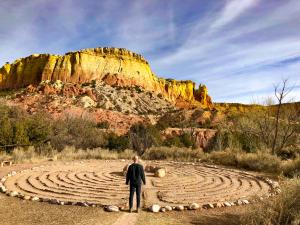 We’ve taken another trip ‘round our Sun. It’s the start of another new year. What to do with it? How shall we live it? As poet Mary Oliver put is, “Tell me, what is it you plan to do with your one wild and precious life?”
Pondering our life ahead can seem like looking into an opaque and misty crystal ball, or like entering into a mysterious maze rife with all manner of pits to fall into, countless places to face-plant, and dead-ends galore.
But perhaps, it may be less of a baffling and treacherous maze and instead, more of a labyrinth – a walk that involves intention and that leads to the heart. I’ll say more about this at the end.
I don’t pretend to have all of the answers (unless we’re playing Balderdash or Trivial Pursuit and then I absolutely do just that). One thing I think I’ve learned as I journey into the year that will conclude my 4th decade is that quite often less is more. There is much wisdom in “K.I.S.S.” – “keep it simple stupid.”
Some things really are rocket science. Some things really are brain surgery.
Most things? …not so much.
When it comes to living a meaningful and satisfying faith life, when it comes to following Jesus, when it comes to being spiritual and/or religious – I find that less really is more. I say this standing on the shoulders of many before me who uttered similar things.
The Talmud (Shabbat 31a) tells a story of Rabbi Hillel, who lived around the time of Jesus. Apparently, a non-believer once approached him promising he’d convert to Judaism if he could teach him the entire Torah in the time the good rabbi could stand on one foot. Hillel responded, “What is hateful to yourself, do not do to your fellow man. That is the whole Torah; the rest is just commentary. Go and study it.”
Similarly, Jesus (who no doubt was very familiar with Hillel’s teachings) was once tested by some religious leaders who asked “Rabbi, what is the greatest commandment in the law?” Jesus replied reciting the famous “Shema”: ‘Love the Lord your God with all your heart and with all your soul and with all your mind.’ And then he went on to add, quoting from Leviticus 19:18: “This is the first and greatest commandment. And the second is like it: ‘Love your neighbor as yourself.’ All the Law and the Prophets hang on these two commandments.” (Paraphrasing from Matthew 22:36-40)
And at another point Jesus put it even more simply “In everything, do to others what you would have them do to you, for this sums up the Law and the Prophets.” (Matthew 7:6)
You may recognize certain words in that last quote as being what we call “The Golden Rule”, i.e., “Do unto others as you would have them do unto you.” Those with a discerning eye may notice that this is an intentional riffing on what Hillel stated earlier, only that it’s worded in a more pro-active manner of not merely avoiding doing what you find hateful to others, but taking it a step further in actively doing good to others, the kind of good treatment that you’d want them to bring to you. (For a deeper exploration about this see this article.)
The prophet Micah reminded the people of Israel and Judah about what it takes to truly be the people of the covenant that God was calling them to be. He didn’t badger them reminding them of all 613 laws – including 248 Positive Commandments (the “do’s”) and 365 Negative Commandments (the “don’ts”), instead he simply says, “God has shown you, O mortal, what is good. And what does the LORD require of you? To act justly, and to love mercy, and to walk humbly with your God.” (Micah 6:8)
That’s only three things!
That seems realistic. That seems viable. That seems “doable.”
And yet… those are the very three things that we keep stumbling on. Whether we view ourselves as religious; spiritual but not religious; or, as I do, spiritual and religious, those are the very 3 things that we tend to suck at – if we’re being honest.
Let’s explore each of them a bit. The form of “Doing Justice” that Micah has in mind here is the same sort that Jesus’ mother Mary sang about in her Magnificat in Luke 1 and that Jesus proclaimed (quoting from Isaiah) in his first sermon in Luke 4. It’s social justice – specifically communal, restorative, and redistributive justice. If you look at the forms of injustice that Micah was calling out and criticizing in the next chapter, it’s clear that he’s (like Ezekiel) referring to Israel and Judah’s slide toward worshipping false gods i.e., greed; and oppressing the vulnerable, ripping off the masses, mistreating and exploiting the poor, aliens, immigrants, orphans, widows, and people in need. Basically, he’s calling out the injustice of treating people unjustly.
Micah called the people to “Love kindness.” You’d think that everyone would love that! And yet, if we look at how people, including ourselves, tend to treat other people on social media – we notice a profound lack of kindness, let alone loving it. Instead we bring out the worst in each other, we assume the worst about each other, and we’re ready to go for the jugular in a heartbeat. The Hebrew language has a word “hesed” – which literally means “loving-kindness.” English needs such a word. In fact, many of us of have forgotten how to be kind.
We moderns would also do well to ponder the wisdom that “It’s more important to be kind than to be right.” Perhaps only exception with the math involved in getting people safely on the moon and back, this is massively true. And yet, so often we can’t stand it if someone is “wrong on the internet” and we go on the attack to set the right instead of seeking to truly connect and communicate with them. In truth, all too often we’re anything but kind. Some of us are ready to “punch a Nazi” – meaning yes, some actual Nazis and white supremacists, but also including those who we are all too quick to lump together, demonize, and write off as beyond hope. The thing is, when we do that to people, it actually says more about us than about them.
The non-violence that Jesus taught doesn’t just mean not punching someone, it means not even being passive-aggressive. It means truly loving the person you feel in conflict with – as you love yourself. And if you/we don’t love yourself very well – if you can’t own your darkness, pettiness, or vindictiveness – it means shedding that lack of self-love we have so we can actually and truly love others – and not treat them with violence – physical or otherwise.
There’s also much truth to the ancient anonymous wisdom (attributed to all sorts of historic greats) in: “Always be more kind than necessary, for everyone you meet is fighting a great battle.” Each of us really is.
In order to help us love kindness, we’d also do well to embrace the inspirational calling of the late Rev. Fred Rogers aka “Mr. Rogers”: “When I was a boy and I would see scary things in the news, my mother would say to me, “Look for the helpers. You will always find people who are helping.” To this day, especially in times of “disaster,” I remember my mother’s words and I am always comforted by realizing that there are still so many helpers – so many caring people in this world.” We can be those helpers.
Finally, Walking humbly with God can be especially challenging – both for conservative Christians and for progressive ones. Conservatives have a dysfunctional tendency to think that they have a monopoly on God and that “Christianity is the only way for people to be right with God.” While progressives pride ourselves on knowing that God is fully at work in all world religions and that no one needs to convert to Christianity at all – and yet, note that we tend to PRIDE ourselves on being so open, affirming, inclusive, and non-exclusive – that we can end up being as arrogant and full of ourselves as those on “the other side” who we think we’re nothing alike.
John Wesley started a renewal movement in England in the 18th Century that become known as Methodism. The “method” to Methodism was far more simple than not.
The following are Wesley’s “General Rules”:
1. Do No harm
2. Do Good
3. Stay in Love with God.
“That’s only three things!
That seems realistic. That seems viable. That seems ‘doable.’
And yet…” –Déjà vu anyone?
Wesley provided the world with a gift in what’s become known as his “Covenant Prayer.” It’s the most humble thing I’ve ever come across and it’s the hardest prayer I’ve ever prayed. Many congregations around the world include this prayer as part of how they start each new year.
The Covenant Prayer of John Wesley
I am no longer my own, but thine.
Put me to what thou wilt, rank me with whom thou wilt.
Put me to doing, put me to suffering.
Let me be employed for thee or laid aside for thee,
exalted for thee or brought low for thee.
Let me be full, let me be empty.
Let me have all things, let me have nothing.
I freely and heartily yield all things to thy pleasure and disposal.
And now, O glorious and blessed God, Father, Son and Holy Spirit,
thou art mine, and I am thine.
So be it.
And the covenant which I have made on earth,
let it be ratified in heaven.
Amen.
 I said I’d come back to the notion of “a labyrinth instead of a maze.” In short, Christian contemplatives and mystics have for years practiced centering prayer and walked labyrinths to help us in our walks with God. These labyrinths were created in the Middle Ages when all Christians were expected to make a pilgrimage to the Holy Land of Israel at least once in their lives. Most Christians simply couldn’t afford the time, expense, or complexity to do that so cathedrals across Europe installed simple stone labyrinths on their properties so pilgrims could take a symbolic journey to God following a path which brings people into a Center and then back out into the world. In the same way that yogis and yoginis engage in movements “on the mat” in order to help them to live life with more grace, ease, and equanimity out in the world “off the mat,” Christians walk labyrinths with similar purpose.
Here’s how I walk a labyrinth: I face the entrance, silently declare an intention, and then I look at the first leg of the path until I see that it makes its first turn. I then size it up, and then intentionally walk it and stop where it bends. I then turn and surmise the next length of the trip, seeing where the next bend is, and then walk that length with intention. And repeat until I reach the center. I then face north, south, east, and west and then sit or stand in the center listening for God’s possible insight or word to me – it’s mostly silence, and that’s okay. I then depart from the center, doing the very same process on the way out as on the way in. Along the way, I get distracted, I daydream, I ponder regrets (where I’ve failed to be just, kind, or humble), I repeat the story of old wounds, of failings in the past, I nurse old grudges, … And then I catch myself, and each time, I breathe in some grace and try to regain intentionality with the next leg of the journey.
Perhaps you can find a church with a labyrinth near you and perhaps you can walk it, each leg of it, with the intention to do justice, love kindness, and walk humbly with your God.
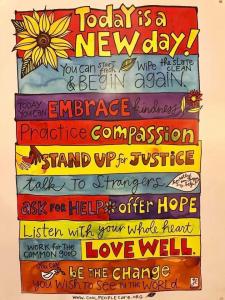 Blessings to us all as we live into our new year and live our “wild and precious lives.”
p.s. “Let us go forward with the heart completely attentive and the soul fully conscious. For if attentiveness and prayer are daily joined together, they become like Elias’ fire-bearing chariot, raising us to heaven. What do I mean? A spiritual heaven, with sun, moon and stars, is formed in the blessed heart of one who has reach a state of watchfulness, or who strives to attain it.” – St. Philotheus of Sinai
– XX, Roger, author, “Kissing Fish: christianity for people who don’t like christianity“
Previous Post

December 22, 2017
The 11 "P"s of progressive Christianity.
Next Post

January 17, 2018 Crypto Christian Collapse? Bitcoin- Bit like Jesus.
Browse Our Archives
Select a Category Uncategorized
Select a Month May 2024 March 2024 February 2024 December 2023 May 2023 April 2023 March 2023 February 2023 October 2022 June 2022 December 2021 September 2021 August 2021 April 2021 March 2021 September 2020 August 2020 March 2020 January 2020 December 2019 November 2019 October 2019 September 2019 August 2019 March 2019 January 2019 December 2018 November 2018 October 2018 September 2018 August 2018 June 2018 May 2018 April 2018 March 2018 February 2018 January 2018 December 2017 November 2017 September 2017 May 2017 February 2017 January 2017 October 2016 August 2016 April 2016 March 2016 February 2016 November 2015 September 2015 June 2015 May 2015 April 2015 March 2015 February 2015 January 2015 December 2014 October 2014 August 2014 July 2014 June 2014 May 2014 April 2014 March 2014 February 2014 January 2014 December 2013 November 2013 July 2013 April 2013 March 2013 December 2012 November 2012 October 2012 September 2012 August 2012 July 2012 June 2012 May 2012 April 2012 March 2012 February 2012 January 2012 December 2011 November 2011 October 2011
Follow Us!
TAKE THE
Religious Wisdom Quiz
Which feast was reinstituted with great joy, reading the Law daily for seven days?
Select your answer to see how you score.
Feast of Tabernacles Passover Purim Day of Atonement
Related posts from The Holy Kiss

The Zombie Apocalypse And Christian Nationalism


Grace, Gays, and Aircraft Carriers.

TRENDING AT PATHEOS Progressive Christian

Why Christians Have a Sacred Duty to Vote:...
The Bible offers strong support for the sacred duty to vote. Here...

What Being a Modern-Day Apostle Means to Me
In my last column, I discussed the ins and outs of modern-day...

Did Ancient China Once Worship the God of...
Across human history, a common thread weaves through the origins of the...

Love Your Neighbor – Including Earth-Kin: Lev. 19,...
God’s command to love your neighbor means acting in an ethical and...

Lead a Church Study of “Jesus and Lao...
Guest writer Jack Thomas (The Irreverent Reverend) reflects on leading his church...

Principles for Understanding the Apostolic Ministry Today
Whenever people discover that my formal ministry title is "apostle," as in...
view all Progressive Christian blogs
Ad-Free & Subscriber Log-In Subscription Support
- About Us
- 2026 Calendar
- Videos
- Podcasts
- Library of World Religions
- Faith In Media Tracker
- Advertise With Us
- Write for Us
- Privacy Policy
- Terms of Service
- Do Not Sell My Data
- Contact Us
- Radiant Digital
- Manage Newsletter Subscriptions
- Unsubscribe From Notifications
- Sitemap
Copyright 2008-2026, Patheos. All rights reserved.
Subscription Support Ad-Free & Subscriber Log-In
Follow Patheos