
BuddhistCatholicContemplativeEvangelicalGeneral ChristianHinduJewishLatter-day SaintMuslimNew VisionsProgressive Christian
Beliefs
- Buddhist
- Catholic
- Contemplative
- Evangelical
- General Christian
- Hindu
- Jewish
- Latter-day Saint
- More Voices
- Muslim
- New Visions
- Pagan
- Progressive Christian
Topics
- Religion News
- Food and Religion
- Sports and Religion
- Religious Art
- Religious Music and Entertainment
- Religious Events
- History and Religion
- Style and Religion
- Politics and Religion
- Women in Religion
- Recreation Outdoors and Religion
- Business Finance and Religion
- Careers Workplace and Religion
- Education and Religion
- Family Parenting and Religion
- Health Fitness and Religion
- Home and Religion
- Relationships and Religion
- Technology and Religion
- Travel and Religion
Columnists
- Buddhist Columnists
- Business Finance and Religion Columnists
- Careers Workplace and Religion Columnists
- Catholic Columnists
- Contemplative Columnists
- Education and Religion Columnists
- Evangelists Columnists
- Family Parenting and Religion Columnists
- General Christian Columnists
- Health Fitness and Religion Columnists
- Hindu Columnists
- History and Religion Columnists
- Home and Religion Columnists
- Jewish Columnists
- More Voices Columnists
- Latter Day Columnists
- Muslim Columnists
- New Visions Columnists
- Nonreligious Columnists
- Pagan Columnists
- Politics and Religion Columnists
- Progressive Columnists
- Recreation Outdoors and Religion Columnists
- Relationships and Religion Columnists
- Religion News Columnists
- Religious Art Columnists
- Religious Events Columnists
- Religious Music and Entertainment Columnists
- Sports and Religion Columnists
- Style and Religion Columnists
- Technology and Religion Columnists
- Travel and Religion Columnists
- Women in Religion Columnists
Resource Library
- 2026 Calendar
- Library of World Religions
- The 100 Most Holy Places on Earth
- Patheos Answers
- Podcasts
- Videos
- Faith Leaders Database
- Anglican Episcopalian
- Bahai
- Baptist
- Buddhism
- Christianity
- Confucianism
- Eastern Orthodoxy
- Hinduism
- Holiness and Pentecostal
- ISKCON
- Islam
- Judaism
- Lutheran
- Methodist
- The Church of Jesus Christ of Latter-day Saints
- New Age
- Paganism
- Presbytarian and Reformed
- Protestantism
- Religion Behind the Scenes
- Roman Catholic
- Scientology
- Shia Islam
- Sikhism
- Sufism
- Sunni Islam
- Taoism
- Zen
- See all religions
Research Tools
 Ad-Free & Subscriber Log-In Subscription Support
Ad-Free & Subscriber Log-In Subscription Support
Follow Patheos 

- Trending:
- Forgiveness
- |
- Marriage
- |
- Consciousness
- |
- Death Penalty
- |
- Election
- |
- Halloween

- Home
- Evangelical
- Evangelical Inquisitions
Evangelical Inquisitions
Last updated on: March 25, 2025 at 5:45 pm by Roger E. Olson
Evangelical Inquisitions 2025-03-25T17:45:11-05:00 Roger E. Olson
Patheos Explore the world's faith through different perspectives on religion and spirituality! Patheos has the views of the prevalent religions and spiritualities of the world.
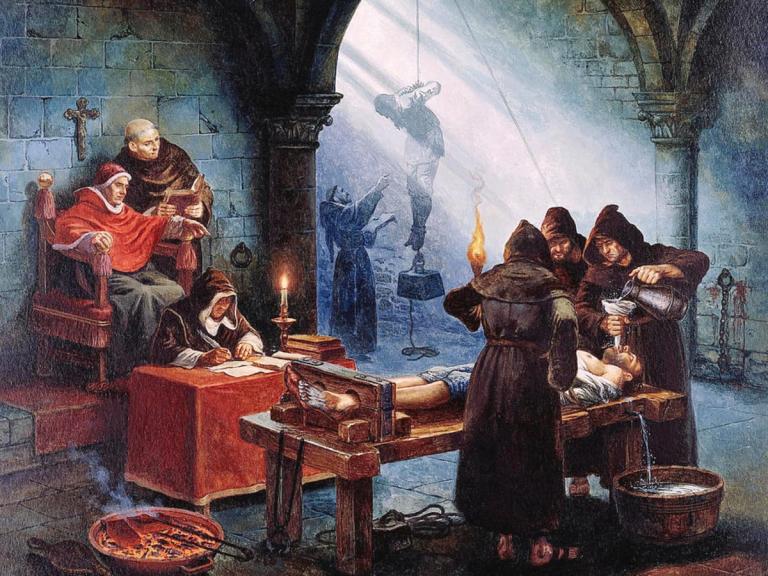
I’ve been actively involved in evangelicalism and especially the evangelical academy (scholarly community) for over thirty years now and I’ve noticed a bad habit among conservative evangelical biblical scholars and theologians. They seem addicted to inquisitions.
It happened to me again, just today. An e-mail from “friends” (an evangelical organization I allegedly belonged to) informing me that I was under investigation (not their words, but clearly their intent) for possibly being in conflict with the organization’s statement of faith. I immediately resigned (assuming I was a member, something I’m not sure about); I won’t be subjected to any more evangelical inquisitions.
So when has this happened before? Well, not that often to me, but often to friends and acquaintances. At the first Christian university where I taught, the chairman of our theology department received a memo from the president. Attached to the memo was a detailed doctrinal questionnaire. Among other questions it asked “Do you agree with Charles Hodge’s interpretation of biblical inspiration?” The president’s memo ordered the chair of the department to have every faculty member in the department fill out the questionnaire and return them to him.
Now you have to understand, that university did not then even have a written statement of faith. The questions were ridiculously detailed (as the above example illustrates) and came at us “out of left field,” so to speak. No one on the faculty had ever been asked about Charles Hodge’s interpretation of biblical inspiration. Hodge was not even indirectly an influence on the university (which was charismatic).
We, the theology department faculty, met and decided to take drastic action. We went together to the provost’s office and laid the uncompleted questionnaires on his desk and informed him we would not be filling them out. We never heard another word about it. But that wasn’t the expected outcome and it isn’t the usual outcome of such evangelical inquisitions. (We didn’t think the president even understood the questions, but we surmised someone he respected gave him the questionnaire and told him he should have us fill them out and then send them to him for analysis.)
Later, when I was on the verge of joining the Evangelical Theological Society, the ETS began its “investigation” of New Testament scholar Robert Gundry over his commentary on Matthew. He resigned from the ETS and I decided not to join and never did join it. Later, the ETS launched its investigation of open theist members Clark Pinnock and John Sanders. I was glad I was not a member; I would have been embarrassed to be associated with that inquisition even only as a member. My advice to my friends who were members was “Come out from among them and be ye separate.”
When I taught at my second (of three) Christian universities (only a college with a seminary then) another inquisition was launched by constituent pastors. It reminded me a lot of the one I observed at the seminary I attended about twenty years earlier. That one was over inerrancy; professors were “asked” to sign a statement of belief in biblical inerrancy or leave. None of them had ever been informed that inerrancy would ever be an issue; it had not been before. Suddenly, they had to sign such a statement to keep their jobs.
The one at my second institutional place of employment was over open theism. Pastors in the denomination banded together to attempt to get my theology colleague fired and some of them threatened to get me fired for supporting him even though I was not an open theist. During that inquisition we (the college and seminary) were forced into holding a heresy trial over something that wasn’t even in the denomination’s statement of faith.
I’ve focused here mainly on evangelical inquisitions that have involved me or at least that I was close to and observed first-hand. There have been many others during those thirty years, though, that I only read about. There was the attempt by one theologian to get another one fired from the seminary where they both taught because the accused theologian (really a New Testament scholar as I recall) allegedly did not believe in the “physical resurrection.” That controversy was labeled by one leading evangelical periodical “The Mother of All Muddles” (in an article about it). It went all the way to the denomination’s annual convention.
Then there was the inquisition of Tony Campolo when he was scheduled to be a speaker at a large Christian youth event in Washington, D.C. Someone accused him of heresy because he has written that “There’s a little bit of Christ in everyone.” He defended his statement by reference to John 1 and early church fathers such as Justin Martyr (his “logos spermatikos” idea based on John 1) and Clement of Alexandra. Somehow (I don’t remember how this happened) a group of evangelical theologians that included J. I. Packer served as a panel to investigate whether Tony was a heretic. Eventually he was exonerated, but only after being put through a terrible inquisition and his reputation damaged (at least in the eyes of some).
Here’s how these evangelical inquisitions often happen. Some evangelicals simply cannot live with diversity or ambiguity. They detect or only hear that someone in their organization has “liberal tendencies.” That’s usually how it starts, but it may be stated simply as “Is out of consistency with the statement of faith” or “with evangelical tradition.” If that person has written a lot, or has a blog, he or she is subjected to “investigation.” That means some watchdog begins to dog him or her, reading everything they write to try to catch them in some statement that could possibly be interpreted as “in conflict” with some part of the organization’s statement of faith.
Let’s take “inerrancy,” for example. When I joined the faculty of the second Christian university it had (and has) a statement of faith that includes affirmation of biblical inerrancy. Before accepting the position I asked for clarification. That was when I was shown the statement about inerrancy by John Piper that I posted here earlier (and that is at his web site). It basically defines inerrancy as “perfection with respect to purpose.” I could gladly sign on to that!
Later, however, some pastors and others in the school’s controlling denomination began to insist that inerrancy means something much more precise and specific than “perfection with respect to purpose” and began to insist that open theists, for example, are automatically in conflict with the statement of faith because open theism denies the truth of the Bible. (These people rarely can tell any difference between “the truth of the Bible” and their own interpretation of the Bible!)
If someone affirms “inerrancy” and writes very much about the Bible (biblical commentaries, theology, etc.), you can always find something that can possibly be interpreted as “in conflict” with inerrancy because so much depends on what that term means. And because nobody (to the best of my knowledge and experience) believes every word of the Bible. That’s right, you read what I wrote. Nobody believes every word of the Bible. What I mean, of course, is that the debate over “errors” in the Bible and “literal interpretation” of the Bible is complicated.
Let me illustrate. As a premillennialist who takes Revelation 20 literally (as well as chapters in the Old Testament prophets) I could argue that all amillennialists are in conflict with biblical inerrancy because they don’t believe “the truth of the Bible.” Of course they would simply say I’m confusing “the truth of the Bible” with my interpretation, a literal interpretation, of those passages. But I could argue that by not taking those passages literally, as I think they clearly were intended to be taken, they are in conflict with biblical inerrancy and no matter how much they claim to believe in inerrancy, their disbelief in a literal one thousand year reign of Christ on earth proves they deny the Bible’s accuracy and trustworthiness.
I don’t make that argument, but if I had the habits of some conservative evangelicals, I could and probably would. And I wouldn’t be the first! Let’s see…who did this exact thing with premillennialism and amillennialism. Oh, yes, William Bell Riley when he helped found a large fundamentalist organization. They made premillennialism one of the “fundamentals of the Christian faith.” That left fellow fundamentalists like J. Gresham Machen out because he was an amillennialist!
My point is that, if you write a lot and someone is determined to “get you” by proving you are in conflict with some portion of some statement of faith, they can. That’s because no statement of faith actually says, verbatim, everything some people think it means. When it was pointed out to the opponents of my open theist colleague (at a former university where I taught for fifteen years) that the statement of faith we all signed said nothing in direct contradiction to open theism, the opponents who were trying to get him fired appealed to “the penumbra” of the statement of faith—what they think it implies. Of course, by that method, any statement of faith can become a wax nose that any knave can twist to suit his own countenance (as Luther said about inner experience of the Spirit as a source and norm for Christian belief).
So, apparently, at some point on this blog, I said something that someone in the organization I apparently belonged to (or they thought I belonged to [I never held a membership card]) thought was in conflict with their statement of faith. That statement of faith includes belief in the “trustworthiness” of Scripture. Apparently, that includes believing everything the Old Testament records actually happened just as it is recorded. Well, that’s a little difficult as anyone who has attempted to reconcile the accounts of the same events given in Samuel and Kings and Kings and Chronicles can testify. Did God inspire David to conduct a census of Israel or was it Satan? Etc., etc., etc.
My point is that nobody can discuss the Old Testament (at least) in any serious fashion and avoid possibly falling into conflict with someone else’s idea of Scripture’s “trustworthiness.” My definition is that the Bible is “perfect with respect to purpose,” not that the Bible offers a flawless performance in statistics. Apparently, for the organization I resigned from today (assuming I ever really was a member), biblical “trustworthiness” and “inerrancy” mean the same thing. Why not just say “inerrancy,” then? I wouldn’t have joined in the first place in that case. (I admit that I joined the organization and was even involved in its founding; the disagreement is over whether I remained a member.)
And so, on and on it goes. Where it stops…. It’s apparently in the DNA of some evangelicals to conduct inquisitions and “investigate” fellow evangelicals, even their friends, from time to time to prove some point. I resign right now, in advance, from any organization that engages in or will engage in such nonsense—aimed at fellow evangelicals who are orthodox Christians (Christologically defined). It’s a bad habit.
Besides, what I write here, on my blog, are (by the blog’s title) my “musings.” They are not necessarily my firm beliefs. I don’t have firm beliefs about everything. Sometimes I say something here to spark thought and discussion. Some of it is “thinking out loud” as an effort to work through something myself. This blog is not meant to be read as gospel truth or dogmatic affirmations. Sometimes I play the devil’s advocate. Sometimes what I write is tongue-in-cheek. I hope you don’t come here expecting to find out my timeless, unalterable truths, carved in stone, by which I will stand come what may. Sometime I put those things here and sometimes what I write here is of an altogether different genre. Think of it as conversation during which I throw out some ideas for consideration and feedback—such as the “neglected theory of the atonement” I blogged about the other day. I didn’t say that is my theory of the atonement. I merely asked for discussion about it. But, I’m sure some people thought I meant to reveal my theory of the atonement. I’m not sure I have one. I find many images of the atonement in Scripture and some truth in all the theories. I’m more attracted to some than others, but, unlike people, I don’t have one that I would insist is “the” central, comprehensive theory of the atonement to the exclusion of others.
To take something I write here and ask me to “explain it” as part of an investigation of my fitness to belong to an organization is simply to misunderstand the purpose of this blog.
*Note: If you decide to comment, make sure your comment is relatively brief (no more than 100 words), on topic, addressed to me, civil and respectful (not hostile or argumentative), and devoid of pictures or linke.*
Previous Post
December 18, 2024
God’s Omnipresence According to Cremer
Next Post
December 23, 2024 Eternity and Immutability of God
Recent Comments
"No doubt Lewis was inspired by earlier thinkers. Ironically (or perhaps serendipitously) I am now ..."
The Abolition of Man: Chapter 3: ..."
"I am sure Lewis would agree. After all, as a Christian he believed in original ..."
The Abolition of Man: Chapter 3: ..."
"If I’m not mistaken, the quote from Lewis is his interpretation of the “Conditioners’” own ..."
The Abolition of Man: Chapter 3: ..."
"Thank you! It's been a great re-read of a thought provoking, but somewhat dense, little ..."
The Abolition of Man: Chapter 3: ..."
Browse Our Archives
Select a Category Against Liberal Theology Uncategorized
Select a Month October 2026 September 2026 August 2026 July 2026 June 2026 May 2026 April 2026 March 2026 February 2026 January 2026 December 2025 November 2025 October 2025 September 2025 August 2025 July 2025 June 2025 May 2025 April 2025 March 2025 February 2025 January 2025 December 2024 November 2024 October 2024 September 2024 August 2024 July 2024 June 2024 May 2024 April 2024 March 2024 February 2024 January 2024 December 2023 November 2023 October 2023 September 2023 August 2023 July 2023 June 2023 May 2023 April 2023 March 2023 February 2023 January 2023 December 2022 November 2022 October 2022 September 2022 August 2022 July 2022 June 2022 May 2022 April 2022 March 2022 February 2022 January 2022 December 2021 November 2021 October 2021 September 2021 August 2021 July 2021 June 2021 May 2021 April 2021 March 2021 February 2021 January 2021 December 2020 November 2020 October 2020 September 2020 August 2020 July 2020 June 2020 May 2020 April 2020 March 2020 February 2020 January 2020 December 2019 November 2019 October 2019 September 2019 August 2019 July 2019 June 2019 May 2019 April 2019 March 2019 February 2019 January 2019 December 2018 November 2018 October 2018 September 2018 August 2018 July 2018 June 2018 May 2018 April 2018 March 2018 February 2018 January 2018 December 2017 November 2017 October 2017 September 2017 August 2017 July 2017 June 2017 May 2017 April 2017 March 2017 February 2017 January 2017 December 2016 November 2016 October 2016 September 2016 August 2016 July 2016 June 2016 May 2016 April 2016 March 2016 February 2016 January 2016 December 2015 November 2015 October 2015 September 2015 August 2015 July 2015 June 2015 May 2015 April 2015 March 2015 February 2015 January 2015 December 2014 November 2014 October 2014 September 2014 August 2014 July 2014 June 2014 May 2014 April 2014 March 2014 February 2014 January 2014 December 2013 November 2013 October 2013 September 2013 August 2013 July 2013 June 2013 May 2013 April 2013 March 2013 February 2013 January 2013 December 2012 November 2012 October 2012 September 2012 August 2012 July 2012 June 2012 May 2012 April 2012 March 2012 February 2012 January 2012 December 2011 November 2011 October 2011 September 2011 August 2011 July 2011 June 2011 May 2011 April 2011 March 2011 February 2011 January 2011 December 2010 November 2010 October 2010 September 2010 August 2010 July 2010
TAKE THE
Religious Wisdom Quiz
Who opposed the rebuilding of the Temple and tried to discourage the Jews?
Select your answer to see how you score.
Their enemies/Samaritans Moabites Philistines Amalekites
Related posts from Roger E. Olson

The Abolition of Man: Chapter 3: The Abolition...

She Survived Her Execution. Should the State Try...
The Abolition of Man Part 2: Chapter 2:...

Ambiguity without Ambivalence in Faith
TRENDING AT PATHEOS Evangelical

I was strolling through the top floor of the brand new Parthenon...

What Does Gêvâh Mean For Kimberley Guifoyle &...
This week, a lot of the news is focused on Kimberly Guilfoyle....

INNER CIRCLE: Profound Mystery (Of Christ In All...
Ephesians 5:31-32 “For this reason, a man will leave his father and...

Do Not Rejoice When Your Enemy Falls: The...
Turning an execution into a public spectacle is a disturbing expression of...

'The Chosen' S6 Trailer: The Passion Gets Very...
Not many watching 'The Chosen' worry about spoilers, but just because they...

The purpose-driven labor priest
A labor activist reads Rick Warren and it gets me wondering about...
view all Evangelical blogs
What Are Your Thoughts?leave a comment
Ad-Free & Subscriber Log-In Subscription Support
- About Us
- 2026 Calendar
- Videos
- Podcasts
- Library of World Religions
- Faith In Media Tracker
- Advertise With Us
- Write for Us
- Privacy Policy
- Terms of Service
- Do Not Sell My Data
- Contact Us
- Radiant Digital
- Manage Newsletter Subscriptions
- Unsubscribe From Notifications
- Sitemap
Copyright 2008-2026, Patheos. All rights reserved.
Subscription Support Ad-Free & Subscriber Log-In
Follow Patheos