
BuddhistCatholicContemplativeEvangelicalGeneral ChristianHinduJewishLatter-day SaintMuslimNew VisionsProgressive Christian
Beliefs
- Buddhist
- Catholic
- Contemplative
- Evangelical
- General Christian
- Hindu
- Jewish
- Latter-day Saint
- More Voices
- Muslim
- New Visions
- Pagan
- Progressive Christian
Topics
- Religion News
- Food and Religion
- Sports and Religion
- Religious Art
- Religious Music and Entertainment
- Religious Events
- History and Religion
- Style and Religion
- Politics and Religion
- Women in Religion
- Recreation Outdoors and Religion
- Business Finance and Religion
- Careers Workplace and Religion
- Education and Religion
- Family Parenting and Religion
- Health Fitness and Religion
- Home and Religion
- Relationships and Religion
- Technology and Religion
- Travel and Religion
Columnists
- Buddhist Columnists
- Business Finance and Religion Columnists
- Careers Workplace and Religion Columnists
- Catholic Columnists
- Contemplative Columnists
- Education and Religion Columnists
- Evangelists Columnists
- Family Parenting and Religion Columnists
- General Christian Columnists
- Health Fitness and Religion Columnists
- Hindu Columnists
- History and Religion Columnists
- Home and Religion Columnists
- Jewish Columnists
- More Voices Columnists
- Latter Day Columnists
- Muslim Columnists
- New Visions Columnists
- Nonreligious Columnists
- Pagan Columnists
- Politics and Religion Columnists
- Progressive Columnists
- Recreation Outdoors and Religion Columnists
- Relationships and Religion Columnists
- Religion News Columnists
- Religious Art Columnists
- Religious Events Columnists
- Religious Music and Entertainment Columnists
- Sports and Religion Columnists
- Style and Religion Columnists
- Technology and Religion Columnists
- Travel and Religion Columnists
- Women in Religion Columnists
Resource Library
- 2026 Calendar
- Library of World Religions
- The 100 Most Holy Places on Earth
- Patheos Answers
- Podcasts
- Videos
- Faith Leaders Database
- Anglican Episcopalian
- Bahai
- Baptist
- Buddhism
- Christianity
- Confucianism
- Eastern Orthodoxy
- Hinduism
- Holiness and Pentecostal
- ISKCON
- Islam
- Judaism
- Lutheran
- Methodist
- The Church of Jesus Christ of Latter-day Saints
- New Age
- Paganism
- Presbytarian and Reformed
- Protestantism
- Religion Behind the Scenes
- Roman Catholic
- Scientology
- Shia Islam
- Sikhism
- Sufism
- Sunni Islam
- Taoism
- Zen
- See all religions
Research Tools
 Ad-Free & Subscriber Log-In Subscription Support
Ad-Free & Subscriber Log-In Subscription Support
Follow Patheos 

- Trending:
- Forgiveness
- |
- Marriage
- |
- Consciousness
- |
- Death Penalty
- |
- Election
- |
- Halloween

- Home
- Evangelical
- The Christian Doctrine of the Divine Attributes 2
The Christian Doctrine of the Divine Attributes 2
Last updated on: October 27, 2024 at 10:15 am by Roger E. Olson
The Christian Doctrine of the Divine Attributes 2 2024-10-27T10:15:09-05:00 Roger E. Olson
Patheos Explore the world's faith through different perspectives on religion and spirituality! Patheos has the views of the prevalent religions and spiritualities of the world.
The Christian Doctrine of the Divine Attributes 2
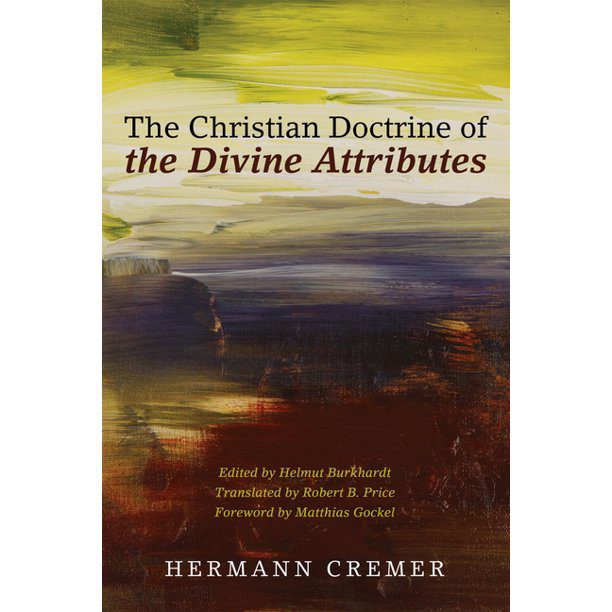
For those of you reading this book with me, I will next, in about a week, take up Chapter 3 “First Series: Divine Attributes Disclosed in Revelation,” Part 1 “The Holiness of God.” (Part 2 is very long, so I want to take it up by itself after Part 1.)
I am again astounded at how much Cremer’s view of God parallels, foreshadows, Karl Barth’s and Emil Brunner’s. I simply have to believe he influenced them.
I often recommend that my students jump to the last two or three paragraphs of a chapter, read those, and then go back and read the whole chapter in their light. I think that would help with this book.
On page 18 Cremer says “The question is therefore whether…we ought to derive [the divine attributes] from the concept of God.” Before that on the same page he asserts that “We are therefore well advised to confine ourselves to revelation in our ‘derivation’ of the divine attributes, so that we draw our assertions concerning the character of God’s action exclusively from this action itself.”
That is the point of the whole chapter and maybe the whole book!
In this chapter Cremer begins by ruling out any approach to the divine attributes by way of the “vias,” especially the ways of Dionysius the Pseudo-Areopagite. I couldn’t agree more. He says “To tread the path of the Areopagus would thus be to turn aside from the Christian knowledge of God.” (11) Why? Because this method begins with our finite ideas, not God’s actual conduct. “We know God through his actual conduct, through his revelation, through his action for us and toward us, through the redemption that he offers us.” (11)
Cremer continues by arguing that in and for God there is no conflict between love and necessity although he strongly denies that God’s love for us is necessary. He simply rejects the old dilemma posed by logicians. Here is a quote from page 12 that pre-echoes Barth: “Faith includes the inalienable certainty that God has no need of us. Even though God’s entire, innermost being is eternally directed toward us, and even though we should never think of him otherwise than as existing entirely and eternally for us, it is nevertheless utterly by his own freedom—a freedom that is not mediated to him…and certainly not extorted from him through any necessity of reason or nature—that he desires to be for us and that we should therefore exist, so that love might have its object.”
That is a typical German sentence! But it bears re-reading. Cremer is arguing exactly what Barth later argued, that God’s love for us is his choice but it is an eternal choice and not at all arbitrary. “God is the one who loves in freedom” (Barth).
Then Cremer argues that we should not give in to “consistency.” He embraces paradox. “God’s revelation in Christ, the revelation of redemption, cannot understood as a matter of consistency.” (15) “Not even human love can be viewed from the perspective of consistency.” (15)
Then Cremer attacks “the viewpoint of the perfection of human development.” (17) I take it Cremer is contradicting Hegel and his followers who believed that human history is developing toward perfection and that God is somehow revealed in that development and is himself developing in it. Cremer does not quote or refer to Kierkegaard, but surely he agrees with Kierkegaard who pre-dated him. I don’t know if he even knew of the Danish philosopher-theologian.
Cremer ends up saying something Kierkegaard would heartily agree with: “God’s revelation remains in every respect the opposite of all rational and moral consistency. It is the revelation of the one who is never coerced by human sin into merely consistent action.” (17)
I am always bothered when theologians argue for inconsistency in theology. It seems like a form os “special pleading.” How can we expect inquiring minds to enter into what we are preaching and teaching if we abandon logic? I do not think God’s revelation is illogical except to the shallow mind that refuses to recognize and embrace its “inner logic” (as T. F. Torrance called it).
But I couldn’t agree more that Christian theology must not begin with natural knowledge of God, the idea of God, or the world and work up to God from there. For example, Cremer mentions the attribute of God’s omnipotence. IF we begin with logic and the idea of “God” as “the being greater than which none can be conceived” (Anselm and Descartes), then we will end up with God’s potentia absoluta in which God can do anything including evil. Or we have to place God “above good and evil” (Nietzsche).
I would prefer to say that since God is love, since love is God’s essence, once God created us in his own image and likeness, he had to love us and has to love us. Love cannot be a choice if love is one’s essence. I appreciate the emphasis on God’s freedom, but I think it is misplaced. God’s freedom means that he does not have to save us. His love is, as Brunner insisted, “holy love.” Jesus’s parable of the prodigal son sheds light on this. Jesus did not say that the father had to go out in search of his wayward son and bring him home against his will. However, once his son came home, repentant, the father had to love him. At least that seems implicit in Jesus’s story. And it is necessary, logically, if we say love is God’s essence.
*Note: If you choose to comment, make sure your comment is relatively brief (no more than 100 words), on topic, addressed to me, civil and respectful (not hostile or argumentative), and devoid of pictures of link. If you have not read this chapter, do not comment. You may, however, ask a question.*
Previous Post
October 24, 2024
What Is a “Form of Life?” Can an Outsider Understand?
Next Post

October 29, 2024 The Scapegoating Phenomenon
Recent Comments
"No doubt Lewis was inspired by earlier thinkers. Ironically (or perhaps serendipitously) I am now ..."
The Abolition of Man: Chapter 3: ..."
"I am sure Lewis would agree. After all, as a Christian he believed in original ..."
The Abolition of Man: Chapter 3: ..."
"If I’m not mistaken, the quote from Lewis is his interpretation of the “Conditioners’” own ..."
The Abolition of Man: Chapter 3: ..."
"Thank you! It's been a great re-read of a thought provoking, but somewhat dense, little ..."
The Abolition of Man: Chapter 3: ..."
Browse Our Archives
Select a Category Against Liberal Theology Uncategorized
Select a Month October 2026 September 2026 August 2026 July 2026 June 2026 May 2026 April 2026 March 2026 February 2026 January 2026 December 2025 November 2025 October 2025 September 2025 August 2025 July 2025 June 2025 May 2025 April 2025 March 2025 February 2025 January 2025 December 2024 November 2024 October 2024 September 2024 August 2024 July 2024 June 2024 May 2024 April 2024 March 2024 February 2024 January 2024 December 2023 November 2023 October 2023 September 2023 August 2023 July 2023 June 2023 May 2023 April 2023 March 2023 February 2023 January 2023 December 2022 November 2022 October 2022 September 2022 August 2022 July 2022 June 2022 May 2022 April 2022 March 2022 February 2022 January 2022 December 2021 November 2021 October 2021 September 2021 August 2021 July 2021 June 2021 May 2021 April 2021 March 2021 February 2021 January 2021 December 2020 November 2020 October 2020 September 2020 August 2020 July 2020 June 2020 May 2020 April 2020 March 2020 February 2020 January 2020 December 2019 November 2019 October 2019 September 2019 August 2019 July 2019 June 2019 May 2019 April 2019 March 2019 February 2019 January 2019 December 2018 November 2018 October 2018 September 2018 August 2018 July 2018 June 2018 May 2018 April 2018 March 2018 February 2018 January 2018 December 2017 November 2017 October 2017 September 2017 August 2017 July 2017 June 2017 May 2017 April 2017 March 2017 February 2017 January 2017 December 2016 November 2016 October 2016 September 2016 August 2016 July 2016 June 2016 May 2016 April 2016 March 2016 February 2016 January 2016 December 2015 November 2015 October 2015 September 2015 August 2015 July 2015 June 2015 May 2015 April 2015 March 2015 February 2015 January 2015 December 2014 November 2014 October 2014 September 2014 August 2014 July 2014 June 2014 May 2014 April 2014 March 2014 February 2014 January 2014 December 2013 November 2013 October 2013 September 2013 August 2013 July 2013 June 2013 May 2013 April 2013 March 2013 February 2013 January 2013 December 2012 November 2012 October 2012 September 2012 August 2012 July 2012 June 2012 May 2012 April 2012 March 2012 February 2012 January 2012 December 2011 November 2011 October 2011 September 2011 August 2011 July 2011 June 2011 May 2011 April 2011 March 2011 February 2011 January 2011 December 2010 November 2010 October 2010 September 2010 August 2010 July 2010
TAKE THE
Religious Wisdom Quiz
How many days did Jesus fast in the wilderness?
Select your answer to see how you score.
12 7 40 30
Related posts from Roger E. Olson

The Abolition of Man: Chapter 3: The Abolition...

She Survived Her Execution. Should the State Try...
The Abolition of Man Part 2: Chapter 2:...

Ambiguity without Ambivalence in Faith
TRENDING AT PATHEOS Evangelical

In "Irreplaceable," our book on vocation and technology, Trevor Sutton and I...

I was strolling through the top floor of the brand new Parthenon...

What Does Gêvâh Mean For Kimberley Guifoyle &...
This week, a lot of the news is focused on Kimberly Guilfoyle....

INNER CIRCLE: Profound Mystery (Of Christ In All...
Ephesians 5:31-32 “For this reason, a man will leave his father and...

Do Not Rejoice When Your Enemy Falls: The...
Turning an execution into a public spectacle is a disturbing expression of...

'The Chosen' S6 Trailer: The Passion Gets Very...
Not many watching 'The Chosen' worry about spoilers, but just because they...
view all Evangelical blogs
What Are Your Thoughts?leave a comment
Ad-Free & Subscriber Log-In Subscription Support
- About Us
- 2026 Calendar
- Videos
- Podcasts
- Library of World Religions
- Faith In Media Tracker
- Advertise With Us
- Write for Us
- Privacy Policy
- Terms of Service
- Do Not Sell My Data
- Contact Us
- Radiant Digital
- Manage Newsletter Subscriptions
- Unsubscribe From Notifications
- Sitemap
Copyright 2008-2026, Patheos. All rights reserved.
Subscription Support Ad-Free & Subscriber Log-In
Follow Patheos