
BuddhistCatholicContemplativeEvangelicalGeneral ChristianHinduJewishLatter-day SaintMuslimNew VisionsProgressive Christian
Beliefs
- Buddhist
- Catholic
- Contemplative
- Evangelical
- General Christian
- Hindu
- Jewish
- Latter-day Saint
- More Voices
- Muslim
- New Visions
- Pagan
- Progressive Christian
Topics
- Religion News
- Food and Religion
- Sports and Religion
- Religious Art
- Religious Music and Entertainment
- Religious Events
- History and Religion
- Style and Religion
- Politics and Religion
- Women in Religion
- Recreation Outdoors and Religion
- Business Finance and Religion
- Careers Workplace and Religion
- Education and Religion
- Family Parenting and Religion
- Health Fitness and Religion
- Home and Religion
- Relationships and Religion
- Technology and Religion
- Travel and Religion
Columnists
- Buddhist Columnists
- Business Finance and Religion Columnists
- Careers Workplace and Religion Columnists
- Catholic Columnists
- Contemplative Columnists
- Education and Religion Columnists
- Evangelists Columnists
- Family Parenting and Religion Columnists
- General Christian Columnists
- Health Fitness and Religion Columnists
- Hindu Columnists
- History and Religion Columnists
- Home and Religion Columnists
- Jewish Columnists
- More Voices Columnists
- Latter Day Columnists
- Muslim Columnists
- New Visions Columnists
- Nonreligious Columnists
- Pagan Columnists
- Politics and Religion Columnists
- Progressive Columnists
- Recreation Outdoors and Religion Columnists
- Relationships and Religion Columnists
- Religion News Columnists
- Religious Art Columnists
- Religious Events Columnists
- Religious Music and Entertainment Columnists
- Sports and Religion Columnists
- Style and Religion Columnists
- Technology and Religion Columnists
- Travel and Religion Columnists
- Women in Religion Columnists
Resource Library
- 2026 Calendar
- Library of World Religions
- The 100 Most Holy Places on Earth
- Patheos Answers
- Podcasts
- Videos
- Faith Leaders Database
- Anglican Episcopalian
- Bahai
- Baptist
- Buddhism
- Christianity
- Confucianism
- Eastern Orthodoxy
- Hinduism
- Holiness and Pentecostal
- ISKCON
- Islam
- Judaism
- Lutheran
- Methodist
- The Church of Jesus Christ of Latter-day Saints
- New Age
- Paganism
- Presbytarian and Reformed
- Protestantism
- Religion Behind the Scenes
- Roman Catholic
- Scientology
- Shia Islam
- Sikhism
- Sufism
- Sunni Islam
- Taoism
- Zen
- See all religions
Research Tools
 Ad-Free & Subscriber Log-In Subscription Support
Ad-Free & Subscriber Log-In Subscription Support
Follow Patheos 

- Trending:
- Forgiveness
- |
- Marriage
- |
- Consciousness
- |
- Death Penalty
- |
- Election
- |
- Halloween

- Home
- Evangelical
- Essentials of Christian Thought: Appendix
Essentials of Christian Thought: Appendix
Last updated on: February 4, 2024 at 6:33 pm by Roger E. Olson
Essentials of Christian Thought: Appendix 2024-02-04T18:33:25-05:00 Roger E. Olson
Patheos Explore the world's faith through different perspectives on religion and spirituality! Patheos has the views of the prevalent religions and spiritualities of the world.
Essentials of Christian Thought: Appendix
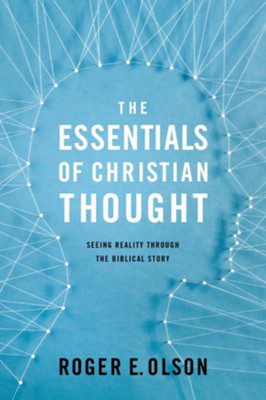
The appendix expresses the reason for the book! It’s title is : A Model for the Integration of Faith and Learning. Several years ago I posted here an essay on which this appendix is based. The book’s publisher asked me to write a book explaining the “faith” part of faith and learning integration. This is that.
Usually here I avoid quoting the book, but here is an especially succinct expression of “faith-learning integration” found on pages 244-245:
”The integration of faith and learning [in Christian colleges and universities] was three threats—anti-intellectual obscurantism (common in the Bible colleges movement), secularism, and two-truths thinking. The basic idea was and is: Let’s focus the ‘faith’ part of higher education, especially outside biblical and theological studies, on what C. S. Lewis called ‘Mere Christianity’ and what before that the Scottish philosopher-theologian James Orr called ‘The Christian View of God and the World.’ And let’s insist that our post-fundamentalist, newer evangelical Christian higher education in arts and sciences be based on that together with the material facts of scholarly research and let’s integrate them with each other. Obviously that was and remains an ambitious and tension-filled project, but it is what defines post-fundamentalist, evangelical higher Christian education.”
I have found two main objections to the project of integrating faith (in the sense explained in this book) and learning (the arts and sciences). One is that much of what is found in modern arts and sciences is so distant from and in conflict with the Bible that a faithful biblicist Christian ought really simply to reject the modern arts and sciences and teach and learn only what is taught in the Bible, meaning, however, a traditionalist interpretation of the Bible. I attended a Bible college founded on that principle idea where the Bible was the main textbook in every course taught. “Modern thought” was simply rejected. The result was an ethos of obscurantism. So, there was no real need for integration of faith and learning. Both were misunderstood.
Later, I encountered the second objection to the project of faith and learning as I attended and earned two graduate degrees (MA and PhD) from a secular university. Although two or three of my professors in the Religious Studies Department such as John Newport (to whom this book is dedicated) did promote and practice integration, the university as a whole tended to consider Christian faith at best private and at worst nonsense.
Then I taught at three Christian universities in succession over thirty some years. At the first one, most faculty were in favor of faith-learning integration but the president, a famous healing evangelist and founder of the university, included in the “faith” part of faith-learning integration his own peculiar theology of “Seed Faith”—a mild form of the prosperity gospel. He also said in chapel that he believed it important for scientists at his university to pray over their experiments in, for example, cancer research, and allow the Holy Spirit to guide their endeavors. In chapel services, he and his selected guest speakers, often said the most ridiculous things such as “You can’t be a good witness for Jesus from a wheelchair” and “If my grandson had been born in The City of Faith [hospital under construction], he wouldn’t have died.” The latter claim was based on the president’s belief that ONLY in his hospital would prayer and medicine work hand-in-hand.
Then I taught at a “middle-of-the-road” and very well-known and highly regarded Christian liberal arts college that emphasized the integration of faith, in the sense I mean in this book, with every discipline taught. However, repeatedly, I heard guest presenters of the project misrepresented or presented in such a way as to guarantee protest and rejection. And many of my colleagues did reject the project.
My explanation of the project of integrating faith and learning in this Appendix is probably controversial at the point where I argue that there cannot be any actual, real conflict between true Christian faith and any material fact of the sciences. Even more likely however, is that some even conservative evangelical Christians will reject my argument that “Christian faith” in the sense I mean in this book must adjust to material facts of the sciences. I explain that I do NOT mean it must adjust to theories of the sciences, some of which must be rejected by the thinking Christian. What I mean is that once something is settled fact, beyond serious doubt or question, Christian faith must accept it as God’s truth and, if necessary, adjust traditional Christian belief to it. An example is the age of the earth. For centuries Irish Anglican bishop Ussher’s dating of creation to 4004 BC was accepted as biblical truth by many conservative Christians. To accept that as true now would be sheer obscurantism. But it was never actually taught in the Bible! It was taught by Ussher without knowledge of geology.
In other words, the integration of faith and learning is a “two way street.” The two must be brought into genuine conversation with each other and they must inform each other. The faith part ought to count as false THEORIES of the modern arts and sciences that actually DO conflict with what I call “biblical-Christian metaphysics.” An example is naturalism. Another example is monism. I could go on. These (from a Christian perspective) false metaphysical perspectives often get smuggled into modern and contemporary “learning” (disciplines) and often they get smuggled into teaching in even evangelical Christian colleges and universities. For example, when I taught at that evangelical liberal arts college some of my faculty colleagues were cultural relativists. They told me to my face that there is no such thing as “the Christian worldview.” Naturally, they resisted the whole project of faith-learning integration.
I will stop now. This bring us to the end of discussion of this book. So I invite comments and questions from readers of the book. Questions are invited from readers of this blog post who did not read the book or did not make it to the Appendix. Comments are invited from those who read the book through to the Appendix.
*Note: If you choose to comment, make sure your comment is relatively brief (no more than 100 words), on topic, addressed to me, civil and respectful, not hostile or argumentative, and devoid of pictures or links.*
Previous Post

January 31, 2024
Next Post
February 6, 2024 The Political Meaning of Christianity
Recent Comments
"No doubt Lewis was inspired by earlier thinkers. Ironically (or perhaps serendipitously) I am now ..."
The Abolition of Man: Chapter 3: ..."
"I am sure Lewis would agree. After all, as a Christian he believed in original ..."
The Abolition of Man: Chapter 3: ..."
"If I’m not mistaken, the quote from Lewis is his interpretation of the “Conditioners’” own ..."
The Abolition of Man: Chapter 3: ..."
"Thank you! It's been a great re-read of a thought provoking, but somewhat dense, little ..."
The Abolition of Man: Chapter 3: ..."
Browse Our Archives
Select a Category Against Liberal Theology Uncategorized
Select a Month October 2026 September 2026 August 2026 July 2026 June 2026 May 2026 April 2026 March 2026 February 2026 January 2026 December 2025 November 2025 October 2025 September 2025 August 2025 July 2025 June 2025 May 2025 April 2025 March 2025 February 2025 January 2025 December 2024 November 2024 October 2024 September 2024 August 2024 July 2024 June 2024 May 2024 April 2024 March 2024 February 2024 January 2024 December 2023 November 2023 October 2023 September 2023 August 2023 July 2023 June 2023 May 2023 April 2023 March 2023 February 2023 January 2023 December 2022 November 2022 October 2022 September 2022 August 2022 July 2022 June 2022 May 2022 April 2022 March 2022 February 2022 January 2022 December 2021 November 2021 October 2021 September 2021 August 2021 July 2021 June 2021 May 2021 April 2021 March 2021 February 2021 January 2021 December 2020 November 2020 October 2020 September 2020 August 2020 July 2020 June 2020 May 2020 April 2020 March 2020 February 2020 January 2020 December 2019 November 2019 October 2019 September 2019 August 2019 July 2019 June 2019 May 2019 April 2019 March 2019 February 2019 January 2019 December 2018 November 2018 October 2018 September 2018 August 2018 July 2018 June 2018 May 2018 April 2018 March 2018 February 2018 January 2018 December 2017 November 2017 October 2017 September 2017 August 2017 July 2017 June 2017 May 2017 April 2017 March 2017 February 2017 January 2017 December 2016 November 2016 October 2016 September 2016 August 2016 July 2016 June 2016 May 2016 April 2016 March 2016 February 2016 January 2016 December 2015 November 2015 October 2015 September 2015 August 2015 July 2015 June 2015 May 2015 April 2015 March 2015 February 2015 January 2015 December 2014 November 2014 October 2014 September 2014 August 2014 July 2014 June 2014 May 2014 April 2014 March 2014 February 2014 January 2014 December 2013 November 2013 October 2013 September 2013 August 2013 July 2013 June 2013 May 2013 April 2013 March 2013 February 2013 January 2013 December 2012 November 2012 October 2012 September 2012 August 2012 July 2012 June 2012 May 2012 April 2012 March 2012 February 2012 January 2012 December 2011 November 2011 October 2011 September 2011 August 2011 July 2011 June 2011 May 2011 April 2011 March 2011 February 2011 January 2011 December 2010 November 2010 October 2010 September 2010 August 2010 July 2010
TAKE THE
Religious Wisdom Quiz
Who opposed the rebuilding of the Temple and tried to discourage the Jews?
Select your answer to see how you score.
Their enemies/Samaritans Moabites Philistines Amalekites
Related posts from Roger E. Olson

The Abolition of Man: Chapter 3: The Abolition...

She Survived Her Execution. Should the State Try...
The Abolition of Man Part 2: Chapter 2:...

Ambiguity without Ambivalence in Faith
TRENDING AT PATHEOS Evangelical

I was strolling through the top floor of the brand new Parthenon...

What Does Gêvâh Mean For Kimberley Guifoyle &...
This week, a lot of the news is focused on Kimberly Guilfoyle....

INNER CIRCLE: Profound Mystery (Of Christ In All...
Ephesians 5:31-32 “For this reason, a man will leave his father and...

Do Not Rejoice When Your Enemy Falls: The...
Turning an execution into a public spectacle is a disturbing expression of...

'The Chosen' S6 Trailer: The Passion Gets Very...
Not many watching 'The Chosen' worry about spoilers, but just because they...

The purpose-driven labor priest
A labor activist reads Rick Warren and it gets me wondering about...
view all Evangelical blogs
What Are Your Thoughts?leave a comment
Ad-Free & Subscriber Log-In Subscription Support
- About Us
- 2026 Calendar
- Videos
- Podcasts
- Library of World Religions
- Faith In Media Tracker
- Advertise With Us
- Write for Us
- Privacy Policy
- Terms of Service
- Do Not Sell My Data
- Contact Us
- Radiant Digital
- Manage Newsletter Subscriptions
- Unsubscribe From Notifications
- Sitemap
Copyright 2008-2026, Patheos. All rights reserved.
Subscription Support Ad-Free & Subscriber Log-In
Follow Patheos