
BuddhistCatholicContemplativeEvangelicalGeneral ChristianHinduJewishLatter-day SaintMuslimNew VisionsProgressive Christian
Beliefs
- Buddhist
- Catholic
- Contemplative
- Evangelical
- General Christian
- Hindu
- Jewish
- Latter-day Saint
- More Voices
- Muslim
- New Visions
- Pagan
- Progressive Christian
Topics
- Religion News
- Food and Religion
- Sports and Religion
- Religious Art
- Religious Music and Entertainment
- Religious Events
- History and Religion
- Style and Religion
- Politics and Religion
- Women in Religion
- Recreation Outdoors and Religion
- Business Finance and Religion
- Careers Workplace and Religion
- Education and Religion
- Family Parenting and Religion
- Health Fitness and Religion
- Home and Religion
- Relationships and Religion
- Technology and Religion
- Travel and Religion
Columnists
- Buddhist Columnists
- Business Finance and Religion Columnists
- Careers Workplace and Religion Columnists
- Catholic Columnists
- Contemplative Columnists
- Education and Religion Columnists
- Evangelists Columnists
- Family Parenting and Religion Columnists
- General Christian Columnists
- Health Fitness and Religion Columnists
- Hindu Columnists
- History and Religion Columnists
- Home and Religion Columnists
- Jewish Columnists
- More Voices Columnists
- Latter Day Columnists
- Muslim Columnists
- New Visions Columnists
- Nonreligious Columnists
- Pagan Columnists
- Politics and Religion Columnists
- Progressive Columnists
- Recreation Outdoors and Religion Columnists
- Relationships and Religion Columnists
- Religion News Columnists
- Religious Art Columnists
- Religious Events Columnists
- Religious Music and Entertainment Columnists
- Sports and Religion Columnists
- Style and Religion Columnists
- Technology and Religion Columnists
- Travel and Religion Columnists
- Women in Religion Columnists
Resource Library
- 2026 Calendar
- Library of World Religions
- The 100 Most Holy Places on Earth
- Patheos Answers
- Podcasts
- Videos
- Faith Leaders Database
- Anglican Episcopalian
- Bahai
- Baptist
- Buddhism
- Christianity
- Confucianism
- Eastern Orthodoxy
- Hinduism
- Holiness and Pentecostal
- ISKCON
- Islam
- Judaism
- Lutheran
- Methodist
- The Church of Jesus Christ of Latter-day Saints
- New Age
- Paganism
- Presbytarian and Reformed
- Protestantism
- Religion Behind the Scenes
- Roman Catholic
- Scientology
- Shia Islam
- Sikhism
- Sufism
- Sunni Islam
- Taoism
- Zen
- See all religions
Research Tools
 Ad-Free & Subscriber Log-In Subscription Support
Ad-Free & Subscriber Log-In Subscription Support
Follow Patheos 

- Trending:
- Forgiveness
- |
- Marriage
- |
- Consciousness
- |
- Death Penalty
- |
- Election
- |
- Halloween

- Home
- Evangelical
- My Religious Roots: A Sentimental Journey and Pilgrimage Story
My Religious Roots: A Sentimental Journey and Pilgrimage Story
Last updated on: July 25, 2019 at 7:16 am by Roger E. Olson
My Religious Roots: A Sentimental Journey and Pilgrimage Story 2019-07-25T07:16:42-05:00 Roger E. Olson
Patheos Explore the world's faith through different perspectives on religion and spirituality! Patheos has the views of the prevalent religions and spiritualities of the world.
My Religious Roots: A Pilgrimage
I rarely talk here about myself, but some of my faithful readers have asked me to do just that. They especially want to know more about my religious background and upbringing and my early religious influences. Here I bow briefly to their desires.
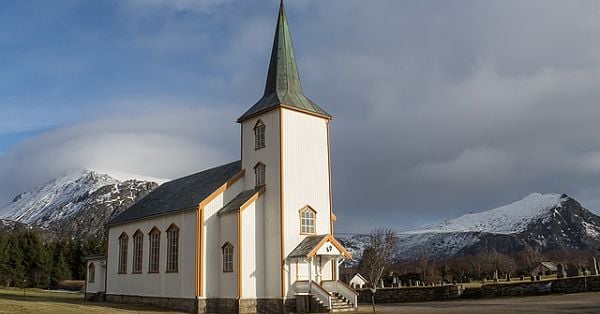
My first memories of church are of Pentecostal or “Full Gospel” services of all kinds in a tiny, very old, almost falling down, white clapboard church in the poorest neighborhood of the city where I was born in the Upper Midwest. About twenty years before I was born the city was visited by “Sister Aimee”—Aimee Semple McPherson—a celebrity Pentecostal healing evangelist. More about her later. The aftermath of her revival there lingered a very long time. Many Pentecostal churches were born out of it. Ours was one, although it was not part of her International Church of the Foursquare Gospel—the denomination she founded.
The leaders of our little Pentecostal “movement” or “fellowship” were her associate evangelists who broke away from her and founded their own. We were often reminded it was not a “denomination” but a “movement” and “fellowship.” It was a denomination and still exists.
I never dreaded church; church was exciting. You never knew what was going to happen. “Church” was on Sunday morning from about 9:00 until about noon and again from about 6:00 until whenever the Spirit stopped moving. I always took a pillow to church on Sunday evenings and slept on a pew as the Spirit stirred the people to sometimes boisterous prayers and praises into the night. Sunday evening service usually ended around 10:00, but sometime it would go until 11:00.
Then there were Tuesday and Thursday evening prayer and Bible study services. And there were “protracted meetings” or extended revivals both at our church and other churches that lasted a week or two. Then we went to church every evening.
My father was the pastor of our little church in “the Bottoms”—the shabbiest, poorest neighborhood in town—but there was another pastor of a larger church in a “swankier” part of town to whom everyone looked as our leading pastor. He was my father’s mentor and mentor to numerous pastors of our denomination (and possibly others). To my parents and everyone in our denomination he was a God-like figure. He had been somehow associated with Sister Aimee as had been other leaders of our denomination.
That “mother church” had been a Methodist Episcopal church until it become Foursquare and then our denomination’s mother church in about 1935. I remember attending many special services there and seeing on the high ceiling of the sanctuary the four hallmarks of the “Foursquare gospel”—Jesus as savior, healer, baptizer with the Holy Spirit, and coming king. (Sister Aimee seems to have borrowed that from A. B. Simpson, founder of the Christian Missionary Alliance.)
I cannot exaggerate the importance of church in our family life. There was no boundary between church, denomination, and home. It was all one. And it was a church, denomination, and home of poverty. Any disposable income was expected to go to world missions. The missionaries, including some of my aunts and uncles, were our saints. Their pictures adorned the walls of our home. When they came to the U.S. on “furlough” to “itinerary” to raise money they stayed in our home.
But, we were part of two larger movements—the Pentecostal or Full Gospel movement and the broader evangelical movement. My father was always active in the local evangelical ministerial alliance. We often attended special Christian ecumenical meetings and events at evangelical churches and camp meetings, conventions and conferences, that were not specifically Pentecostal. We loved our “close cousins” the Nazarenes and wished they spoke in tongues. Every summer my parents took me to the area-wide Nazarene camp meeting where the newest Southern gospel music was premiered by groups like the Speer Family. Emotions ran high there, but there was no speaking in tongues except my stepmother’s under her breath.
Youth for Christ was active in our city and our church was very much involved in YFC which usually met for all kinds of special evening events at First Covenant Church. YFC was transdenominational, a parachurch organization where young people met other young people from a wide variety of churches.
Some years ago I assigned each student in one of my classes to write up his or her own “religious history”—going as far back as possible using family histories. The exercise was a study of religious roots.
So here is mine in brief.
All of my ancestors—as far back as I can trace—were European Lutheran or Reformed. My birth mother’s ancestors lived in Southwest Germany and belonged to what in the United States came to be called the Evangelical and Reformed Church (which eventually merged with the American Congregational Churches to form the United Church of Christ). My great-great-grandparents came from the same town in Germany as Reinhold Niebuhr’s family and at the same time. Both families settled first in the same Illinois town and then went their separate ways from there. My mother, however, was raised in the Evangelical Free Church near where that denomination was founded by Swedish and Norwegian immigrants who were pietists. More about her later. My grandparents always belonged to the EvFree Church and their funerals were in it. My mother’s siblings were either that or became members of the similar Covenant Church.
My father’s parents immigrated to the United States from Norway and Denmark when they were children. In “the old countries” they were baptized Lutheran. However, when their parents settled on the empty prairies of eastern South Dakota the only church nearby was a Church of God (Anderson, Indiana)—a “Holiness” denomination that also claimed not to be a denomination but a movement. My paternal grandparents are buried in that church’s cemetery in the middle of nowhere. The church is now gone.
My father, however, was raised in a Pentecostal church after his family “lost the farm” in the Great Depression. They moved into a small city and there joined the tiny church of our denomination. Most of his aunts and uncles, however, stayed in the Church of God.
My father often testified that he was saved on May 16, 1943 at that tiny Pentecostal church which I visited numerous times as a child. He then moved to the city where I was born, attended “our” Bible college, and became pastor of our tiny Pentecostal/Full Gospel church in the Bottoms at the ripe old age of nineteen. There he met another graduate of the Bible college who had become Pentecostal at the “mother church” and taught Sunday School at the church my father pastored. The church’s congregation was the poorest of the poor and almost all immigrants to that city from the Ozarks.
Back then, in the 1950s, our denomination and ones like it were widely considered “cults” by mainstream Christians. But we were part of the National Association of Evangelicals. Many people called us “holy rollers” although I never saw anyone actually roll. But we did believe fervently in divine healing (not “faith healing”) and admired healing evangelists like William Branham and Oral Roberts and later Kathryn Kuhlman. There was much talk about “Sister Aimee” especially by those who knew her but I learned early that she was somewhat “scandalous.” The word “flamboyant” must have been invented for her! You can see her on Youtube. She died in the 1940s leaving behind a denomination much like ours but not ours.
Like other Pentecostal denominations we had women evangelists, church planters and even pastors. I grew up assuming that women could be ordained and pastor and preach. In other ways, however, we were fundamentalists. Everyone used the Scofield Reference Bible and we were premillennialism who believed in the “rapture” and fully expected that, in our lifetimes, the “Antichrist” would arise and Jesus Christ would return to defeat him. We specialized in eschatology (beliefs bout the end times).
We had no theologians; “theology” was considered a waste of time and a distraction. The highest and really only calling a young person could have and follow was to be an evangelist or missionary or church planter. When I decided to become a theologian I’m sure many prayers went put for me. People in our denomination almost never went to seminary. I was one of the first and that was the beginning of the end for me—in our denomination.
Recently I was reminded of all of this as I toured Angelus Temple in the Echo Park neighborhood of Los Angeles. That is the megachurch founded by Sister Aimee. Her parsonage next to the church is now a museum to her and her ministry. In a way I trace my spiritual roots back to her and to that church. Most of the founders of our denomination were at some time associated with it and with Sister Aimee.
I have read several biographies of Sister Aimee and watched documentaries about her. She was a feminist before feminism was a movement. Someone recently asked me how she got men to allow her to start her own church, her own denomination, her own radio station, her own Bible college and her own everything. I replied “She didn’t. She did it without them.” And yet, she is almost completely ignored by feminists when they talk or write about influential women of the past.
Yes, parts of her life were scandalous, but the facts are much debated. Like most great, influential, independent religious founders she was complicated. In the 1920s and into the 1930s she was one of America’s and the world’s best known religious celebrities—making headlines everywhere she went but especially in Los Angeles.
I have made it part of my mission as a church historian to teach about Aimee Semple McPherson and to fill in that gap in my students’ knowledge about women in religion.
So that is the story of my religious background in a nutshell. Of course, in my twenties I became Baptist but also taught at Oral Roberts University for two years in the 1980s. But that is for another blog post.
*Note: Here I speak only for myself. If you choose to respond be brief and civil. I will not post hostile comments here.
Previous Post

July 23, 2019
Stopping the Mouths of Evangelicalism’s Critics
Next Post
July 27, 2019 The Key Difference between Conservative and Postconservative Evangelicals
Browse Our Archives
Select a Category Against Liberal Theology Uncategorized
Select a Month October 2026 September 2026 August 2026 July 2026 June 2026 May 2026 April 2026 March 2026 February 2026 January 2026 December 2025 November 2025 October 2025 September 2025 August 2025 July 2025 June 2025 May 2025 April 2025 March 2025 February 2025 January 2025 December 2024 November 2024 October 2024 September 2024 August 2024 July 2024 June 2024 May 2024 April 2024 March 2024 February 2024 January 2024 December 2023 November 2023 October 2023 September 2023 August 2023 July 2023 June 2023 May 2023 April 2023 March 2023 February 2023 January 2023 December 2022 November 2022 October 2022 September 2022 August 2022 July 2022 June 2022 May 2022 April 2022 March 2022 February 2022 January 2022 December 2021 November 2021 October 2021 September 2021 August 2021 July 2021 June 2021 May 2021 April 2021 March 2021 February 2021 January 2021 December 2020 November 2020 October 2020 September 2020 August 2020 July 2020 June 2020 May 2020 April 2020 March 2020 February 2020 January 2020 December 2019 November 2019 October 2019 September 2019 August 2019 July 2019 June 2019 May 2019 April 2019 March 2019 February 2019 January 2019 December 2018 November 2018 October 2018 September 2018 August 2018 July 2018 June 2018 May 2018 April 2018 March 2018 February 2018 January 2018 December 2017 November 2017 October 2017 September 2017 August 2017 July 2017 June 2017 May 2017 April 2017 March 2017 February 2017 January 2017 December 2016 November 2016 October 2016 September 2016 August 2016 July 2016 June 2016 May 2016 April 2016 March 2016 February 2016 January 2016 December 2015 November 2015 October 2015 September 2015 August 2015 July 2015 June 2015 May 2015 April 2015 March 2015 February 2015 January 2015 December 2014 November 2014 October 2014 September 2014 August 2014 July 2014 June 2014 May 2014 April 2014 March 2014 February 2014 January 2014 December 2013 November 2013 October 2013 September 2013 August 2013 July 2013 June 2013 May 2013 April 2013 March 2013 February 2013 January 2013 December 2012 November 2012 October 2012 September 2012 August 2012 July 2012 June 2012 May 2012 April 2012 March 2012 February 2012 January 2012 December 2011 November 2011 October 2011 September 2011 August 2011 July 2011 June 2011 May 2011 April 2011 March 2011 February 2011 January 2011 December 2010 November 2010 October 2010 September 2010 August 2010 July 2010
TAKE THE
Religious Wisdom Quiz
I wanted a vineyard so badly that my wife arranged the owner's death through false witnesses. Who am I?
Select your answer to see how you score.
David Ahab Jezebel Naboth
Related posts from Roger E. Olson

The Abolition of Man: Chapter 3: The Abolition...

She Survived Her Execution. Should the State Try...
The Abolition of Man Part 2: Chapter 2:...

Ambiguity without Ambivalence in Faith
TRENDING AT PATHEOS Evangelical

I was strolling through the top floor of the brand new Parthenon...

What Does Gêvâh Mean For Kimberley Guifoyle &...
This week, a lot of the news is focused on Kimberly Guilfoyle....

INNER CIRCLE: Profound Mystery (Of Christ In All...
Ephesians 5:31-32 “For this reason, a man will leave his father and...

Do Not Rejoice When Your Enemy Falls: The...
Turning an execution into a public spectacle is a disturbing expression of...

'The Chosen' S6 Trailer: The Passion Gets Very...
Not many watching 'The Chosen' worry about spoilers, but just because they...

The purpose-driven labor priest
A labor activist reads Rick Warren and it gets me wondering about...
view all Evangelical blogs
Ad-Free & Subscriber Log-In Subscription Support
- About Us
- 2026 Calendar
- Videos
- Podcasts
- Library of World Religions
- Faith In Media Tracker
- Advertise With Us
- Write for Us
- Privacy Policy
- Terms of Service
- Do Not Sell My Data
- Contact Us
- Radiant Digital
- Manage Newsletter Subscriptions
- Unsubscribe From Notifications
- Sitemap
Copyright 2008-2026, Patheos. All rights reserved.
Subscription Support Ad-Free & Subscriber Log-In
Follow Patheos