
BuddhistCatholicContemplativeEvangelicalGeneral ChristianHinduJewishLatter-day SaintMuslimNew VisionsProgressive Christian
Beliefs
- Buddhist
- Catholic
- Contemplative
- Evangelical
- General Christian
- Hindu
- Jewish
- Latter-day Saint
- More Voices
- Muslim
- New Visions
- Pagan
- Progressive Christian
Topics
- Religion News
- Food and Religion
- Sports and Religion
- Religious Art
- Religious Music and Entertainment
- Religious Events
- History and Religion
- Style and Religion
- Politics and Religion
- Women in Religion
- Recreation Outdoors and Religion
- Business Finance and Religion
- Careers Workplace and Religion
- Education and Religion
- Family Parenting and Religion
- Health Fitness and Religion
- Home and Religion
- Relationships and Religion
- Technology and Religion
- Travel and Religion
Columnists
- Buddhist Columnists
- Business Finance and Religion Columnists
- Careers Workplace and Religion Columnists
- Catholic Columnists
- Contemplative Columnists
- Education and Religion Columnists
- Evangelists Columnists
- Family Parenting and Religion Columnists
- General Christian Columnists
- Health Fitness and Religion Columnists
- Hindu Columnists
- History and Religion Columnists
- Home and Religion Columnists
- Jewish Columnists
- More Voices Columnists
- Latter Day Columnists
- Muslim Columnists
- New Visions Columnists
- Nonreligious Columnists
- Pagan Columnists
- Politics and Religion Columnists
- Progressive Columnists
- Recreation Outdoors and Religion Columnists
- Relationships and Religion Columnists
- Religion News Columnists
- Religious Art Columnists
- Religious Events Columnists
- Religious Music and Entertainment Columnists
- Sports and Religion Columnists
- Style and Religion Columnists
- Technology and Religion Columnists
- Travel and Religion Columnists
- Women in Religion Columnists
Resource Library
- 2026 Calendar
- Library of World Religions
- The 100 Most Holy Places on Earth
- Patheos Answers
- Podcasts
- Videos
- Faith Leaders Database
- Anglican Episcopalian
- Bahai
- Baptist
- Buddhism
- Christianity
- Confucianism
- Eastern Orthodoxy
- Hinduism
- Holiness and Pentecostal
- ISKCON
- Islam
- Judaism
- Lutheran
- Methodist
- The Church of Jesus Christ of Latter-day Saints
- New Age
- Paganism
- Presbytarian and Reformed
- Protestantism
- Religion Behind the Scenes
- Roman Catholic
- Scientology
- Shia Islam
- Sikhism
- Sufism
- Sunni Islam
- Taoism
- Zen
- See all religions
Research Tools
 Ad-Free & Subscriber Log-In Subscription Support
Ad-Free & Subscriber Log-In Subscription Support
Follow Patheos 

- Trending:
- Forgiveness
- |
- Marriage
- |
- Consciousness
- |
- Death Penalty
- |
- Election
- |
- Halloween
 Robert Hunt: Interfaith Encounters
- Home
- Progressive Christian
- Cross-Talk in the UMC
Cross-Talk in the UMC
Last updated on: April 25, 2017 at 11:45 am by Robert Hunt
Cross-Talk in the UMC 2017-04-25T11:45:37-06:00 Robert Hunt
Patheos Explore the world's faith through different perspectives on religion and spirituality! Patheos has the views of the prevalent religions and spiritualities of the world.
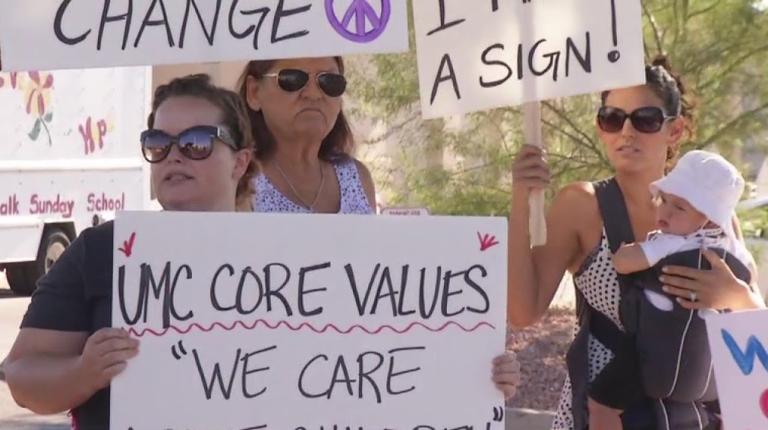 With the United Methodist Judicial Council meeting next week to consider several cases related to human sexuality the interwebs are abuzz with debate, particularly about Bishop Oliveto, who was an acting leader and was consecrated as bishop while married to another woman.
As I read the various blogs and multiple responses one thing becomes clear. United Methodist discussions about human sexuality, while polarized into pro-LGBTQ marriage and ordination and anti-LBGTQ marriage and ordination, involve so many and varied appeals to authority and types or arguments that trying to delineate them might give a little clarity.
- Biblical Arguments. Differences in interpretation seem inevitable because similar historical/critical methods are deployed but on the basis of fundamentally different assumptions about the relationship of Jesus to the Bible. For some United Methodists Jesus is the author of inclusion, challenging the excluding religious teaching of his time. Others see Jesus as the one who restores through grace a fallen creation in part by calling his disciples back into God’s natural order. These aren’t mutually exclusive positions until one seeks a criterion to distinguish between ancient religious norms and God’s natural order. Is that criterion the inclusive core of Jesus teaching? Or is it the difference between unchanging moral law and laws of ritual and identity confined to Israel?
- Arguments from the early church. Here the word “orthodoxy” can create confusion. To some it simply means the theological affirmations of the ecumenical creeds and the apostles creed. To others it means the entire teaching and practice of the church for which the creeds are normative theological statements. So both pro and anti sides in the debate can claim to be upholding orthodoxy, depending on the limits they place on its meaning.
- Arguments from Wesley and the distinctly Methodist tradition. As with arguments from scripture, arguments from Wesley’s writings and the larger Methodist tradition can look at the same documents and come to different interpretations. The pro people tend to interpret the Methodist tradition in light of Wesley’s strong emphasis on God’s love understood as radically inclusive. The anti people don’t deny the emphasis on God’s love, but don’t see it implying an every widening realm of inclusion of what Wesley, following Christian tradition, regarded as sin.
- Arguments from God’s providence at work in history. Here the pro people argue that God has providentially led humans generally and Christians specifically to better understandings of both gender and sexual relations that open the door for a greater variety of morally good sexual relationships. The anti people typically argue that God has providentially provided the church as a bulwark resisting the rebellion against God’s order that modernity calls social progress. Typically the pro people deny that they antinomian, and on the contrary argue that they are open to learning dimensions of God’s order lost in pre-modern worldviews. Typically the anti people deny that they they are legalists or embrace a pre-modern worldview and insist that discipline to an order is an essential manifestation of God’s grace and serving Christ.
- Arguments about the basis of valid ministry. Typically the pro people argue that the ultimate basis on which the validity of an ordained ministry must be judged is it fruits, and that ministry by LGBTQ persons living in committed relations or marriages is as fruitful as ministry by straight people. Typically the anti people argue that the basis on which the validity of and ordained ministry must be judged is its place within the order of the church, and this in turn relates to the legality of the ordination process.
- Legal arguments. Tedious and possibly tendencious arguments are being made on all sides. I have no expertise to judge or even characterize them. I’ll simply note that successive General Conferences appear to have rejected decisively both same-sex marriage and ordination of those living in such a relationship. Whether that rejection has been adequately translated into church law so as to comprehensively exclude all possible ways to circumvent the will of the General Conference is for the Judicial Council to decide.
One theme runs through these arguments and in some ways shows their relationship to similar debates in other religions. On one side are those who argue that Christianity is about certain essential principles that must be enacted in different ways in different times. For them the Bible and all successive Christian tradition is a contextual document, telling us how those principles were to be enacted in a particular places and times. The combination of general principles and specific instances of their realization over time helps us clearly understand the principles, but doesn’t force us to accept those enactments as precedents that must be followed.
On the other side are those who argue that Christianity is precisely about fidelity to the precedents set by Christ, his apostles, and the apostolic church. The principles of Christianity are not mere abstractions, but specific structures, laws, and actions commanded by Christ that must be upheld in all cultural and historical contexts.
A second theme, also common to other religions, relates to whether sexuality is an essential part of human identity that must be enacted for a person to live as a full human being. The pro side tends to regard sexuality as something that must have the potential for being enacted if a person to live as a full human being, with that fulfillment limited by and fully realized within any relationship of genuine consent and mutual fidelity. The anti side may or may not regard sexuality as essential to human personhood, but rejects the idea that it must be enacted for a person to live as a full human being. For some sexuality can be enacted in male-female relationship taking place in one or a series of consensual exclusive relationships. For others sexuality will find fulfillment in abstinence.
As I look over this short list of both arguments and the ways in which they are deployed, not to mention the actual blogs, Facebook posts, news articles, and public debates between the two sides, I can only conclude that we no longer have dialogue. We have cross-talk. While both sides talk about scripture, tradition, Wesley, God’s providence, discipline, and humanity these words mean different things to them.
Given that I know fine and faithful people on both sides of the debate I can only conclude that these two different approaches are rooted in two different experiences of the God’s Spirit. At this time those different experiences have created incompatible responses of faith and action, even as a response in faith and action is absolutely necessary to being a follower of Christ.
The Body of Christ has been through this before. What one might hope is that in the midst of inevitable separation into two different polities (because if we cannot act together we must act apart) we might at least accept one another as Christians, and indeed as Christians bound within the Wesleyan tradition.
Previous Post

April 20, 2017
The Fear Factor in Texas Politics
Next Post
May 4, 2017 INRI - An Insult at the Heart of Christian Symbolism
Browse Our Archives
Select a Category Christian Identity Christian Muslim Relations Home Page Inter-Religious Dialogue Uncategorized
Select a Month September 2017 August 2017 July 2017 June 2017 May 2017 April 2017 March 2017 February 2017 January 2017 December 2016 November 2016 October 2016 September 2016 August 2016 July 2016 June 2016 April 2016 March 2016 February 2016 January 2016 December 2015 November 2015 October 2015 September 2015 August 2015 July 2015 June 2015 May 2015 April 2015 March 2015 February 2015 January 2015 December 2014 October 2014 September 2014 August 2014 July 2014 June 2014 May 2014 April 2014 March 2014 February 2014 January 2014 December 2013 September 2013 August 2013 July 2013 June 2013 April 2013 March 2013 February 2013 January 2013 December 2012 November 2012 October 2012 September 2012 August 2012 July 2012 June 2012 May 2012 April 2012 December 2011 November 2011 October 2011 September 2011 August 2011 June 2011 May 2011 April 2011 March 2011 February 2011 January 2011 December 2010 November 2010 October 2010 September 2010 July 2010 May 2010
TAKE THE
Religious Wisdom Quiz
What is the Christian principle about speaking words?
Select your answer to see how you score.
Never speak Speak harshly Speak with love and grace Always be silent
Related posts from Robert Hunt: Interfaith Encounters

Atheism as Religion, not its Antithesis
Robert Hunt: Interfaith Encounters

Atheism and the New Conditions of Disbelief
Robert Hunt: Interfaith Encounters

Robert Hunt: Interfaith Encounters

Robert Hunt: Interfaith Encounters
TRENDING AT PATHEOS Progressive Christian

Did Prayer Cure His Cancer? Or Was It...
At 4 AM one morning, Joshua W. Brown’s wife awoke to a...

8 Ways a Near-Death Experience Rewires the Soul
Does Consciousness Survive Physical Death? After 50 Years of Research, Dr. Raymond...

Holy Longing: What Our Restlessness Is Telling Us
“One can find so many pains when the rain is falling.” -John...

What this is NOT about. This blog is definitely not about...

Who said the Israelites were God’s chosen? That’s right, they did. Who...

The Spirit World Is the Real World: God...
A Monk’s Wisdom on Body and Spirit I sit with Brother Martin...
view all Progressive Christian blogs
Ad-Free & Subscriber Log-In Subscription Support
- About Us
- 2026 Calendar
- Videos
- Podcasts
- Library of World Religions
- Faith In Media Tracker
- Advertise With Us
- Write for Us
- Privacy Policy
- Terms of Service
- Do Not Sell My Data
- Contact Us
- Radiant Digital
- Manage Newsletter Subscriptions
- Unsubscribe From Notifications
- Sitemap
Copyright 2008-2026, Patheos. All rights reserved.
Subscription Support Ad-Free & Subscriber Log-In
Follow Patheos