
BuddhistCatholicContemplativeEvangelicalGeneral ChristianHinduJewishLatter-day SaintMuslimNew VisionsProgressive Christian
Beliefs
- Buddhist
- Catholic
- Contemplative
- Evangelical
- General Christian
- Hindu
- Jewish
- Latter-day Saint
- More Voices
- Muslim
- New Visions
- Pagan
- Progressive Christian
Topics
- Religion News
- Food and Religion
- Sports and Religion
- Religious Art
- Religious Music and Entertainment
- Religious Events
- History and Religion
- Style and Religion
- Politics and Religion
- Women in Religion
- Recreation Outdoors and Religion
- Business Finance and Religion
- Careers Workplace and Religion
- Education and Religion
- Family Parenting and Religion
- Health Fitness and Religion
- Home and Religion
- Relationships and Religion
- Technology and Religion
- Travel and Religion
Columnists
- Buddhist Columnists
- Business Finance and Religion Columnists
- Careers Workplace and Religion Columnists
- Catholic Columnists
- Contemplative Columnists
- Education and Religion Columnists
- Evangelists Columnists
- Family Parenting and Religion Columnists
- General Christian Columnists
- Health Fitness and Religion Columnists
- Hindu Columnists
- History and Religion Columnists
- Home and Religion Columnists
- Jewish Columnists
- More Voices Columnists
- Latter Day Columnists
- Muslim Columnists
- New Visions Columnists
- Nonreligious Columnists
- Pagan Columnists
- Politics and Religion Columnists
- Progressive Columnists
- Recreation Outdoors and Religion Columnists
- Relationships and Religion Columnists
- Religion News Columnists
- Religious Art Columnists
- Religious Events Columnists
- Religious Music and Entertainment Columnists
- Sports and Religion Columnists
- Style and Religion Columnists
- Technology and Religion Columnists
- Travel and Religion Columnists
- Women in Religion Columnists
Resource Library
- 2026 Calendar
- Library of World Religions
- The 100 Most Holy Places on Earth
- Patheos Answers
- Podcasts
- Videos
- Faith Leaders Database
- Anglican Episcopalian
- Bahai
- Baptist
- Buddhism
- Christianity
- Confucianism
- Eastern Orthodoxy
- Hinduism
- Holiness and Pentecostal
- ISKCON
- Islam
- Judaism
- Lutheran
- Methodist
- The Church of Jesus Christ of Latter-day Saints
- New Age
- Paganism
- Presbytarian and Reformed
- Protestantism
- Religion Behind the Scenes
- Roman Catholic
- Scientology
- Shia Islam
- Sikhism
- Sufism
- Sunni Islam
- Taoism
- Zen
- See all religions
Research Tools
 Ad-Free & Subscriber Log-In Subscription Support
Ad-Free & Subscriber Log-In Subscription Support
Follow Patheos 

- Trending:
- Forgiveness
- |
- Marriage
- |
- Consciousness
- |
- Death Penalty
- |
- Election
- |
- Halloween
 Robert Hunt: Interfaith Encounters
- Home
- Progressive Christian
- At the Intersection of Exclusion
At the Intersection of Exclusion
Last updated on: March 23, 2017 at 1:35 pm by Robert Hunt
At the Intersection of Exclusion 2017-03-23T13:35:42-06:00 Robert Hunt
Patheos Explore the world's faith through different perspectives on religion and spirituality! Patheos has the views of the prevalent religions and spiritualities of the world.
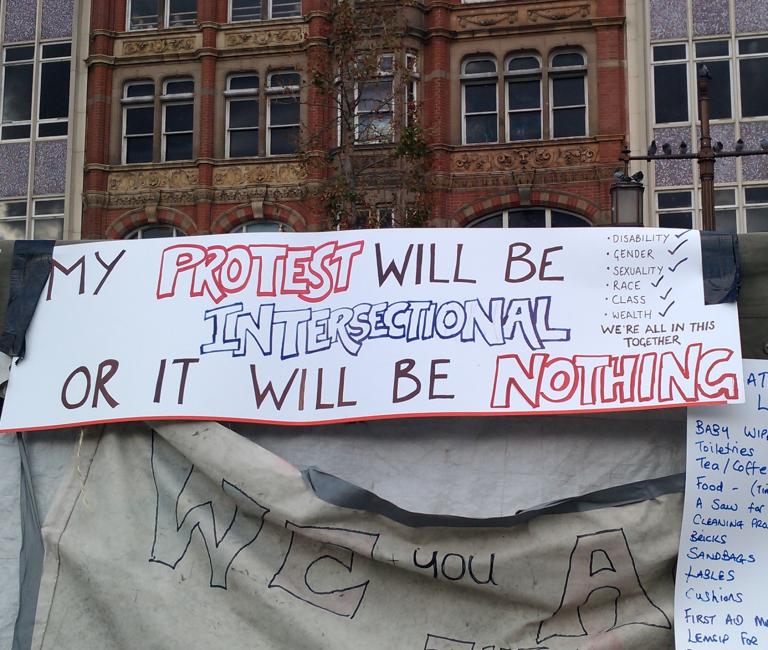 An editorial in the New York Times on Wednesday March 8th, a feminist who is also Jewish
wondered if she could really join in the international women’s day movement. After all, the organizers were linked to groups promoting the “decolonization of Palestine,” which effectively means putting an end to the nation of Israel. (https:/www.nytimes.com/2017/03/07/opinion/does-feminism-have-room-for-zionists.html)
She wasn’t the only person to wonder. A strong pro “reproductive rights” agenda was bound to exclude those who believe that human life begins at conception and abortion should be legal only under strictly defined circumstances. (In other words many Catholic and Evangelical feminists.)
And the organizers also tossed in solidarity with Native Americans resisting pipeline construction. So if you supported a woman’s reproductive rights but had issues with Native American claims you were out of luck. And visa-versa.
One could go on. There is a theoretical basis for linking these apparently different social action agendas. It’s called intersectionality. (https://en.wikipedia.org/wiki/Intersectionality) Intersectionality theory proposes that a wide variety of different forms of oppression intersect to create a system of oppression and marginalization.
Thus a woman denied an equal wage is facing the same oppressive system as a Palestinian denied a housing permit by the Israeli authorities. And both face the same oppressive system as Native Americans, African Americans, undocumented immigrants, and LGBTQ individuals; all struggling for equal rights and justice.
Now as the article above points out, this gets very complicated very quickly – but serves the very useful purpose of showing simplistic approaches to discrimination that just address individual cases of oppression are often inadequate. They don’t get to the structural roots of the problem.
Those roots are usually characterized by the terms colonialism and empire theory. State and non-state allies (typically corporations) are linked through participation in neoliberal economic structures that inevitably divide the world into those who colonize (physically, economically, culturally, religiously) and those who are colonized. There is the Empire (often treated as an abstract almost metaphysical entity) and those whom it subjugates.
So we can also see the problem for a Jewish feminist. On one hand she recognizes and has experienced the oppression of women. On the other she has experienced anti-semitism as another ancient and virulent form of oppression, and knows that in its contemporary form it is often in the guise of being anti-Israel. But in her this case inter-sectionalist analysis ends up pitting two forms of oppression against each other rather than illuminating the relationship between them. In the intersectionalist analysis Israel is seen as an neoliberal, colonialist state, and even a puppet of the American Empire. Next to American society itself Israel is seen as the apotheosis of systemic oppression.
And this means that Jews have a stark choice. If they want to be counted among the oppressed they must abandon their support of Israel and understand anti-semitism as yet another manifestation of systemic oppression of which Israel is somehow ironically a part. Put more bluntly, they must abandon a fundamental part of Jewish identity in order to be counted among the oppressed.
And what about disabled persons who have a strong interest in the marginalizing effects of the present American health care system, but who are deeply opposed to abortion because it is a means of getting rid of potentially disabled children? If access to abortion is the sin qua non of feminist advocacy for health care then the disabled find themselves on the side of the oppressor.
Or minority religious groups (like Sikhs and Muslims) who oppose same-sex marriage. Well they also have an ambiguous place at the intersection of the oppressed even as they are suffering immediate and deadly attacks on members of their community. Intersectionality as an ideology of action rather than a description of social realities requires that these groups give up fundamental aspects of their identity in order to stand at the intersection of the oppressed.
Even the concatenation of LGBTQ as an intersection of marginalization is problematic, because while many would recognize the unique vulnerabilities of transgendered individuals, addressing those vulnerabilities doesn’t necessarily equate with supporting same-sex marriage. And as this author has witnessed, many African Americans simply don’t see the struggle for LGBTQ rights intersecting their struggle against racism for basic civil rights.
In short intersectionality has the potential to exclude from the struggle for justice and liberation as many as it includes. What was intended to help understand the complexity of identity in relation to power ends up reifying oppression and liberation into abstract, indeed nearly metaphysical forces.
And that creates several problems.
First, it’s hard to create political strategies against metaphysical forces. The result is a focus on public symbolic acts such as marches and rallies that may have little political effect. Political action (the Civil Right Act being a key example) takes coalition building. And that in turn means letting go of the requirement that everyone in the coalition agree on everything.
Secondly it’s specific political acts are weakened because couching them in ideological terms alienates potential supporters. Many Jews not only support a two state solution but some even support boycott and divestiture to that end. But they will not support “the decolonization of Palestine” as called for by the international women’s movement and they certainly won’t support the “right of return” that is central to the BDS movement. Because both terms are simply synonyms for the destruction of Israel as a Jewish state.
Similarly many conservative Christian groups can fully support the civil rights of ethnic minorities and the rights of undocumented migrants, but will not associate themselves with attacks on so-called neoliberal economic structures or the “American Empire.” One may regard the Christians as naive in this regard, but naive or not the voice they could bring to the struggle is lost.
Finally, intersectionality, through exclusion, too easily makes particular communities the embodiment of oppression. Certain social institution like the police, or congress, or corporations, or evangelical Christians, or Catholics, or Jews, by their failure to adopt the entire progressive package at the intersection of the oppressed are legitimized as targets for attack. And this is being played out today.
Reports of antisemitism on college campuses are on the rise, sometimes specifically in the context of excluding Jewish voices from student governments intent on pressing the BSD movement. Other times in the kind of graffiti and name calling directed against Jews.
My own Facebook feed gives ample evidence of the vitriol directed against Catholic and Evangelical Christians who do not support every aspect of the progressive agenda with regard to same-sex marriage and abortion.
Both verbal/symbolic attacks against police, not to mention violent murder of police personnel, have become more common even when the individual officers are members of just those minorities that are otherwise regarded as oppressed. And across the board the term “privileged” has become a catchall delegitimization of any voice that disagrees with any aspect of the intersectionality movement. This is far from what intersectionality theory would intend with its complex analysis of privilege, but it becomes the practical effect.
Finally, intersectionality potentially ends real dialogue. The Parliament of the World’s Religions, which now bills itself as a “Global Interfaith Movement” is an example of this. Begun so that people of many different religious could experience each other and engage in dialogue, as it has adopted a progressive agenda that excludes all those religious voices that cannot support that agenda. Quite frankly you can’t be both an interfaith political movement and a venue for serious and difficult dialogue among those with real differences in their perceptions of reality. I witnessed this in Salt Lake City in 2015, when Parliament delegates shouted down a speaker who didn’t accept their particular interpretation of Islam and the only Jewish voices allowed were those on the most leftward end of the American Reformed movement.
As an analytical framework intersectionality is both powerful and useful. But like all such frameworks its descriptive power becomes distorted when as a basis for prescribing a course of action it becomes yet another way of excluding those whose identity keeps them from the intersection of the oppressed.
Previous Post

March 21, 2017
Fear and Loathing in the AG's Office
Next Post
April 3, 2017 Privilege and the Loss of Personhood
Browse Our Archives
Select a Category Christian Identity Christian Muslim Relations Home Page Inter-Religious Dialogue Uncategorized
Select a Month September 2017 August 2017 July 2017 June 2017 May 2017 April 2017 March 2017 February 2017 January 2017 December 2016 November 2016 October 2016 September 2016 August 2016 July 2016 June 2016 April 2016 March 2016 February 2016 January 2016 December 2015 November 2015 October 2015 September 2015 August 2015 July 2015 June 2015 May 2015 April 2015 March 2015 February 2015 January 2015 December 2014 October 2014 September 2014 August 2014 July 2014 June 2014 May 2014 April 2014 March 2014 February 2014 January 2014 December 2013 September 2013 August 2013 July 2013 June 2013 April 2013 March 2013 February 2013 January 2013 December 2012 November 2012 October 2012 September 2012 August 2012 July 2012 June 2012 May 2012 April 2012 December 2011 November 2011 October 2011 September 2011 August 2011 June 2011 May 2011 April 2011 March 2011 February 2011 January 2011 December 2010 November 2010 October 2010 September 2010 July 2010 May 2010
TAKE THE
Religious Wisdom Quiz
What was the profession of Peter and Andrew?
Select your answer to see how you score.
Carpenters Fishermen Tax collectors Priests
Related posts from Robert Hunt: Interfaith Encounters

Robert Hunt: Interfaith Encounters

Privilege and the Loss of Personhood
Robert Hunt: Interfaith Encounters

Restoring Civilization: Whose Babies?
Robert Hunt: Interfaith Encounters
The Dis-Uniting of Methodist Christianity - When Dialogue...
Robert Hunt: Interfaith Encounters
TRENDING AT PATHEOS Progressive Christian

Did Prayer Cure His Cancer? Or Was It...
At 4 AM one morning, Joshua W. Brown’s wife awoke to a...

8 Ways a Near-Death Experience Rewires the Soul
Does Consciousness Survive Physical Death? After 50 Years of Research, Dr. Raymond...

Holy Longing: What Our Restlessness Is Telling Us
“One can find so many pains when the rain is falling.” -John...

What this is NOT about. This blog is definitely not about...

Who said the Israelites were God’s chosen? That’s right, they did. Who...

The Spirit World Is the Real World: God...
A Monk’s Wisdom on Body and Spirit I sit with Brother Martin...
view all Progressive Christian blogs
Ad-Free & Subscriber Log-In Subscription Support
- About Us
- 2026 Calendar
- Videos
- Podcasts
- Library of World Religions
- Faith In Media Tracker
- Advertise With Us
- Write for Us
- Privacy Policy
- Terms of Service
- Do Not Sell My Data
- Contact Us
- Radiant Digital
- Manage Newsletter Subscriptions
- Unsubscribe From Notifications
- Sitemap
Copyright 2008-2026, Patheos. All rights reserved.
Subscription Support Ad-Free & Subscriber Log-In
Follow Patheos