
BuddhistCatholicContemplativeEvangelicalGeneral ChristianHinduJewishLatter-day SaintMuslimNew VisionsProgressive Christian
Beliefs
- Buddhist
- Catholic
- Contemplative
- Evangelical
- General Christian
- Hindu
- Jewish
- Latter-day Saint
- More Voices
- Muslim
- New Visions
- Pagan
- Progressive Christian
Topics
- Religion News
- Food and Religion
- Sports and Religion
- Religious Art
- Religious Music and Entertainment
- Religious Events
- History and Religion
- Style and Religion
- Politics and Religion
- Women in Religion
- Recreation Outdoors and Religion
- Business Finance and Religion
- Careers Workplace and Religion
- Education and Religion
- Family Parenting and Religion
- Health Fitness and Religion
- Home and Religion
- Relationships and Religion
- Technology and Religion
- Travel and Religion
Columnists
- Buddhist Columnists
- Business Finance and Religion Columnists
- Careers Workplace and Religion Columnists
- Catholic Columnists
- Contemplative Columnists
- Education and Religion Columnists
- Evangelists Columnists
- Family Parenting and Religion Columnists
- General Christian Columnists
- Health Fitness and Religion Columnists
- Hindu Columnists
- History and Religion Columnists
- Home and Religion Columnists
- Jewish Columnists
- More Voices Columnists
- Latter Day Columnists
- Muslim Columnists
- New Visions Columnists
- Nonreligious Columnists
- Pagan Columnists
- Politics and Religion Columnists
- Progressive Columnists
- Recreation Outdoors and Religion Columnists
- Relationships and Religion Columnists
- Religion News Columnists
- Religious Art Columnists
- Religious Events Columnists
- Religious Music and Entertainment Columnists
- Sports and Religion Columnists
- Style and Religion Columnists
- Technology and Religion Columnists
- Travel and Religion Columnists
- Women in Religion Columnists
Resource Library
- 2026 Calendar
- Library of World Religions
- The 100 Most Holy Places on Earth
- Patheos Answers
- Podcasts
- Videos
- Faith Leaders Database
- Anglican Episcopalian
- Bahai
- Baptist
- Buddhism
- Christianity
- Confucianism
- Eastern Orthodoxy
- Hinduism
- Holiness and Pentecostal
- ISKCON
- Islam
- Judaism
- Lutheran
- Methodist
- The Church of Jesus Christ of Latter-day Saints
- New Age
- Paganism
- Presbytarian and Reformed
- Protestantism
- Religion Behind the Scenes
- Roman Catholic
- Scientology
- Shia Islam
- Sikhism
- Sufism
- Sunni Islam
- Taoism
- Zen
- See all religions
Research Tools
 Ad-Free & Subscriber Log-In Subscription Support
Ad-Free & Subscriber Log-In Subscription Support
Follow Patheos 

- Trending:
- Forgiveness
- |
- Marriage
- |
- Consciousness
- |
- Death Penalty
- |
- Election
- |
- Halloween
 Rhetoric Race and Religion
- Home
- Progressive Christian
- Special Issue: Communication, Religion, and Race in America
Special Issue: Communication, Religion, and Race in America
Last updated on: June 4, 2018 at 7:06 am by Andre E. Johnson
Special Issue: Communication, Religion, and Race in America 2018-06-04T07:06:20-05:00 Andre E. Johnson
Patheos Explore the world's faith through different perspectives on religion and spirituality! Patheos has the views of the prevalent religions and spiritualities of the world.
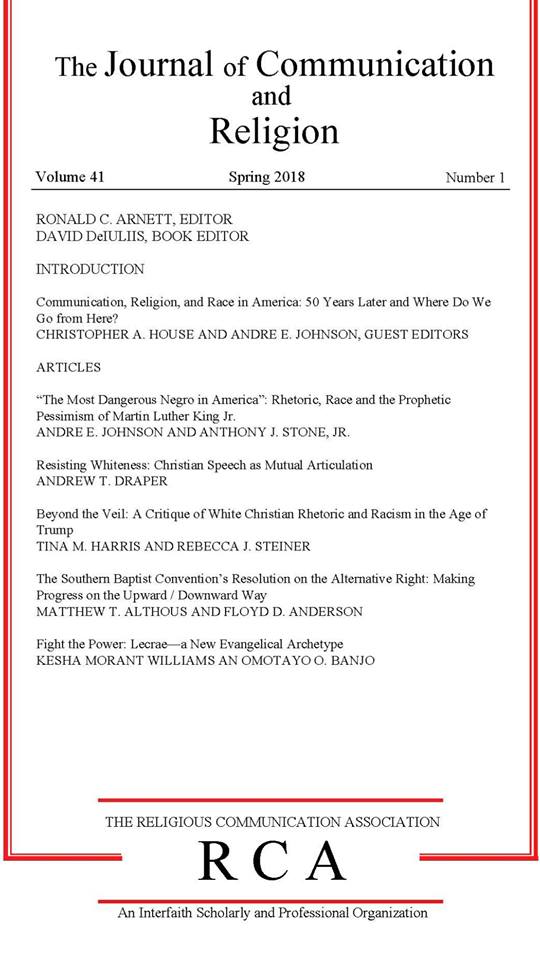
I am pleased to announce that the Spring 2018 special issue of the Journal of Communication and Religion is now out. Christopher A. House and I had the pleasure of guest editing this special issue titled, Communication, Religion, and Race in America: 50 Years Later and Where Do We Go from Here? In the first article, “The Most Dangerous Negro in America”: Rhetoric, Race and the Prophetic Pessimism of Martin Luther King Jr., I and my co-author Anthony J. Stone focused our attention on the last twelve months of Martin Luther King’s life and particularly on his rhetoric that addressed systemic racism. In their essay, we argue that King adopted the persona of a pessimistic prophet that consequently marked him as “The Most Dangerous Negro in America.” Rather than inspiring readers to take a sentimental look at King’s life, we attempt to get readers to see King as a radical prophetic voice who unapologetically challenged white supremacy until the very end of his life. Andrew T. Draper’s article, Resisting Whiteness: Christian Speech as Mutual Articulation, raises an important question: is whiteness a theological issue? Contextualized against narratives of a “post-racial” society, Draper provides scholars of communication, race and religion with a framework by which we can further examine how whiteness is socially communicated, performed, and understood as Godtalk. If whiteness is to be examined as a theological issue, the next three articles all then deal with cases studies on the relationship of whiteness, theology, and politics in the era of Donald Trump.
While some have characterized Trump’s behavior and rhetoric as mean-spirited and bigoted, eighty-one percent of white evangelicals supported Trump with their votes. Tina M. Harris and Rebecca Steiner in their essay, Beyond the Veil: A Critique of White Christian Rhetoric and Racism in the Age of Trump, discuss the Christian community’s response to Trump’s election through the lens of race and racialized theology. Specifically, Harris and Steiner interrogate how the overwhelming support of White evangelicals to Trump’s election is best understood through the lens of whiteness. Analogously, Matthew Althouse and Floyd Anderson in their essay, The Southern Baptist Convention’s Resolution on the Alternative Right: Making Progress on the Upward / Downward Way, offer a Burkean analysis of the 2017 Southern Baptist Convention’s (SBC) resolution condemning the “Alt-Right” movement. Althouse and Anderson identify how the SBC’s initial trepidation to condemn the Alt-Right was a costly misstep to their larger efforts at racial healing. Their further analysis of SBC’s revised solution condemning the Alt-Right further illustrates how white SBC members understood and communicated God’s story as part of their story in ways in that elide difference, render the lived experience of SBC members of color invisible, and reinforce white supremacy. The next article, Fight the Power: Lecrae—a New Evangelical Archetype, by Kesha Morant Williams and Omotayo O. Banjo, uses Stewart’s functional approach to the rhetoric of social movements to analyze the recent rhetorical strategies of rapper Lecrae Moore’s challenges to whiteness and white evangelical social and theological investment in whiteness. Williams and Banjo contextualize Moore’s music within an African American rhetorical tradition of truth-telling about America’s racial past and present and the current struggle of meaning-making at the intersection of race and faith in the era of Black Lives Matter and White Supremacist rallies such as that witnessed in Charlottesville, VA. In each of these articles, Harris and Steiner, Draper, Williams and Banjo, and Althouse and Anderson, use their studies to point a way forward in race relations through means of dialogue, confession, acknowledgment, and expressions of suffering, and public redress of individual and systemic racism.
We thank the editor of the Journal, Ron Arnett for his gracious invitation to co-edit this issue.
Donate to the Work of R3
Like the work we do at Rhetoric Race and Religion? Please consider helping us continue to do this work. All donations are tax-deductible through Gifts of Life Ministries/G’Life Outreach, a 501 (3) tax-exempt organization, and our fiscal sponsor. Any donation helps. Just click here to support our work.
Previous Post

May 31, 2018
The Most Dangerous Negro in America
Browse Our Archives
Select a Category Amy Steele Andre E. Johnson Book Reviews/Series Brian Foulks Call for Chapters Carol Howard Merritt Classes Conferences Contributors Crystal St.Marie Lewis Daniel White Hodge Earle Fisher Eulogy Fredrick Robinson Guest Contributions Henry McNeal Turner Institutes Interviews Joseph Boston Katherine Whitfield Kimberly Peeler-Ringer Lectures/Roundtables Natalie Bullock Brown R3 Book Series R3 Contributor Rashad Grove Readers Reflections Symposiums Teaching Traci Ellis Travis Harris Uncategorized Video
Select a Month June 2020 February 2020 December 2019 November 2019 July 2019 June 2019 May 2019 October 2018 June 2018 May 2018 April 2018 March 2018 February 2018 January 2018 December 2017 November 2017 October 2017 September 2017 August 2017 July 2017 June 2017 May 2017 April 2017 March 2017 February 2017 January 2017 December 2016 November 2016 October 2016 September 2016 August 2016 July 2016 June 2016 May 2016 April 2016 March 2016 February 2016 January 2016 December 2015 November 2015 October 2015 September 2015 August 2015 July 2015 June 2015 May 2015 April 2015 March 2015 February 2015 January 2015 December 2014 November 2014 October 2014 September 2014 August 2014 July 2014 June 2014 May 2014 April 2014 March 2014 February 2014 January 2014 December 2013 November 2013 October 2013 September 2013 August 2013 July 2013 June 2013 May 2013 April 2013 March 2013 February 2013 January 2013 December 2012 November 2012 October 2012 September 2012 August 2012 July 2012 June 2012 May 2012 April 2012 March 2012 February 2012 January 2012 December 2011 November 2011 October 2011
Follow Us!
TAKE THE
Religious Wisdom Quiz
I saw the Promised Land from a mountain but was not allowed to enter it. Who am I?
Select your answer to see how you score.
Joshua Moses Aaron Caleb
Related posts from Rhetoric Race and Religion

Mother Emanuel, Black Pain and the Rhetoric of...

New Book in R3 Book Series on #BLM...

Dislocations and Shutdowns: #MLK, #BLM and the Rhetoric...
TRENDING AT PATHEOS Progressive Christian

What Being a Modern-Day Apostle Means to Me
In my last column, I discussed the ins and outs of modern-day...

Did Ancient China Once Worship the God of...
Across human history, a common thread weaves through the origins of the...

Love Your Neighbor – Including Earth-Kin: Lev. 19,...
God’s command to love your neighbor means acting in an ethical and...

Lead a Church Study of “Jesus and Lao...
Guest writer Jack Thomas (The Irreverent Reverend) reflects on leading his church...

Pastoral Wisdom for Responding to Sermon Pushback
Getting sermon pushback on your social justice sermon? Learn practical, Proverbs-based strategies...

Principles for Understanding the Apostolic Ministry Today
Whenever people discover that my formal ministry title is "apostle," as in...
view all Progressive Christian blogs
Ad-Free & Subscriber Log-In Subscription Support
- About Us
- 2026 Calendar
- Videos
- Podcasts
- Library of World Religions
- Faith In Media Tracker
- Advertise With Us
- Write for Us
- Privacy Policy
- Terms of Service
- Do Not Sell My Data
- Contact Us
- Radiant Digital
- Manage Newsletter Subscriptions
- Unsubscribe From Notifications
- Sitemap
Copyright 2008-2026, Patheos. All rights reserved.
Subscription Support Ad-Free & Subscriber Log-In
Follow Patheos