
BuddhistCatholicContemplativeEvangelicalGeneral ChristianHinduJewishLatter-day SaintMuslimNew VisionsProgressive Christian
Beliefs
- Buddhist
- Catholic
- Contemplative
- Evangelical
- General Christian
- Hindu
- Jewish
- Latter-day Saint
- More Voices
- Muslim
- New Visions
- Pagan
- Progressive Christian
Topics
- Religion News
- Food and Religion
- Sports and Religion
- Religious Art
- Religious Music and Entertainment
- Religious Events
- History and Religion
- Style and Religion
- Politics and Religion
- Women in Religion
- Recreation Outdoors and Religion
- Business Finance and Religion
- Careers Workplace and Religion
- Education and Religion
- Family Parenting and Religion
- Health Fitness and Religion
- Home and Religion
- Relationships and Religion
- Technology and Religion
- Travel and Religion
Columnists
- Buddhist Columnists
- Business Finance and Religion Columnists
- Careers Workplace and Religion Columnists
- Catholic Columnists
- Contemplative Columnists
- Education and Religion Columnists
- Evangelists Columnists
- Family Parenting and Religion Columnists
- General Christian Columnists
- Health Fitness and Religion Columnists
- Hindu Columnists
- History and Religion Columnists
- Home and Religion Columnists
- Jewish Columnists
- More Voices Columnists
- Latter Day Columnists
- Muslim Columnists
- New Visions Columnists
- Nonreligious Columnists
- Pagan Columnists
- Politics and Religion Columnists
- Progressive Columnists
- Recreation Outdoors and Religion Columnists
- Relationships and Religion Columnists
- Religion News Columnists
- Religious Art Columnists
- Religious Events Columnists
- Religious Music and Entertainment Columnists
- Sports and Religion Columnists
- Style and Religion Columnists
- Technology and Religion Columnists
- Travel and Religion Columnists
- Women in Religion Columnists
Resource Library
- 2026 Calendar
- Library of World Religions
- The 100 Most Holy Places on Earth
- Patheos Answers
- Podcasts
- Videos
- Faith Leaders Database
- Anglican Episcopalian
- Bahai
- Baptist
- Buddhism
- Christianity
- Confucianism
- Eastern Orthodoxy
- Hinduism
- Holiness and Pentecostal
- ISKCON
- Islam
- Judaism
- Lutheran
- Methodist
- The Church of Jesus Christ of Latter-day Saints
- New Age
- Paganism
- Presbytarian and Reformed
- Protestantism
- Religion Behind the Scenes
- Roman Catholic
- Scientology
- Shia Islam
- Sikhism
- Sufism
- Sunni Islam
- Taoism
- Zen
- See all religions
Research Tools
 Ad-Free & Subscriber Log-In Subscription Support
Ad-Free & Subscriber Log-In Subscription Support
Follow Patheos 

- Trending:
- Forgiveness
- |
- Marriage
- |
- Consciousness
- |
- Death Penalty
- |
- Election
- |
- Halloween
 Rhetoric Race and Religion
- Home
- Progressive Christian
- Dislocations and Shutdowns: #MLK, #BLM and the Rhetoric of Confrontation
Dislocations and Shutdowns: #MLK, #BLM and the Rhetoric of Confrontation
Last updated on: June 17, 2018 at 9:31 am by Andre E. Johnson
Dislocations and Shutdowns: #MLK, #BLM and the Rhetoric of Confrontation 2018-06-17T09:31:57-05:00 Andre E. Johnson
Patheos Explore the world's faith through different perspectives on religion and spirituality! Patheos has the views of the prevalent religions and spiritualities of the world.
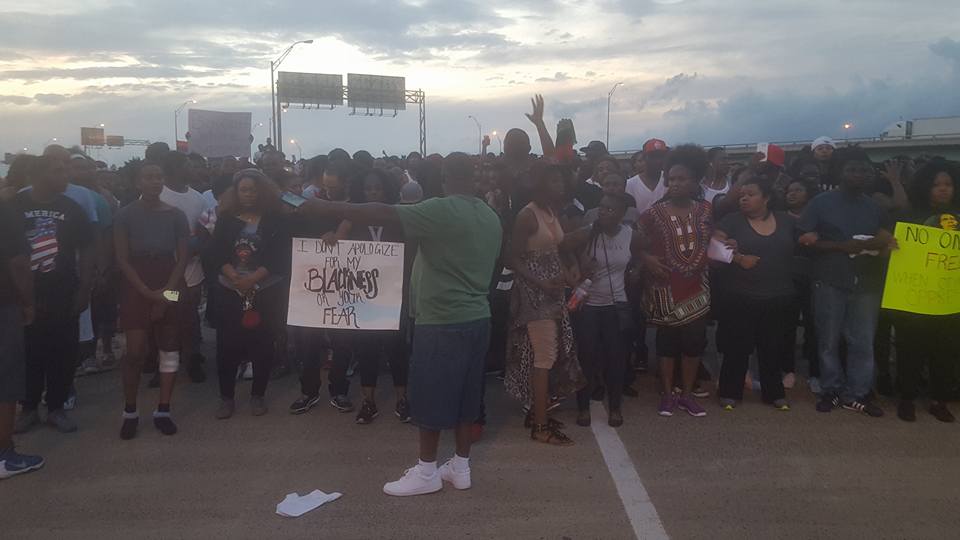 On April 4, 2018, America commemorated the 50th year anniversary of the death of Martin Luther King Jr. The social media landscape was full of think pieces, editorials, long-form essays and reflections that centered on the life and legacy of America’s prophet of nonviolence. News stations and newspapers from all around the world produced stories and interviewed people who lived during King’s time and those who did not. However, much of the commemoration focused on the memory of King and how his words continue to shape and frame our current challenges and problems.
Anticipating the conversations that would take place during the 50th year commemoration, I thought that a journal in our discipline should devote a special issue that examines the rhetoric of King. I thought this would give scholars in our field an opportunity to (re)discover the rhetoric of King and to study one of America’s finest orators. It would also give us the opportunity to add to what is a surprisingly small collection of scholarship solely devoted to the rhetoric of King. To give a comparison, a search in the Communication and Mass Media index reveals a shocking discovery. Since his assassination in 1968, only thirty-five articles examine the rhetoric of King. Compare this to articles examining the rhetoric of President Barack Obama. Since 2005, seventy-nine articles examine the rhetoric of Obama. Therefore, despite Edwin Black’s observations that King left a very “considerable body of written work—speeches, articles and books” and that King’s “influence on the character of public persuasion is by itself sufficient to regard King’s rhetorical efforts as revolutionary,” the dearth of scholarship in rhetoric on King speaks volumes.2
However, I did not want to lock King in the past. The commemorations that occurred throughout the world pointed to contemporary understanding and meanings of King’s rhetoric. We wanted essays that would not only ground themselves in the rhetoric of King but also point to his legacy 50 years later after his death. We looked for essays that centered on people, groups or institutions that draw inspiration from King’s rhetoric. In short, in this special issue, “From the Mountain Top and Beyond: Contemporary Meanings and Understandings of the Rhetoric of Martin Luther King Jr., 50 Years Later,” we sought to connect the historical to the contemporary to show the vibrancy of King’s rhetoric and how people interpret that rhetoric today.
The idea for this special issue came to me while teaching a graduate seminar on King’s rhetoric. As we focused on the last year of King’s public discourse, I begin to see and understand the shift in King’s rhetoric. As Sunnemark noted in his study of King, the pre-1965, King had what he called a “common discourse.” According to Sunnemark, this was an “inviting discourse,” focused on “recognition and affirmation” that was meant to be “non-offensive” to as many people as possible. This, argued Sunnemark, opens the rhetoric to multiple interpretations when employed today. “The vague generality,” wrote Sunnemark, “means that King’s rhetoric can still be filled with meaning from different sources. It can still confirm a particular identity of traditional American ideology and self-understanding and its system of signification has become tied in with this identity.” He further maintains that this is how King has become frozen in time with his “I Have a Dream” speech. The speech, argues Sunnemark, has become a signifier of righteousness which means people can use it in a “wide range of circumstances for a variety of means.” However, according to Sunnemark, King’s rhetoric later in his life “is not available for use in this manner.” He argues that since King’s transformation meant the “gradual disintegration of the Civil Rights movement discourse,” one cannot fill it with different kinds of meaning in the same way his one could fill his earlier discourses. For Sunnemark, his later rhetoric poses a grave challenge and makes an accusation, and that is much harder to handle and use than an affirmation.” So to compensate for this, we tend to misread King’s rhetoric during his later life.
I argue that this misreading of King’s later rhetoric, especially in the last year of his life, leads to a misremembering of King’s legacy and the challenge that King left.
Read the rest here.
Donate to the Work of R3
Like the work we do at Rhetoric Race and Religion? Please consider helping us continue to do this work. All donations are tax-deductible through Gifts of Life Ministries/G’Life Outreach, a 501 (3) tax-exempt organization, and our fiscal sponsor. Any donation helps. Just click here to support our work.
Journal of Contemporary Rhetoric
Previous Post

June 12, 2018
From the Mountain Top and Beyond: The Rhetoric of #MLK 50 Years Later
Next Post
October 20, 2018 New Book in R3 Book Series on #BLM and #ALM
Browse Our Archives
Select a Category Amy Steele Andre E. Johnson Book Reviews/Series Brian Foulks Call for Chapters Carol Howard Merritt Classes Conferences Contributors Crystal St.Marie Lewis Daniel White Hodge Earle Fisher Eulogy Fredrick Robinson Guest Contributions Henry McNeal Turner Institutes Interviews Joseph Boston Katherine Whitfield Kimberly Peeler-Ringer Lectures/Roundtables Natalie Bullock Brown R3 Book Series R3 Contributor Rashad Grove Readers Reflections Symposiums Teaching Traci Ellis Travis Harris Uncategorized Video
Select a Month June 2020 February 2020 December 2019 November 2019 July 2019 June 2019 May 2019 October 2018 June 2018 May 2018 April 2018 March 2018 February 2018 January 2018 December 2017 November 2017 October 2017 September 2017 August 2017 July 2017 June 2017 May 2017 April 2017 March 2017 February 2017 January 2017 December 2016 November 2016 October 2016 September 2016 August 2016 July 2016 June 2016 May 2016 April 2016 March 2016 February 2016 January 2016 December 2015 November 2015 October 2015 September 2015 August 2015 July 2015 June 2015 May 2015 April 2015 March 2015 February 2015 January 2015 December 2014 November 2014 October 2014 September 2014 August 2014 July 2014 June 2014 May 2014 April 2014 March 2014 February 2014 January 2014 December 2013 November 2013 October 2013 September 2013 August 2013 July 2013 June 2013 May 2013 April 2013 March 2013 February 2013 January 2013 December 2012 November 2012 October 2012 September 2012 August 2012 July 2012 June 2012 May 2012 April 2012 March 2012 February 2012 January 2012 December 2011 November 2011 October 2011
Follow Us!
TAKE THE
Religious Wisdom Quiz
Who was the father of John the Baptist?
Select your answer to see how you score.
Simeon Zechariah Joseph Nathan
Related posts from Rhetoric Race and Religion

Mother Emanuel, Black Pain and the Rhetoric of...

New Book in R3 Book Series on #BLM...

From the Mountain Top and Beyond: The Rhetoric...
TRENDING AT PATHEOS Progressive Christian

What Being a Modern-Day Apostle Means to Me
In my last column, I discussed the ins and outs of modern-day...

Did Ancient China Once Worship the God of...
Across human history, a common thread weaves through the origins of the...

Love Your Neighbor – Including Earth-Kin: Lev. 19,...
God’s command to love your neighbor means acting in an ethical and...

Lead a Church Study of “Jesus and Lao...
Guest writer Jack Thomas (The Irreverent Reverend) reflects on leading his church...

Pastoral Wisdom for Responding to Sermon Pushback
Getting sermon pushback on your social justice sermon? Learn practical, Proverbs-based strategies...

Principles for Understanding the Apostolic Ministry Today
Whenever people discover that my formal ministry title is "apostle," as in...
view all Progressive Christian blogs
Ad-Free & Subscriber Log-In Subscription Support
- About Us
- 2026 Calendar
- Videos
- Podcasts
- Library of World Religions
- Faith In Media Tracker
- Advertise With Us
- Write for Us
- Privacy Policy
- Terms of Service
- Do Not Sell My Data
- Contact Us
- Radiant Digital
- Manage Newsletter Subscriptions
- Unsubscribe From Notifications
- Sitemap
Copyright 2008-2026, Patheos. All rights reserved.
Subscription Support Ad-Free & Subscriber Log-In
Follow Patheos