
BuddhistCatholicContemplativeEvangelicalGeneral ChristianHinduJewishLatter-day SaintMuslimNew VisionsProgressive Christian
Beliefs
- Buddhist
- Catholic
- Contemplative
- Evangelical
- General Christian
- Hindu
- Jewish
- Latter-day Saint
- More Voices
- Muslim
- New Visions
- Pagan
- Progressive Christian
Topics
- Religion News
- Food and Religion
- Sports and Religion
- Religious Art
- Religious Music and Entertainment
- Religious Events
- History and Religion
- Style and Religion
- Politics and Religion
- Women in Religion
- Recreation Outdoors and Religion
- Business Finance and Religion
- Careers Workplace and Religion
- Education and Religion
- Family Parenting and Religion
- Health Fitness and Religion
- Home and Religion
- Relationships and Religion
- Technology and Religion
- Travel and Religion
Columnists
- Buddhist Columnists
- Business Finance and Religion Columnists
- Careers Workplace and Religion Columnists
- Catholic Columnists
- Contemplative Columnists
- Education and Religion Columnists
- Evangelists Columnists
- Family Parenting and Religion Columnists
- General Christian Columnists
- Health Fitness and Religion Columnists
- Hindu Columnists
- History and Religion Columnists
- Home and Religion Columnists
- Jewish Columnists
- More Voices Columnists
- Latter Day Columnists
- Muslim Columnists
- New Visions Columnists
- Nonreligious Columnists
- Pagan Columnists
- Politics and Religion Columnists
- Progressive Columnists
- Recreation Outdoors and Religion Columnists
- Relationships and Religion Columnists
- Religion News Columnists
- Religious Art Columnists
- Religious Events Columnists
- Religious Music and Entertainment Columnists
- Sports and Religion Columnists
- Style and Religion Columnists
- Technology and Religion Columnists
- Travel and Religion Columnists
- Women in Religion Columnists
Resource Library
- 2026 Calendar
- Library of World Religions
- The 100 Most Holy Places on Earth
- Patheos Answers
- Podcasts
- Videos
- Faith Leaders Database
- Anglican Episcopalian
- Bahai
- Baptist
- Buddhism
- Christianity
- Confucianism
- Eastern Orthodoxy
- Hinduism
- Holiness and Pentecostal
- ISKCON
- Islam
- Judaism
- Lutheran
- Methodist
- The Church of Jesus Christ of Latter-day Saints
- New Age
- Paganism
- Presbytarian and Reformed
- Protestantism
- Religion Behind the Scenes
- Roman Catholic
- Scientology
- Shia Islam
- Sikhism
- Sufism
- Sunni Islam
- Taoism
- Zen
- See all religions
Research Tools
 Ad-Free & Subscriber Log-In Subscription Support
Ad-Free & Subscriber Log-In Subscription Support
Follow Patheos 

- Trending:
- Forgiveness
- |
- Marriage
- |
- Consciousness
- |
- Death Penalty
- |
- Election
- |
- Halloween
 Rhetoric Race and Religion
- Home
- Progressive Christian
- White Supremacy in the Age of Trump
White Supremacy in the Age of Trump
Last updated on: February 26, 2018 at 2:29 pm by blog admin
White Supremacy in the Age of Trump 2018-02-26T14:29:10-05:00 blog admin
Patheos Explore the world's faith through different perspectives on religion and spirituality! Patheos has the views of the prevalent religions and spiritualities of the world.
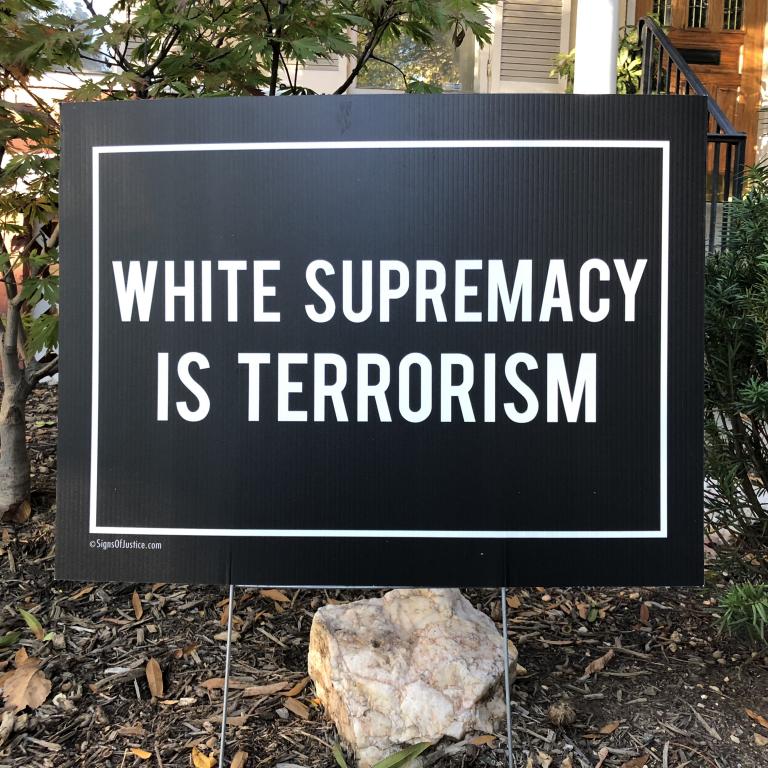 Below is a special issue on “White Supremacy in the Age of Trump” in the Journal of Contemporary Rhetoric (JCR).
From the Journal:
The Journal of Contemporary Rhetoric (JCR) is a peer-reviewed publication that publishes original scholarship that that promotes critical engagement with rhetorical dimensions of current events (those of the past 18 months or so). In promoting the practice of public intellectualism, JCR offers an outlet for scholarship that is both intellectually rigorous and accessible to lay audiences. To this end, JCR specifically seeks to publish scholarship that evidences how rhetorical criticism and theory can help promote a more informed public that is better able to take part in a democratic society. Essays in JCR add to public discussions of current events and help the general public understand more fully the critical and theoretical underpinnings of public debates and controversies, political discourse, social movements, and media events.
JCR is primarily an outlet for works of rhetorical criticism and theory. We are open to other related methodologies and perspectives under the broad purview of rhetoric.
All manuscripts submitted for publication consideration must be original work that has not been published previously and is not currently under review by any other publication outlet.
Latest Issue
Volume 8, Issue 1/2
White Supremacy in the Age of Trump: An Introduction to a Special Issue of the Journal of Contemporary Rhetoric
George F. McHendry, Jr.
This essay introduces a special issue of the Journal of Contemporary Rhetoric on White Supremacy in the age of Trump. This essay recounts an abbreviated history of racism in the United States of America and myriad instances where white supremacy was a vibrant part of Donald J. Trump’s rise to political power. These events demonstrate that racial animus is both a cornerstone of American history and contemporary politics.
Keywords: Donald Trump, White Supremacy, Alt-Right
Alt-White: Conceptualizing the “Alt-Right” as a Rhetorical Bridge between White Nationalism and Mainstream Public Discourse
Stephanie L. Hartzell
Contemporary scholarship on race from critical rhetorical perspectives has revealed the dominance of a color-blind racial ideology and its accompanying norms of race-evasive discourse in the post-1960’s United States. In the “Age of Trumpism,” however, there has been a marked resurgence of explicitly pro-white rhetoric and a rise in public displays of various formations of white supremacy, including the emergence of a loose group of disgruntled pro-white, far-right reactionaries who have strategically adopted the label of “alt-right.” To help make sense of articulations among “alt-right,” far-right, and pro-white ideologies in the Trump-era, this essay investigates the emergence and early evolution of the “alt-right” to reveal how appeals to intellectualism and political correctness have been deployed to make space for overtly pro-white rhetoric in mainstream U.S. American public discourse. Along the way, I reveal (dis)connections among contemporary formations of pro-white ideologies to illuminate strategic constructions of rhetorical distance between these formations and white supremacy. Ultimately, I argue that “alt-right” rhetoric is positioned as a rhetorical bridge between white nationalism and mainstream public discourse.
Keywords: Alt-Right, white nationalism, white supremacy, whiteness, critical rhetoric
Hello Darkness: Antisemitism and Rhetorical Silence in the “Trump Era”
Jamie Moshin
This essay investigates the simultaneously loud and silent rhetorics of antisemitism that have proliferated leading up to, and since the inception of, the Donald Trump presidency. How is it possible that discourse that seems so obvious, and so antithetical to US ideals, has managed to go either unnoticed or unremarked upon, or has been met with passionate support? The answers to this lie in the difficulty in ascribing authorial intent to silence, in the nebulous space of liminal Whiteness occupied by American Jews, and in Trump’s usage of five strategic rhetorical silences that signify antisemitism: literal; symbolic; dialogic; paraliptic; and dog-whistled. The essay concludes by discussing how the Trump campaign/Cabinet’s attempts to capitalize on White dispossession and utilization of “the radical flank” is helping both to normalize his antisemitic followers and to add to his appeal.
Keywords: Jewishness, Antisemitism, Donald Trump, Rhetorical Silence, Dog-whistle
Trump, the KKK, and the Versatility of White Supremacy Rhetoric
James Chase Sanchez
This article theorizes the use of rhetorical versatility as a language tool for white supremacists in the age of Donald Trump, specifically referring to the ways Trump and the KKK speak to their various audiences through textual winks and polysemy. After demonstrating the recent rise of white supremacist groups in this country, rhetorical versatility is explored as way for rhetors to camouflage and signal their ideological viewpoints, which ultimately leads to an analysis of key terms and ideas that both the KKK and Trump utilize in the public sphere: “patriotism,” “heritage,” and “security.” Diving into the specific uses of these terms, this article pinpoints the textual winks that have constructed a civic version of white supremacy over the last few years. Ultimately, this analysis not only builds a theory of rhetorical versatility but also argues that we need more scholarship on the tacit forms of white supremacy.
Keywords: white supremacy, Donald Trump, KKK, rhetorical versatility, textual winks, rhetorical climates
President Trump and Charlottesville: Uncivil Mourning and White Supremacy
Samuel Perry
This essay examines President Donald Trump’s responses to the tragic events in Charlottesville that took place on August 10 and 11 of 2017. It argues that Trump failed to fulfill his role as mourner-in-chief because he engaged in “uncivil mourning.” The essay establishes a theoretical framework for understanding mourning and then examines the three responses Trump gave after Heather Heyer was killed and others were injured by a white supremacist. It argues that rather than mourning Heyer or the values of protestors who confronted “Unite the Right” rally participants, Trump mourned the cultural erosion of whiteness. This follows a pattern well established in Trump’s speeches and tweets.
Keywords: White supremacy, Mourning, Presidential rhetoric, Donald Trump
“Not White/Not Quite”: Racial/Ethnic Hybridity and the Rhetoric of the “Muslim Ban”
Stephanie L. Gomez
During the turmoil surrounding Executive Orders 13769 and 13780, colloquially known as President Donald Trump’s “Muslim bans,” discourse turned to who “counted” as someone allowed in the U.S. In this essay, I conduct a critical rhetorical analysis of tweets about the Muslim ban, using a theoretical framework of hybridity, in order to examine how hybridity was, and is, used to rhetorically position people as “acceptable” or “unacceptable” within the rubric of the law and the Muslim ban more specifically. I argue that hybridity is rhetorically articulated as malleable in order to suit the goals of white supremacy; race/ethnicity, religion, and nationality are both conflated and separated depending upon the specific goals and arguments put forth. Thus, racial/ethnic/religious/national identity is seen as both fluid and fixed, but all in service of shoring up discourses of whiteness and white supremacy.
Keywords: white supremacy, Muslim ban, Trump, whiteness, racial/ethnic hybridity
Trump’s Warsaw Address, or How the “West” Was Widened
Rebecca M. Townsend
In his first major address in Europe, President Donald J. Trump relies upon visual and historical scenic elements to argue for battle in a clash of civilizations. In so doing, he broadens the notion of the “West,” which relies upon a purified perspective, one whitened and Christian. Using Burkeian rhetorical theory, this essay explores the War-saw address for its scenic development of identity as the location for this symbolic battle with material consequences. The address engages in a victimage ritual that united an oppositional interpretation of the physical locale, traces of President Kennedy’s Berlin Address, and retells parts of Polish history to support Poland’s right-wing government’s anti-immigrant and nationalist policies. Notable as well for its absences, the address fails to bolster democratic principles like the rule of law or the independence of a judiciary and instead amplifies white supremacist rhetoric.
**Keywords:**Trump, Poland, West, scene, agency, victimage ritual, clash of civilization, white supremacy
How People Make Sense of Trump and Why It Matters for Racial Justice
Will Penman
Doug Cloud
Scholars, journalists, pundits and others have criticized the racist, anti-queer, anti-Semitic, Islamophobic, and xenophobic rhetoric that pervades the Trump campaign and presidency. At the same time, commentators have expended a vast number of words analyzing Trump’s character: why does he do the things he does? We ask, how do the latter (analyses of Trump’s character) help explain the former (Trump’s racist statements)? Through a close rhetorical analysis of 50 diverse examples of Trump criticism, we reveal four prevailing characterizations or “archetypes” of Trump: Trump the Acclaim-Seeker, Trump the Sick Man, Trump the Authoritarian, and Trump the Idiot. Each archetype explains Trump’s racism in a different way, with significant consequences for social critique. For example, the Trump the Idiot archetype dismisses his racist statements as a series of terrible gaffes, whereas Trump the Authoritarian explains them as an actualization of white supremacy. We trace the benefits and tradeoffs of each archetype for resisting white supremacy.
Keywords: Donald Trump, white supremacy, identity, rhetoric, archetypes
Donate to the Work of R3
Like the work we do at Rhetoric Race and Religion? Please consider helping us continue to do this work. All donations are tax-deductible through Gifts of Life Ministries/G’Life Outreach, a 501 (3) tax-exempt organization, and our fiscal sponsor. Any donation helps. Just click here to support our work.
Journal of Contemporary Rhetoric
Previous Post

February 22, 2018
Plantation Jesus: Race, Faith and a New Way Forward
Next Post
March 6, 2018 Why Do We Have Such a Disdain For Poor People?
Browse Our Archives
Select a Category Amy Steele Andre E. Johnson Book Reviews/Series Brian Foulks Call for Chapters Carol Howard Merritt Classes Conferences Contributors Crystal St.Marie Lewis Daniel White Hodge Earle Fisher Eulogy Fredrick Robinson Guest Contributions Henry McNeal Turner Institutes Interviews Joseph Boston Katherine Whitfield Kimberly Peeler-Ringer Lectures/Roundtables Natalie Bullock Brown R3 Book Series R3 Contributor Rashad Grove Readers Reflections Symposiums Teaching Traci Ellis Travis Harris Uncategorized Video
Select a Month June 2020 February 2020 December 2019 November 2019 July 2019 June 2019 May 2019 October 2018 June 2018 May 2018 April 2018 March 2018 February 2018 January 2018 December 2017 November 2017 October 2017 September 2017 August 2017 July 2017 June 2017 May 2017 April 2017 March 2017 February 2017 January 2017 December 2016 November 2016 October 2016 September 2016 August 2016 July 2016 June 2016 May 2016 April 2016 March 2016 February 2016 January 2016 December 2015 November 2015 October 2015 September 2015 August 2015 July 2015 June 2015 May 2015 April 2015 March 2015 February 2015 January 2015 December 2014 November 2014 October 2014 September 2014 August 2014 July 2014 June 2014 May 2014 April 2014 March 2014 February 2014 January 2014 December 2013 November 2013 October 2013 September 2013 August 2013 July 2013 June 2013 May 2013 April 2013 March 2013 February 2013 January 2013 December 2012 November 2012 October 2012 September 2012 August 2012 July 2012 June 2012 May 2012 April 2012 March 2012 February 2012 January 2012 December 2011 November 2011 October 2011
Follow Us!
TAKE THE
Religious Wisdom Quiz
What does the name "Samuel" mean in Hebrew?
Select your answer to see how you score.
The Lord is my salvation Heard by God Chosen one Servant of the Lord
Related posts from Rhetoric Race and Religion

Dislocations and Shutdowns: #MLK, #BLM and the Rhetoric...

From the Mountain Top and Beyond: The Rhetoric...
When the Illusionists Believe They’re Performing Real Magic
Donald Trump, Religious Freedom, and the African American...
TRENDING AT PATHEOS Progressive Christian

What Being a Modern-Day Apostle Means to Me
In my last column, I discussed the ins and outs of modern-day...

Did Ancient China Once Worship the God of...
Across human history, a common thread weaves through the origins of the...

Love Your Neighbor – Including Earth-Kin: Lev. 19,...
God’s command to love your neighbor means acting in an ethical and...

Lead a Church Study of “Jesus and Lao...
Guest writer Jack Thomas (The Irreverent Reverend) reflects on leading his church...

Pastoral Wisdom for Responding to Sermon Pushback
Getting sermon pushback on your social justice sermon? Learn practical, Proverbs-based strategies...

Principles for Understanding the Apostolic Ministry Today
Whenever people discover that my formal ministry title is "apostle," as in...
view all Progressive Christian blogs
Ad-Free & Subscriber Log-In Subscription Support
- About Us
- 2026 Calendar
- Videos
- Podcasts
- Library of World Religions
- Faith In Media Tracker
- Advertise With Us
- Write for Us
- Privacy Policy
- Terms of Service
- Do Not Sell My Data
- Contact Us
- Radiant Digital
- Manage Newsletter Subscriptions
- Unsubscribe From Notifications
- Sitemap
Copyright 2008-2026, Patheos. All rights reserved.
Subscription Support Ad-Free & Subscriber Log-In
Follow Patheos